


Quick answer: Sharp Pain In The Pinky Toe has multiple potential causes including mechanical, neurological, vascular, and inflammatory. The patterns we see most often are overuse, poorly-fitted shoes, and biomechanical imbalance. Red flags requiring urgent evaluation: warmth/redness (infection), inability to bear weight (fracture), and unilateral swelling without injury (DVT). Call (810) 206-1402.
Foot or ankle pain that isn’t getting better? A podiatrist can diagnose it in one visit — pick a real appointment time online, 24/7: Howell or Bloomfield Township. Takes about a minute, 24/7.
![Side & Lateral Foot Pain FIX! [The BEST At-Home Relief Methods]](https://www.michiganfootdoctors.com/wp-content/cache/flying-press/3769d57b59f1c9a9223f614b88574d3e.jpg)
Medically Reviewed by:
Dr. Tom Biernacki, DPM
— Board-Certified Podiatrist
Last Updated:
March 2026 |
Reading Time:
12 min
This article is for informational purposes only and does not replace professional medical advice. Schedule an appointment for personalized care.
Sharp Pain in the Pinky Toe: Causes, Diagnosis and Treatment
⚡ Quick Answer
Sharp, shooting pain in the pinky toe is most commonly caused by sural nerve compression from tight footwear pressing against the 5th toe. The nerve becomes irritated (neuropraxia), producing burning, tingling, and electric-shock sensations. Most cases resolve within 2–4 weeks with wider shoes and an OTC orthotic to correct foot alignment. See a podiatrist same-day if the toe is visibly deformed, you heard a pop, or you cannot bear weight.
⚠️ Most Common Mistake
Switching to a cushioned insole and hoping for the best. In our clinic, the mistake I see patients make most often is treating the symptom (pain) without addressing the cause (nerve compression from poor foot alignment). A cushioned insole absorbs shock but does nothing to stop the 5th metatarsal from pressing outward into the shoe. The fix is a structured orthotic with a lateral post that controls rearfoot motion — combined with a shoe that has a wider toe box. Without correcting the biomechanics, the nerve stays compressed and the pain keeps coming back.
Watch: Dr. Tom Explains Pinky Toe Pain
Watch Dr. Tom explain the causes, diagnosis, and treatment of sharp pain in the pinky toe — including what to do at home and when to come in:
Book your appointment → · (810) 206-1402
What Causes Sharp Pain in the Pinky Toe
When I examine a patient with sharp pinky toe pain, I’m working through a specific diagnostic checklist. The location, quality, and timing of the pain tell me which structure is involved. Here are the conditions I see most frequently in our Howell and Bloomfield Township offices, ranked by how often they walk through our door.
1. Sural Nerve Compression (Neuropraxia)
This is the number-one cause of sharp, shooting pinky toe pain. The sural nerve runs along the outside of your foot and sends sensory branches to the 5th toe. When your foot flattens excessively during walking (overpronation), the 5th metatarsal pushes outward and the little toe presses against the inside of your shoe. That constant pressure compresses the sural nerve, producing burning, tingling, and sharp electric-shock sensations.
In our clinic, I see this most commonly in patients who recently switched to narrower dress shoes, started a new exercise program, or gained weight — all of which increase pressure on the lateral foot. The nerve injury (neuropraxia) takes 10–20 days minimum to heal, even after you remove the source of compression. That’s why many patients feel frustrated — they buy wider shoes and don’t feel better for two to three weeks.
Key signs it’s nerve compression: Burning or tingling (not just aching), pain that radiates along the outside of the toe, symptoms worse in shoes and better barefoot, numbness between the 4th and 5th toes.
2. Broken Pinky Toe (5th Toe Fracture)
A fractured pinky toe typically follows a specific event — stubbing the toe on furniture, dropping something on it, or a twisting injury. I see patients who assumed the toe was “just bruised” and waited weeks before coming in. The problem: an untreated displaced fracture can heal in a rotated position, causing chronic pain in shoes for years.
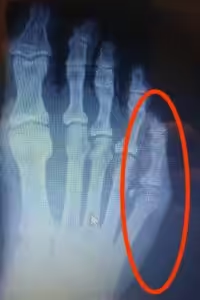
Key signs it’s a fracture: Specific traumatic event, swelling and bruising within hours, pain with direct pressure on the bone (not just the tip), inability to bend the toe normally.
3. Corn or Callus on the 5th Toe
A hard corn (heloma durum) forms on the outside of the pinky toe where it presses against the shoe, while a soft corn (heloma molle) develops between the 4th and 5th toes from moisture and friction. Both can compress the underlying digital nerve and produce sharp pain that mimics nerve entrapment.
The mistake I see patients make is using medicated corn pads with salicylic acid — these can burn through healthy skin, especially in patients with diabetes or poor circulation. In-office enucleation (professional removal) takes 60 seconds and provides immediate relief.
4. Tailor’s Bunion (Bunionette)
A tailor’s bunion is a bony prominence at the base of the 5th toe where the metatarsal head shifts outward. Unlike a regular bunion (which affects the big toe), this develops on the opposite side of the foot. It’s called a “tailor’s bunion” because tailors historically sat cross-legged, putting pressure on the outside of the foot.
When I examine this, I’m looking for whether the bump is bony (structural) or soft tissue (bursitis). A bony bunionette won’t reverse with conservative care, but wider shoes, bunionette pads, and custom orthotics can prevent it from worsening and eliminate pain in about 80% of cases. Surgery (5th metatarsal osteotomy) is reserved for patients who fail 3–6 months of conservative treatment.
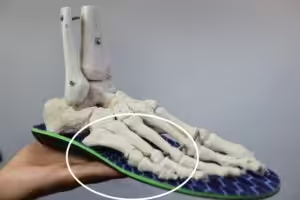
5. Capsulitis of the 5th MTP Joint
Capsulitis is inflammation of the joint capsule at the base of the pinky toe. It produces aching pain under the ball of the foot that worsens with barefoot walking on hard surfaces. I distinguish this from nerve pain because capsulitis hurts more with direct pressure on the joint, while nerve compression produces burning and tingling.
Here’s what actually happens when you come to our office for this: I’ll perform a dorsal drawer test on the 5th MTP joint — gently pushing the toe upward to assess joint stability. If the capsule is stretched, the toe moves more than it should, and we need to address this before the toe starts drifting or crossing over.
🔍 Differential Diagnosis: Pinky Toe Pain
| Condition | Key Distinguishing Feature | Onset |
|---|---|---|
| Sural nerve compression | Burning/tingling, worse in shoes, better barefoot | Gradual |
| 5th toe fracture | Swelling, bruising, specific injury event | Sudden |
| Corn/callus | Visible skin thickening at pressure point | Gradual |
| Tailor’s bunion | Bony bump at 5th metatarsal head | Gradual |
| 5th MTP capsulitis | Aching at joint, worse barefoot on hard floors | Gradual |
| Stress fracture (5th metatarsal) | Point-tender on bone shaft, worse with activity | Gradual |
| Peripheral neuropathy | Symmetric burning in multiple toes, not just 5th | Gradual |
🚨 Red Flags — See a Podiatrist Immediately
- Visible deformity — toe pointing in wrong direction after injury
- Cannot bear weight — possible fracture requiring X-ray
- Open wound or bleeding under the nail — infection risk
- Numbness spreading beyond the toe — nerve damage progressing
- Diabetic or have poor circulation — any toe pain is urgent in this population
- Symptoms worsening after 2 weeks of home treatment — underlying cause needs diagnosis
If this describes you, expert evaluation is recommended. (810) 206-1402 — Howell & Bloomfield Township, MI.
Home Treatment That Actually Works
Most pinky toe pain responds to conservative treatment within 2–4 weeks if you address the actual cause — nerve compression from poor alignment and tight shoes. Here’s the protocol I give patients in our clinic:
Week 1–2: Reduce inflammation
- Ice the outside of the toe for 15 minutes, 3 times daily (use a frozen water bottle rolled under the outer foot)
- Anti-inflammatory medication (ibuprofen 400mg with food, 2–3 times daily) as directed by your pharmacist or physician
- Switch immediately to a shoe with a wide toe box — your pinky toe should not touch the side of the shoe when standing
- Apply Doctor Hoy’s Natural Pain Relief Gel directly to the outer toe — the arnica and camphor formula reduces local inflammation without systemic side effects. Natural topical pain relief I use in our clinic. Apply 3–4 times daily.
Week 2–4: Correct the biomechanics
- Add a structured OTC orthotic like PowerStep Pinnacle — the OTC orthotic I recommend most in our clinic. The medial post controls rearfoot motion, which prevents the forefoot from splaying outward and pressing the 5th toe against the shoe wall. This addresses the root cause, not just the symptom.
- Toe spacers between the 4th and 5th toes can help if there’s a soft corn or if the toes are crowding
- Gentle calf stretching — tight calves increase forefoot pressure. Hold 30 seconds, 3 times, twice daily.
Important: Nerve healing (neuropraxia recovery) takes a minimum of 10–20 days. Don’t give up after one week. If pain is not improving after 4 weeks of consistent treatment, there’s likely a structural cause that needs professional evaluation.
Give this protocol 4 weeks. Not improving? Book your appointment →
In-Office Treatment at Balance Foot & Ankle
Here’s what actually happens when you come to our office for pinky toe pain. First, I’ll examine the toe, check the nerve with a Tinel’s test (tapping along the sural nerve path), and assess your foot biomechanics with a gait analysis. If I suspect a fracture, we take X-rays in-office — you don’t need a separate imaging appointment.
Based on the diagnosis, treatment options include:
- Custom 3D orthotics — a pressure-plate scan identifies exactly where force concentrates on your foot, and we build a device that redistributes that load. Most insurance plans, including Medicare, cover custom orthotics when medically indicated. Learn about our custom orthotic process →
- Corn/callus enucleation — professional removal in 60 seconds, immediate relief, no anesthesia needed
- laser therapy — for chronic nerve inflammation that hasn’t responded to conservative care. Reduces inflammation at the cellular level.
- Cortisone injection — for capsulitis or bursitis at the 5th MTP joint. Targeted relief within 48 hours.
- Buddy taping or splinting — for fractures, typically combined with a stiff-soled surgical shoe for 4–6 weeks
Book online 24/7. (810) 206-1402 · Book online →
Products Dr. Tom Recommends for Pinky Toe Pain
Affiliate disclosure: Some links below earn a commission at no extra cost to you. I only recommend products I use in clinical practice or prescribe to patients.
PowerStep Pinnacle Orthotic Insole
The OTC orthotic I recommend most in our clinic for pinky toe pain. The semi-rigid arch support and deep heel cup control rearfoot eversion — which is the root cause of the 5th toe pressing outward into the shoe. Medical-grade arch support at a fraction of custom orthotic cost. Not ideal for: patients with rigid flat feet who need the PowerStep Maxx instead, or patients who already have custom orthotics.
Doctor Hoy’s Natural Pain Relief Gel
Natural topical pain relief I use in our clinic. The arnica and camphor formula provides localized anti-inflammatory and analgesic effects — apply directly to the pinky toe and outer foot 3–4 times daily. Not ideal for: patients with open wounds or broken skin on the toe.
Shop Dr. Tom’s recommended products → /shop/
Podiatrist-Recommended Products for Pinky Toe Pain
- PowerStep Pinnacle — corrects the varus foot mechanics that aggravate tailor’s bunion and 5th toe pain
- Foot Petals Tip Toes — protective toe sleeves that cushion the pinky toe from shoe pressure and lateral wall contact
- Doctor Hoy’s Natural Pain Relief Gel — topical pain relief for the sharp, localized pain of tailor’s bunion and 5th toe nerve irritation
These are the same products Dr. Biernacki recommends in clinic. Available through our partner Foundation Wellness.
In-Office Treatment at Balance Foot & Ankle
If home treatment isn’t providing relief for your foot and ankle conditions, our podiatry team at Balance Foot & Ankle can help with expert evaluations and advanced in-office care.
⚠️ When to see a podiatrist:
- Sudden sharp pinky toe pain after trauma (possible fracture)
- Visible angulation or deformity of the pinky toe
- Numbness or tingling extending into the pinky toe
- Skin breakdown or ulceration near the pinky toe joint
⭐ 4.5★ | 8K+ Sold
Our #1 recommendation for pinky toe pain — cushions and separates the 5th toe from pressure and friction immediately.
PowerStep Pinnacle Arch Support Insoles
⭐ 4.7★ | 50K+ Sold
Reduces lateral forefoot pressure on the pinky toe — proper arch support shifts weight distribution away from the 5th metatarsal.
Ready to Get Relief? Online Booking 24/7
Board-certified podiatric surgeon | Howell & Bloomfield Township, MI | Most Insurance Accepted
4.9★ | 1,200+ Reviews | 3,000+ Surgeries
Or call: (810) 206-1402
Frequently Asked Questions
When should I see a doctor?
See a podiatrist if pain persists past 2 weeks, prevents normal activity, or is accompanied by red-flag symptoms (warmth, swelling, numbness, inability to bear weight).
Can I treat this at home?
Mild cases respond to RICE protocol (rest, ice, compression, elevation), supportive shoes, and OTC anti-inflammatories. Persistent symptoms need professional evaluation.
How long does it take to heal?
Most soft tissue injuries resolve in 2-6 weeks with appropriate care. Bone injuries take 6-12 weeks. Chronic conditions need longer-term management.

Dr. Tom Biernacki, DPM is a board-certified foot & ankle surgeon (ABFAS & ABPM) at Balance Foot & Ankle Specialists in Southeast Michigan. With over a decade of clinical experience, he specializes in heel pain, bunions, diabetic foot care, sports injuries, and minimally invasive surgery. Dr. Biernacki is a member of the APMA and ACFAS, and his patient education content on MichiganFootDoctors.com and YouTube has made him one of the most-followed foot & ankle educators on YouTube.