


Quick answer: Shoes Rubbing Heel affects roughly 1 in 4 adults in our practice. Effective treatment starts with a targeted diagnosis, conservative-first treatment, and escalation only when needed. We treat this regularly at our Howell and Bloomfield Township practices. Call (810) 206-1402.
Medically reviewed by Dr. Tom Biernacki, DPM · Board-Certified Podiatric Surgeon · Last reviewed: April 2026 · Editorial Policy
Quick Answer
Shoes Rubbing Heel relates to plantar fasciitis — typically caused by tight calves and arch overload. Most patients improve in 6-12 weeks with conservative care. Same-week appointments in Howell + Bloomfield Township: (810) 206-1402.
✅ Medically reviewed by Dr. Tom Biernacki, DPM — Board-Certified Podiatrist · Last updated April 6, 2026
Are Your Shoes Rubbing the Heel or Back of the Ankle [Best Treatment]
Are your shoes rubbing the heel or the back of your ankle? We show you the #1 home remedies and best treatment for your back of the heel pain! Are Your Shoes Rubbing the Heel or Back of the Ankle [Best Treatment] Overview:- Back of the heel pain in back of the heel rubbing is almost always due to your calcaneus.
- This can be a Haglund’s bump deformity.
- He can be insertional Achilles tendinitis pain.
- It can be a back of the heel spur.
- It could also be referred bottom of the heel pain.
- There are some simple proven home remedies and home best treatment options that can make her foot start to feel better!

Symptoms:
The most common symptoms of shoes rubbing the heel or the ankle rubbing the back of the heel is aching in the back of your shoe.- This can cause numbness burning and tingling.
- This could cause swelling in the back of her heel.
- It can cause swelling in the back of her ankle.
- Swelling in the back of the Achilles tendon.
Causes:
These are the most common causes of back of the ankle rubbing and back of the shoes rubbing inside the shoes.- This is common for her back to the shoes and back of the boots.
Insertional Achilles tendinitis:
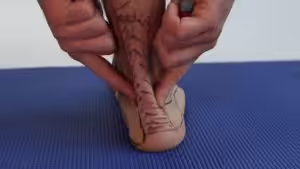
- The most common cause of the back of the heel pain is insertional Achilles tendinitis.
- This is a very Achilles tendon inserts into the back of your calcaneus bone.
- That calf muscle which is also called your gastrocnemius muscle Your Achilles tendon which is the biggest tendon in your body.
- The Achilles tendon then inserts in the back of your calcaneus.
- If this goes on for too long this can lead to what is called a back of the heel spur.
- I back of the heel spur is the formation of bone that attempts to reinforce the insertion of the Achilles tendon.
- Click on the picture and the title and this will help you find the treatment options for insertional Achilles tendinitis pain.
Hagland bump deformity:

- Hagland bump is the thickening of bone in the back of your heel.
- This is increased bone on the back of your calcaneus bone.
- This is also related to retrocalcaneal bursitis and insertional Achilles tendinitis to the back of the heel.
- Hagland bump usually occurs because your heel bone is not only moving up and down with each step, or the heel is twisting out at the same time.
- This Hagland bump is sometimes an increased thickness in the bone, but sometimes it is simply the rubbing and is associated with a high arch or cavus foot type.
Retrocalcaneal bursitis:
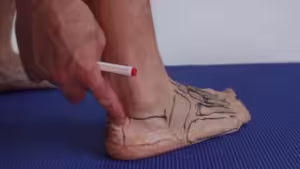
- Retrocalcaneal bursitis is the inflammation of the bursa behind the heel.
- A bursa is a fluid-filled sac that prevents rubbing between her skin and the Achilles tendon and even the calcaneus and Achilles tendon.
- If this bursa becomes inflamed or irritated, it can lead to a condition called bursitis.
- Bursitis means that you have inflammation of the bursa.
- Click on the associated picture for the best home treatment and the best home remedies for retrocalcaneal bursitis.
Back of the heel spur:
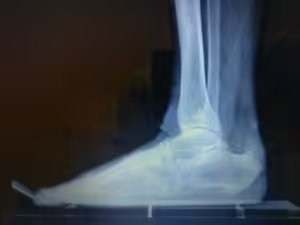
- Back of the heel spur is also known as a calcaneal spur.
- This spur is actually proven to be as strengthening of the insertion of the Achilles tendon.
- This is extra bone that attempts to strengthen too much stress through the Achilles tendon insertion.
- This occurs when insertional Achilles tendinitis occurs for 2 months.
- This can cause continued pain through the calcaneus and through the back of the heel.
- This can lead to a deep aching throb, that is worse with the 10 steps, or the 10-20 steps first thing in the morning.
- This can cause back to the heel insertional pain.
Blisters on back of heel from new shoes:
- Blisters on the back of the heel from new shoes most frequently occur due to too much tightness, especially from low quality shoes.
- This is less likely to be associated with the above diseases.
- Watch the video above for the best home remedies and the best home treatment options for blisters on the back of the heel from new shoes!
Shoes rubbing back of ankle:
- Do have shoes rubbing the back of your ankle? This is most likely the Achilles tendon, and this is known as the watershed region of her Achilles tendon.
- This occurs 2-6 cm above the back of the heel.
- This can cause pain above the calcaneus.
- A good way to get rid of this pain is to treat her Achilles tendinitis at the same time as commission point.
- Achilles tendinitis usually occurs not at the heel bone but just above the heel bone.
Shoes rubbing back of heel:
- Do have shoes rubbing the back of your heel?
- This is more likely to be Haglund’s deformity, insertional Achilles tendinitis pain, and back of the heel spur.
- This is causing continued pain through the back of the heel.
- Click on the links to Haglund’s deformity, insertional Achilles tendinitis and back of the heel spur pain to find out how to fix this problem!
Related Treatment Guides
Shoes Rubbing Your Heel?
Persistent heel friction can indicate Haglund’s deformity or other structural issues. Our podiatrists provide expert diagnosis and lasting solutions.
Clinical References
- Buldt AK, Menz HB. Incorrectly fitted footwear, foot pain and foot disorders: a systematic search and narrative review of the literature. J Foot Ankle Res. 2018;11:43.
- Kucuksen S, Karahan AY, Erol K. Haglund syndrome with pump bumps. Med Arch. 2012;66(6):425-427.
- Frey C, Thompson F, Smith J, Sanders M, Horstman H. American Orthopaedic Foot and Ankle Society women’s shoe survey. Foot Ankle. 1993;14(2):78-81.
Insurance Accepted
BCBS · Medicare · Aetna · Cigna · United Healthcare · HAP · Priority Health · Humana · View All →
📋 Dr. Tom Also Recommends
Podiatrist Recommended Orthotics 2026: Dr. Tom’s Top 10 Insoles & Arch Supports
A podiatrist’s complete clinical guide to the best insoles — custom orthotics, OTC picks, and what actually works for plantar fasciitis, flat feet, neuropathy & more.
Read the Full Guide →Howell Office
4330 E Grand River Ave
Howell, MI 48843
Get Directions →
Bloomfield Township Office
43494 Woodward Ave, #208
Bloomfield Township, MI 48302
Get Directions →
Your Board-Certified Podiatrists



Ready to Get Back on Your Feet?
Same-week appointments available at both locations.
Book Your Appointment👟 Dr. Tom’s Complete Footwear Library
Podiatrist-Approved Guides for Every Foot Type & Condition
Clinically reviewed by Dr. Tom Biernacki, DPM — Board-Certified Podiatrist
All guides are written and reviewed by licensed podiatrists. Schedule an appointment →
More Podiatrist-Recommended Shoes Essentials
Hoka Clifton 10

Max-cushion neutral runner — podiatrist favorite for all-day comfort.
Brooks Adrenaline GTS 25
Stability runner for overpronators — great for flat feet and bunions.
New Balance 990v6
Premium walking shoe with wide toe box — bunion and flat-foot friendly.
As an Amazon Associate, Balance Foot & Ankle earns from qualifying purchases. Product recommendations are based on clinical experience; prices and availability shown above update live from Amazon.
When to See a Podiatrist
The right shoe shape, last, and stability category is more important than brand. Balance Foot & Ankle evaluates your foot type (neutral, pronator, supinator, high-arched) and recommends specific shoe models that match. Bringing in your current pair lets us spot wear patterns that reveal gait issues — a free 5-minute assessment that can prevent years of foot pain.
Call Balance Foot & Ankle: (810) 206-1402 · Book online · Offices in Howell & Bloomfield Township
Pros & Cons of Conservative Care for footwear
Advantages
- ✓ Right shoe = pain reduction
- ✓ Multiple price points
- ✓ Fast adjustment
Considerations
- ✗ Trial-and-error
- ✗ Replace every 400 miles
- ✗ Custom orthotics often needed
Dr. Tom’s Recommended Products for footwear
Affiliate disclosure: As an Amazon Associate, Balance Foot & Ankle earns from qualifying purchases. We only recommend products we use with patients.
Brooks Ghost 17 Dr. Tom’s Pick
Best for: Neutral runner
Check Price on Amazon
Brooks Adrenaline GTS 23 Dr. Tom’s Pick
Best for: Stability for flat feet
Check Price on Amazon
Altra Torin 8 Dr. Tom’s Pick
Best for: Zero-drop wide toe box
Check Price on Amazon
Ready to Get Back on Your Feet?
Same-day appointments in Howell + Bloomfield Township. Most insurance accepted. Dr. Tom Biernacki, DPM & team.
Book Today — Same-Day Appointments Available
Call Now: (810) 206-1402
About Your Care Team at Balance Foot & Ankle
Dr. Tom Biernacki, DPM · Board-Certified Foot & Ankle Surgeon. Specializes in conservative-first care, minimally invasive bunion surgery, and complex reconstruction.
Dr. Carl Jay, DPM · Accepting new patients. Specializes in sports medicine, athletic injuries, and routine podiatric care.
Dr. Daria Gutkin, DPM, AACFAS · Accepting new patients. Specializes in surgical reconstruction and pediatric podiatry.
Locations: 4330 E Grand River Ave, Howell, MI 48843 · 43494 Woodward Ave Suite 208, Bloomfield Township, MI 48302
Hours: Mon–Fri 8:00 AM – 5:00 PM · (810) 206-1402
🩺 Dr. Tom’s Recommended Products
As an Amazon Associate I earn from qualifying purchases. These are products I personally use and recommend to patients.
The OTC orthotic I recommend most in our clinic. Sub-$50 before custom orthotics.
View on Amazon →
Natural menthol + arnica topical. FSA-eligible — what I switched my family to from Doctor Hoy’s Natural Pain Relief Gel.
View on Amazon →
In-Office Treatment at Balance Foot & Ankle
If home treatment isn’t providing relief for your foot and ankle conditions, our podiatry team at Balance Foot & Ankle can help with same-day evaluations and advanced in-office care.
Same-day appointments available. (810) 206-1402

Dr. Tom Biernacki, DPM is a board-certified foot & ankle surgeon (ABFAS & ABPM) at Balance Foot & Ankle Specialists in Southeast Michigan. With over a decade of clinical experience, he specializes in heel pain, bunions, diabetic foot care, sports injuries, and minimally invasive surgery. Dr. Biernacki is a member of the APMA and ACFAS, and his patient education content on MichiganFootDoctors.com and YouTube has made him one of the most-followed foot & ankle educators on YouTube.
More questions patients ask
How do you stop shoes from rubbing your heel?
Stop shoes from rubbing your heel by: using heel grip inserts inside the shoe, applying moleskin or gel heel pads over the pressure point, using heel lock lacing technique (loops through top eyelets), wearing thicker heel socks, choosing shoes with padded heel collars, ensuring proper shoe size (not too large), and breaking in new shoes gradually with short wear periods. Balance Foot & Ankle can advise on the best solution for your specific footwear situation.
Why do shoes always rub my heel?
Shoes rub the heel when they are slightly too large (allowing heel slippage), have rigid or poorly padded heel counters, are new and stiff, or when you have a prominent posterior heel such as a Haglund's bump. Balance Foot & Ankle evaluates persistent heel rubbing to determine whether it is a simple shoe fit issue or an underlying structural problem like Haglund's deformity requiring professional treatment.
What are heel grips and do they work for shoe rubbing?
Heel grips are padded inserts placed inside the heel of the shoe to reduce slippage and provide a softer surface against the back of the heel. They are effective for mild heel rubbing from shoe heel counters and slipping. They add about a quarter-size to the effective shoe fit. Balance Foot & Ankle may recommend heel grips as a first-line measure for shoe heel rubbing alongside other footwear modifications.
Can shoes rubbing my heel cause a bone spur?
Chronic rubbing of a shoe heel counter against the back of the heel bone can contribute to Haglund's deformity over time in susceptible individuals, as the repetitive irritation stimulates bone formation. However, most heel bone spurs (plantar) are related to plantar fascia traction, not shoe friction. Balance Foot & Ankle evaluates heel pain with X-ray to identify the type of any bone spur present and guide appropriate treatment.
How do I break in new shoes that are rubbing my heel?
Break in new shoes gradually: wear them for 1-2 hours the first day and increase wearing time over 1-2 weeks, wear thick socks to reduce friction, use shoe stretch spray on leather heel areas, apply moleskin or blister prevention products proactively, and consider using a shoe stretcher on the heel area. At Balance Foot & Ankle, we advise patients on safe shoe break-in protocols to prevent blisters and heel injury from new footwear.
Still have a question about coverage or cost? Book online and we will check your benefits before your visit: Book in Howell · Book in Bloomfield Township. Prefer to talk it through first? Call (810) 206-1402.