
You are in the right place. Dr. Tom Biernacki, DPM, FACFAS — board-certified foot & ankle surgeon with 3,000+ surgeries — explains exactly what Achilles tendon repair surgery means and what actually works. Call (810) 206-1402 for a same-day appointment at our Howell or Bloomfield Township office.
The most important clinical decision with Achilles Tendon Repair Surgery isn’t which treatment to start with — it’s identifying the correct subtype. That changes everything. Call (810) 206-1402.
Dr. Tom’s Top Bob and Brad Massage Guns (2026)
Medically reviewed by Dr. Tom Biernacki, DPM
Board-certified podiatric surgeon | Balance Foot & Ankle
Last reviewed: May 2026
Affiliate disclosure: As an Amazon Associate, Balance Foot & Ankle earns from qualifying purchases. Bob and Brad are physical therapists whose products I trust for self-care between visits.
Dr. Tom’s Top Pain Relief Picks — Dr. Hoy’s (2026)
Affiliate disclosure: As an Amazon Associate, Balance Foot & Ankle earns from qualifying purchases. I personally use Dr. Hoy’s in my practice for patients who need topical relief.
| Product | Best For | Dr. Tom’s Take | Get It |
|---|---|---|---|
| Dr. Hoy’s Natural Pain Relief Gel 3.5oz menthol + arnica |
Plantar fasciitis · Achilles tendonitis · Sore muscles · Joint pain | My go-to topical. Cooling-then-warming sensation. No greasy residue. Non-NSAID alternative. | Buy Now |
| Dr. Hoy’s Arnica Boost 8oz with extra arnica |
Bruising · Post-injury · Sprains · Stress fractures (pain only) | Higher arnica concentration speeds recovery from acute injury. Use 4x daily for first 7 days. | Buy Now |
| Dr. Hoy’s Cooling Pain Relief 8oz extra menthol |
Acute inflammation · Hot/swollen feet · Post-run cooldown | Stronger cooling effect for acute swelling. Pair with ice for first 48 hours after injury. | Buy Now |
| Dr. Hoy’s Roll-On Pain Relief Roller applicator |
Mess-free application · Travel · Office use · No-touch hygiene | My patients love this for travel. Glides on without hand contact — cleanest application available. | Buy Now |
| Dr. Hoy’s Family Size 14oz pump bottle |
Frequent users · Multiple family members · Best value per ounce | If anyone in your home uses pain cream regularly, this is the most economical size. Same formula. | Buy Now |
Why I recommend Dr. Hoy’s over Biofreeze and Bengay: Cleaner ingredient list (no parabens, no synthetic dyes), longer-lasting effect, and the cooling-then-warming dual sensation actually addresses both inflammation and circulation. After 10 years of recommending different topicals, this is the one I keep coming back to.
Quick Compare: Dr. Tom’s Top Running Shoes
| Shoe | Best For | Watch Out For | Buy | ||||||||||||||||||||||||
|---|---|---|---|---|---|---|---|---|---|---|---|---|---|---|---|---|---|---|---|---|---|---|---|---|---|---|---|
| Hoka Bondi 9 | Plantar fasciitis, max cushion | Heavy, tall stack | Buy | ||||||||||||||||||||||||
| Brooks Ghost 17 | Neutral runners, first running shoe | Not for 200+lb runners | Buy | ||||||||||||||||||||||||
| Brooks Adrenaline GTS 23 | Flat feet, overpronation | Snug toe box | Buy | ||||||||||||||||||||||||
| Altra Torin 8 | Wide feet, bunions, Morton’s toe | Zero-drop transition | Buy | ||||||||||||||||||||||||
| Hoka Clifton 10 | Daily training, lighter Hoka | Less cushion than Bondi | Buy | ||||||||||||||||||||||||
| NB 990v6 | Senior fall prevention, 6E width |
Dr. Tom’s Top Pain Relief Picks — Dr. Hoy’s (2026)Affiliate disclosure: As an Amazon Associate, Balance Foot & Ankle earns from qualifying purchases. I personally use Dr. Hoy’s in my practice for patients who need topical relief.
Why I recommend Dr. Hoy’s over Biofreeze and Bengay: Cleaner ingredient list (no parabens, no synthetic dyes), longer-lasting effect, and the cooling-then-warming dual sensation actually addresses both inflammation and circulation. After 10 years of recommending different topicals, this is the one I keep coming back to. 75-200, not for running |
Buy |
For full detailed reviews with pros/cons/Dr. Tom’s tips, see our complete shoe guide.
Related Conditions
Quick Answer
Achilles Tendon Repair Surgery 2026: Recovery Guide DPM relates to Achilles tendonitis — typically caused by sudden activity increase. Most patients improve in 8-12 weeks with conservative care. Same-week appointments in Howell + Bloomfield Township: (810) 206-1402.

Quick Answer
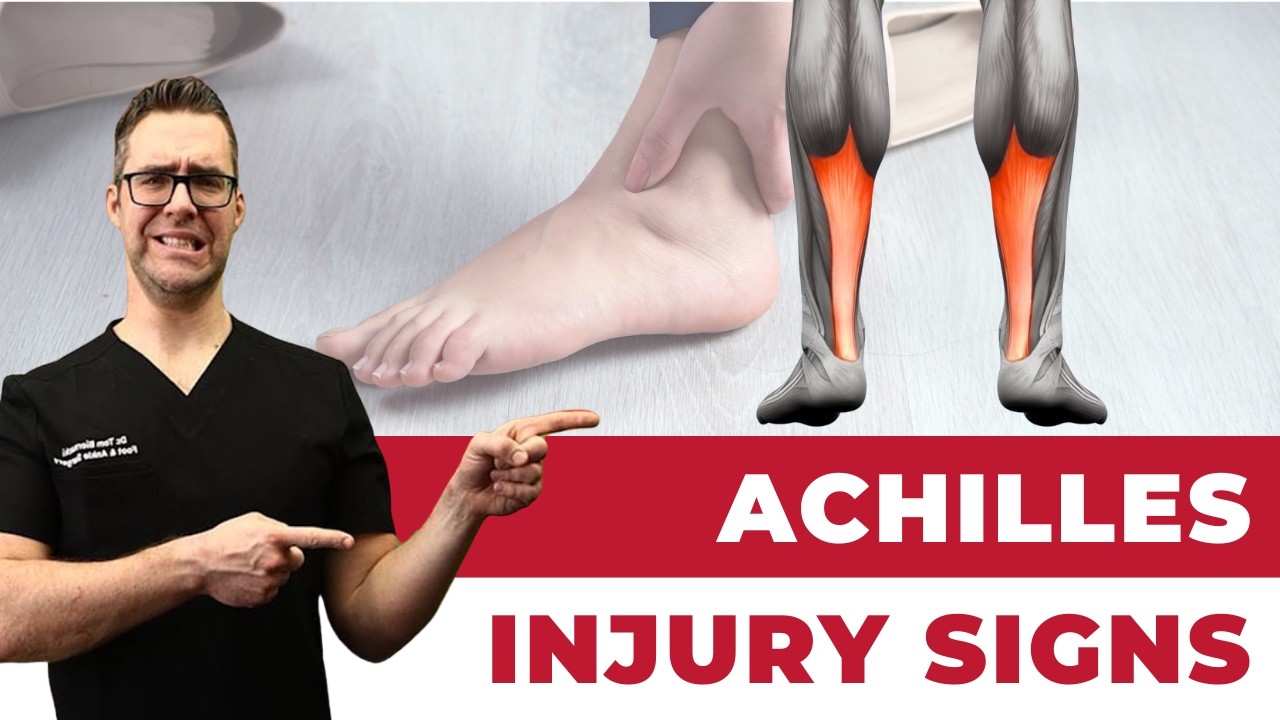
Achilles tendonitis causes pain and stiffness at the back of the heel along the Achilles tendon. Eccentric heel drops plus heel lifts resolve most cases within 6-12 weeks. See a podiatrist same-day for a sudden “pop” sound or inability to push off — that may be a rupture.
Watch: Dr. Tom Biernacki, DPM
Achilles Tendon Repair Surgery: Open vs. Minimally Invasive, Recovery, and Outcomes
Achilles Tendon Repair: An Overview
Achilles tendon repair surgery reconstructs a ruptured Achilles tendon — the thick cord connecting the calf muscles to the heel bone. Complete ruptures most commonly occur during athletic activity with a sudden push-off or forced dorsiflexion, producing a characteristic snap and immediate inability to push off the foot. Surgery restores tensile strength and function faster than non-operative treatment in younger, active patients.
Surgery vs. Conservative Management
Both surgical repair and functional bracing (non-operative) are accepted treatments for acute Achilles rupture. The debate between approaches has evolved — current evidence shows that functional bracing with early range-of-motion rehabilitation achieves outcomes similar to surgery in terms of re-rupture rates and functional recovery when a structured protocol is followed. Surgery provides a small but consistent advantage in re-rupture rates in studies where non-operative patients are not managed with accelerated rehabilitation. The choice depends on patient age, activity level, time from injury, and patient preference after informed discussion.
Open vs. Minimally Invasive Repair
Traditional open repair uses a longitudinal incision along the back of the ankle. The tendon ends are identified, debrided if necessary, and sutured together with strong non-absorbable sutures in a locking configuration. The repair is augmented with additional sutures around the repair site. Open repair provides excellent direct visualization and is the preferred approach for complex or chronic ruptures.
Minimally invasive and percutaneous techniques use smaller incisions and specialized instruments to pass sutures through the tendon without full exposure. These approaches may reduce wound complications — wound healing problems are a recognized concern with open Achilles surgery due to the tenuous blood supply of the posterior ankle skin — but carry a slightly higher risk of sural nerve injury. Outcomes are comparable to open repair in experienced hands.
Chronic Achilles Tendinopathy Surgery
For insertional Achilles tendinopathy (degenerative pain and calcification at the heel insertion) that fails conservative care, surgery involves detaching the tendon, removing calcific deposits and degenerated tissue, reattaching the tendon with anchors, and often addressing any associated Haglund deformity (prominent heel bone). This is a larger procedure with a longer recovery than acute rupture repair.
Non-insertional tendinopathy (mid-tendon degeneration) may be treated surgically with tendon debridement, longitudinal tenotomies to stimulate healing, and sometimes flexor hallucis longus tendon augmentation when the tendon is severely compromised.
Recovery After Acute Rupture Repair
The first 2 weeks are spent in a splint in plantarflexion (toes pointed down) to protect the repair. Weight-bearing in a walking boot with heel lifts begins around week 2. Progressive rehabilitation advances range of motion, then strengthening. Return to jogging is typically possible at 4 to 6 months; return to sport at 6 to 9 months. Calf strength and endurance take 12 to 18 months to fully recover even in athletes who return to competition sooner.
Recovery After Insertional Tendinopathy Surgery
Because the tendon is detached and reattached, recovery is more prolonged. Non-weight-bearing for 4 to 6 weeks is standard, followed by gradual transition to weight-bearing in a boot. Full recovery takes 9 to 12 months. Patients should have realistic expectations for this timeline before proceeding.
Risks of Achilles Surgery
Wound complications including delayed healing and infection are the most significant concern with posterior ankle surgery. The Achilles tendon region has limited blood supply, making wound closure demanding. Other risks include sural nerve injury causing lateral foot numbness, deep vein thrombosis, re-rupture, and scar adhesion causing tendon stiffness. Smoking, diabetes, and obesity significantly increase wound complication risk.
Choosing the Right Approach
The surgical vs. non-operative decision should be individualized. Discuss your activity goals, overall health, willingness to commit to intensive rehabilitation, and the available evidence with a foot and ankle surgeon. For the right patient, Achilles repair provides reliable restoration of function — the Achilles is the strongest tendon in the body and, when properly repaired, allows return to the highest levels of sport.
Achilles Repair in the Setting of Tendinopathy: Augmentation Techniques
When Achilles tendon rupture occurs through a segment of advanced degenerative tissue — identified intraoperatively as gray, friable tendon rather than healthy white fibrillar collagen — the standard repair into degenerated tissue may provide inadequate mechanical strength. In these cases, augmentation reinforces the primary repair. The plantaris tendon, which runs adjacent to the Achilles and is expendable, can be woven through the repair site to provide additional collagen bulk. The flexor hallucis longus (FHL) tendon — the most commonly used augmentation for chronic Achilles ruptures — is transferred from behind the medial malleolus into the calcaneus, providing a functioning plantarflexion tendon with excellent biological compatibility.
For delayed Achilles rupture presentations (more than 4–6 weeks after injury) where tendon ends have retracted and scarred, reconstruction with allograft tendon tissue or V-Y tendon lengthening may be required to achieve length restoration without excessive repair tension. At Balance Foot & Ankle in Howell and Bloomfield Township, our podiatric surgeons evaluate each Achilles rupture individually to determine the optimal repair strategy for the specific tendon quality, gap characteristics, and patient demands.
Related Treatment Guides
- Achilles Tendinopathy Treatment
- Plantar Fasciitis & Heel Pain Treatment
- Custom 3D Orthotics
- Sports Foot & Ankle Injury Treatment
Michigan patients can access expert Achilles tendon care in Michigan at Balance Foot & Ankle. Our board-certified podiatrists serve Howell (4330 E Grand River) and Bloomfield Township (43494 Woodward Ave #208). Schedule an appointment online or call (810) 206-1402 for same-week availability.
Insurance Accepted
BCBS · Medicare · Aetna · Cigna · United Healthcare · HAP · Priority Health · Humana · View All →
Howell Office
4330 E Grand River Ave
Howell, MI 48843
Get Directions →
Bloomfield Township Office
43494 Woodward Ave, #208
Bloomfield Township, MI 48302
Get Directions →
Your Board-Certified Podiatrists



Ready to Get Back on Your Feet?
Same-week appointments available at both locations.
In-Office Treatment at Balance Foot & Ankle
If home care isn’t resolving your Achilles tendon pain, a visit with a board-certified podiatrist is the fastest path to accurate diagnosis and a personalized plan. At Balance Foot & Ankle Specialists, Dr. Tom Biernacki, Dr. Carl Jay, and Dr. Daria Gutkin offer same-day and next-day appointments at both our Howell and Bloomfield Township offices. We perform on-site diagnostic ultrasound, digital X-ray, conservative care, advanced regenerative treatments, and minimally invasive surgery when indicated.
Call (810) 206-1402 or request an appointment online. Most insurance plans accepted, including Medicare, Blue Cross Blue Shield, Aetna, Cigna, and United Healthcare.
Differential Diagnosis: What Else Could It Be?
Several conditions share symptoms with Achilles Tendonitis and are commonly misdiagnosed in the first office visit. Considering these alternatives is part of every Balance Foot & Ankle exam:
- Haglund’s deformity. Bony bump at the back of the heel rubbing against the shoe counter.
- Insertional vs. mid-substance Achilles. Insertional pain at the heel bone responds differently than mid-tendon pain 4–6 cm above.
- Retrocalcaneal bursitis. Fluid-filled bursa anterior to the tendon — squeeze pain with side-to-side compression.
If your symptoms don’t fit the textbook pattern, ask your podiatrist which differentials they ruled out — that conversation often shortcuts months of trial-and-error treatment.
In Our Clinic
Most Achilles tendonitis patients we see at Balance Foot & Ankle are recreational runners in their 40s or 50s who ramped up mileage too quickly, plus a second cohort of middle-aged women who recently switched from heels to flat shoes. The first question we ask is whether the pain is at the insertion on the heel bone versus 2–6 cm up the mid-substance — the treatment ladder is genuinely different. Eccentric heel-drops, heel lifts, and a soft-strike gait retraining pass resolve ~80 % of cases. The ones who aren’t improving by week 8 usually have an unrecognized Haglund’s deformity or insertional calcific tendinosis that needs imaging.
Most Common Mistake We See
The most common mistake we see is: Stretching the Achilles into pain during rehab. Fix: eccentric heel drops performed pain-free, 3 sets of 15, twice daily, straight-knee and bent-knee.
Warning Signs That Need Same-Day Care
Seek immediate evaluation at Balance Foot & Ankle if you experience any of the following:
- Pop or snap with sudden inability to push off
- Loss of active plantarflexion
- Significant swelling within 24 hours
- Rest or night pain in the tendon
Call (810) 206-1402 — same-day and next-day appointments at our Howell and Bloomfield Township offices.
Pros & Cons of Conservative Care for Achilles tendonitis
Advantages
- ✓ Eccentric heel drops 80%+ effective
- ✓ Conservative treatment first
- ✓ Strong recovery prognosis
Considerations
- ✗ Recovery 8-12 weeks typical
- ✗ Risk of rupture if ignored
- ✗ Surgery required if rupture
In This Article
- Quick Answer
- In-Office Treatment at Balance Foot & Ankle
- Differential Diagnosis: What Else Could It Be?
Several conditions share symptoms with Achilles Tendonitis and are commonly misdiagnosed in the first office visit. Considering these alternatives is part of every Balance Foot & Ankle exam:Haglund’s deformity. Bony bump at the back of the heel rubbing against the shoe counter.
Insertional vs. mid-substance Achilles. Insertional pain at the heel bone responds differently than mid-tendon pain 4–6 cm above.
Retrocalcaneal bursitis. Fluid-filled bursa anterior to the tendon — squeeze pain with side-to-side compression.If your symptoms don’t fit the textbook pattern, ask your podiatrist which differentials they ruled out — that conversation often shortcuts months of trial-and-error treatment.
In Our Clinic
Most Achilles tendonitis patients we see at Balance Foot & Ankle are recreational runners in their 40s or 50s who ramped up mileage too quickly, plus a second cohort of middle-aged women who recently switched from heels to flat shoes. The first question we ask is whether the pain is at the insertion on the heel bone versus 2–6 cm up the mid-substance — the treatment ladder is genuinely different. Eccentric heel-drops, heel lifts, and a soft-strike gait retraining pass resolve ~80 % of cases. The ones who aren’t improving by week 8 usually have an unrecognized Haglund’s deformity or insertional calcific tendinosis that needs imaging.Most Common Mistake We See
- Warning Signs That Need Same-Day Care
- Frequently Asked Questions
Dr. Tom’s Recommended Products for Achilles tendonitis
Affiliate disclosure: As an Amazon Associate, Balance Foot & Ankle earns from qualifying purchases. We only recommend products we use with patients.
TriggerPoint Footballer Dr. Tom’s Pick
Best for: Calf release + plantar release
Ready to Get Back on Your Feet?
Same-day appointments in Howell + Bloomfield Township. Most insurance accepted. Dr. Tom Biernacki, DPM & team.
Book Today — Same-Day Appointments Available
Call Now: (810) 206-1402
About Your Care Team at Balance Foot & Ankle
Dr. Tom Biernacki, DPM · Board-Certified Foot & Ankle Surgeon. Specializes in conservative-first care, minimally invasive bunion surgery, and complex reconstruction.
Dr. Carl Jay, DPM · Accepting new patients. Specializes in sports medicine, athletic injuries, and routine podiatric care.
Dr. Daria Gutkin, DPM, AACFAS · Accepting new patients. Specializes in surgical reconstruction and pediatric podiatry.
Locations: 4330 E Grand River Ave, Howell, MI 48843 · 43494 Woodward Ave Suite 208, Bloomfield Township, MI 48302
Hours: Mon–Fri 8:00 AM – 5:00 PM · (810) 206-1402

Dr. Tom Biernacki, DPM is a board-certified foot & ankle surgeon (ABFAS & ABPM) at Balance Foot & Ankle Specialists in Southeast Michigan. With over a decade of clinical experience, he specializes in heel pain, bunions, diabetic foot care, sports injuries, and minimally invasive surgery. Dr. Biernacki is a member of the APMA and ACFAS, and his patient education content on MichiganFootDoctors.com and YouTube has made him one of the most-followed foot & ankle educators on YouTube.
More questions patients ask
How long does an ankle sprain take to heal?
Recovery time depends on severity: Grade 1 (mild stretching) typically heals in 1-3 weeks, Grade 2 (partial tear) in 3-6 weeks, and Grade 3 (complete tear) in 6-12 weeks or longer. Proper rehabilitation is critical to prevent chronic ankle instability, which affects up to 40% of patients who don't receive adequate treatment. Dr. Biernacki creates customized recovery plans.
When should I see a doctor for a sprained ankle?
Seek professional evaluation if you can't bear weight, notice significant swelling or bruising, hear a pop at the time of injury, have numbness, or if pain hasn't improved after 5-7 days of RICE treatment. X-rays or MRI may be needed to rule out fractures. Dr. Biernacki offers same-day urgent evaluations at 810-206-1402.
Can a sprained ankle heal without treatment?
While mild sprains may heal with rest and home care, undiagnosed ligament tears and improperly rehabilitated sprains frequently lead to chronic ankle instability, recurrent sprains, and early-onset arthritis. A proper evaluation ensures appropriate treatment and reduces your risk of long-term complications significantly.
Still have a question about coverage or cost? Book online and we will check your benefits before your visit: Book in Howell · Book in Bloomfield Township. Prefer to talk it through first? Call (810) 206-1402.