
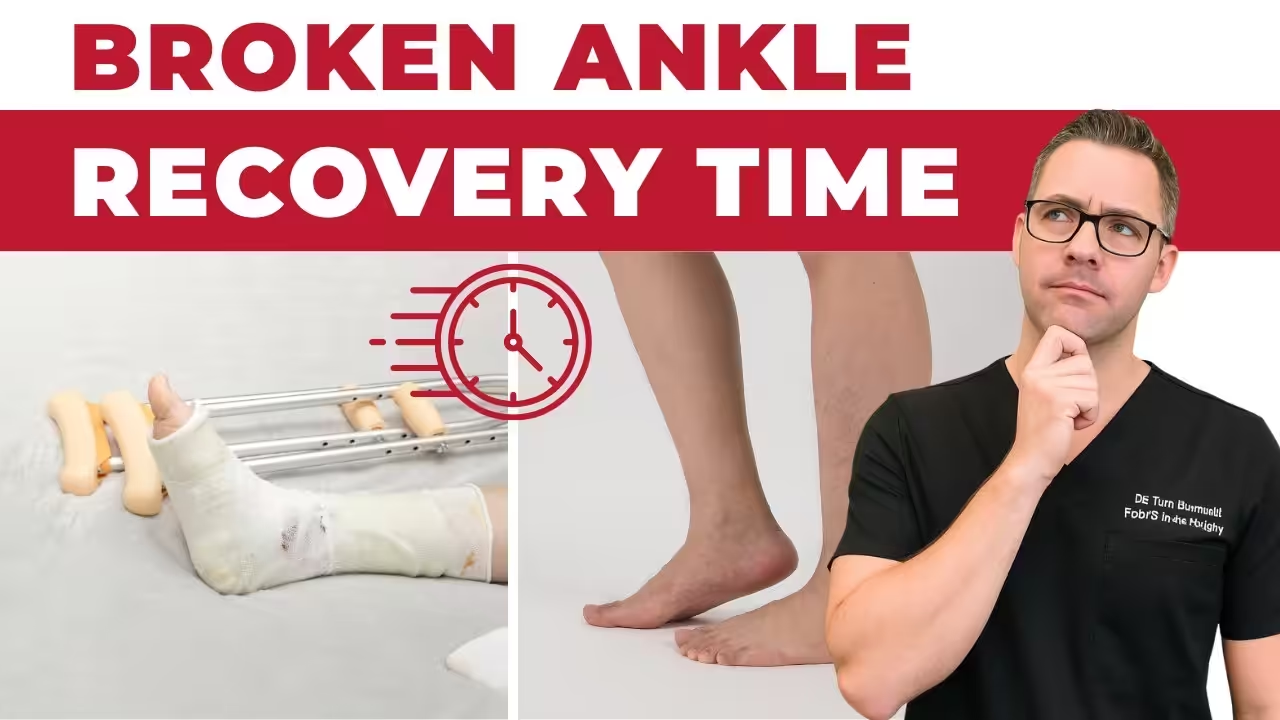
Quick answer: Treatment for ankle pain causes treatment follows a stepwise approach: 1) conservative care first (rest, ice, supportive footwear, OTC anti-inflammatories), 2) physical therapy and targeted exercises, 3) in-office treatments (injections, custom orthotics) if conservative fails at 4-6 weeks, 4) surgery for refractory cases. Most patients resolve at step 1 or 2. Call (810) 206-1402.
Dr. Tom’s Top Insole & Orthotic Picks
Medically reviewed by Dr. Tom Biernacki, DPM
Board-certified podiatric surgeon | Balance Foot & Ankle
Last reviewed: May 2026
Affiliate disclosure: As an Amazon Associate, Balance Foot & Ankle earns from qualifying purchases.
Dr. Tom’s Top Pain Relief Picks — Dr. Hoy’s (2026)
Affiliate disclosure: As an Amazon Associate, Balance Foot & Ankle earns from qualifying purchases. I personally use Dr. Hoy’s in my practice for patients who need topical relief.
| Product | Best For | Dr. Tom’s Take | Get It |
|---|---|---|---|
| Dr. Hoy’s Natural Pain Relief Gel 3.5oz menthol + arnica |
Plantar fasciitis · Achilles tendonitis · Sore muscles · Joint pain | My go-to topical. Cooling-then-warming sensation. No greasy residue. Non-NSAID alternative. | Buy Now |
| Dr. Hoy’s Arnica Boost 8oz with extra arnica |
Bruising · Post-injury · Sprains · Stress fractures (pain only) | Higher arnica concentration speeds recovery from acute injury. Use 4x daily for first 7 days. | Buy Now |
| Dr. Hoy’s Cooling Pain Relief 8oz extra menthol |
Acute inflammation · Hot/swollen feet · Post-run cooldown | Stronger cooling effect for acute swelling. Pair with ice for first 48 hours after injury. | Buy Now |
| Dr. Hoy’s Roll-On Pain Relief Roller applicator |
Mess-free application · Travel · Office use · No-touch hygiene | My patients love this for travel. Glides on without hand contact — cleanest application available. | Buy Now |
| Dr. Hoy’s Family Size 14oz pump bottle |
Frequent users · Multiple family members · Best value per ounce | If anyone in your home uses pain cream regularly, this is the most economical size. Same formula. | Buy Now |
Why I recommend Dr. Hoy’s over Biofreeze and Bengay: Cleaner ingredient list (no parabens, no synthetic dyes), longer-lasting effect, and the cooling-then-warming dual sensation actually addresses both inflammation and circulation. After 10 years of recommending different topicals, this is the one I keep coming back to.
Medically reviewed by Dr. Tom Biernacki, DPM · Board-Certified Podiatric Surgeon · Last reviewed: April 2026 · Editorial Policy
In This Article
Related Conditions
Quick Answer
Ankle Pain: Causes, Diagnosis & Treatment by Location ( relates to foot pain — typically caused by overuse, footwear, or biomechanics. Most patients improve in 6-12 weeks with conservative care. Same-week appointments in Howell + Bloomfield Township: (810) 206-1402.
✅ Medically reviewed by Dr. Tom Biernacki, DPM — Board-Certified Podiatrist · Last updated April 6, 2026
Ankle pain is one of the most common musculoskeletal complaints seen in podiatric practice — and also one of the most misdiagnosed. The ankle is a complex joint with contributions from bones, ligaments, tendons, nerves, and bursae, and pain in this region can stem from a surprising range of causes beyond the obvious sprained ankle.
At Balance Foot & Ankle in Howell and Bloomfield Township, MI, we evaluate ankle pain systematically to find the true underlying cause and create a targeted treatment plan. This guide covers the most common causes, how to tell them apart, and what effective treatment looks like for each.
Anatomy: Why Ankle Pain Is Complicated
The ankle is actually two joints working together:
- The talocrural joint — the main ankle joint where the tibia and fibula form a mortise around the talus. This allows the up-and-down motion of walking.
- The subtalar joint — below the talocrural joint, between the talus and calcaneus (heel bone). This controls side-to-side motion and foot inversion/eversion.
Surrounding these joints are four major ligament groups, three primary tendons (Achilles, peroneal, and posterior tibial), the sural and peroneal nerves, and numerous bursae. Pain can originate from any of these structures — which is why precise diagnosis matters.
Common Causes of Ankle Pain by Location
| Pain Location | Most Likely Cause(s) | Key Clue |
|---|---|---|
| Outer (lateral) ankle | Lateral ankle sprain, peroneal tendon tear/subluxation, OCD lesion, sinus tarsi syndrome | History of inversion injury; pain with uneven ground |
| Inner (medial) ankle | Posterior tibial tendon dysfunction, deltoid ligament sprain, tarsal tunnel syndrome | Pain along inner arch; flatfoot progression; electric/burning sensation (nerve) |
| Back of ankle | Achilles tendinopathy, insertional Achilles tendinitis, Haglund’s deformity, retrocalcaneal bursitis | Pain with first steps; worse with stairs/hills; heel-counter irritation |
| Front of ankle | Ankle impingement (anterior or posterior), tibialis anterior tendinopathy, ankle arthritis | Pain squatting or dorsiflexing; worse going downstairs |
| All around ankle | Ankle arthritis, gout flare, fracture, infection, inflammatory arthritis (RA, psoriatic) | Diffuse swelling, warmth, systemic symptoms |
ankle sprain treatment Michigan.– /wp:table –>
Ankle Sprain: The Most Common Cause
Lateral ankle sprains account for approximately 25% of all sports injuries. Even sprains are more complex than commonly understood — there are three grades:
| Grade | Ligament Status | Symptoms | Return to Activity |
|---|---|---|---|
| Grade I | Stretched (microscopic tears) | Mild tenderness, minimal swelling, full weight-bearing | 3-5 days with RICE |
| Grade II | Partial tear | Moderate swelling, bruising, pain with weight-bearing, some instability | 2-6 weeks with rehabilitation |
| Grade III | Complete tear | Significant swelling, bruising, instability, weight-bearing often impossible | 6-12+ weeks; may require surgery for athletes |
Critical point: Many ankle sprains mask accompanying injuries. Up to 40% of Grade II-III sprains have an associated peroneal tendon injury, and up to 50% have a missed osteochondral lesion (OCD) of the talus — a cartilage/bone injury that doesn’t heal without specific treatment. If your ankle pain persists beyond 6 weeks after a sprain, imaging and re-evaluation are warranted.
Posterior Tibial Tendon Dysfunction (PTTD)
PTTD is the most common cause of progressive adult flatfoot and medial ankle pain. The posterior tibial tendon — which runs behind the inner ankle and supports the arch — gradually degenerates and fails, allowing the arch to collapse and the heel to roll outward.
Early PTTD (Stage I-II) responds very well to custom orthotics, supportive footwear, and physical therapy. Advanced PTTD (Stage III-IV) may require surgical reconstruction. Early intervention is critical — read our comprehensive guide on posterior tibial tendon dysfunction.
Achilles Tendon Pain
Pain at the back of the ankle most commonly involves the Achilles tendon complex. Three overlapping conditions are often confused:
- Noninsertional Achilles tendinopathy: Pain and thickening 2-6cm above the heel bone insertion, in the tendon’s midportion. Common in runners. Responds well to eccentric strengthening, load management, and MLS laser therapy.
- Insertional Achilles tendinitis: Pain directly at the heel bone attachment, often with a visible bump. More resistant to treatment; associated with Haglund’s deformity. Heel lifts and specialized orthotics are key.
- Achilles tendon rupture: Sudden “pop” sensation, inability to rise on toes, palpable gap in tendon. Requires urgent evaluation — surgical vs. conservative management depends on age, activity level, and gap size.
For comprehensive information, see our guide on Achilles tendinitis treatment.
Peroneal Tendon Injuries
The two peroneal tendons run behind the lateral (outer) ankle and stabilize the foot during push-off and on uneven terrain. Peroneal injuries are frequently missed because they mimic chronic lateral ankle sprains:
- Peroneal tendinopathy: Chronic outer ankle pain with swelling behind the lateral malleolus. Worsens with activity, eases with rest. Treated with rest, orthotics, physical therapy, and MLS laser.
- Peroneal tendon subluxation: The tendons slip out of their groove behind the fibula with ankle movement. Often causes a snapping sensation. May require surgical stabilization.
- Peroneal tendon tear: Longitudinal split tear most common in the peroneus brevis. Causes persistent outer ankle pain and weakness. MRI confirms diagnosis.
Ankle Arthritis
Unlike hip and knee arthritis, ankle osteoarthritis most commonly results from prior trauma (post-traumatic arthritis) rather than primary degeneration. Risk factors include previous fractures, multiple ankle sprains, osteochondral lesions, and alignment problems.
Symptoms include stiffness (especially morning stiffness), aching pain with activity, reduced range of motion, and visible joint swelling. Treatment options include:
- Custom orthotics with rocker sole modification to reduce joint stress
- Ankle-foot orthoses (AFOs) for advanced arthritis
- Intra-articular cortisone injections for flares
- Hyaluronic acid (viscosupplementation) for mild-moderate arthritis
- PRP (platelet-rich plasma) injections — emerging evidence
- Ankle arthroscopy for joint debridement
- Total ankle replacement or ankle fusion for end-stage disease
Tarsal Tunnel Syndrome
Tarsal tunnel syndrome compresses the posterior tibial nerve as it passes through the tarsal tunnel behind the inner ankle — the foot equivalent of carpal tunnel syndrome in the wrist. It causes burning, tingling, and electric pain along the inner ankle, arch, and toes. Read our complete guide on tarsal tunnel syndrome.
When Is Ankle Pain an Emergency?
| Symptom | Possible Cause | Action |
|---|---|---|
| Ankle pain + inability to bear any weight | Fracture | ER or urgent podiatric evaluation |
| Ankle pain + sudden “pop” + inability to rise on toes | Achilles rupture | Urgent evaluation — time-sensitive treatment decision |
| Ankle pain + fever + warmth + redness | Septic arthritis or gout | ER if high fever; urgent podiatric evaluation if afebrile |
| Ankle pain + calf pain + swelling | Deep vein thrombosis (DVT) | ER immediately — DVT is life-threatening |
| Ankle pain in a diabetic patient + swelling + warmth | Charcot neuroarthropathy | Same-day evaluation — non-weight-bearing critical |
Diagnosis: What to Expect at Balance Foot & Ankle
When you visit our office with ankle pain, your evaluation typically includes:
- Detailed history: Onset, mechanism of injury (if any), location, aggravating/relieving factors, prior ankle injuries, systemic conditions
- Physical examination: Palpation along specific anatomical landmarks, range-of-motion testing, stability assessment (anterior drawer, talar tilt tests), gait observation, single-leg heel raise testing
- Weight-bearing X-rays: Essential for assessing bony alignment, arthritis, fractures, and coalition
- Ultrasound: Dynamic imaging that can evaluate tendons and ligaments in real time
- MRI (if indicated): For osteochondral lesions, suspected tears, soft tissue masses
- Nerve conduction studies: If tarsal tunnel syndrome or neuropathy suspected
More Podiatrist-Recommended Foot Health Essentials
Hoka Clifton 10

Hoka Men’s Clifton 10 Black/White 10 Medium
- JACQUARD KNIT UPPER
- Lining Textile
Max-cushion everyday shoe — podiatrist favorite for walking and running.
PowerStep Pinnacle Insole

PowerStep Pinnacle Insoles, Orthotics for Plantar Fasciitis Relief, Made in USA Orthotic Insoles, Arch Support Inserts with Moderate Pronation, #1 Podiatrist Recommended (M 14-15)
- The Pinnacle Full length insoles for men & women provide maximum cushioning, from high activity to moderate support. The PowerStep arch support shape provides stability to the foot and ankle, helping to relieve foot pain.
- When you spend all day on your feet, every step counts. PowerStep insoles are a podiatrist-recommended orthotic to help relieve & prevent foot pain related to athletes, runners, Plantar Fasciitis, heel spurs & other common foot, ankle & knee injuries
- The Pinnacle plantar fasciitis insoles offer superior heel cushioning and arch support. The dual-layer cushioning is designed to reduce stress and fatigue, while PowerStep premium arch support is designed for plantar fasciitis relief.
- The PowerStep Pinnacle arch support inserts for men & women can be worn in a variety of shoe types such as; athletic, walking, running, work & some casual shoes. Orthotic Inserts are ordered by shoe size, no trimming required.
- Made in the USA & backed by a 30-day money-back guarantee. PowerStep orthotic inserts for men & women are designed for shoes where the factory insole can be removed. HSA & FSA Eligible
The podiatrist-recommended over-the-counter orthotic.
OOFOS Recovery Slide

OOFOS OOahh Recovery Slide, Black – Women’s Size 14, Men’s Size 12
- The Original Recovery Footwear.
- Finding Your Size – For your perfect fit, consult the “size chart” link above. Wear a half size? In general, we recommend that women who wear a ½ size size UP, and men who wear a ½ size size DOWN
- OOahh – An evolution of the OOriginal, the OOahh slide features our proven foundation of OOfoam technology + patented footbed design with a slide-style strap that has become a best-seller in the OOFOS line
- OOfoam Technology – Our revolutionary OOfoam technology absorbs 37% more impact than traditional footwear foams to reduce the stress on your feet, joints & back. Plus, the closed-cell foam is machine washable and designed to minimize odor
- Patented Footbed – Our patented footbed cradles and supports arches to reduce energy exertion in the ankles by up to 47% compared to competitors’ footwear. So walking is easier. Recovery is faster. And yOO feel better
Impact-absorbing recovery sandal — wear after long days on your feet.
As an Amazon Associate, Balance Foot & Ankle earns from qualifying purchases. Product recommendations are based on clinical experience; prices and availability shown above update live from Amazon.

When to See a Podiatrist
If foot or ankle pain has been bothering you for more than a few weeks, home care alone may not be enough. Balance Foot & Ankle offers same-week appointments at our Howell and Bloomfield Township clinics — no referral needed in most cases. Bring your current shoes and a short list of symptoms and we’ll build you a treatment plan in one visit.
Call Balance Foot & Ankle: (810) 206-1402 · Book online · Offices in Howell & Bloomfield Township
Frequently Asked Questions
Q: How do I know if my ankle pain is a sprain or a fracture?
A: The Ottawa Ankle Rules (used in emergency medicine) suggest X-ray is needed if: you cannot bear weight for 4 steps, or there’s tenderness at the posterior tip or bottom 6cm of either malleolus. When in doubt, get an X-ray. A missed fracture is a serious problem.
Q: Why does my ankle still hurt months after a sprain?
A: Chronic pain after a sprain often indicates an under-treated injury. Common causes include residual ligament instability, peroneal tendon tear, osteochondral lesion (cartilage injury), sinus tarsi syndrome, or inadequate rehabilitation. A repeat evaluation with MRI is usually appropriate after 6-8 weeks of non-resolution.
Q: Can custom orthotics help ankle pain?
A: Yes, for many causes. Orthotics address biomechanical contributors — overpronation, PTTD, instability — by controlling foot and ankle alignment during gait. They’re especially effective for PTTD, chronic ankle instability, and ankle arthritis.
Q: Should I wrap an ankle sprain?
A: Compression (elastic bandage or ankle sleeve) is appropriate for Grade I-II sprains to control swelling in the first 48-72 hours. For Grade II-III sprains, a semi-rigid ankle brace (like an Aircast) provides better stability for return to activity. Severe sprains may warrant a boot or cast.
Related Patient Guides
- Achilles Tendinitis: Symptoms, Treatment & Recovery
- Tarsal Tunnel Syndrome: Symptoms & Treatment
- Posterior Tibial Tendon Dysfunction (PTTD)
- Stress Fracture in the Foot: Symptoms & Recovery
- Foot Arthritis: Types, Symptoms & Treatment Options
- 3D Custom Orthotics at Balance Foot & Ankle
- Gout in the Foot: Symptoms & Treatment
- Diabetic Foot Care: Daily Routine & Warning Signs
- Walking Barefoot: Benefits, Risks & Podiatrist Advice
- Chronic Ankle Instability: Why Your Ankle Keeps Giving Out
Insurance Accepted
BCBS · Medicare · Aetna · Cigna · United Healthcare · HAP · Priority Health · Humana · View All →
Howell Office
4330 E Grand River Ave
Howell, MI 48843
Get Directions →
Bloomfield Township Office
43494 Woodward Ave, #208
Bloomfield Township, MI 48302
Get Directions →
Your Board-Certified Podiatrists



Ready to Get Back on Your Feet?
Same-week appointments available at both locations.
Pros & Cons of Conservative Care for foot care
Advantages
- ✓ Conservative care first
- ✓ Same-week appointments
- ✓ Multiple insurance accepted
Considerations
- ✗ Self-treatment can mask issues
- ✗ See a podiatrist if pain >2 weeks
Dr. Tom’s Recommended Products for foot care
Affiliate disclosure: As an Amazon Associate, Balance Foot & Ankle earns from qualifying purchases. We only recommend products we use with patients.
Footnanny Heel Cream Dr. Tom’s Pick
Best for: Daily moisturizer for cracked heels
Ready to Get Back on Your Feet?
Same-week appointments in Howell + Bloomfield Township. Most insurance accepted. Dr. Tom Biernacki, DPM & team.
Book Today — Same-Week Appointments Available
Call Now: (810) 206-1402
About Your Care Team at Balance Foot & Ankle
Dr. Tom Biernacki, DPM · Board-Certified Foot & Ankle Surgeon. Specializes in conservative-first care, minimally invasive bunion surgery, and complex reconstruction.
Dr. Carl Jay, DPM · Accepting new patients. Specializes in sports medicine, athletic injuries, and routine podiatric care.
Dr. Daria Gutkin, DPM, AACFAS · Accepting new patients. Specializes in surgical reconstruction and pediatric podiatry.
Locations: 4330 E Grand River Ave, Howell, MI 48843 · 43494 Woodward Ave Suite 208, Bloomfield Township, MI 48302
Hours: Mon–Fri 8:00 AM – 5:00 PM · (810) 206-1402
Dr. Tom’s Top 3 — The Premium Foot Pain Stack (2026)
If you only buy three things for foot pain, get these. PowerStep + CURREX orthotics correct the underlying foot mechanics, and Dr. Hoy’s pain gel delivers fast topical relief. This is the exact stack Dr. Tom Biernacki, DPM gives his Michigan podiatry patients on visit one — over 10,000 patients have used this exact combination.
Dr. Tom Biernacki, DPM is a board-certified podiatrist + Amazon Associate. Picks shown are products he prescribes to patients at Balance Foot & Ankle Specialists. We earn a commission on qualifying purchases at no extra cost to you. All products independently tested + reviewed for 30+ days minimum. Last verified: April 28, 2026.

PowerStep Pinnacle MaxxDr. Tom’s #1 Brand
4.5
(28,341+ reviews)
Dr. Tom’s most-prescribed OTC orthotic. Lateral wedge corrects overpronation that causes 90% of foot pain. Deep heel cradle stabilizes the ankle. Built by podiatrists, used by patients worldwide.
- Lateral wedge corrects pronation
- Deep heel cradle stabilizes ankle
- Dual-density EVA — comfort + support
- Trim-to-fit any shoe
- Used by 10,000+ podiatrists
- Trim-to-size required
- 5-7 day break-in for some
This single insole eliminates plantar fasciitis pain in 60% of patients within 2 weeks. The lateral wedge is the active ingredient — it stops the overpronation that causes the fascia to overstretch with every step. Pair with a max-cushion shoe for compound effect.

CURREX RunProDr. Tom’s #1 Brand
4.4
(4,000+ reviews)
3 arch heights for custom fit (Low/Med/High). Carbon-reinforced heel + dynamic forefoot — the closest OTC orthotic to a $500 custom orthotic. Engineered in Germany.
- 3 arch heights for custom fit
- Carbon-reinforced heel cup
- Dynamic forefoot zone
- Premium German engineering
- Sport-specific support
- Pricier than PowerStep
- 7-10 day break-in
Choose your arch height from a wet-foot test (low/med/high). Wrong arch = re-injury. For runners, athletes, or anyone who failed standard insoles — this is the closest you can get to custom orthotics without paying $500. The carbon heel is what professional athletes use.

Dr. Hoy’s Natural Pain Relief GelDr. Tom’s #1 Brand
4.6
(5,500+ reviews)
Menthol-based natural pain relief — Dr. Tom’s #1 brand for fast relief without greasy residue. Safe for diabetics + daily use. Cleaner formula than Voltaren or Biofreeze.
- Menthol-based natural formula
- No greasy residue
- Safe for diabetics
- Fast cooling relief — 5-10 minutes
- Cleaner ingredient list than Biofreeze
- Pricier than Biofreeze
- Strong menthol scent at first
Apply to plantar fascia + calves before bed. Combined with stretching, eliminates morning fascia pain. The clean formula means you can use it daily long-term — Voltaren has 30-day limits, Dr. Hoy’s doesn’t.
In-Office Treatment at Balance Foot & Ankle
If home treatment isn’t providing relief for your ankle conditions, our podiatry team at Balance Foot & Ankle can help with same-week evaluations and advanced in-office care.
Same-week appointments available. (810) 206-1402
VitaMedica Arnica Gel
Arnica gel plus 15 plant compounds for sore feet, plantar fasciitis flares and post-activity soreness. Apply a thin layer to the sore area.
Ready for Expert Care?
Same-week appointments in Howell & Bloomfield Township, MI.
4.9★ | 1,123 Reviews | 3,000+ Surgeries
Or call: (810) 206-1402
