
Dr. Tom’s Top Foot Health Supplements
Medically reviewed by Dr. Tom Biernacki, DPM
Board-certified podiatric surgeon | Balance Foot & Ankle
Last reviewed: May 2026
Affiliate disclosure: Amazon Associate. Always discuss supplements with your physician before starting.
Vitamin B12 Methylcobalamin
Neuropathy support · Nerve repair
PROS
- Active B12 form
- Sublingual absorption
- Neuropathy adjunct
CONS
- Effects take 2-3 months
- Doesn’t replace medical care
Alpha Lipoic Acid 600mg
Diabetic neuropathy · Nerve antioxidant
PROS
- Peer-reviewed for neuropathy
- Both fat- and water-soluble
- Clinical doses available
CONS
- Possible blood sugar effect
- GI upset possible
Acetyl-L-Carnitine (ALCAR)
Diabetic neuropathy · Energy
PROS
- Crosses blood-brain barrier
- Studied for nerve repair
- Pairs with ALA
CONS
- Effects gradual (3+ months)
- Higher cost
Vitamin D3 5000 IU
Bone health · Stress fracture prevention
PROS
- Improves bone density
- Most patients deficient
- Affordable preventive
CONS
- Get blood test first
- Toxicity at very high doses
Dr. Tom’s Top Pain Relief Picks — Dr. Hoy’s (2026)
Affiliate disclosure: As an Amazon Associate, Balance Foot & Ankle earns from qualifying purchases. I personally use Dr. Hoy’s in my practice for patients who need topical relief.
| Product | Best For | Dr. Tom’s Take | Get It |
|---|---|---|---|
| Dr. Hoy’s Natural Pain Relief Gel 3.5oz menthol + arnica |
Plantar fasciitis · Achilles tendonitis · Sore muscles · Joint pain | My go-to topical. Cooling-then-warming sensation. No greasy residue. Non-NSAID alternative. | Buy Now |
| Dr. Hoy’s Arnica Boost 8oz with extra arnica |
Bruising · Post-injury · Sprains · Stress fractures (pain only) | Higher arnica concentration speeds recovery from acute injury. Use 4x daily for first 7 days. | Buy Now |
| Dr. Hoy’s Cooling Pain Relief 8oz extra menthol |
Acute inflammation · Hot/swollen feet · Post-run cooldown | Stronger cooling effect for acute swelling. Pair with ice for first 48 hours after injury. | Buy Now |
| Dr. Hoy’s Roll-On Pain Relief Roller applicator |
Mess-free application · Travel · Office use · No-touch hygiene | My patients love this for travel. Glides on without hand contact — cleanest application available. | Buy Now |
| Dr. Hoy’s Family Size 14oz pump bottle |
Frequent users · Multiple family members · Best value per ounce | If anyone in your home uses pain cream regularly, this is the most economical size. Same formula. | Buy Now |
Why I recommend Dr. Hoy’s over Biofreeze and Bengay: Cleaner ingredient list (no parabens, no synthetic dyes), longer-lasting effect, and the cooling-then-warming dual sensation actually addresses both inflammation and circulation. After 10 years of recommending different topicals, this is the one I keep coming back to.
Related Conditions
Quick Answer
Foot Arthritis: Types, Symptoms & Treatment Options Tha relates to foot pain — typically caused by overuse, footwear, or biomechanics. Most patients improve in 6-12 weeks with conservative care. Appointments in Howell + Bloomfield Township: (810) 206-1402.
Quick Answer
Most foot and ankle problems respond to conservative care — proper footwear, supportive inserts, activity modification, and targeted stretching — within 4-8 weeks. Persistent pain beyond that window, or any symptom that prevents walking, warrants a podiatric evaluation to rule out fracture, tendon tear, or systemic cause.
Watch: Dr. Tom Biernacki, DPM
✅ Medically reviewed by Dr. Tom Biernacki, DPM — Board-Certified Podiatrist · Last updated April 6, 2026
Foot Arthritis: Types, Symptoms & Treatment Options That Actually Work
Arthritis in the foot and ankle is one of the leading causes of disability and activity limitation in older adults — yet many people believe their only option is to live with the pain or undergo joint replacement surgery. The reality is that most foot arthritis is highly treatable with targeted conservative care, and surgery is reserved for a small fraction of cases that fail all other options.
Types of Arthritis That Affect the Foot
| Type | Mechanism | Most Common Foot Joints | Key Features |
|---|---|---|---|
| Osteoarthritis (OA) | Cartilage wear from mechanical loading, age, prior injury | Big toe (1st MTP), midfoot, ankle, subtalar | Morning stiffness <30 min; pain with activity; bone spurs on X-ray |
| Rheumatoid arthritis (RA) | Autoimmune — synovial inflammation destroys cartilage | MTP joints (especially 2nd-4th); ankle; midfoot | Bilateral symmetric; morning stiffness >1 hour; elevated CRP/ESR; systemic features |
| Gout | Uric acid crystal deposition in joints | Big toe 1st MTP (podagra) | Episodic flares; intense pain; red, hot, swollen |
| Psoriatic arthritis | Autoimmune; associated with psoriasis | MTP joints; dactylitis (sausage toe); enthesitis | “Sausage toes”; nail pitting; skin lesions |
| Post-traumatic arthritis | Cartilage damage from fracture or sprain | Ankle, subtalar, midfoot (Lisfranc) | History of prior injury; asymmetric; onset years after injury |
Symptoms of Foot Arthritis
- Pain with activity — worsens during and after weight-bearing; may improve with mild motion (gel phenomenon in OA)
- Morning stiffness — less than 30 minutes in OA; greater than 1 hour in inflammatory arthritis
- Swelling — joint effusion; visible enlargement around the joint
- Reduced range of motion — difficulty flexing or extending the affected joint
- Crepitus — grinding or clicking sensation with joint movement
- Deformity — bunion, hammertoe, flatfoot deformity, hallux rigidus developing over time
- Altered gait — limping, externally rotating the foot, short stride length to reduce joint loading
Diagnosis
- X-ray — shows joint space narrowing, bone spurs (osteophytes), subchondral sclerosis; essential first-line imaging for OA
- MRI — assesses cartilage integrity, synovial hypertrophy, bone marrow edema; better for early-stage or inflammatory arthritis
- Blood tests — CRP, ESR, rheumatoid factor, anti-CCP, uric acid, HLA-B27 to differentiate inflammatory arthritis types
- Joint fluid analysis — definitive for gout (crystals) vs. infection vs. inflammatory arthritis
- Ultrasound — real-time visualization of synovitis and can guide aspiration/injection
Non-Surgical Treatment Options
1. Custom Orthotics
Custom foot orthoses are one of the most evidence-supported conservative treatments for foot arthritis. By redistributing joint loading — moving pressure away from arthritic areas — they significantly reduce pain and slow joint damage progression.
- Morton’s extension for 1st MTP (hallux rigidus) arthritis
- Metatarsal pads and bars for 2nd-5th MTP arthritis (RA, OA)
- Medial arch support and hindfoot posting for ankle/subtalar arthritis and associated overpronation
- Accommodative orthotics with full contact for midfoot arthritis
2. MLS Laser Therapy
laser therapy penetrates joint tissue to reduce inflammation, modulate pain, and promote cartilage metabolism. For arthritis pain management, it offers a drug-free, non-invasive option with no side effects — particularly valuable for patients on anticoagulants or with kidney disease limiting NSAID use.
3. Intra-Articular Injections
- Corticosteroid — rapid, potent anti-inflammatory; typically 3 months of relief; limit 3-4 per year to protect cartilage
- Hyaluronic acid (viscosupplementation) — lubricates and cushions the joint; may provide longer-duration relief than cortisone for OA
- Platelet-rich plasma (PRP) — emerging evidence for OA; promotes cartilage repair growth factors
4. Supportive Footwear
- Rocker-sole shoes reduce forefoot and ankle joint stress during push-off
- Extra-depth, wide toe box shoes accommodate deformity without pressure
- Ankle-foot orthosis (AFO) for significant ankle arthritis or instability
5. Disease-Modifying Therapy (for RA, PsA)
Inflammatory arthritis (rheumatoid, psoriatic) requires rheumatologist-directed treatment with disease-modifying antirheumatic drugs (DMARDs) and biologics to prevent progressive joint destruction. Podiatrists coordinate with rheumatologists to provide foot-specific care within this framework.
If foot arthritis is limiting your daily activities, see a podiatrist specializing in foot arthritis — the window for effective conservative treatment is wide, and most patients find significant relief without surgery.
Related Patient Guides
- Foot & Ankle Arthritis Treatment Michigan
- Hallux Rigidus: Big Toe Arthritis Treatment
- Gout in the Foot: Symptoms & Treatment
- Laser Therapy for Joint Pain
- The Complete Guide to Custom Orthotics
- Ankle Pain: Causes by Location & Treatment Guide
- Foot Care for Seniors: Common Problems & Fall Prevention
Insurance Accepted
BCBS · Medicare · Aetna · Cigna · United Healthcare · HAP · Priority Health · Humana · View All →
Howell Office
4330 E Grand River Ave
Howell, MI 48843
Get Directions →
Bloomfield Township Office
43494 Woodward Ave, #208
Bloomfield Township, MI 48302
Get Directions →
Your Board-Certified Podiatrists



Ready to Get Back on Your Feet?
Book online 24/7 at either office.
In-Office Treatment at Balance Foot & Ankle
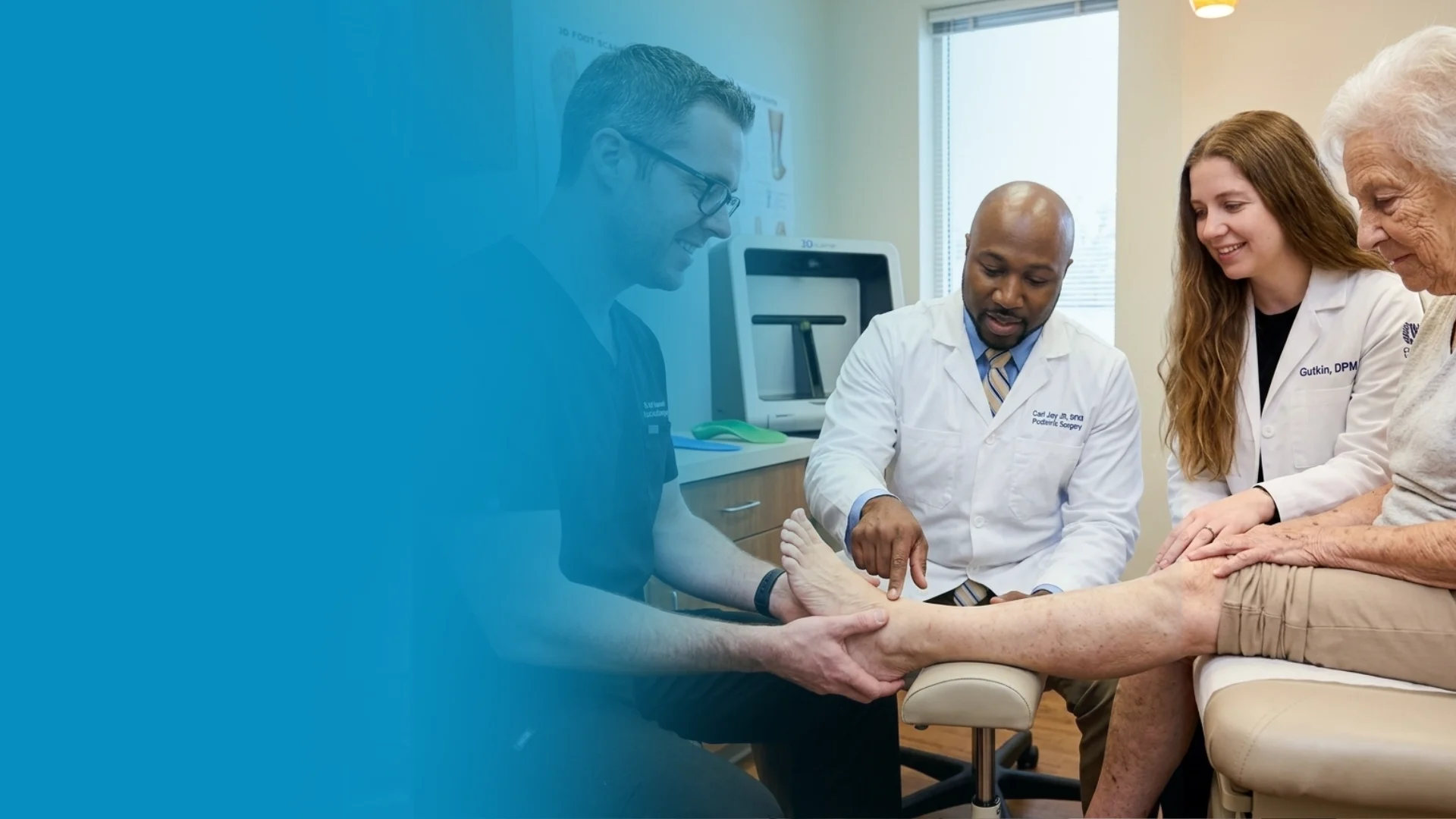
If home care isn’t resolving your your foot or ankle concern, a visit with a board-certified podiatrist is the fastest path to accurate diagnosis and a personalized plan. At Balance Foot & Ankle Specialists, Dr. Tom Biernacki, Dr. Carl Jay, and Dr. Daria Gutkin offer appointments at both our Howell and Bloomfield Township offices. We perform on-site diagnostic ultrasound, digital X-ray, conservative care, advanced regenerative treatments, and minimally invasive surgery when indicated.
Call (810) 206-1402 or request an appointment online. Most insurance plans accepted, including Medicare, Blue Cross Blue Shield, Aetna, Cigna, and United Healthcare.
Most Common Mistake We See
The most common mistake we see is: Waiting too long before seeking care. Fix: any foot pain lasting more than 4 weeks, or any sudden severe symptom, deserves a professional evaluation rather than more rest.
Warning Signs That Need Same-Day Care
Seek immediate evaluation at Balance Foot & Ankle if you experience any of the following:
- Unable to bear weight
- Severe swelling with skin colour change
- Fever with foot pain (possible infection)
- Diabetes plus any new foot symptom
Call (810) 206-1402 — appointments at our Howell and Bloomfield Township offices.
Pros & Cons of Conservative Care for foot care
Advantages
- ✓ Conservative care first
- ✓ Appointments
- ✓ Multiple insurance accepted
Considerations
- ✗ Self-treatment can mask issues
- ✗ See a podiatrist if pain >2 weeks
In This Article
Dr. Tom’s Recommended Products for foot care
Affiliate disclosure: As an Amazon Associate, Balance Foot & Ankle earns from qualifying purchases. We only recommend products we use with patients.
Footnanny Heel Cream Dr. Tom’s Pick
Best for: Daily moisturizer for cracked heels
Ready to Get Back on Your Feet?
Appointments in Howell + Bloomfield Township. Most insurance accepted. Dr. Tom Biernacki, DPM & team.
Book Today — Online Booking 24/7 Available
Call Now: (810) 206-1402
About Your Care Team at Balance Foot & Ankle
Dr. Tom Biernacki, DPM · Board-Certified Foot & Ankle Surgeon. Specializes in conservative-first care, minimally invasive bunion surgery, and complex reconstruction.
Dr. Carl Jay, DPM · Accepting new patients. Specializes in sports medicine, athletic injuries, and routine podiatric care.
Dr. Daria Gutkin, DPM, AACFAS · Accepting new patients. Specializes in surgical reconstruction and pediatric podiatry.
Locations: 4330 E Grand River Ave, Howell, MI 48843 · 43494 Woodward Ave Suite 208, Bloomfield Township, MI 48302
Hours: Mon–Fri 8:00 AM – 5:00 PM · (810) 206-1402
Ready for Expert Care?
Appointments in Howell & Bloomfield Township, MI.
4.9★ | 1,123 Reviews | 3,000+ Surgeries
Or call: (810) 206-1402
