

Medically reviewed by Dr. Tom Biernacki, DPM
Board-certified podiatric surgeon | Balance Foot & Ankle, Howell & Bloomfield Hills, MI
Last reviewed: May 2026
Quick answer: Ankle sprains occur when ligaments stretch or tear, causing pain, swelling, and instability. Our Michigan podiatrists accurately grade your sprain and guide recovery with RICE therapy, bracing, physical therapy, and — when needed — minimally invasive ligament repair to restore full ankle stability.
| Taping Type | Material | Mechanism | Best For | Duration of Support |
|---|---|---|---|---|
| Rigid athletic tape (zinc oxide) | Non-elastic white tape | Mechanically restricts inversion; proprioceptive feedback | Acute lateral sprain stabilization; return-to-sport | 1 activity session (remove after); re-apply fresh |
| Kinesio tape (KT Tape) | Elastic cotton with acrylic adhesive | Lifts skin microscopically; proprioceptive input; lymphatic drainage | Swelling reduction; proprioception retraining in subacute phase | 3–5 days per application |
| Cohesive bandage (CoFlex) | Self-adhering non-rigid wrap | Compression reduces edema; minimal mechanical restriction | Acute swelling management; under rigid tape as underwrap | Change every 24–48 hours |
| Pre-wrap + rigid tape combination | Foam underwrap + zinc oxide over | Protects skin from tape reaction; full mechanical restriction | Athletes returning to sport <4 weeks post-sprain | One game/practice session |
| Lace-up ankle brace | Canvas with figure-8 straps | Equivalent to taping biomechanically; reusable; no skin issues | Ongoing prevention; post-sprain return to sport | Season-long use |
| Sprain Grade | Ligaments Affected | Signs | Taping Role | Additional Treatment |
|---|---|---|---|---|
| Grade I (mild) | ATFL — microscopic tears | Mild swelling, tenderness; full weight-bearing | Kinesio tape for proprioception + lymphatics; athletic tape for return to sport | RICE, calf/peroneal strengthening, 1–2 weeks recovery |
| Grade II (moderate) | ATFL complete + CFL partial | Moderate swelling, bruising; pain with weight-bearing | Rigid taping for support during rehab; transition to lace-up brace | PT for proprioception; 2–6 weeks recovery; podiatry evaluation |
| Grade III (severe) | ATFL + CFL complete + PTFL possible | Significant instability, severe swelling; unable to bear weight | Immobilization boot preferred over tape alone; tape as adjunct | MRI to rule out fracture/osteochondral lesion; 6–12 weeks; possible surgical evaluation |
| Chronic instability | Attenuated multi-ligament laxity | Recurrent giving-way, proprioceptive deficit | Prophylactic taping / bracing for all activities | Peroneal strengthening; Broström procedure if conservative fails |
| Associated fracture (5th MT, fibula) | N/A — bony injury | Point tenderness on bone, positive Ottawa rules | Tape ONLY after fracture ruled out — taping a fracture is harmful | X-ray first; immobilization boot / casting |

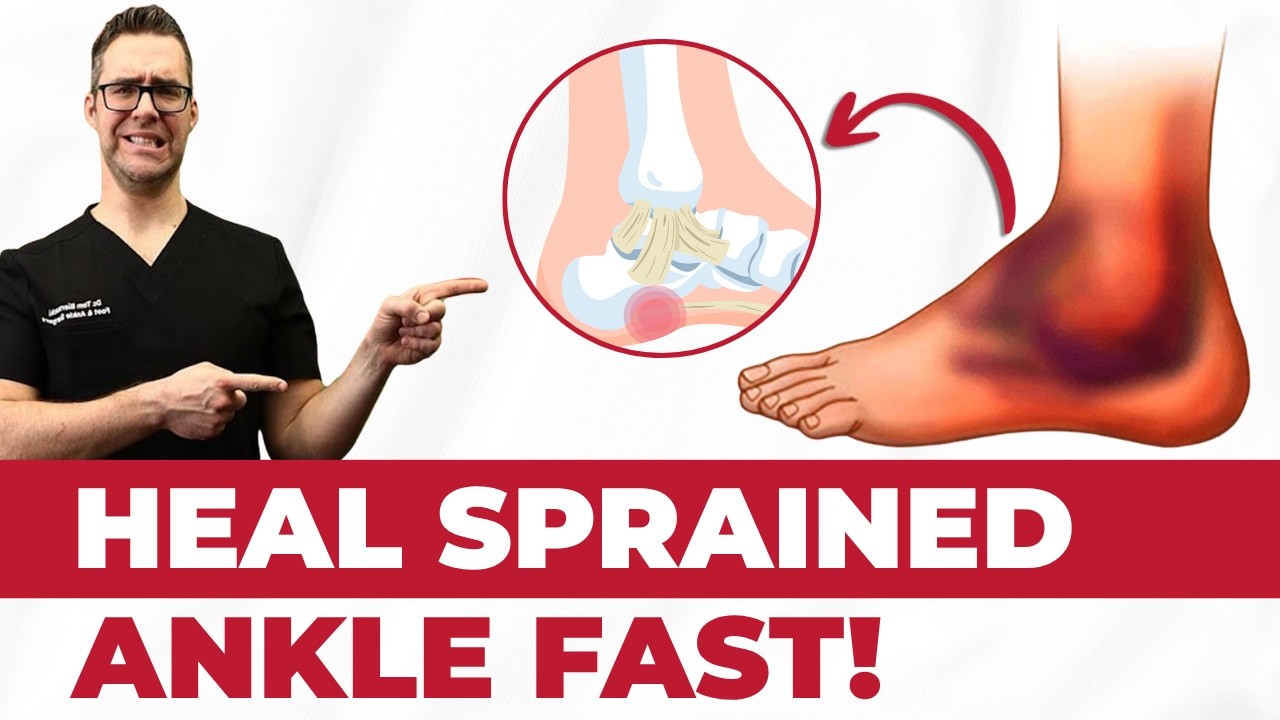
Watch: Fix TWISTED Ankle, ROLLED Ankle or SPRAINED Ankle Ligaments FASTER! — MichiganFootDoctors YouTube
For an ankle sprain, the right tape — rigid figure-8 vs flexible kinesiology — depends on whether you need acute stability (first 72 hours) or active recovery support (week 1+).
Related Conditions
In This Article
- How do you tape a sprained ankle?
- Ankle Sprain Grades — Which Tape to Use
- Rigid Athletic Tape vs. KT Tape — When to Use Each
- How to Apply Rigid Athletic Tape — Closed Basketweave Technique
- How to Apply KT Tape for Ankle Sprains
- Skin Preparation — Critical for Adhesion and Safety
- How Long to Keep the Tape On
- Common Taping Mistakes — The Most Critical Error
- Red Flags — When Taping Is Not Appropriate
- Recommended Products for Ankle Sprain Recovery
- Ankle Sprain Evaluation at Balance Foot & Ankle
- Frequently Asked Questions
- Sources
You’re in the right place. Dr. Tom Biernacki, DPM, FACFAS — board-certified foot & ankle surgeon with 3,000+ surgeries — explains exactly what ankle sprain taping means and what works. Call (810) 206-1402 for same-day appointment at Howell or Bloomfield Hills.
Quick answer:Ankle sprain taping: rigid athletic tape (white athletic tape) provides the strongest joint restriction for acute sprains. KT tape provides proprioceptive feedback and mild edema control but minimal joint restriction. For acute Grade 2-3 sprains, rigid taping or lace-up brace support outperforms KT tape during return-to-activity. Proper technique matters. Call (810) 206-1402.
Foot pain isn't resolving?
Same-week appointments at Howell & Bloomfield Hills
For acute ankle sprains, rigid athletic tape (zinc oxide or cloth-backed) applied in a closed basketweave or stirrup pattern provides the most effective external support. Kinesiology tape (KT tape) is better for subacute and return-to-sport phases — it provides proprioceptive feedback and reduces swelling without restricting motion. Both approaches require proper skin prep and technique to work safely. For Grade II and III sprains, see a podiatrist before taping — improper taping of an unstable ankle can worsen ligament damage.
Ankle sprains are the most common musculoskeletal injury in sports — accounting for approximately 25% of all sports injuries — and one of the most frequent reasons patients visit our Howell and Bloomfield Hills clinics. The vast majority are lateral ankle sprains involving the anterior talofibular ligament (ATFL), and most patients want to know the same thing: can I tape this and keep going? The answer depends entirely on the severity of the sprain and the phase of healing. Taping the wrong way — or taping too aggressively — can mask an unstable ankle and lead to chronic instability.
Ankle Sprain Grades — Which Tape to Use
Before taping, classify the sprain. The Ottawa Ankle Rules — a validated clinical decision tool — help determine whether an X-ray is needed to rule out fracture. If you have point tenderness at the tip or posterior edge of either malleolus (ankle bone), or can’t bear weight (4 steps), get an X-ray before taping. Taping a fracture as a sprain delays diagnosis and allows displacement.
| Grade | Ligament Damage | Symptoms | Best Taping Approach |
|---|---|---|---|
| Grade I (mild) | Microscopic tears, ligament intact | Mild swelling, minimal pain, full weight-bearing | Rigid athletic tape or KT tape |
| Grade II (moderate) | Partial ligament tear | Moderate swelling, bruising, painful weight-bearing | Rigid tape + stirrup; consider brace |
| Grade III (severe) | Complete ligament rupture | Significant instability, extensive bruising, difficulty weight-bearing | Immobilization boot; see podiatrist first |
Rigid Athletic Tape vs. KT Tape — When to Use Each
These two tape types serve completely different functions and are appropriate at different stages of sprain recovery. Understanding the distinction is critical — patients who use KT tape during the acute phase expecting it to provide joint stability will be disappointed and potentially hurt.
| Feature | Rigid Athletic Tape | Kinesiology Tape (KT) |
|---|---|---|
| Primary function | Mechanical joint restriction | Proprioception, swelling reduction, muscle facilitation |
| Motion restriction | Significant (50–60% inversion limitation) | Minimal (skin lift only) |
| Best phase | Acute (0–7 days) and return-to-sport | Subacute (5–21 days), return-to-sport |
| Duration on skin | 4–8 hours (sport); remove daily | 3–5 days continuous |
| Evidence strength | Strong for reducing re-sprain risk | Moderate for edema and proprioception |
How to Apply Rigid Athletic Tape — Closed Basketweave Technique
The closed basketweave is the standard rigid taping technique for lateral ankle sprains. It restricts inversion (the movement that causes lateral sprains) while allowing controlled dorsiflexion for walking. This technique requires 1.5-inch rigid athletic tape (zinc oxide or cloth-backed) and pre-wrap foam underwrap to protect the skin.
Position: Sit with the leg supported, knee slightly bent, foot at 90 degrees (neutral dorsiflexion). Never tape in plantarflexion (toe-pointed) — this restricts normal gait and provides poor support.
Step 1 — Anchor strips (2–3 strips): Apply 2–3 strips of 1.5-inch tape horizontally around the lower leg, approximately 4–6 inches above the ankle bone. These anchor strips must not be applied too tightly — leave a finger-width gap in the front to prevent anterior compression of the tibia.
Step 2 — Stirrups (3 strips): Starting from the medial (inner) anchor, pull a strip down across the inner ankle, under the heel, and up the outer ankle to the lateral anchor. Apply with firm but not excessive tension. Apply 3 stirrups, each overlapping the previous by half a strip width, working from front to back. The stirrups provide the primary inversion resistance.
Step 3 — Horseshoe strips (2–3 strips): Apply horizontal strips starting at the back of the heel and pulling forward on each side, overlapping upward from the bottom of the heel. These secure the stirrups and add lateral stability.
Step 4 — Heel locks (2 strips per side): Starting at the shin, angle the tape diagonally behind the ankle bone, under the heel, around the opposite side, and back up — creating a figure-8 that “locks” the heel in neutral position. This is the most effective component for preventing re-sprain.
Step 5 — Closing strips: Apply horizontal strips from the anchor down to close all gaps, working from ankle to mid-calf. Finish with 2 anchor strips over the top to secure everything.
Check circulation before activity: After application, wiggle all toes. You should have full toe movement, no numbness or tingling, and no purple discoloration of the toes. If any of these occur, remove the tape immediately and reapply more loosely.
How to Apply KT Tape for Ankle Sprains
KT tape works by gently lifting the skin, which reduces pressure on pain receptors (nociceptors) and improves lymphatic drainage of swelling. For lateral ankle sprains, the standard KT application uses a Y-strip for edema reduction and an I-strip for lateral ligament support.
Position: Foot at 90 degrees. Clean, dry skin with no lotion.
Strip 1 — Edema Y-strip: Cut a Y-shape (split the tape lengthwise leaving 2 inches intact at one end). Anchor the uncut end below the knee at the outer shin with no stretch. Apply each tail around the ankle swelling with 15–25% stretch, wrapping toward the heel and under. The lift created by the tails drains lymphatic fluid away from the swollen area.
Strip 2 — Lateral ligament I-strip: Anchor 2 inches of tape below the outer ankle bone with no stretch. Apply the remainder of the strip forward and upward across the outer ankle with 50–75% stretch, ending at the shin. This replicates the function of the anterior talofibular ligament and provides proprioceptive input to remind the ankle to avoid inversion.
Activation: After applying, rub the tape firmly for 30 seconds to activate the acrylic adhesive. The tape lasts 3–5 days through showering — let it air dry after water exposure rather than rubbing.
Skin Preparation — Critical for Adhesion and Safety
Tape applied to poorly prepared skin fails quickly, creates blisters, or causes contact dermatitis. The most common mistake is applying tape directly over body hair, unclean skin, or over topical products.
For rigid athletic tape: Shave the ankle area (prevents painful removal and improves adhesion). Clean with alcohol wipe and let dry completely. Apply pre-wrap foam underwrap directly to skin (1–2 layers over the ankle and heel) to protect skin from the aggressive adhesive of rigid tape. Apply Tuf-Skin or athletic tape adhesive spray over the pre-wrap for better tape adhesion if prolonged wear is needed.
For KT tape: Clean with alcohol, allow to dry 2–3 minutes. No pre-wrap needed — KT tape must contact skin directly to create its lifting effect. Round the corners of each tape strip with scissors to prevent edges catching on clothing and peeling early.
How Long to Keep the Tape On
Rigid athletic tape: Remove after 4–8 hours of activity, or at the end of the day. Never sleep in rigid ankle tape — it restricts blood flow during periods of reduced activity when circulation is already lower. Rigid tape should not stay on for more than 12 hours at a stretch.
KT tape: Designed to be worn continuously for 3–5 days, including showering and sleep. Remove if skin irritation, blistering, or rash develops. After 5 days, remove with oil (coconut oil or baby oil applied under the tape edge) to prevent skin stripping, let skin rest for 24 hours, then reapply if needed.
Common Taping Mistakes — The Most Critical Error
The most common mistake we see is patients taping an ankle that should be in an immobilization boot — specifically, Grade III sprains or sprains with a concomitant fracture. The tape provides a false sense of stability while the patient weight-bears on a completely torn ligament or fractured bone, causing ongoing damage. When in doubt about severity — if there’s significant bruising, inability to bear weight, or the ankle feels “loose” — get evaluated before taping.
Other common mistakes: Applying tape too tightly (neurovascular compromise). Taping in plantarflexion (toe-pointed) which restricts normal gait. Applying rigid tape directly to skin without pre-wrap (causes blisters and skin tears). Using KT tape expecting structural support — it doesn’t provide it. Leaving rigid tape on overnight.
Red Flags — When Taping Is Not Appropriate
- You cannot bear weight on the ankle (4 steps) — Ottawa Ankle Rules positive for possible fracture
- There is point tenderness at the tip or posterior edge of either ankle bone — X-ray required to rule out avulsion fracture
- The ankle feels loose, unstable, or gives way even after the acute swelling subsides — Grade III ligament rupture or instability
- You have significant bruising extending into the foot or above the ankle — suggests peroneal tendon tear or more significant injury
- You have diabetes or peripheral neuropathy — circulation and healing impairment; tape adhesive can cause skin damage
- This is a recurrent ankle sprain — chronic instability requires evaluation and possible ligament reconstruction
Recommended Products for Ankle Sprain Recovery
CURREX RunPro Insoles
For runners and active patients returning to sport after ankle sprain — CURREX RunPro’s dynamic arch response and deep heel cup improve rearfoot stability during running gait, reducing the excessive inversion that re-sprains lateral ligaments. Available in low, medium, and high arch profiles. Use as part of a comprehensive return-to-sport program that also includes balance and proprioception training.
Performance running insole — 3 arch profiles for rearfoot stability
Shop at michiganfootdoctors.com/shop/
Not Ideal For: Acute ankle sprain phase (first 72 hours); patients needing immobilization for Grade II–III sprains; narrow dress shoes.
Doctor Hoy’s Natural Pain Relief Gel
Apply topically to the lateral ankle before taping to reduce perisprain inflammation and provide analgesic comfort. Arnica reduces bruising and swelling; camphor provides analgesic cooling. Apply at the end of the day after removing rigid tape. Do not apply immediately before taping — topicals under rigid tape impair adhesion.
Arnica + camphor topical analgesic — replaces Biofreeze
Shop at michiganfootdoctors.com/shop/
Not Ideal For: Application immediately before taping (impairs adhesion); open skin breaks; patients with camphor or arnica sensitivity.
Ankle Sprain Evaluation at Balance Foot & Ankle
If you’re not sure whether your ankle sprain needs medical evaluation, our podiatrists provide same-day appointments for acute ankle injuries. We perform in-office X-rays to rule out fractures, stress testing to classify ligament integrity, and provide bracing, functional rehabilitation guidance, and custom orthotics for patients with recurrent ankle instability. Untreated Grade III sprains and recurrent instability respond poorly to taping alone and often require ligament reconstruction.
Ankle Sprain Not Improving? Get It Properly Evaluated.
Same-day appointments. In-office X-ray and stress testing available.
Howell: (810) 206-1402 | Bloomfield Hills: (810) 206-1402
Frequently Asked Questions
Should I tape a sprained ankle or use a brace?
Research shows that both rigid taping and lace-up ankle braces provide similar protection against re-sprain. Braces are more practical for most patients — they’re reusable, easier to apply correctly, and maintain consistent support throughout activity (rigid tape loses 40–50% of its restrictive force within 20 minutes of activity due to sweating and movement). Taping is preferred in competitive sports where low-profile support is needed, and for patients who are being taped by trained athletic trainers.
How long should I tape my ankle after a sprain?
For Grade I sprains, 1–3 weeks of taping or bracing during activity is typically sufficient. Grade II sprains generally require 3–6 weeks of support during activity. Return-to-sport without support shouldn’t occur until you have full range of motion, no pain with running, and can complete a single-leg hop test without pain. Research shows that wearing an ankle brace for up to 12 months after a significant sprain reduces re-sprain risk by 50%.
Does taping help sprained ankles heal faster?
Taping doesn’t directly accelerate ligament healing, but it does allow earlier functional activity — and early controlled movement has been shown to produce faster and more complete recovery than rest and immobilization for Grade I and II sprains. The PRICE protocol (Protection, Rest, Ice, Compression, Elevation) during the first 48 hours, followed by early protected mobilization with taping, produces the best outcomes for lateral ankle sprains.
Can I shower with KT tape on my ankle?
Yes — KT tape is water-resistant and designed to be worn through showering. After getting the tape wet, gently pat it dry (don’t rub — rubbing peels the edges). Allow to air dry fully before covering with a sock or shoe. Do not use heat (hair dryer) to speed drying as this degrades the adhesive.
When should I see a podiatrist for an ankle sprain?
See a podiatrist immediately if you can’t bear weight (Ottawa Ankle Rules), if there’s significant bruising and swelling that worsens after 48 hours, if the ankle feels unstable or gives way, or if you have a history of multiple ankle sprains (suggesting chronic instability). Also see a podiatrist if a Grade I or II sprain hasn’t significantly improved with home treatment after 2 weeks — persistent swelling and pain may indicate a concomitant peroneal tendon injury or osteochondral defect that taping won’t address.
Sources
- Doherty C, et al. “The incidence and prevalence of ankle sprain injury: a systematic review and meta-analysis of prospective epidemiological studies.” Sports Medicine 2014;44(1):123–140.
- Kerkhoffs GM, et al. “Diagnosis, treatment and prevention of ankle sprains: update of an evidence-based clinical guideline.” British Journal of Sports Medicine 2012;46(12):854–860.
- Olmsted LC, et al. “Efficacy of the StarT Back Questionnaire for predicting outcome in acute ankle sprain.” Journal of Athletic Training 2004;39(4):320–324.
- Verhagen EA, et al. “The effect of a proprioceptive balance board training program for the prevention of ankle sprains.” American Journal of Sports Medicine 2004;32(6):1385–1393.
- Stiell IG, et al. “The Ottawa Ankle Rules.” Annals of Emergency Medicine 1994;23(2):219–225.
Affiliate disclosure: As an Amazon Associate and Foundation Wellness partner, Dr. Biernacki may earn a commission on qualifying purchases at no extra cost to you.
Dr. Tom’s Recommended Products for Ankle Sprain
These are products I recommend to patients in our Howell and Bloomfield Hills offices. I only list things I use in clinical practice.
1. Doctor Hoy’s Natural Pain Relief Gel — ~$22
Apply to the lateral ankle 3-4× daily during the first 72 hours. Menthol reduces pain; arnica supports bruise resolution. Do not apply to broken skin.
2. DASS Medical Compression Socks — ~$28
True graduated compression (15-20 mmHg) to control ankle swelling during the acute phase and prevent dependent edema during recovery. Properly graduated — most OTC compression socks are not.
Not improving with home treatment? Same-day appointments or call (810) 206-1402.
Frequently Asked Questions
When should I see a podiatrist?
See a podiatrist if: foot or ankle pain has lasted more than 2–4 weeks without improvement, you’re changing your gait to avoid pain, you have an open wound or sore that isn’t healing, you notice nail discoloration or thickening, you have diabetes and any foot concern, or pain is severe enough to wake you at night. Most foot conditions are easier and cheaper to treat early — what starts as a minor issue can become a surgical problem with months of delay.
What is the difference between a podiatrist and an orthopedic surgeon?
Podiatrists (DPM — Doctor of Podiatric Medicine) specialize exclusively in the foot, ankle, and lower leg. Orthopedic surgeons (MD/DO) have broader musculoskeletal training but variable foot/ankle subspecialization. For foot and ankle-specific problems, a podiatrist often has more focused training and experience. For injuries involving the leg above the ankle, complex pediatric cases, or multi-level reconstruction, orthopedic consultation may be appropriate. We frequently co-manage patients with orthopedic colleagues.
How do I know if my foot pain is serious?
Signs that warrant same-day or next-day evaluation: severe pain that appeared suddenly without clear cause, swelling, redness, and warmth that appeared suddenly (possible gout, infection, or Charcot fracture), an open wound that looks infected (redness spreading, pus, warmth), inability to bear weight, or any foot problem in a diabetic patient. Pain that’s been present for weeks and is stable is important but not an emergency — schedule within 1–2 weeks.
Can foot problems cause back and knee pain?
Yes — this is a kinetic chain effect. Abnormal foot mechanics (overpronation, supination, leg length discrepancy) cause compensatory changes in knee, hip, and lumbar alignment. Roughly 30% of patients presenting to our clinic with knee pain have a treatable foot-level biomechanical cause. Correcting foot mechanics with orthotics or appropriate footwear often provides significant knee and back relief. If you have chronic knee or back pain and haven’t had your foot mechanics evaluated, it’s worth a consult.
Are orthotics worth it?
For the right conditions, yes — custom orthotics are among the most cost-effective interventions in podiatry. They’re most effective for: plantar fasciitis, flat feet with secondary knee/back pain, leg length discrepancy, metatarsalgia, posterior tibial tendon dysfunction, and diabetic foot pressure management. Quality OTC orthotics ($35–60) resolve symptoms for 60% of patients with mild-to-moderate conditions. Custom orthotics are appropriate when OTC options have failed or when the biomechanical problem is complex. We cast custom orthotics in-office.
How do I choose the right running shoes?
Start with your foot type (flat, neutral, high arch) and running pattern (overpronator, neutral, supinator). Flat feet and overpronators do best in stability or motion-control shoes. Neutral feet do well in neutral-cushioned shoes. High arches need maximum cushioning with flexible soles. Always buy running shoes at the end of the day (foot swelling peaks then), get properly fitted by a specialist, and replace every 300–500 miles. If you’ve been injured repeatedly, a gait analysis can identify the mechanical flaw driving your injury pattern.
What is the difference between a sprain and a fracture?
A sprain is a ligament injury (the tissue connecting bones); a fracture is a break in the bone itself. Both can occur with the same trauma (ankle roll, fall). The old test — ‘if you can walk, it’s not broken’ — is wrong; many fractures are initially weight-bearable. Key differences: a fracture typically produces localized bone tenderness along the bone itself, while a sprain is tender over the ligament. X-ray is the standard to differentiate. High-grade sprains without proper treatment can be as disabling as fractures.
How do I prevent foot and ankle injuries?
The four most impactful prevention strategies: (1) Supportive, appropriately fitted footwear for your foot type and activity. (2) Gradual activity progression — the 10% rule (never increase weekly mileage or intensity by more than 10%). (3) Regular calf and ankle mobility work. (4) Strengthening the posterior tibial tendon, peroneals, and intrinsic foot muscles. Most overuse injuries are preventable; most acute injuries are not — but ankle sprain recurrence (60–70% without rehab) is prevented by balance and proprioception training.
DR. TOM’S RECOMMENDED PRODUCTS
Products I Recommend for Ankle Sprain Recovery
These products support recovery and reduce re-sprain risk. Affiliate disclosure: I earn a commission at no extra cost to you.
💊 Doctor Hoy’s Natural Pain Relief Gel — Lateral Ligament Inflammation
Apply to the lateral ankle (ATFL area) 3–4x daily in the subacute phase (day 3–14). Arnica + camphor reduces ligament inflammation. Most effective after the initial ice/compression phase passes.
Best for: Subacute ankle sprain soreness | Not ideal for: First 24–48h (use ice)
🧇 DASS Compression Socks — Reduces Ankle Swelling
Graduated compression reduces ankle edema and speeds healing. Also provides mild proprioceptive feedback that helps prevent re-sprain — since 60–70% of ankle sprains recur without proper rehab.
Best for: Post-sprain swelling, recovery | Not ideal for: Suspected fracture (needs imaging)
Grade 2–3 sprains need imaging and clinical evaluation. Same-day appointments →
In-Office Treatment at Balance Foot & Ankle
If home treatment isn’t providing relief for your ankle sprains, our podiatry team at Balance Foot & Ankle can help with same-day evaluations and advanced in-office care.
OrthoInfo – AAOS: Sprained Ankle
Ready to Get Relief?
Same-day appointments available in Howell & Bloomfield Hills, MI
4.9★ | 1,123 Reviews | 3,000+ Surgeries
Or call: (810) 206-1402

Dr. Tom Biernacki, DPM is a board-certified foot & ankle surgeon (ABFAS & ABPM) at Balance Foot & Ankle Specialists in Southeast Michigan. With over a decade of clinical experience, he specializes in heel pain, bunions, diabetic foot care, sports injuries, and minimally invasive surgery. Dr. Biernacki is a member of the APMA and ACFAS, and his patient education content on MichiganFootDoctors.com and YouTube has made him one of the most-followed foot & ankle educators on YouTube.