
Medically reviewed by Dr. Tom Biernacki, DPM
Board-certified podiatric surgeon | Balance Foot & Ankle
Last reviewed: May 2026


Medically reviewed by Dr. Tom Biernacki, DPM — Board-certified foot & ankle surgeon, 3,000+ surgeries performed. Updated April 2026 with current clinical evidence. This article reflects real practice experience from Balance Foot & Ankle Specialists in Howell and Bloomfield Hills, Michigan.
Quick Answer
Most foot and ankle problems respond to conservative care — proper footwear, supportive inserts, activity modification, and targeted stretching — within 4-8 weeks. Persistent pain beyond that window, or any symptom that prevents walking, warrants a podiatric evaluation to rule out fracture, tendon tear, or systemic cause.
Watch: Dr. Tom Biernacki, DPM
Pros and Cons of Big Toe Joint Fusion [The Best Big Toe Joint Surgery?]
Pros and Cons of Big Toe Joint Fusion: It is a bigger and more final procedure, but it is usually the only bunion surgery that you will EVER need! Look:- Big toe joint pain can sometimes be improved without surgery.
- We are foot doctors & we see this problem get better almost every day.
- The goal is to solve this problem without medication or surgery if possible.
Should I get a big toe joint fusion video?
![6 Best Bunion Surgery Pros & Cons [Get the FASTEST Recovery Time]](https://www.michiganfootdoctors.com/wp-content/cache/flying-press/66d15a1ad4778385b67cc4a855ce446b.jpg)
Causes of big toe joint pain:
Pros and Cons of Big Toe Joint Fusion Overview:- This is the most predictable procedure available for foot and ankle surgery.
- This is reliable and essential ensures you will only need one surgery in your life if all goes well. The downside is that it is very permanent, and you will no longer have motion in the joint.
Pros and Cons of Big Toe Joint Fusion:
The big toe joint fusion is recognized as the “most permanent and satisfactory correction of hallux valgus(bunion).” Numerous studies have indicated that this is the most predictable and effective surgery for any big toe joint deformity or arthritis.
Pros of Big Toe Joint Fusion:
- Better long-term results and happiness.
- More stable.
- Better push-off strength.
- It will not shorten over time like an arthroplasty might(more chronic arthritis will develop).
- Long-term durability.
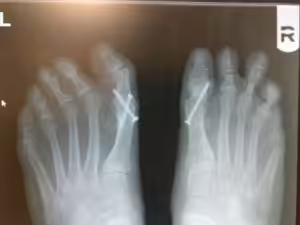
Cons of Big Toe Joint Fusion:
- Longer recovery time.
- No joint motion means fewer shoe options.
- The shorter bone may mean less contact to the floor(more pressure on the 2nd metatarsophalangeal joint).
- No going back unless you get more surgery.

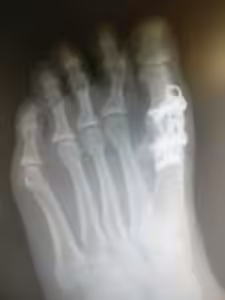
Primarily used for Hallux Abducto Valgus and Hallux Limitus:
- The big toe fusion is called a McKeever bunionectomy.
- It is primarily used for both severe hallux abducto valgus deformities(bunions) and stiff big toe joints due to osteoarthritis.
- Big toe joint arthritis is termed hallux limitus and hallux rigidus.
Secondarily used for Repair of Failed Surgeries.
- The big toe fusion is secondarily used to repair severe/recurrent surgeries.
- This is a favorite procedure of ours!
- Hallux abducto valgus.
- Failed implant joint arthroplasty (remodeling)
- Hallux varus.
- Primary first MPJ osteoarthritis.
- Post-traumatic arthritis.
- Inflammatory and septic arthritis and various other neuromuscular conditions.

People are Usually Very Happy with the Operation
- An appropriately fused big toe joint has shown to have the greatest long-term patient happiness.
- This happiness regarding no further recurrence, a pain standpoint, and a functionality standpoint.
- It seems that the only problem is the psychology behind telling a patient that their joint will be fused, and they expect that it is much worse than it really is.
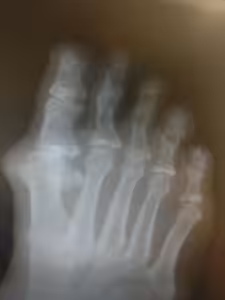
Should I Remodel the Joint or Fuse the Big Toe?
- The big toe joint fusion has the benefit of locking the toe in the proper position and removing pain in the joint.
- The big toe joint arthroplasty (remodeling) procedure is beneficial when the position is not a big problem, such as in a straight joint with a mild amount of joint damage.
- An arthroplasty procedure is also beneficial because it allows for more types of shoes to be worn.
- The benefit of the big toe joint fusion (arthrodesis) is that you will have a greater degree of push-off strength in the joint.
- It essentially guaranteed prevention of future pain and improper positioning if all goes well with the surgery.
- The arthroplasty has a quicker healing time but weaker push-off strength (less of a problem if the patient is already not walking very much).
- More stable, Better push-off strength, Better long-term results, and happiness will not shorten over time like an arthroplasty might(more chronic arthritis will develop).
- Longer recovery time, No joint motion means fewer shoe options. The shorter bone may mean less contact to the floor(more pressure on the 2nd metatarsophalangeal joint).

Who should Avoid Big Toe Fusion
- People who need to kneel and bend should choose an arthroplasty over fusion. Bowlers and carpet layers need to bend their big toe joints every day. People like this should avoid it.
- People who cannot tolerate being immobilized in a boot for an extended period of time(cast or CAM Walker).
- Anyone who plans to wear heels larger than 1″ tall. This will basically cause you to develop a hallux rigidus as the big toe will press against the floor in its fused position, causing a callus to form on the inside of the big toe.
Big Toe Fusion Operation:
- A detailed guide on the principles of the surgery and how the podiatrist performs it.
Big Toe Fusion Recovery Time :
- A rough estimate on how long it will take for your joint to fuse and what you can do to speed that up.
Big Toe Fusion Complications:
- Nonunion and mal-position are the two major complications.
- Nonunion can be prevented by proper fenestration and ensuring that the patient does not have any systemic problems such as smoking or diabetes.
- If this does occur, the painful non-union will need to be excised and then filled in with a bone graft.
Bone Spur on Top of the Foot Surgery Recovery Time Protocol:
This guide will detail the length of specific step-by-step bone spur surgery recovery times.Day 1: Top of the Foot Spur Removal Surgery Day:
- The actual surgery takes well under an hour, and your foot is usually numbed up for the rest of the day.
- Some people don’t need much if any pain medication outside of anti-inflammatories.
- If you do have pain at this site, it is normal to have a prescription for narcotic pain medication immediately after the surgery.
- After surgery, you will wake up with a dressing on your foot. Keep this dressing in place, and your pain will be well under control with medication.
- No implants or bone healing is necessary, except for the healing of bone pain.
- You can wear a boot over your dressing almost immediately.
- Most physically able people do not need crutches or a walker unless they have other health issues.
- Usually, there are about 2 sutures in the foot.
Day 7: Top of the Foot Bone Spur Removal Surgery Postoperative Visit #1:
- Within about a week, we have the first postoperative visit.
- You will have an X-ray at this visit, and we will make sure there is no irritation or damage to your dressing.
- With this dressing change, some antibiotic ointment is applied. We make sure you are not having any problems at this time.
- Sutures are not removed yet at this visit.
Week 2-3: Top of the Foot Bone Spur Removal Surgery Postoperative Visit #2:
- This can fluctuate depending on your overall health needs, physical fitness, and life needs.
- If you can rest more, weigh less, and are really healthy, sutures can usually come out at 2 weeks. Some patients need to walk and be more active. If this is the case, you will likely need sutures longer and have a larger dressing.
- If you swell more and are more tender, they can stay in a little bit longer.
- If you are a smoker or have decreased healing ability, we may need to keep your sutures in place longer.
- At this point, your incision site should be healed.
- At this point, you will wear a band-aid for 2 weeks and walk in a good supportive running shoe.
Week 5: Postoperative Visit #3:
- This is what the incision site will look like after the sutures are removed at 2-3 weeks or so.
- If everything looks good, you no longer need to wear a band-aid.
- At this point, you will still be sore but can transition back into more normal function.
2 Months: Postoperative Visit #4:
- At this point, you continue wearing a good supportive orthotic and good shoe.
- If everything is feeling well, you should be close to healed.
- Keep in mind that you will continue improving for about 6 months total.
- But you should be feeling better at this point than you did prior to when you have a heel spur.
Treatment algorithm for bunion surgery:
- Find out if a different procedure is best for you.
- A metatarsal joint fusion may not always be worth it.
- Many times other procedures are just as effective, and the healing time can be much quicker.
Big Toe Joint Home Treatment:
- If you have read the above causes and symptoms and are confident that you have big toe joint arthritis, then the below might be a good idea to look through.
- If you are considering big toe joint fusion, these options may be something to consider before surgery.
Injections:
- We would recommend doing this at home, but a doctor can help you with this.
- If you do have severe pain that is really preventing you from doing anything, this may be an option in the right circumstances.
Medications:
- Anti-inflammatory medications could be good, but we do not recommend this as a long-term solution.
- Focus on the orthotics in the shoes.
- If you have tried all the above stuff, and a couple of months have gone by, and you have not started to improve at all, then further and imaging like ultrasound, x-ray, or MRI might make sense.
- If you have long-term permanent damage to the big toe, especially if it has been going on for over 6 to 12 months, then you may need surgery.
- Bunion surgery has its benefits, but any surgery may have its negatives.
- Make sure to check with a podiatrist to see if you qualify. You may be one of the 10% for whom it may be a great idea!
Related Treatment Guides
📧 Get Dr. Tom’s Free Lab Test Guide
Discover the 5 lab tests every person over 35 should ask their doctor about — explained in plain English by a board-certified physician.
📍 Located in Michigan?
Our board-certified podiatrists treat this condition at two convenient locations. Same-day appointments often available.
Exploring Big Toe Joint Fusion Options?
Big toe joint fusion provides lasting pain relief for severe arthritis. Our board-certified podiatric surgeons offer the latest fixation techniques for optimal outcomes and faster recovery.
📞 Or call us directly: (810) 206-1402
Clinical References
- McNeil DS, Baumhauer JF, Glazebrook MA. Evidence-based analysis of the efficacy for operative treatment of hallux rigidus. Foot and Ankle International. 2013;34(1):15-32.
- Hyer CF, Glover JP, Berlet GC, Lee TH. Cost comparison of crossed screws versus dorsal plate construct for first metatarsophalangeal joint arthrodesis. Journal of Foot and Ankle Surgery. 2008;47(1):13-17.
- Coughlin MJ, Grebing BR, Jones CP. Arthrodesis of the first metatarsophalangeal joint for idiopathic hallux valgus. Foot and Ankle International. 2005;26(10):783-792.
If home care isn’t resolving your your foot or ankle concern, a visit with a board-certified podiatrist is the fastest path to accurate diagnosis and a personalized plan. At Balance Foot & Ankle Specialists, Dr. Tom Biernacki, Dr. Carl Jay, and Dr. Daria Gutkin offer same-day and next-day appointments at both our Howell and Bloomfield Hills offices. We perform on-site diagnostic ultrasound, digital X-ray, conservative care, advanced regenerative treatments, and minimally invasive surgery when indicated.
Call (810) 206-1402 or request an appointment online. Most insurance plans accepted, including Medicare, Blue Cross Blue Shield, Aetna, Cigna, and United Healthcare.
Managing Big Toe Pain Before and After Surgery
- PowerStep Pinnacle — Stiff sole + arch support offloads the 1st MTP joint. Buys time before or assists recovery after fusion.
- Doctor Hoy’s Natural Pain Relief Gel — Post-op pain management: natural arnica + camphor topical. Discuss with your surgeon before use post-fusion.
- Plantar Fasciitis Compression Socks — Post-surgical compression reduces swelling in the forefoot during early recovery.
Hallux rigidus or severe bunion arthritis? Learn about our Hallux Rigidus treatment options — not every case requires fusion. (810) 206-1402
Frequently Asked Questions
When should I see a podiatrist?
If symptoms persist past 2 weeks, affect your normal activity, or are accompanied by red-flag symptoms (warmth, redness, swelling, inability to bear weight).
What does treatment cost?
Most diagnostic visits and conservative treatments are covered by Medicare and major insurers. Out-of-pocket costs vary by your specific plan.
How quickly can I get an appointment?
Most non-urgent cases see us within 5 business days. Urgent cases (sudden pain, possible fracture) typically same or next business day.
What is Foot pain?
Foot pain is a common foot/ankle condition that affects mobility and quality of life. Understanding the underlying cause is the first step in successful treatment. Our podiatrists at Balance Foot & Ankle perform a hands-on biomechanical exam, review your activity history, and use diagnostic imaging when appropriate to identify the root cause—not just treat the symptom. Many patients have been told to “rest and ice” without a deeper diagnostic workup; our approach is different.
Symptoms and warning signs
Common signs of foot pain include pain that worsens with activity, morning stiffness, swelling, tenderness when palpated, and difficulty bearing weight. If you experience sudden severe pain, inability to walk, visible deformity, numbness or color change, contact our office the same day or visit urgent care—these can signal a more serious injury such as a fracture, tendon rupture, or vascular compromise. Diabetics with any foot wound should seek same-day care.
Conservative treatment options
Most cases of foot pain respond to non-surgical care: structured rest, supportive footwear changes, custom orthotics, targeted stretching and strengthening protocols, anti-inflammatory medications when medically appropriate, and in-office procedures such as ultrasound-guided injections. We also offer advanced therapies including MLS laser therapy, EPAT/shockwave, regenerative injections, and image-guided procedures. Treatment is sequenced from least invasive to most invasive, and we explain the rationale at every step.
When is surgery considered?
Surgery is reserved for cases that fail 3-6 months of well-structured conservative care, when there is structural pathology (severe deformity, complete tear, advanced arthritis), or when imaging shows damage that will not heal without intervention. Our surgeons have performed 3,000+ foot and ankle procedures and prioritize minimally-invasive techniques whenever appropriate. We discuss recovery timelines, return-to-activity milestones, and realistic outcome expectations before any procedure is scheduled.
Recovery timeline and prevention
Recovery from foot pain varies based on severity and chosen treatment path. Conservative cases often improve within 4-8 weeks with consistent adherence to the protocol. Post-procedural recovery may range from a few days (in-office procedures) to several months (reconstructive surgery). Long-term prevention involves footwear assessment, activity modification, structured strengthening, and regular check-ins with your podiatrist if you have a history of recurrence. We provide written home-exercise plans and digital follow-up support.
Ready to Get Relief?
Same-day appointments available in Howell & Bloomfield Hills, MI
4.9★ | 1,123 Reviews | 3,000+ Surgeries
Or call: (810) 206-1402

Dr. Tom Biernacki, DPM is a board-certified foot & ankle surgeon (ABFAS & ABPM) at Balance Foot & Ankle Specialists in Southeast Michigan. With over a decade of clinical experience, he specializes in heel pain, bunions, diabetic foot care, sports injuries, and minimally invasive surgery. Dr. Biernacki is a member of the APMA and ACFAS, and his patient education content on MichiganFootDoctors.com and YouTube has made him one of the most-followed foot & ankle educators on YouTube.