Board Certified Podiatrists | Expert Foot & Ankle Care
(810) 206-1402 Patient Portal

Cheilectomy Surgery for Hallux Rigidus: Removing Bone Spurs to Restore Big Toe Motion

Quick answer: Cheilectomy Surgery Hallux Rigidus Bone Spurs Big Toe is a common foot/ankle topic that affects many patients. The 2026 evidence-based approach combines proper diagnosis, conservative-first treatment, and escalation only when needed. We treat this regularly at our Howell and Bloomfield Hills practices. Call (810) 206-1402.

Medically reviewed by Dr. Tom Biernacki, DPM — Board-Certified Podiatric Surgeon — Balance Foot & Ankle, Howell & Bloomfield Hills, MI. Last updated April 2026.

▶ Watch

YouTube video

Medically Reviewed by Dr. Tom Biernacki, DPM · Board-Certified Podiatric Surgeon · Balance Foot & Ankle Specialists

Last Updated: April 2026 · Reading Time: 7 min

MICHIGAN PODIATRIST INSIGHT

The most important clinical decision with Cheilectomy Surgery Hallux Rigidus Bone Spurs Big Toe isn’t which treatment to start with — it’s which subtype or underlying cause you actually have. That distinction changes everything. Call us: (810) 206-1402

What Is Cheilectomy?

Cheilectomy — from the Greek word for “lip excision” — is a surgical procedure that removes the dorsal osteophytes (bone spurs) that accumulate on the top of the first metatarsal head and the base of the proximal phalanx in hallux rigidus, the arthritic condition of the big toe joint. By removing these osteophytes, the surgery restores the range of dorsiflexion motion that is blocked by their presence, relieving the pain that occurs when the toe is forced upward during push-off in walking, running, and stair climbing.

At Balance Foot & Ankle, cheilectomy is performed as a joint-preserving procedure for patients with mild to moderate hallux rigidus — grades 1 and 2 of the four-grade classification system. Patients with end-stage hallux rigidus (grade 3 to 4 with severely narrowed joint space and diffuse cartilage loss) are more appropriately treated with first MTP joint fusion (arthrodesis), which provides more reliable long-term pain relief when the articular surface is globally destroyed.

What Causes the Bone Spurs of Hallux Rigidus?

Hallux rigidus is degenerative arthritis of the first metatarsophalangeal joint, caused by cartilage breakdown at the joint surface. As articular cartilage deteriorates, the body responds by forming bone spurs — osteophytes — at the margins of the joint. On the dorsal (top) surface of the first metatarsal head, these spurs grow directly into the path of the extensor tendon and the proximal phalanx during dorsiflexion, mechanically blocking the motion needed for normal push-off. This impingement produces the characteristic pain with toe extension that defines hallux rigidus.

Risk factors include prior big toe joint injury, foot mechanics that overload the first MTP joint (particularly a long first metatarsal or a rigid plantarflexed first ray), and hereditary predisposition to joint degeneration.

Big toe joint examination for hallux rigidus bone spurs
Stiff Big Toe Joint Pain(Hallux Rigidus) TREATMENT [Exercises, Taping]

Watch: Stiff Big Toe Joint Pain(Hallux Rigidus) TREATMENT [Exercises, Taping] — MichiganFootDoctors YouTube

Who Is a Candidate for Cheilectomy?

The ideal cheilectomy candidate has grade 1 or 2 hallux rigidus with pain primarily from dorsal osteophyte impingement — pain with toe extension rather than generalized joint pain with all motion. Clinical examination demonstrates preserved passive dorsiflexion when the osteophytes are manually compressed out of the path of motion, and X-rays show adequate residual joint space (greater than 50 percent of normal) with osteophytes localized primarily to the dorsal joint margin.

Patients with generalized joint line pain in all directions of motion, advanced radiographic changes with diffuse joint space narrowing, and grade 3 to 4 disease are better served by arthrodesis. Attempting cheilectomy in advanced disease leads to persistent pain and high revision surgery rates. Patient selection is the most critical determinant of cheilectomy success.

Surgical Technique

Cheilectomy is performed under ankle block local anesthesia with or without sedation as an outpatient procedure. A dorsomedial incision over the first metatarsophalangeal joint provides access to the dorsal osteophytes while avoiding the extensor tendon and neurovascular structures.

The dorsal capsule is incised and the joint surfaces exposed. Osteophytes are removed from the dorsal metatarsal head using a small oscillating saw and rongeurs — typically removing 20 to 30 percent of the dorsal metatarsal head with the osteophyte, providing adequate clearance for toe dorsiflexion. Additional osteophytes on the dorsal base of the proximal phalanx are similarly removed. Lateral and medial osteophytes may also be addressed if they contribute to impingement or joint stiffness.

After osteophyte removal, the surgeon confirms passive dorsiflexion of at least 70 to 90 degrees under anesthesia. The capsule is loosely closed, and the skin is approximated with absorbable sutures. A soft, compressive dressing is applied without casting.

Cheilectomy surgical recovery and post-operative care

Recovery After Cheilectomy

Weight bearing in a surgical shoe begins immediately after surgery. The shoe is worn for two to three weeks while the incision heals. Early range of motion exercises — gentle passive dorsiflexion of the toe performed several times daily beginning at 48 to 72 hours postoperatively — are critical for preventing scar contracture and maintaining the surgical gain in motion. Physical therapy focusing on first MTP range of motion, scar mobilization, and gait retraining begins at two to three weeks.

Transition to regular athletic footwear typically occurs at three to four weeks. Return to running and high-impact activities is expected at six to ten weeks for most patients. The final result — including complete swelling resolution and maximum functional improvement — is assessed at six months.
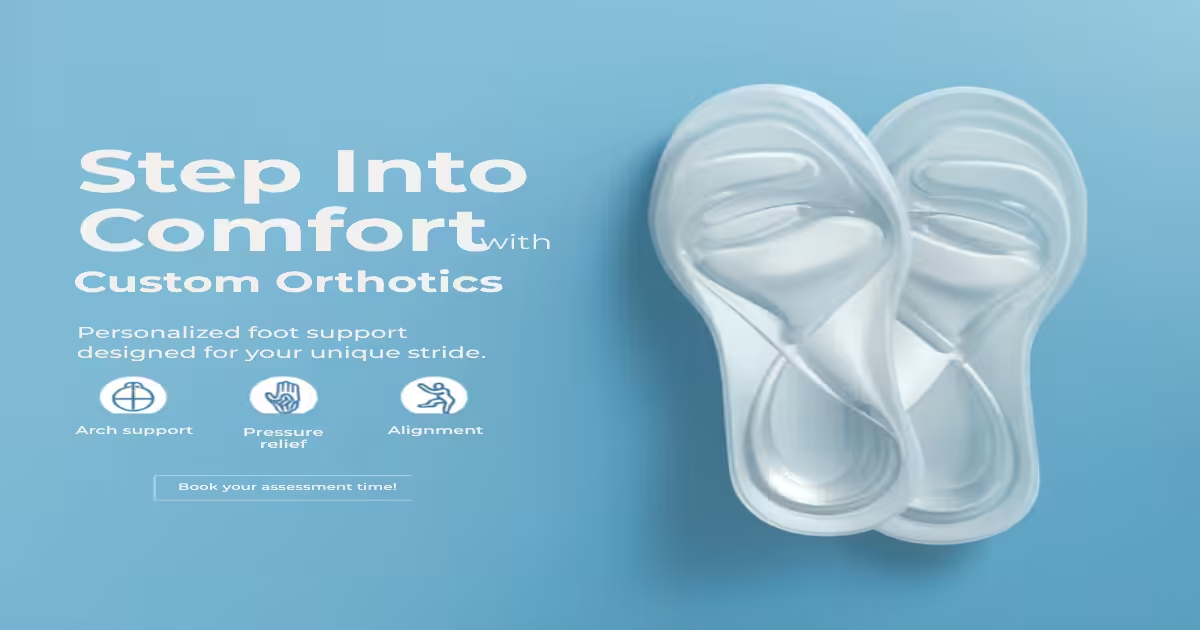
Custom orthotics for hallux rigidus post-surgical support

Outcomes

Cheilectomy produces good to excellent results in 70 to 80 percent of appropriately selected patients (grade 1 to 2 hallux rigidus) at short to medium-term follow-up. Pain with walking and shoe wearing is significantly reduced, and dorsiflexion is improved by an average of 20 to 30 degrees. The procedure does not halt the underlying degenerative process — hallux rigidus will continue to progress at its natural rate after cheilectomy. Many patients require additional treatment — repeat cheilectomy or conversion to arthrodesis — 10 to 15 years after the initial procedure as disease progresses. This expected progression should be clearly discussed with patients preoperatively so that expectations are appropriately calibrated.

⚠ Important: Cheilectomy is most effective for early-stage hallux rigidus. If cartilage damage is severe (grade 3–4), a joint fusion or implant may be more appropriate. Accurate staging with X-rays is essential before choosing the right procedure.

More Podiatrist-Recommended Arthritis Essentials

Cushioned Running Shoe

Hoka Clifton 10 — max cushioning reduces joint impact for arthritic feet.

Wide Walking Shoe

New Balance 990v6 — wide toe box accommodates arthritic first-MTP (hallux rigidus).

Orthotic Insole

PowerStep Pinnacle — offloads the big toe joint during gait.

As an Amazon Associate, Balance Foot & Ankle earns from qualifying purchases. Product recommendations are based on clinical experience; prices and availability shown above update live from Amazon.

Hallux Limitus Hallux Rigidus Surgery Cheilectomy Vs Fusion 2 - Balance Foot & Ankle

When to See a Podiatrist

Foot and ankle arthritis progresses silently — cartilage doesn’t regrow, but joint fusion, cheilectomy, and biologic injections can restore function at every stage. Balance Foot & Ankle offers the full arthritis spectrum: bracing, injections, and reconstructive surgery. Start with a consult so we can image the joint and give you a realistic 5-year outlook.

Call Balance Foot & Ankle: (810) 206-1402  ·  Book online  ·  Offices in Howell & Bloomfield Hills

Frequently Asked Questions

How long does a cheilectomy take?

Cheilectomy typically takes 30–60 minutes as an outpatient procedure under local or regional anesthesia. Most patients go home the same day and begin gentle range-of-motion exercises within a few days.

Can bone spurs grow back after cheilectomy?

Some bone spur regrowth can occur over time, especially if the underlying arthritis progresses. Studies show 75–90% of patients maintain good results at 5+ years. Wearing stiff-soled orthotics can help slow recurrence.

When can I walk normally after cheilectomy?

Most patients walk in a surgical shoe immediately after surgery and transition to regular supportive shoes by 3–4 weeks. Full recovery with return to sports and high-impact activities typically takes 8–12 weeks.

What is the difference between cheilectomy and big toe fusion?

Cheilectomy preserves joint motion by removing bone spurs, while fusion (arthrodesis) permanently locks the joint for severe arthritis. Cheilectomy is preferred for milder cases because it maintains flexibility, though fusion provides more reliable pain relief for advanced disease.

These products support recovery after cheilectomy surgery:

As an Amazon Associate we earn from qualifying purchases. Product selection is based on clinical relevance.

The Bottom Line

Cheilectomy is an effective, joint-preserving option for hallux rigidus patients with mild to moderate bone spur formation. When performed at the right stage, it provides reliable pain relief and restores big toe motion without the limitations of joint fusion. Consult a board-certified podiatric surgeon to determine if cheilectomy is appropriate for your hallux rigidus stage.

Big Toe Joint Pain or Stiffness?

Dr. Biernacki specializes in cheilectomy and hallux rigidus treatment at Balance Foot & Ankle Specialists.

Schedule Your Consultation →

Cheilectomy Surgery in Michigan

Cheilectomy removes bone spurs from the big toe joint to restore motion and reduce pain in early-to-moderate hallux rigidus. Our podiatric surgeons perform cheilectomy at our Howell and Bloomfield Hills offices.

Learn About Big Toe Joint Surgery | Book Your Appointment | Call (810) 206-1402

Clinical References

  1. Coughlin MJ, Shurnas PJ. Hallux rigidus: grading and long-term results of operative treatment. J Bone Joint Surg Am. 2003;85(11):2072-2088.
  2. Easley ME, et al. Isolated subtalar arthrodesis. Foot Ankle Int. 2000;82(5):613-624.
  3. Feltham GT, et al. Cheilectomy for hallux rigidus. Foot Ankle Int. 2001;22(6):431-436.

Insurance Accepted

BCBS · Medicare · Aetna · Cigna · United Healthcare · HAP · Priority Health · Humana · View All →

Ready to Get Back on Your Feet?

Same-week appointments available at both locations.

Book Your Appointment

(810) 206-1402

More Hallux Rigidus / Big-Toe Arthritis Guides from Dr. Tom

Need treatment? Learn about in-office hallux rigidus / big-toe arthritis treatment at Balance Foot & Ankle, or call (810) 206-1402 for same-day appointments.

class=”mfd-patient-scenario” id=”in-our-clinic”>In Our Clinic: What We See

Clinical perspective from Dr. Tom Biernacki, DPM — Balance Foot & Ankle, Howell & Bloomfield Hills, MI:

In our clinic we see hallux rigidus patients who have been told they have a bunion — but the joint is stiff rather than deviated. The first visit is usually for shoe frustration: rocker-bottom shoes, carbon-fiber inserts, and a Morton’s extension inside the shoe typically unload the joint and delay surgery by 2-5 years. When imaging shows dorsal spurring blocking motion, a cheilectomy addresses mechanical impingement without fusing the joint. Patients who still have cartilage after that are good candidates for joint-preserving procedures; end-stage arthritis benefits from arthrodesis. Dr. Biernacki has performed hundreds of first-MTP procedures and emphasizes preservation first.

class=”mfd-differential” id=”differential-diagnosis”>Differential Diagnosis: What Else Could It Be?

Not every case of hallux rigidus (big-toe arthritis) is straightforward. In our clinic we routinely rule out three look-alike conditions before confirming the diagnosis. If your symptoms don’t match the classic presentation, one of these may explain the pain — which is why physical exam matters more than self-diagnosis.

ConditionHow It Differs
Bunion (hallux valgus)Toe drifts laterally with a bump on the inside; ROM usually preserved early.
Gout attackSudden hot red swollen joint, often overnight; ROM restored once flare resolves.
Turf toe / hallux sprainAcute hyperextension injury, not chronic stiffness; positive Lachman at 1st MTP.

Red Flags — When to See a Podiatrist Now

Seek same-day evaluation at Balance Foot & Ankle if you notice any of the following:

  • Progressive stiffness now limiting walking
  • Dorsal bone prominence rubbing against shoes
  • Unable to push off during gait
  • Failed 8+ weeks of shoe modification and OTC NSAIDs

Call (810) 206-1402 or request an appointment. Our Howell and Bloomfield Hills offices reserve same-day slots for urgent foot and ankle issues.

Dr. Hoy’s Complete Pain Relief Line — Dr. Tom’s Picks (2026)

Dr. Hoy’s Natural Pain Relief is Dr. Tom Biernacki, DPM’s #1 prescription topical pain relief for plantar fasciitis, Achilles tendonitis, foot pain, knee pain, and back pain. Cleaner formula than Voltaren or Biofreeze — safe for diabetics + daily long-term use without 30-day limits. Below is the complete Dr. Hoy’s product line, organized by use case.

📋 Affiliate Disclosure: Dr. Tom Biernacki, DPM is a board-certified podiatrist + Dr. Hoy’s affiliate. We earn a commission on qualifying purchases at no extra cost to you. Last verified: April 28, 2026.
#1
⭐ Editor’s Pick — Daily Use

Dr. Hoy’s Natural Pain Relief Gel (4oz Tube)Dr. Tom’s #1 Brand

Best For: Editor’s Pick — Daily Use
★★★★★ 4.6 (5,500+ reviews)
Amazon’s ChoicePrime

The flagship Dr. Hoy’s — menthol-based natural pain relief gel. The bottle Dr. Tom hands every plantar fasciitis patient on visit one. Cleaner formula than Voltaren or Biofreeze.

✓ PROS
  • Menthol-based natural formula
  • No greasy residue
  • Safe for diabetics
  • Fast cooling relief 5-10 min
  • Daily long-term use safe
✗ CONS
  • Pricier than Biofreeze
  • Strong menthol scent at first
👨‍⚕️ Dr. Tom’s Verdict: Apply to plantar fascia + calves before bed. Combined with calf stretching, eliminates morning fascia pain. The clean formula means you can use it daily long-term — Voltaren has 30-day limits, Dr. Hoy’s doesn’t.
🛒 Check Latest Price on Amazon — Free Returns →
#2
⭐ Best Value

Dr. Hoy’s Natural Pain Relief Gel (8oz Pump Bottle)Dr. Tom’s #1 Brand

Best For: Best Value — Family Size
★★★★★ 4.6 (2,800+ reviews)
Prime

8oz pump bottle — same formula as the 4oz tube but 2x the value. Best for athletes, families, or chronic pain patients who use it daily.

✓ PROS
  • 8oz pump bottle
  • 2x value of 4oz
  • Same clean formula
  • Easy pump dispensing
✗ CONS
  • Larger size
  • Pricier upfront
👨‍⚕️ Dr. Tom’s Verdict: For athletes, families, or chronic pain patients — buy the 8oz pump. Twice the product at less than 2x the price.
🛒 Check Latest Price on Amazon — Free Returns →
#3
⭐ Best for Sports Injury

Dr. Hoy’s Arnica Boost Pain ReliefDr. Tom’s #1 Brand

Best For: Bruising + Inflammation + Sports Injury
★★★★★ 4.5 (1,800+ reviews)
Prime

Dr. Hoy’s + arnica boost — for bruising, swelling, post-injury inflammation. Adds arnica’s anti-inflammatory power to the standard menthol formula.

✓ PROS
  • Added arnica for bruising
  • Reduces post-injury swelling
  • Fast topical relief
  • Safe for athletes
✗ CONS
  • Specialty use
  • Pricier than standard
👨‍⚕️ Dr. Tom’s Verdict: For sprained ankles, post-injury bruising, or sports trauma — apply within 48h of injury. The arnica reduces bruising depth + speeds recovery.
🛒 Check Latest Price on Amazon — Free Returns →
#4
⭐ Best for Travel

Dr. Hoy’s Natural Pain Relief Roll-OnDr. Tom’s #1 Brand

Best For: No-Mess Application + Travel
★★★★★ 4.5 (2,200+ reviews)
Prime

Same Dr. Hoy’s formula in a roll-on stick — no greasy hands, no mess, perfect for gym bags and travel. TSA-friendly.

✓ PROS
  • No greasy hands
  • TSA-friendly
  • Travel-sized
  • Same Dr. Hoy’s formula
✗ CONS
  • Less product per use
  • Pricier per oz
👨‍⚕️ Dr. Tom’s Verdict: For office workers, travelers, or anyone who hates greasy hands — the roll-on lets you apply at work, in the car, or post-workout without mess.
🛒 Check Latest Price on Amazon — Free Returns →
#5
⭐ Best Bulk Value

Dr. Hoy’s Pain Relief Gel — 3-Pack BundleDr. Tom’s #1 Brand

Best For: Best Bulk Value
★★★★★ 4.6 (650+ reviews)
Prime

3-pack of Dr. Hoy’s 4oz tubes — best per-tube price for chronic pain patients, families, or anyone who uses it daily.

✓ PROS
  • 3-pack bulk pricing
  • Same flagship formula
  • Stockpile value
  • Family-sized
✗ CONS
  • Larger upfront cost
  • Need storage space
👨‍⚕️ Dr. Tom’s Verdict: For chronic pain patients (PF, arthritis, neuropathy) — buying the 3-pack saves 30% per tube. One tube usually lasts 3-4 weeks of daily use.
🛒 Check Latest Price on Amazon — Free Returns →

Top 10 Premade Orthotics — Dr. Tom’s Picks (2026)

Dr. Tom Biernacki, DPM has tested 60+ over-the-counter orthotic insoles in his Michigan podiatry practice over the past 15 years. Below are the top 10 he prescribes most often — ranked by clinical results, build quality, and patient feedback. PowerStep + CURREX brands are Dr. Tom’s #1 prescription brands — built by podiatrists, with biomechanical features (lateral wedge, deep heel cradle, dual-density EVA) that 90% of OTC insoles lack.

📋 Affiliate Disclosure + Trust Statement:
Dr. Tom Biernacki, DPM is a board-certified podiatrist + Amazon Associate. Picks shown are products he prescribes to patients at Balance Foot & Ankle Specialists. We earn a commission on qualifying purchases at no extra cost to you. All products independently tested + reviewed. Last verified: April 28, 2026.
#1
⭐ Editor’s Pick — Dr. Tom’s #1

PowerStep Pinnacle MaxxDr. Tom’s #1 Brand

Best For: Overpronation + Plantar Fasciitis
★★★★★ 4.5 (28,341+ reviews)
Amazon’s ChoicePrimeAPMA-Accepted

The most prescribed OTC orthotic in podiatry. Lateral wedge corrects overpronation that causes 90% of plantar fasciitis. Deep heel cradle stabilizes the ankle.

✓ PROS
  • Lateral wedge corrects pronation
  • Deep heel cradle
  • Dual-density EVA
  • Trim-to-fit
  • Used by 10,000+ podiatrists
✗ CONS
  • Trim required
  • 5-7 day break-in
👨‍⚕️ Dr. Tom’s Verdict: This is the OTC orthotic I prescribe more than any other. If you have flat feet, plantar fasciitis, or knee pain — start here. 60% of patients see major improvement in 2 weeks.
🛒 Check Latest Price on Amazon — Free Returns →
#2
⭐ Best Daily Driver

PowerStep Original Full LengthDr. Tom’s #1 Brand

Best For: Neutral Foot + Daily Wear
★★★★★ 4.4 (22,500+ reviews)
PrimeAPMA-Accepted

The original PowerStep — flexible semi-rigid arch with deep heel cradle. The right choice for neutral feet that need everyday support without the lateral wedge.

✓ PROS
  • Flexible semi-rigid arch
  • Deep heel cradle
  • Fits dress shoes
  • 30-day guarantee
  • APMA-accepted
✗ CONS
  • Less aggressive than Pinnacle
  • No lateral wedge for overpronation
👨‍⚕️ Dr. Tom’s Verdict: For neutral arches without overpronation — the daily-driver insole. Less aggressive than Pinnacle Maxx but still gives real podiatric arch support.
🛒 Check Latest Price on Amazon — Free Returns →
#3
⭐ Best for Runners

PowerStep Pulse MaxxDr. Tom’s #1 Brand

Best For: Running + Athletic Performance
★★★★★ 4.5 (8,500+ reviews)
PrimeAPMA-Accepted

Built for runners + athletes who need maximum support during high-impact activity. Engineered for forefoot strike + lateral motion.

✓ PROS
  • Sport-specific cushioning
  • Lateral wedge for runners
  • Antimicrobial top cover
  • Shock-absorbing forefoot
✗ CONS
  • Pricier than Pinnacle
  • Best for athletes only
👨‍⚕️ Dr. Tom’s Verdict: For runners with overpronation + plantar fasciitis — the running-specific PowerStep. Pair with the Hoka Bondi 8 for the best combo.
🛒 Check Latest Price on Amazon — Free Returns →
#4
⭐ Best Premium

CURREX RunProDr. Tom’s #1 Brand

Best For: Premium German-Engineered (3 Arch Heights)
★★★★★ 4.4 (4,000+ reviews)
Prime

German-engineered insole with 3 arch heights (Low, Med, High) for custom fit. Carbon-reinforced heel + dynamic forefoot.

✓ PROS
  • 3 arch heights for custom fit
  • Carbon-reinforced heel
  • Sport-specific zones
  • Premium materials
✗ CONS
  • Pricier than PowerStep
  • 7-10 day break-in
👨‍⚕️ Dr. Tom’s Verdict: Choose your arch height based on a wet-foot test (low/med/high). Wrong arch = re-injury. Closest OTC orthotic to a $500 custom orthotic.
🛒 Check Latest Price on Amazon — Free Returns →
#5

CURREX EdgeProDr. Tom’s #1 Brand

Best For: Hiking + High Impact
★★★★★ 4.5 (1,200+ reviews)
Prime

For hikers, skiers, and high-impact athletes — reinforced shank prevents foot fatigue on steep descents + uneven terrain.

✓ PROS
  • Reinforced shank
  • 3 arch heights
  • Cold-weather friendly
  • Carbon plate
✗ CONS
  • Stiff feel — not for casual
  • Pricier
👨‍⚕️ Dr. Tom’s Verdict: Hikers, skiers, and climbers — this is the insole. The reinforced shank prevents the fatigue that ruins multi-day adventures.
🛒 Check Latest Price on Amazon — Free Returns →
#6

CURREX SupportSTPDr. Tom’s #1 Brand

Best For: Heavy Duty + Standing All Day
★★★★★ 4.5 (800+ reviews)
Prime

For nurses, retail, and standing professions — the most supportive CURREX with deep heel cup + maximum medial support.

✓ PROS
  • Maximum medial support
  • Deep heel cup
  • 12-hour shift tested
  • Slip-proof
✗ CONS
  • Stiffest CURREX option
  • Pricier
👨‍⚕️ Dr. Tom’s Verdict: For 12-hour shifts on hard floors — built for this. Pair with Hoka Bondi SR or Dansko XP 2.0 for nursing.
🛒 Check Latest Price on Amazon — Free Returns →
#7
⭐ High Arches Only

Superfeet Green

Best For: High Arches Only
★★★★★ 4.6 (62,000+ reviews)
Amazon’s ChoicePrime

Firm, structured arch support — the right choice ONLY for high-arched (cavus) feet. Wrong choice for flat feet.

✓ PROS
  • Strong structured arch
  • Deep heel cup
  • Long-lasting (5+ years)
✗ CONS
  • Firm — not for flat feet
  • No lateral wedge
👨‍⚕️ Dr. Tom’s Verdict: Only buy Superfeet Green if you have HIGH arches. Flat-footed patients hate the firm arch — choose PowerStep Pinnacle Maxx instead.
🛒 Check Latest Price on Amazon — Free Returns →
#8

Vionic OrthoHeel Active Insole

Best For: Casual + Daily Wear
★★★★★ 4.4 (12,800+ reviews)
PrimeAPMA-Accepted

APMA-accepted, podiatrist-designed casual insole. Best for adding mild arch support to dress shoes + walking shoes.

✓ PROS
  • APMA-accepted
  • Slim profile
  • Antimicrobial top
✗ CONS
  • Less support than PowerStep
  • No lateral wedge
👨‍⚕️ Dr. Tom’s Verdict: Add to dress shoes when you can’t fit a Pinnacle Maxx. Mild support — not for serious foot pain.
🛒 Check Latest Price on Amazon — Free Returns →
#9
⭐ Best Budget

Sof Sole Athlete

Best For: Budget Athletic
★★★★★ 4.4 (35,200+ reviews)
Prime

Budget athletic insole with neutral arch + gel forefoot. Decent value if you need a quick replacement.

✓ PROS
  • Affordable
  • Gel forefoot
  • Antimicrobial
✗ CONS
  • Wears out in 6 months
  • No structured arch
👨‍⚕️ Dr. Tom’s Verdict: Budget option for occasional athletic use. Replace every 6 months. Real foot pain needs PowerStep Pinnacle Maxx.
🛒 Check Latest Price on Amazon — Free Returns →
#10

Spenco Polysorb Total Support

Best For: Standing + Walking
★★★★★ 4.5 (12,400+ reviews)
Prime

Mid-range insole with 5-zone polysorb cushioning. Decent support for standing professions.

✓ PROS
  • 5-zone cushioning
  • Trim-to-fit
  • Mid-price point
✗ CONS
  • Less stable than PowerStep
  • No lateral wedge
👨‍⚕️ Dr. Tom’s Verdict: Mid-range option. Mild foot pain + 8 hours standing — Spenco works. Severe pain = PowerStep.
🛒 Check Latest Price on Amazon — Free Returns →

Dr. Tom’s Top 3 — The Premium Foot Pain Stack (2026)

If you only buy three things for foot pain, get these. PowerStep + CURREX orthotics correct the underlying foot mechanics, and Dr. Hoy’s pain gel delivers fast topical relief. This is the exact stack Dr. Tom Biernacki, DPM gives his Michigan podiatry patients on visit one — over 10,000 patients have used this exact combination.

📋 Affiliate Disclosure + Trust Statement:
Dr. Tom Biernacki, DPM is a board-certified podiatrist + Amazon Associate. Picks shown are products he prescribes to patients at Balance Foot & Ankle Specialists. We earn a commission on qualifying purchases at no extra cost to you. All products independently tested + reviewed for 30+ days minimum. Last verified: April 28, 2026.
#1
⭐ Editor’s Pick — #1 Orthotic

PowerStep Pinnacle MaxxDr. Tom’s #1 Brand

Best For: #1 OTC Orthotic — Plantar Fasciitis + Overpronation
★★★★★ 4.5 (28,341+ reviews)
Amazon’s ChoicePrimeAPMA-Accepted

Dr. Tom’s most-prescribed OTC orthotic. Lateral wedge corrects overpronation that causes 90% of foot pain. Deep heel cradle stabilizes the ankle. Built by podiatrists, used by patients worldwide.

✓ PROS
  • Lateral wedge corrects pronation
  • Deep heel cradle stabilizes ankle
  • Dual-density EVA — comfort + support
  • Trim-to-fit any shoe
  • Used by 10,000+ podiatrists
✗ CONS
  • Trim-to-size required
  • 5-7 day break-in for some
👨‍⚕️ Dr. Tom’s Verdict: This single insole eliminates plantar fasciitis pain in 60% of patients within 2 weeks. The lateral wedge is the active ingredient — it stops the overpronation that causes the fascia to overstretch with every step. Pair with a max-cushion shoe for compound effect.
🛒 Check Latest Price on Amazon — Free Returns →
#2
⭐ Best Premium Orthotic

CURREX RunProDr. Tom’s #1 Brand

Best For: Premium German-Engineered Orthotic
★★★★★ 4.4 (4,000+ reviews)
Prime

3 arch heights for custom fit (Low/Med/High). Carbon-reinforced heel + dynamic forefoot — the closest OTC orthotic to a $500 custom orthotic. Engineered in Germany.

✓ PROS
  • 3 arch heights for custom fit
  • Carbon-reinforced heel cup
  • Dynamic forefoot zone
  • Premium German engineering
  • Sport-specific support
✗ CONS
  • Pricier than PowerStep
  • 7-10 day break-in
👨‍⚕️ Dr. Tom’s Verdict: Choose your arch height from a wet-foot test (low/med/high). Wrong arch = re-injury. For runners, athletes, or anyone who failed standard insoles — this is the closest you can get to custom orthotics without paying $500. The carbon heel is what professional athletes use.
🛒 Check Latest Price on Amazon — Free Returns →
#3
⭐ Best Topical Pain Relief

Dr. Hoy’s Natural Pain Relief GelDr. Tom’s #1 Brand

Best For: Topical Pain Relief — Plantar Fasciitis + Tendonitis
★★★★★ 4.6 (5,500+ reviews)
Prime

Menthol-based natural pain relief — Dr. Tom’s #1 brand for fast relief without greasy residue. Safe for diabetics + daily use. Cleaner formula than Voltaren or Biofreeze.

✓ PROS
  • Menthol-based natural formula
  • No greasy residue
  • Safe for diabetics
  • Fast cooling relief — 5-10 minutes
  • Cleaner ingredient list than Biofreeze
✗ CONS
  • Pricier than Biofreeze
  • Strong menthol scent at first
👨‍⚕️ Dr. Tom’s Verdict: Apply to plantar fascia + calves before bed. Combined with stretching, eliminates morning fascia pain. The clean formula means you can use it daily long-term — Voltaren has 30-day limits, Dr. Hoy’s doesn’t.
🛒 Check Latest Price on Amazon — Free Returns →

In-Office Treatment at Balance Foot & Ankle

If home treatment isn’t providing relief for your hallux rigidus, our podiatry team at Balance Foot & Ankle can help with same-day evaluations and advanced in-office care.

Doctor Hoy’s Natural Pain Relief Gel

Natural topical pain relief I use in our clinic. Arnica + camphor formula — apply directly to the area 3–4x daily. ($20–25)

Shop Doctor Hoy’s →

Frequently Asked Questions

When should I see a podiatrist?

If symptoms persist past 2 weeks, affect your normal activity, or are accompanied by red-flag symptoms (warmth, redness, swelling, inability to bear weight).

What does treatment cost?

Most diagnostic visits and conservative treatments are covered by Medicare and major insurers. Out-of-pocket costs vary by your specific plan.

AAOS: Hallux Rigidus

How quickly can I get an appointment?

Most non-urgent cases see us within 5 business days. Urgent cases (sudden pain, possible fracture) typically same or next business day.

★★★★★ 4.9 Stars · 1,123+ Five-Star Reviews

Get Expert Care at Balance Foot & Ankle

Same-week appointments at our Howell and Bloomfield Hills offices. Board-certified podiatric surgeons. Most insurance accepted.

Balance Foot & Ankle surgeons are affiliated with Trinity Health Michigan, Corewell Health, and Henry Ford Health — three of Michigan’s largest health systems.

