

You are in the right place. Dr. Tom Biernacki, DPM, FACFAS — board-certified foot & ankle surgeon with 3,000+ surgeries — explains exactly what deltoid ligament injury means and what actually works. Call (810) 206-1402 for a same-day appointment at our Howell or Bloomfield Township office.
Medically reviewed by Dr. Tom Biernacki, DPM · Board-Certified Podiatric Surgeon · Last reviewed: April 2026 · Editorial Policy
The most important clinical decision with Deltoid Ligament isn’t which treatment to start with — it’s identifying the correct subtype. That changes everything. Call (810) 206-1402.
The most important clinical decision with Deltoid Ligament isn’t which treatment to start with — it’s identifying the correct subtype. That changes everything. Call (810) 206-1402.
Related Conditions
Quick Answer
Deltoid Ligament Injury 2026 Podiatrist Guide relates to foot pain — typically caused by overuse, footwear, or biomechanics. Most patients improve in 6-12 weeks with conservative care. Same-week appointments in Howell + Bloomfield Township: (810) 206-1402.
Medically reviewed by Dr. Tom Biernacki, DPM — Board-Certified Podiatric Surgeon — Balance Foot & Ankle, Howell & Bloomfield Township, MI. Last updated April 2026.
What Is the Deltoid Ligament?
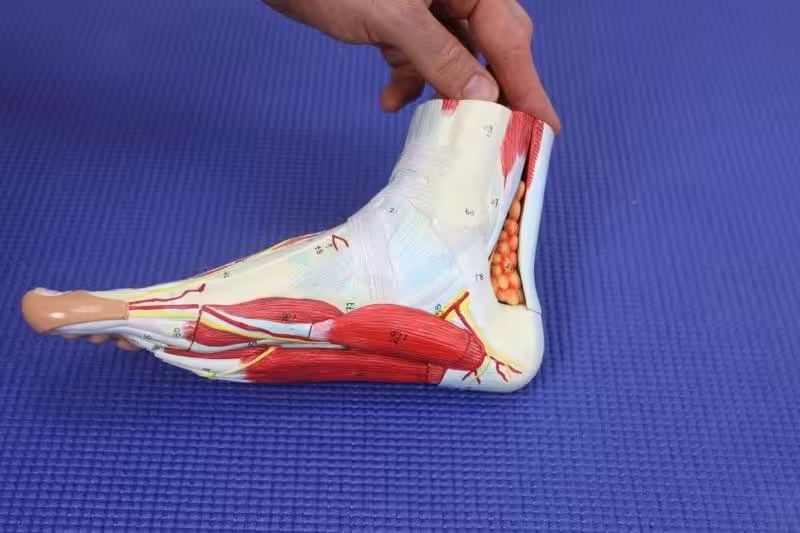

The deltoid ligament is the broad, triangular medial ankle ligament complex that connects the medial malleolus (the inner ankle bone) to the talus, calcaneus, and navicular. It is the strongest ankle ligament and provides primary resistance to eversion (outward rolling) and external rotation forces at the ankle. The deltoid consists of a superficial layer (tibiocalcaneal, tibionavicular, and superficial tibiotalar ligaments) and a deep layer (deep anterior and posterior tibiotalar ligaments). The deep deltoid is the most critical component for ankle rotational stability.
Because the deltoid ligament is substantially stronger than the lateral ankle ligaments, medial ankle sprains are far less common than lateral sprains—accounting for only 5–15% of ankle ligament injuries. When the deltoid is injured, it is often part of a more complex injury pattern, such as a bimalleolar ankle fracture, syndesmotic (high ankle) sprain, or pronation-external rotation mechanism that simultaneously injures multiple ankle stabilizers.
How the Deltoid Ligament Is Injured
Isolated deltoid ligament sprains typically result from eversion (outward rolling) of the ankle—the foot twists outward rather than inward, placing tensile stress on the medial structures. This mechanism is less common than inversion (the mechanism of lateral ankle sprains) but occurs with falls, athletic pivoting injuries, and stepping into holes. Pronation-abduction and pronation-external rotation mechanisms (which occur in severe ankle fractures described by the Lauge-Hansen classification) produce deltoid disruption as part of complex fracture-ligament injury patterns. Syndesmotic ankle sprains (high ankle sprains) involving the tibiofibular ligaments often have concurrent deltoid injury.
Symptoms of Deltoid Ligament Injury
Deltoid ligament injury presents with medial ankle pain, swelling, and tenderness directly over the medial malleolus and the structures inferior and posterior to it. Eversion stress (turning the foot outward) reproduces pain. In complete deltoid disruption, the ankle may feel unstable with a sense of the ankle shifting outward. After ankle fractures treated surgically, persistent medial ankle pain or instability often indicates unaddressed deltoid injury. The Ottawa Ankle Rules for X-ray guidance apply—bony tenderness at the medial malleolus or inability to bear weight requires imaging.
Diagnosis: Imaging Considerations
Standard X-rays evaluate for medial malleolus fracture, bimalleolar fracture, and medial clear space widening (increased space between the medial malleolus and talus indicating deltoid disruption). Weight-bearing X-rays and stress views may demonstrate talar shift in complete deltoid tears. MRI provides definitive evaluation of deltoid integrity—distinguishing partial from complete tears, identifying associated pathology (bone contusions, osteochondral lesions, peroneal injury), and guiding surgical planning when operative treatment is considered. CT scanning is used to characterize complex fracture patterns.
Treatment
Conservative Treatment (Partial Tears)
Isolated partial deltoid ligament tears are treated conservatively with a period of immobilization in a walking boot (2–6 weeks depending on severity), followed by functional rehabilitation emphasizing proprioception, eversion strength, and sport-specific activities. Full recovery typically takes 6–12 weeks. Persistent medial ankle pain or instability after conservative treatment warrants repeat imaging and consideration of surgical evaluation.
Surgical Treatment (Complete Tears and Fracture-Associated Injuries)
Complete deltoid ligament disruption with ankle instability, or deltoid injury associated with an ankle fracture that creates medial instability after bony fixation, may require surgical repair. Direct deltoid repair or reconstruction restores medial stability. In ankle fractures with clear space widening, the deltoid is often repaired or the medial clear space is reduced and stabilized during the same surgical procedure. Outcomes of surgical deltoid repair are generally excellent when performed in appropriate candidates.
Frequently Asked Questions
How long does a deltoid ligament sprain take to heal?
Deltoid ligament sprains generally take longer to heal than lateral ankle sprains because the forces involved in eversion injuries are typically greater and the ligament complex is thicker. Grade I and II partial tears typically resolve with 6–12 weeks of appropriate conservative treatment. Complete deltoid tears treated conservatively may require 3–6 months for functional recovery. Associated fractures, osteochondral lesions, or syndesmotic injuries significantly extend recovery time. Return to sport criteria include full pain-free range of motion, symmetric eversion strength, and successful completion of sport-specific functional tests.
Is a deltoid ligament tear the same as an ankle sprain?
A deltoid ligament tear is technically a medial ankle sprain, but it is distinct from the far more common lateral ankle sprain (which injures the ATFL, CFL, and PTFL). The deltoid is stronger than the lateral ligaments, so medial sprains require greater force and are more frequently associated with fractures and other injuries. Patients and clinicians who assume all ankle sprains are the same may inadequately manage medial ankle injuries—failing to recognize an associated fracture, osteochondral lesion, or syndesmotic injury. Any ankle injury with medial (inside) ankle pain and tenderness, particularly following an eversion mechanism, should be carefully evaluated rather than assumed to be a routine sprain.
Can a deltoid ligament injury cause chronic ankle problems?
Yes. Incompletely healed deltoid ligament injuries can produce chronic medial ankle instability (uncommon but underrecognized), persistent medial ankle pain, and abnormal ankle mechanics that accelerate joint degeneration. Following ankle fractures where the deltoid was not repaired, medial ankle instability and early post-traumatic arthritis can develop years later. Chronic deltoid insufficiency may also develop in patients with severe flatfoot deformity, where progressive valgus forces repeatedly stress and attenuate the medial structures. If you have persistent medial ankle pain or instability following a prior ankle injury or fracture, MRI evaluation and podiatric or orthopedic consultation are warranted.
Medical References & Sources
- PubMed Research — Deltoid Ligament Injury Outcomes
- PubMed Research — Medial Ankle Sprain Surgical Management
- American Orthopaedic Foot & Ankle Society — Ankle Sprains
📧 Get Dr. Tom’s Free Lab Test Guide
Discover the 5 lab tests every person over 35 should ask their doctor about — explained in plain English by a board-certified physician.
Dr. Tom Biernacki, DPM is a board-certified podiatric surgeon at Balance Foot & Ankle in Howell and Bloomfield Township, Michigan. He diagnoses and treats deltoid ligament injuries, medial ankle instability, and complex ankle ligament injuries with conservative management and surgical reconstruction.
Join 950,000+ Learning About Foot Health
Dr. Tom shares honest medical advice, supplement reviews, and treatment guides you won’t find anywhere else.
Subscribe on YouTube →📍 Located in Michigan?
Our board-certified podiatrists treat this condition at two convenient locations. Same-day appointments often available.
Insurance Accepted
BCBS · Medicare · Aetna · Cigna · United Healthcare · HAP · Priority Health · Humana · View All →
Howell Office
4330 E Grand River Ave
Howell, MI 48843
Get Directions →
Bloomfield Township Office
43494 Woodward Ave, #208
Bloomfield Township, MI 48302
Get Directions →
Your Board-Certified Podiatrists



Ready to Get Back on Your Feet?
Same-week appointments available at both locations.
Book Your AppointmentPros & Cons of Conservative Care for foot care
Advantages
- ✓ Conservative care first
- ✓ Same-week appointments
- ✓ Multiple insurance accepted
Considerations
- ✗ Self-treatment can mask issues
- ✗ See a podiatrist if pain >2 weeks
Dr. Tom’s Recommended Products for foot care
Affiliate disclosure: As an Amazon Associate, Balance Foot & Ankle earns from qualifying purchases. We only recommend products we use with patients.
Footnanny Heel Cream Dr. Tom’s Pick
Best for: Daily moisturizer for cracked heels
Ready to Get Back on Your Feet?
Same-day appointments in Howell + Bloomfield Township. Most insurance accepted. Dr. Tom Biernacki, DPM & team.
Book Today — Same-Day Appointments Available
Call Now: (810) 206-1402
About Your Care Team at Balance Foot & Ankle
Dr. Tom Biernacki, DPM · Board-Certified Foot & Ankle Surgeon. Specializes in conservative-first care, minimally invasive bunion surgery, and complex reconstruction.
Dr. Carl Jay, DPM · Accepting new patients. Specializes in sports medicine, athletic injuries, and routine podiatric care.
Dr. Daria Gutkin, DPM, AACFAS · Accepting new patients. Specializes in surgical reconstruction and pediatric podiatry.
Locations: 4330 E Grand River Ave, Howell, MI 48843 · 43494 Woodward Ave Suite 208, Bloomfield Township, MI 48302
Hours: Mon–Fri 8:00 AM – 5:00 PM · (810) 206-1402
In-Office Treatment at Balance Foot & Ankle
If home treatment isn’t providing relief for your foot and ankle conditions, our podiatry team at Balance Foot & Ankle can help with same-day evaluations and advanced in-office care.
Same-day appointments available. (810) 206-1402
Doctor Hoy’s Natural Pain Relief Gel
Natural topical pain relief I use in our clinic. Arnica + camphor formula — apply directly to the area 3–4x daily. ($20–25)
Shop Doctor Hoy’s →Ready for Expert Care?
Same-day appointments in Howell & Bloomfield Township, MI.
4.9★ | 1,123 Reviews | 3,000+ Surgeries
Or call: (810) 206-1402
