
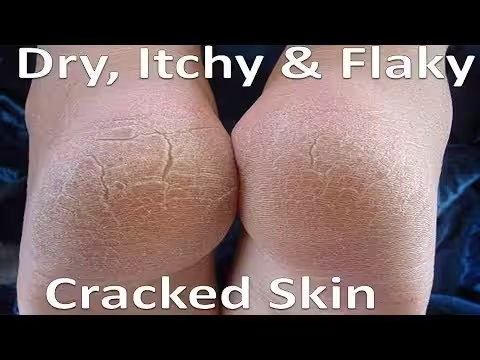
Dry cracked heels combine dry skin, callus buildup, and pressure. The right combination of urea cream, callus debridement, and protective heel cups clears it within weeks.
You’ve come to the right podiatry team. Dr. Tom Biernacki, DPM, FACFAS — board-certified foot & ankle surgeon with 3,000+ surgeries — explains exactly what dry cracked heels means and what works. Call (810) 206-1402 for same-day appointment at Howell or Bloomfield Township.
Quick answer: Treatment for dry cracked heels treatment causes prevention follows a stepwise approach: 1) conservative care first (rest, ice, supportive footwear, OTC anti-inflammatories), 2) physical therapy and targeted exercises, 3) in-office treatments (injections, custom orthotics) if conservative fails at 4-6 weeks, 4) surgery for refractory cases. Most patients resolve at step 1 or 2. Call (810) 206-1402.
Medically reviewed by Dr. Tom Biernacki, DPM · Board-Certified Podiatric Surgeon · Last reviewed: April 2026 · Editorial Policy
The most important clinical decision with Dry Cracked Heels Treatment Causes Prevention isn’t which treatment to start with — it’s identifying the correct subtype. That changes everything. Call (810) 206-1402.
Quick Answer
Dry, Cracked Heels: Causes, Treatment, and When It Becomes a relates to plantar fasciitis — typically caused by tight calves and arch overload. Most patients improve in 6-12 weeks with conservative care. Same-week appointments in Howell + Bloomfield Township: (810) 206-1402.
Medically reviewed by Dr. Tom Biernacki, DPM — Board-Certified Podiatric Surgeon — Balance Foot & Ankle, Howell & Bloomfield Township, MI. Last updated April 2026.
▶ Watch
Medically Reviewed by Dr. Tom Biernacki, DPM — Board-Certified Podiatrist, Balance Foot & Ankle Specialists, Michigan. Last updated April 2026.
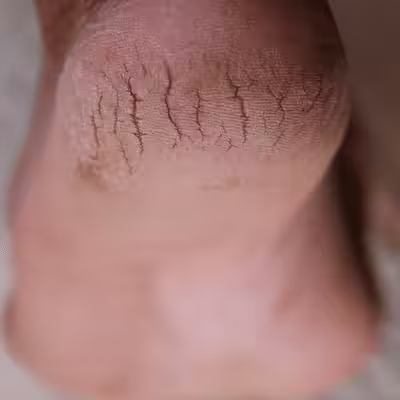
Dry, cracked heels — clinically termed heel fissures or xerosis plantaris — are a common problem that exists on a spectrum from a cosmetic nuisance to a serious medical condition. For most people, appropriate moisturization and exfoliation is sufficient management. But for diabetic patients, those with peripheral vascular disease, or anyone whose heel cracks have become deep enough to bleed or cause pain, cracked heels are a genuine wound care issue that warrants professional evaluation.
Why Heels Crack
The heel skin is unique — it lacks the sebaceous (oil) glands present elsewhere in the skin, making it dependent on water for hydration. The thick callus of the weight-bearing heel surface is particularly prone to dehydration, and when the skin loses elasticity from dryness, the repeated compressive and tensile forces of walking cause it to split — initially superficially, and with time, through the full thickness of the skin to the dermis.
Contributing Factors
- Dry climate and low humidity — Michigan winters, with indoor heating reducing humidity, substantially worsen heel skin dryness
- Open-backed footwear — sandals and open-backed shoes allow the fat pad to splay outward under load, creating lateral tensile stress on the heel skin that promotes fissuring
- Prolonged standing on hard surfaces — increases mechanical stress on the heel skin
- Systemic skin conditions — psoriasis, eczema, and palmoplantar keratoderma cause abnormal skin turnover that increases fissure formation
- Thyroid disease (hypothyroidism) — causes skin dryness throughout the body, including the feet
- Diabetes — autonomic neuropathy reduces the sweating that normally provides natural skin moisture; diabetics are at high risk for severe heel fissures
- Obesity — increases compressive force on the heel fat pad
- Vitamin and mineral deficiencies — omega-3 fatty acid, zinc, and vitamin E deficiency can impair skin barrier function
Grades of Heel Fissures
- Grade 1 (Surface fissures) — superficial cracks in the outermost layer of skin; dry, rough texture; no pain; cosmetic concern only
- Grade 2 (Partial-thickness fissures) — deeper cracks that may be tender with direct pressure; beginning to cause pain with activity
- Grade 3 (Full-thickness fissures) — cracks extend through the full skin thickness; painful with every step; bleeding; potential for bacterial entry and infection
- Grade 4 (Infected fissures) — cellulitis, purulent drainage, or systemic signs of infection; requires urgent medical management
Treatment
Grade 1–2: Self-Care Protocol
- Urea-based heel cream (20–40% urea) — urea is both a humectant (draws water into the skin) and a keratolytic (breaks down thickened callus). Applied nightly under socks, 20–40% urea cream is far more effective than standard moisturizers for heel skin. Brands include Eucerin Intensive Repair, AmLactin (lactic acid is equivalent), and CeraVe SA.
- Pumice stone or foot file — gentle exfoliation of loose callus edges after soaking improves cream penetration; avoid aggressive filing of inflamed or bleeding skin
- Occlusive nighttime socks — applying heel cream and wearing socks overnight (or gel-lined moisture socks) significantly accelerates healing by preventing transepidermal water loss during sleep
- Adequate footwear — transitioning from open-backed sandals and open-heeled shoes to closed-heel footwear reduces the splaying forces that cause heel fissures
Grade 3: Professional Treatment
- Professional debridement — removing the thick callus and cracked skin edges using sterile instruments; improves cream penetration and removes the mechanical stress of the thick callus rim
- Prescription-strength urea preparations (40–50%)
- Wound closure products — liquid bandages and wound closure strips (Steri-Strips, medical-grade cyanoacrylate) can hold fissure edges together while healing occurs, providing pain relief and protecting the wound
- Addressing underlying conditions — thyroid testing, diabetic management optimization
When a Podiatrist Is Necessary
Seek professional evaluation for:
- Any heel fissure in a diabetic patient or patient with peripheral vascular disease — Grade 1 and above
- Fissures that bleed, are significantly painful, or haven’t improved after 2–4 weeks of appropriate self-care
- Signs of infection: increasing redness, warmth, swelling, purulent drainage, fever
- Recurrent severe heel fissures — indicates an underlying systemic condition or structural problem requiring assessment
Painful Cracked Heels? Professional Treatment Available.
Dr. Biernacki provides professional heel fissure treatment and identifies underlying contributing conditions for Michigan patients.
📞 (810) 206-1402 | Request Appointment →
Bloomfield Township: 6900 Orchard Lake Rd Suite 103, Bloomfield Township | Howell: 2350 E Grand River Ave, Howell
📧 Get Dr. Tom’s Free Lab Test Guide
Discover the 5 lab tests every person over 35 should ask their doctor about — explained in plain English by a board-certified physician.
📍 Located in Michigan?
Our board-certified podiatrists treat this condition at two convenient locations. Same-day appointments often available.

Insurance Accepted
BCBS · Medicare · Aetna · Cigna · United Healthcare · HAP · Priority Health · Humana · View All →
Howell Office
4330 E Grand River Ave
Howell, MI 48843
Get Directions →
Bloomfield Township Office
43494 Woodward Ave, #208
Bloomfield Township, MI 48302
Get Directions →
Your Board-Certified Podiatrists



Ready to Get Back on Your Feet?
Same-week appointments available at both locations.
Book Your AppointmentMore Podiatrist-Recommended Foot Health Essentials
Hoka Clifton 10

Watch: Heel Pad Syndrome Fat Pad Atrophy – Bottom Foot Pain FIX — MichiganFootDoctors YouTube
Max-cushion everyday shoe — podiatrist favorite for walking and running.

OOFOS Recovery Slide

Impact-absorbing recovery sandal — wear after long days on your feet.
As an Amazon Associate, Balance Foot & Ankle earns from qualifying purchases. Product recommendations are based on clinical experience; prices and availability shown above update live from Amazon.
When to See a Podiatrist
If foot or ankle pain has been bothering you for more than a few weeks, home care alone may not be enough. Balance Foot & Ankle offers same-week appointments at our Howell and Bloomfield Township clinics — no referral needed in most cases. Bring your current shoes and a short list of symptoms and we’ll build you a treatment plan in one visit.
Call Balance Foot & Ankle: (810) 206-1402 · Book online · Offices in Howell & Bloomfield Township
Watch: Dr. Tom explains
Podiatrist-recommended products
As an Amazon Associate, Dr. Tom earns from qualifying purchases.
Topical moisture for heel fissures.
View on Amazon →Reduces heel fissuring from pressure.
View on Amazon →Supports overall skin and nerve health.
View on Amazon →Closed-back protection for heel fissures.
View on Amazon →Related resources
Ready to solve this? Book today.
Same-week appointments · Howell & Bloomfield Township · 4.9★ (1,123+ reviews)
☎ (810) 206-1402Book Online →Pros & Cons of Conservative Care for foot care
Advantages
- ✓ Conservative care first
- ✓ Same-week appointments
- ✓ Multiple insurance accepted
Considerations
- ✗ Self-treatment can mask issues
- ✗ See a podiatrist if pain >2 weeks
Dr. Tom’s Recommended Products for foot care
Affiliate disclosure: As an Amazon Associate, Balance Foot & Ankle earns from qualifying purchases. We only recommend products we use with patients.
Footnanny Heel Cream Dr. Tom’s Pick
Best for: Daily moisturizer for cracked heels
Ready to Get Back on Your Feet?
Same-day appointments in Howell + Bloomfield Township. Most insurance accepted. Dr. Tom Biernacki, DPM & team.
Book Today — Same-Day Appointments Available
Call Now: (810) 206-1402
About Your Care Team at Balance Foot & Ankle
Dr. Tom Biernacki, DPM · Board-Certified Foot & Ankle Surgeon. Specializes in conservative-first care, minimally invasive bunion surgery, and complex reconstruction.
Dr. Carl Jay, DPM · Accepting new patients. Specializes in sports medicine, athletic injuries, and routine podiatric care.
Dr. Daria Gutkin, DPM, AACFAS · Accepting new patients. Specializes in surgical reconstruction and pediatric podiatry.
Locations: 4330 E Grand River Ave, Howell, MI 48843 · 43494 Woodward Ave Suite 208, Bloomfield Township, MI 48302
Hours: Mon–Fri 8:00 AM – 5:00 PM · (810) 206-1402
Frequently Asked Questions
How long does treatment take to work?
Most patients see improvement in 4-8 weeks with consistent conservative care. Persistent symptoms after 8 weeks need imaging and escalation.
When is surgery needed?
Surgery is reserved for cases that fail 3-6 months of conservative care, structural deformities, or fractures requiring stabilization.
Is this covered by insurance?
Most diagnostic visits and conservative treatments are covered by Medicare and major insurers. Custom orthotics often require diabetic or post-surgical justification.
In-Office Treatment at Balance Foot & Ankle

If home treatment isn’t providing relief for your heel pain, our podiatry team at Balance Foot & Ankle can help with same-day evaluations and advanced in-office care.
Same-day appointments available. (810) 206-1402
Same-Week Appointments in Howell & Bloomfield Township
Three board-certified podiatric surgeons. 1,123+ five-star reviews. Most insurance accepted.
Ready for Expert Care?
Same-day appointments in Howell & Bloomfield Township, MI.
4.9★ | 1,123 Reviews | 3,000+ Surgeries
Or call: (810) 206-1402

Dr. Tom Biernacki, DPM is a board-certified foot & ankle surgeon (ABFAS & ABPM) at Balance Foot & Ankle Specialists in Southeast Michigan. With over a decade of clinical experience, he specializes in heel pain, bunions, diabetic foot care, sports injuries, and minimally invasive surgery. Dr. Biernacki is a member of the APMA and ACFAS, and his patient education content on MichiganFootDoctors.com and YouTube has made him one of the most-followed foot & ankle educators on YouTube.