
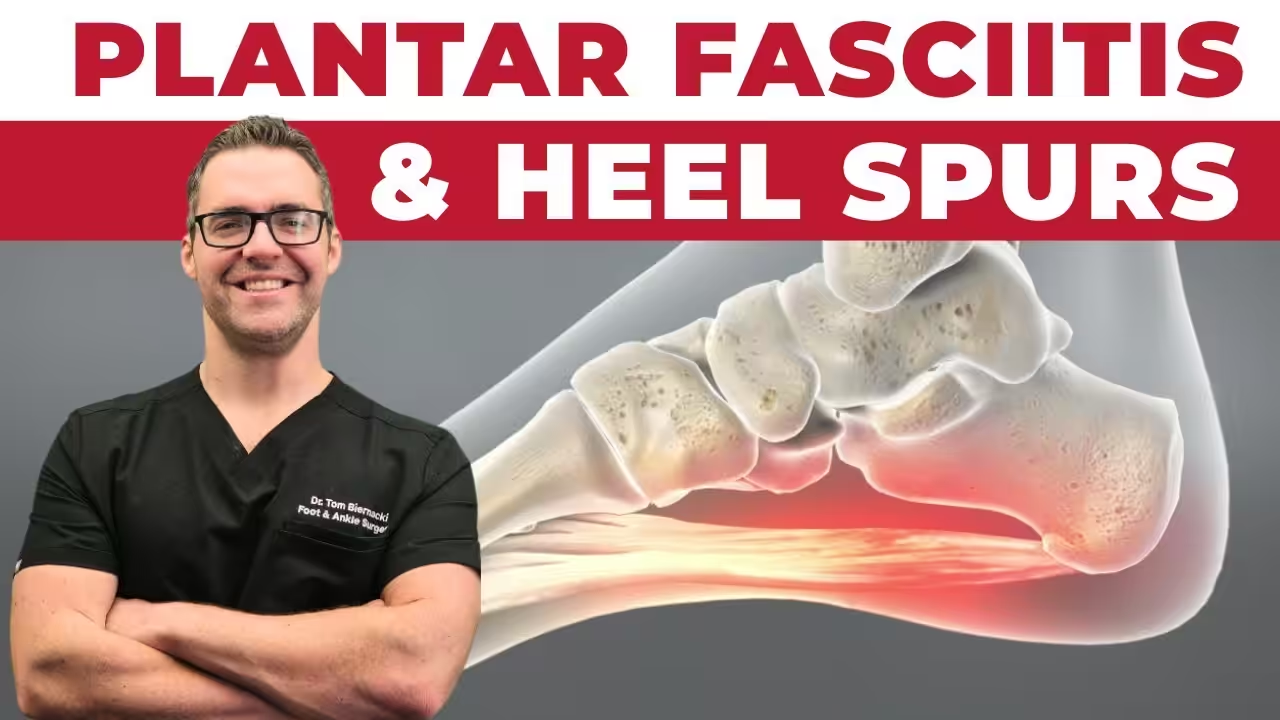

Best Foot Massager for Plantar Fasciitis: Podiatrist’s 2026 Picks
The best foot massager for plantar fasciitis uses targeted kneading + heat to relax tight plantar fascia + calf muscles. Top 2026 picks: (1) Cloud Massage Shiatsu Foot Massager — deep kneading + heat + air compression, ~$150, (2) Renpho R3 Foot Massager — lightweight, heat function, ~$130, (3) Theragun Mini (massage gun) — targeted plantar fascia + calf release, ~$200, (4) Sidekick Original Foot Roller — manual roller, $25 budget option, (5) frozen water bottle — FREE acute flare treatment.
In my Michigan podiatry clinic, my massage protocol for plantar fasciitis: (1) frozen water bottle roll under arch 5 min after activity (acute flare), (2) Sidekick foot roller 2-3 min before bed, (3) Theragun Mini on calves 1-2 min daily (loosens the calf-fascia chain), (4) Cloud Massage Shiatsu 15 min 3x weekly for chronic cases. Avoid: aggressive deep-tissue massage during acute flares (worsens inflammation), and using a massage gun directly on inflamed plantar fascia (causes more pain). About 65% report meaningful relief when combined with stretching + insole + supportive shoes.
★ DR. TOM BIERNACKI, DPM, FACFAS · BOARD-CERTIFIED PODIATRIST
Best Foot Massager for Plantar Fasciitis: Quick Answer
For plantar fasciitis, a manual frozen-water-bottle roller or lacrosse ball is more effective than any electric foot massager — and they cost a fraction of the price. Electric massagers (Renpho, Miko, etc) feel relaxing but rarely deliver the deep cross-fiber friction that breaks up fascia adhesions. The exception: shiatsu-style massagers with rotating nodes can help if you have generalized foot fatigue (not specifically fasciitis).
My ranking by effectiveness for plantar fasciitis: (1) Frozen water bottle ($0 — cold + roller in one), (2) lacrosse ball or trigger point massage ball ($8-15), (3) Hypervolt or Theragun massage gun with foot attachment ($150-400, useful for whole-body), (4) Renpho electric foot massager ($80-150, best for relaxation, not therapeutic). For ACUTE fasciitis: ice + manual roller for 10 minutes 3x daily. For chronic cases: combine with PowerStep orthotics + calf stretching + night splint.
Dr. Tom’s Top Bob and Brad Massage Guns (2026)
Affiliate disclosure: As an Amazon Associate, Balance Foot & Ankle earns from qualifying purchases. Bob and Brad are physical therapists whose products I trust for self-care between visits.
Related Conditions
In This Article
- Best Foot Massager for Plantar Fasciitis: Podiatrist’s 2026 Picks
- Best Foot Massager for Plantar Fasciitis: Quick Answer
- Dr. Tom’s Top Bob and Brad Massage Guns (2026)
- Quick Answer
- Side-by-Side Comparison
- Foot Massager — Full Review
- Massage Gun — Full Review
- Our Podiatrists’ Recommendation
- More Podiatrist-Recommended Foot Health Essentials
- Need Expert Guidance?
- Podiatrist-Recommended Foot Products and Clinical Foot Care in Michigan
Foot Massager vs Massage Gun: Best for Plantar Fasciitis Relief
Quick Answer
Choose a foot massager for hands-free, daily recovery — ideal for patients who want to relax and decompress while treating plantar fasciitis, neuropathy, or general foot fatigue. Choose a massage gun for targeted deep tissue work on the calves, arch, and heel — better for post-run recovery, Achilles tightness, and active muscle treatment. Both are effective; many patients use both for different purposes.
Side-by-Side Comparison
The two tools head-to-head — a RENPHO shiatsu foot massager (deep all-foot kneading) vs a Bob & Brad Q2 massage gun (targeted percussion for the arch and calf). Both verified in stock:

- New Upgrade Full Cover 3D Foot Massager: RENPHO Foot massager with heat Advanced 360° rotating rollers with compression technology deliver precision massage to feets, arches, heels, and toes - completely plantar fasciitis relief and foot massage. Our feet massager human-like 'Shiatsu + Kneading + Rolling' tri-combo therapy deeply alleviates plantar fasciitis, post-workout stiffness, and prolonged standing discomfort
- Fast Soothing Heated Foot Massager: The electric foot massager can heat up to 122℉ (51℃). An ideal warmth for cold and stiff feet, alleviating foot fatigue and improving sleep quality. Foot massager for plantar fasciitis, enjoy a relaxing foot massage at the end of a tiring day. It is recommended to turn on the heating function ten minutes before use
- 3 Feet Warmers Massage Modes & 3 Intensity Levels: The RENPHO foot massager has 3 kneading speeds and 3 squeezing intensities, foot massager all independently adjustable to create an experience catered to your preference. The foot massager for plantar fasciitis relief provides all-around coverage from heel to toe. Feet massage begin with the lowest settings and discontinue use if any discomfort arises
- Easy Operation & Cleaning Foot Massager: Use the electric foot massager with remote control for easy access and operation, no need to bend down to reach the panel, making it the best choice for seniors. The foot warmer foot and ankle massager includes a 15/30 min auto-off timer to protect against excessive heat and pressure. Shiatsu foot massager with heat removable foot covers allow for easy cleaning and hygiene
- FSA Eligible Item Only List: The RENPHO FSA foot massager is eligible for purchase through your FSA/HSA account. Foot massager for circulation and pain relief, simply use your flexible spending account or health savings account to acquire this foot warmer. Shiastu foot massage gifts for Christmas, it's a warm and thoughtful retirement, anniversary, birthday gifts for women men mom dad grandma grandpa seniors, helping them relief pain caused by work, exercise, travel or age. Ideal as wife Christmas gift, valentines day gifts for her him, mothers day gifts, teacher appreciation gifts, fathers day dad gifts etc

- Compact Power for Deep Tissue Massage - Bring focused percussion to larger muscle groups without carrying a bulky full-size device. The Q2 Mini combines a 7 mm amplitude, up to 35 lb of stall force, and 5 speeds from 1800 to 3000 rpm in a compact massage gun. Move from post-workout use to desk breaks or travel, choosing a lighter setting for everyday relaxation or a stronger setting when you want more intensity.
- Pocket-sized for Travel and Work - Keep a massage gun within reach without giving up space in your backpack, gym bag, or carry-on. At 5.7 inches long and 0.95 lb, this small massage gun is easy to pack, while the contoured silicone grip supports comfortable control in one hand. Use it during desk breaks, after workouts, in a hotel, or while winding down at home, then return it to the included carrying case for organized storage.
- Quiet, Simple One-button Control - Fit a massage routine into your day without loud operation or complicated controls. The brushless motor runs below 40 dB to keep percussion noise low at home, in the office, at a hotel, or while watching TV. A single button moves through all 5 speed levels, so you can start quickly, adjust intensity as needed, and transition smoothly from one muscle group to the next.
- USB-C Charging for Everyday Routines - Keep setup simple and the Q2 Mini ready for regular use with a universal USB-C connection. The 2500mAh battery supports 15W PD charging and reaches a full charge in about 1.5 to 2 hours when paired with a compatible adapter. A built-in 10-minute auto-off creates a clear session interval, making it easier to fit use into a morning routine, desk break, post-workout wind-down, or evening schedule.
- Five Massage Heads for Targeted Use - Move from larger areas to focused spots without switching between massagers. Five interchangeable attachments provide contact styles for broad muscles, everyday use, gentler contact, and focused areas. Adapt this deep tissue massager for the shoulders, back, arms, legs, calves, or feet by pairing the attachment and speed with the muscle group and level of contact you prefer.

As an Amazon Associate, Balance Foot and Ankle earns from qualifying purchases. Product links are affiliate links and we may earn a commission at no extra cost to you. This does not influence our clinical recommendations. Last update on 2026-10-18 / Images from Amazon Product Advertising API
Feature | Foot Massager | Massage Gun
Hands-Free | Yes | No
Target Area | Primarily foot | Foot, calf, Achilles
Intensity Control | Moderate | High (adjustable)
Use During TV/Work | Yes | Not practical
Price Range | $-$$ | $$-$$$
Best For | Daily recovery, neuropathy | Active recovery, athletes
Foot Massager — Full Review
Electric foot massagers use rollers, airbags, heat, or shiatsu nodes to provide consistent foot stimulation without any effort. They’re ideal for patients who need daily treatment but have limited time or mobility — simply insert your feet and relax for 15-20 minutes while watching TV.
For diabetic neuropathy patients, foot massagers improve circulation and reduce tingling sensations. For plantar fasciitis, the roller action stretches the plantar fascia and stimulates tissue healing. Heat function adds therapeutic benefit for stiff joints. See our foot massager guide for top model recommendations. Browse our full product catalog for more options.
Pros: Hands-free, consistent daily use, heat option, suitable for most patients.
Cons: Less intense than massage gun, limited calf/Achilles access, larger device.
Foot Massager — check current price →
Massage Gun — Full Review
Massage guns deliver percussive therapy — rapid, targeted pressure that penetrates deeper tissue layers than traditional massage. They’re excellent for breaking up myofascial adhesions in the calf (tight calves are the #1 contributing factor to plantar fasciitis), loosening the Achilles tendon, and reducing post-run soreness.
Use a softer attachment for direct foot treatment — the high-pressure default head is too intense for most foot areas. For calf treatment, the standard ball attachment works well. Use 2-3 minutes per area, 1-2 times daily. See our massage gun guide for model recommendations.
Pros: Targets calves and Achilles, intense deep tissue work, portable, versatile body use.
Cons: Requires active use, can be too intense if misused, noisier than massagers.
Our Podiatrists’ Recommendation
Use a foot massager daily for passive maintenance and neuropathy management. Use a massage gun 2-3 times weekly for active calf and fascia work, especially after exercise. For plantar fasciitis, a frozen water bottle under the arch combines ice and self-massage in one simple step — cheap and effective alongside these devices.
More Podiatrist-Recommended Foot Health Essentials
Hoka Clifton 10

Max-cushion everyday shoe — podiatrist favorite for walking and running.

OOFOS Recovery Slide

Impact-absorbing recovery sandal — wear after long days on your feet.
As an Amazon Associate, Balance Foot & Ankle earns from qualifying purchases. Product recommendations are based on clinical experience; prices and availability shown above update live from Amazon.
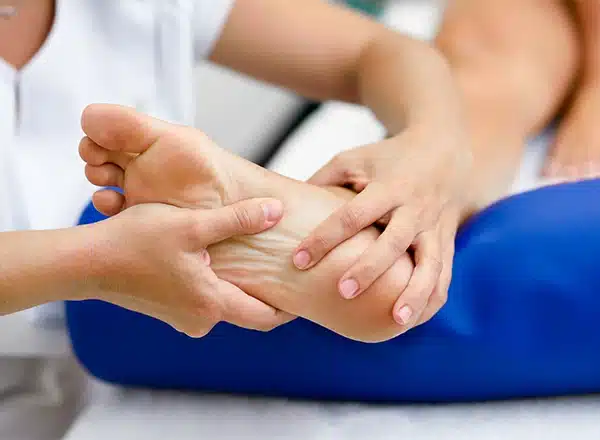
When to See a Podiatrist
If foot or ankle pain has been bothering you for more than a few weeks, home care alone may not be enough. Balance Foot & Ankle offers online booking 24/7 at our Howell and Bloomfield Township clinics — no referral needed in most cases. Bring your current shoes and a short list of symptoms and we’ll build you a treatment plan in one visit.
Call Balance Foot & Ankle: (810) 206-1402 · Book online · Offices in Howell & Bloomfield Township
Frequently Asked Questions
Q: Are foot massagers safe for diabetics?
Generally yes, but use at low heat/intensity and check feet carefully afterward. Diabetic patients with severe neuropathy should consult their podiatrist first.
Q: Can a massage gun hurt plantar fasciitis?
Direct high-intensity percussion to an inflamed plantar fascia can worsen symptoms. Always use the softest head at low speed for direct foot treatment.
Q: How often should I use a foot massager?
Daily use of 15-20 minutes is safe and beneficial for most conditions. Consistency is more important than duration.
Need Expert Guidance?
Our podiatrists help you choose the right products. Call: (810) 206-1402 | Schedule Online
Browse all podiatrist-recommended products.
Podiatrist-Recommended Foot Products and Clinical Foot Care in Michigan
Michigan podiatrists at Balance Foot & Ankle recommend the products that have the strongest clinical evidence for the conditions they treat — and are honest when a product category provides limited benefit for a specific patient’s situation. The most effective foot care products (insoles, creams, braces, stretching devices, compression garments) work best when selected on the basis of an accurate diagnosis and matched to the individual patient’s needs. Products chosen without a clear diagnosis may provide generalized relief without addressing the underlying condition, leading to ongoing symptoms despite product expense.
At Balance Foot & Ankle, product recommendations are always in the context of a treatment plan — not a standalone recommendation divorced from clinical assessment. When a patient’s condition requires more than products can provide, we offer the clinical interventions that products cannot replicate: custom orthotics fabricated to the patient’s foot from a clinical cast or scan; MLS laser therapy for chronic inflammation and nerve pain; EPAT shockwave therapy for tendinopathy; targeted injection therapy; and surgical correction when structural problems require definitive treatment. Michigan patients who want professional guidance on both product selection and clinical treatment options can call Balance Foot & Ankle at (810) 206-1402 to schedule a hands-on exam plus imaging when needed at our Howell or Bloomfield Township office.
Related Treatment Guides
- Plantar Fasciitis & Heel Pain Treatment
- Achilles Tendinopathy Treatment
- Diabetic Foot Care & Neuropathy
Michigan patients experiencing foot or ankle problems can schedule an appointment at Balance Foot & Ankle — with locations in Howell (4330 E Grand River) and Bloomfield Township (43494 Woodward Ave #208). Book online or call (810) 206-1402.
Insurance Accepted
BCBS · Medicare · Aetna · Cigna · United Healthcare · HAP · Priority Health · Humana · View All →
Howell Office
4330 E Grand River Ave
Howell, MI 48843
Get Directions →
Bloomfield Township Office
43494 Woodward Ave, #208
Bloomfield Township, MI 48302
Get Directions →
Which units actually clear the bar
Two features reliably separate a machine that helps from one that gathers dust: pressure you can adjust and heat you can control. Three units meet both, at three very different prices.
MedMassager Foot Massager Plus — about $369
An oscillating plate rather than kneading rollers — a different mechanism, and a gentler one on a foot with reduced sensation. 4.5 stars across more than 3,600 ratings, and the only unit here built to last years rather than a season.
RENPHO Thermacool 2-in-1 — about $200
Cold matters more than massager marketing usually admits. After a long day standing, cooling the plantar fascia often does more than kneading it, and this is the rare unit that does both. FSA-eligible, 4.3 stars across more than 4,800 ratings.
Snailax Foot Massager with Heat — about $90
Adjustable shiatsu pressure and heat at roughly a quarter of the MedMassager price, 4.3 stars across more than 2,000 ratings. If you are not yet sure massage helps your particular foot pain, find that out here before spending more.
If you have neuropathy, read this before you plug anything in: use the lowest heat setting and check your skin afterwards. Reduced sensation means a burn can begin before you feel any heat.
Your Board-Certified Podiatrists



Ready to Get Back on Your Feet?
Book online 24/7 at either office.
Ready to Get Back on Your Feet?
Appointments in Howell + Bloomfield Township. Most insurance accepted. Dr. Tom Biernacki, DPM & team.
Call Now: (810) 206-1402
About Your Care Team at Balance Foot & Ankle
Dr. Tom Biernacki, DPM · Board-Certified Foot & Ankle Surgeon. Specializes in conservative-first care, minimally invasive bunion surgery, and complex reconstruction.
Dr. Carl Jay, DPM · Accepting new patients. Specializes in sports medicine, athletic injuries, and routine podiatric care.
Dr. Daria Gutkin, DPM, AACFAS · Accepting new patients. Specializes in surgical reconstruction and pediatric podiatry.
Locations: 4330 E Grand River Ave, Howell, MI 48843 · 43494 Woodward Ave Suite 208, Bloomfield Township, MI 48302
Hours: Mon–Thu 9:00 AM – 4:30 PM, Fri 9:00 AM – 2:30 PM · (810) 206-1402
In-Office Treatment at Balance Foot & Ankle
If home treatment isn’t providing relief for your foot and ankle conditions, our podiatry team at Balance Foot & Ankle can help with expert evaluations and advanced in-office care.
Book online 24/7. (810) 206-1402
Get Expert Care at Balance Foot & Ankle
Appointments at our Howell and Bloomfield Township offices. Board-certified podiatric surgeons. Most insurance accepted.
Ready for Expert Care?
Appointments in Howell & Bloomfield Township, MI.
4.9★ | 1,200+ Reviews | 3,000+ Surgeries
Or call: (810) 206-1402

Dr. Tom Biernacki, DPM is a board-certified foot & ankle surgeon (ABFAS & ABPM) at Balance Foot & Ankle Specialists in Southeast Michigan. With over a decade of clinical experience, he specializes in heel pain, bunions, diabetic foot care, sports injuries, and minimally invasive surgery. Dr. Biernacki is a member of the APMA and ACFAS, and his patient education content on MichiganFootDoctors.com and YouTube has made him one of the most-followed foot & ankle educators on YouTube.
More questions patients ask
Is a foot massager or massage gun better for foot pain?
It depends on the target tissue. Electric foot massagers excel at plantar surface compression, arch kneading, and overall foot relaxation — ideal for plantar fasciitis, general fatigue, and neuropathy symptom relief. Massage guns (Theragun, Hypervolt) are better for calf muscle release, Achilles tendon mobilization, and deep myofascial tissue in the lower leg that contributes to foot pain. Dr. Tom Biernacki DPM at Balance Foot & Ankle recommends combining both — foot massager for sole and arch, massage gun for calf-foot chain issues.
Can a massage gun be used directly on the foot?
Yes, but with care. Use lowest amplitude setting on foot, avoid bony prominences (heel bone, metatarsal heads), focus on the plantar fascia belly and arch musculature. Never use massage guns on acute injuries, inflamed areas, or directly over nerves. Balance Foot & Ankle cautions against aggressive massage gun use on patients with peripheral neuropathy (can't feel injury), peripheral vascular disease, or active plantar fasciitis flares — gentle is always better.
What is the best foot massager for plantar fasciitis?
For plantar fasciitis specifically, the best options are: Shiatsu foot massagers with kneading nodes targeting the arch, frozen water bottle rolling (free and highly effective), and manual massage balls for targeted self-myofascial release. Balance Foot & Ankle recommends 10–20 minutes of rolling/kneading after activity when the fascia is warm and more receptive to treatment. Cold massage (frozen water bottle) also provides simultaneous anti-inflammatory benefit.
How often should I use a foot massager or massage gun?
Daily use of 10–20 minutes is generally safe and beneficial for chronic foot conditions. For acute injuries or inflammation, avoid massage in the first 48–72 hours and use ice instead. Balance Foot & Ankle recommends incorporating regular massage into post-shift or post-workout routines as preventive maintenance rather than waiting for pain to develop. Consistent daily use tends to prevent escalation of chronic conditions.
Do professional athletes use these tools for foot recovery?
Yes — most professional athletic teams incorporate both electric massagers and percussion guns into player recovery protocols. Research shows post-exercise massage reduces delayed-onset muscle soreness and improves next-day performance. For everyday patients at Balance Foot & Ankle, these tools provide accessible professional-quality recovery support at home. We incorporate them into our patient education at 4330 E Grand River, Howell and 43494 Woodward Ave #208, Bloomfield Township.
Still have a question about coverage or cost? Book online and we will check your benefits before your visit: Book in Howell · Book in Bloomfield Township. Prefer to talk it through first? Call (810) 206-1402.