


Forefoot pain has 3 main differential diagnoses — sesamoiditis (under big toe), metatarsalgia (broad ball-of-foot), and Morton’s neuroma (between 3rd and 4th toes). Each one feels distinct on palpation.
You’re in the right place. Dr. Tom Biernacki, DPM, FACFAS — board-certified foot & ankle surgeon with 3,000+ surgeries — explains exactly what forefoot pain differential diagnosis means and what works. Call (810) 206-1402 for same-day appointment at Howell or Bloomfield Hills.
Quick answer: Forefoot Pain Differential Sesamoiditis Metatarsalgia Mortons Neuroma has multiple potential causes including mechanical, neurological, vascular, and inflammatory. The patterns we see most often are overuse, poorly-fitted shoes, and biomechanical imbalance. Red flags requiring urgent evaluation: warmth/redness (infection), inability to bear weight (fracture), and unilateral swelling without injury (DVT). Call (810) 206-1402.
Medically reviewed by Dr. Tom Biernacki, DPM · Board-Certified Podiatric Surgeon · Last reviewed: April 2026 · Editorial Policy
The most important clinical decision with Forefoot Pain Differential Sesamoiditis Metatarsalgia Mortons Neuroma isn’t which treatment to start with — it’s identifying the correct subtype. That changes everything. Call (810) 206-1402.
Quick Answer
Forefoot Pain Differential: Sesamoiditis vs. Metatarsalgia v relates to Morton’s neuroma — typically caused by nerve compression between toes. Most patients improve in 8-12 weeks conservative with conservative care. Same-week appointments in Howell + Bloomfield Hills: (810) 206-1402.
Medically reviewed by Dr. Tom Biernacki, DPM — Board-Certified Podiatric Surgeon — Balance Foot & Ankle, Howell & Bloomfield Hills, MI. Last updated April 2026.
▶ Watch
Medically Reviewed by Dr. Tom Biernacki, DPM — Board-Certified Podiatrist, Balance Foot & Ankle Specialists, Michigan. Last updated April 2026.
Forefoot pain is one of the most symptomatically diverse regions in foot pathology — the same complaint of “ball of foot pain” can originate from sesamoid bone pathology, metatarsal head overloading and stress, interdigital nerve compression, plantar plate insufficiency, or Freiberg’s infraction, each requiring a distinct treatment approach. Accurate clinical differentiation through history, physical examination, and targeted imaging prevents the common error of treating the wrong diagnosis and delaying effective care.
Sesamoiditis: Big Toe Joint Undersurface Pain
The two sesamoid bones embedded within the flexor hallucis brevis tendons beneath the first metatarsal head serve as pulleys that increase the mechanical advantage of the FHB in hallux plantarflexion and bear significant weight-bearing load during push-off. Sesamoiditis — inflammation of the sesamoid-plantar complex — presents as plantar pain at the first MTP joint, exacerbated by walking, running, or any activity loading the forefoot. Tenderness is precisely localized beneath the first metatarsal head when palpating the tibial or fibular sesamoid individually with the hallux dorsiflexed. Differential diagnosis includes sesamoid stress fracture (confirmed on MRI or bone scan — plain film sesamoid bipartite is a normal variant), avascular necrosis of the medial sesamoid (MRI demonstrates marrow edema and bone death), and turf toe with sesamoid ligament injury. Treatment: offloading with a J-pad (donut pad around the sesamoid), dancer’s padding, carbon fiber foot plate to reduce first MTP dorsiflexion load, and corticosteroid injection for persistent inflammation. Sesamoidectomy is reserved for failed non-surgical treatment with documented avascular necrosis.
Metatarsalgia: Central Forefoot Pressure Overloading
Metatarsalgia describes pain and callus formation under the central metatarsal heads (2nd–4th most commonly) from chronic pressure overloading — a biomechanical problem rather than a diagnosis. Etiology includes relative metatarsal length discrepancy (long 2nd metatarsal), elevated first metatarsal (from hallux valgus or neuromuscular cavus), gastrocnemius contracture (which increases forefoot loading in terminal stance), and intrinsic foot muscle weakness. Conservative treatment centers on reducing metatarsal head pressure: metatarsal pads placed proximal to the affected heads redistribute load to the metatarsal shafts, custom orthotics with forefoot modifications address the biomechanical drivers, and gastrocnemius recession reduces forefoot pressure by improving ankle dorsiflexion. Surgical distal metatarsal osteotomy (Weil osteotomy) plantarflexes and shortens the offending metatarsal for refractory cases.
Morton’s Neuroma: Interdigital Nerve Compression
Morton’s neuroma — perineural fibrosis of the interdigital nerve, most commonly the 3rd common digital nerve in the 3rd web space — presents as burning, shooting, or electric pain in the 3rd and 4th toes, often described as “walking on a pebble” or a sensation of a folded sock. The Mulder’s click (transverse compression of the forefoot while palpating the intermetatarsal space) provokes an audible or palpable click with pain. Diagnostic ultrasound visualizes the thickened nerve mass (>5mm in longitudinal diameter strongly predictive). Treatment: wide-toed footwear, metatarsal pad proximal to the web space, corticosteroid or alcohol sclerosing injection series (3–5 injections produces >75% resolution in appropriately selected patients), or surgical neurectomy for refractory cases. Dr. Biernacki at Balance Foot & Ankle evaluates forefoot pain with clinical examination, Mulder’s testing, and diagnostic ultrasound to accurately differentiate these conditions at the first visit. Call (810) 206-1402.
📧 Get Dr. Tom’s Free Lab Test Guide
Discover the 5 lab tests every person over 35 should ask their doctor about — explained in plain English by a board-certified physician.
📍 Located in Michigan?
Our board-certified podiatrists treat this condition at two convenient locations. Same-day appointments often available.

Insurance Accepted
BCBS · Medicare · Aetna · Cigna · United Healthcare · HAP · Priority Health · Humana · View All →
Howell Office
4330 E Grand River Ave
Howell, MI 48843
Get Directions →
Bloomfield Hills Office
43494 Woodward Ave, #208
Bloomfield Hills, MI 48302
Get Directions →
Your Board-Certified Podiatrists



Ready to Get Back on Your Feet?
Same-week appointments available at both locations.
Book Your AppointmentWatch: Dr. Tom explains

Podiatrist-recommended products
As an Amazon Associate, Dr. Tom earns from qualifying purchases.
Differentiates pain by response.
View on Amazon →Forefoot load redistribution.
View on Amazon →Topical for ball-of-foot pain.
View on Amazon →Acute flare.
View on Amazon →Related resources
Ready to solve this? Book today.
Same-week appointments · Howell & Bloomfield Hills · 4.9★ (1,123+ reviews)
☎ (810) 206-1402Book Online →Differential Diagnosis: What Else Could It Be?
Not every case of sesamoiditis is straightforward. In our clinic we routinely rule out three look-alike conditions before confirming the diagnosis. If your symptoms don’t match the classic presentation, one of these may explain the pain — which is why physical exam matters more than self-diagnosis.
| Condition | How It Differs |
|---|---|
| Sesamoid stress fracture | Acute or gradually worsening sharp pain, tender directly over one sesamoid, positive findings on MRI. |
| Hallux rigidus | Stiff, painful big toe joint with limited dorsiflexion — pain is AT the joint, not UNDER the ball. |
| Turf toe (plantar plate injury) | Acute hyperextension mechanism, diffuse swelling of the 1st MTP, positive 1st MTP drawer test. |
Red Flags — When to See a Podiatrist Now
Seek same-day evaluation at Balance Foot & Ankle if you notice any of the following:
- Sudden sharp onset (possible fracture)
- Bruising or swelling under the big toe
- Pain at rest or at night
- Inability to push off during gait
Call (810) 206-1402 or request an appointment. Our Howell and Bloomfield Hills offices reserve same-day slots for urgent foot and ankle issues.
In Our Clinic: What We See
Clinical perspective from Dr. Tom Biernacki, DPM — Balance Foot & Ankle, Howell & Bloomfield Hills, MI:
In our Balance Foot & Ankle clinic, sesamoiditis patients are usually dancers, runners, or women who have spent significant time in heels. They describe pain directly UNDER the big toe joint — not at the joint (that’s hallux rigidus) — which worsens with push-off. On exam we palpate each sesamoid separately (tibial and fibular) and assess for sensitivity. We always get X-rays to look for sesamoid fracture or bipartite sesamoid (a normal variant). Treatment uses a dancer’s pad to offload the sesamoid, stiff-soled footwear to reduce push-off stress, and activity modification.
More Podiatrist-Recommended Neuroma Essentials
Wide Neutral Cushion Shoe
New Balance 1080 V14 — max forefoot room decompresses the pinched nerve.
Wide-Toe-Box Walking Shoe
New Balance 990v6 — prevents the forefoot compression that triggers Morton’s neuroma.
Orthotic with Met Pad Built-In

![Metatarsalgia Treatment [BEST Ball of Foot Pain RELIEF 2024]](https://www.michiganfootdoctors.com/wp-content/cache/flying-press/d7857672675f2bf191a8e896b2f7208b.jpg)
Watch: Metatarsalgia Treatment [BEST Ball of Foot Pain RELIEF 2024] — MichiganFootDoctors YouTube
PowerStep Pinnacle — arch support reduces nerve irritation between metatarsals.
As an Amazon Associate, Balance Foot & Ankle earns from qualifying purchases. Product recommendations are based on clinical experience; prices and availability shown above update live from Amazon.
When to See a Podiatrist
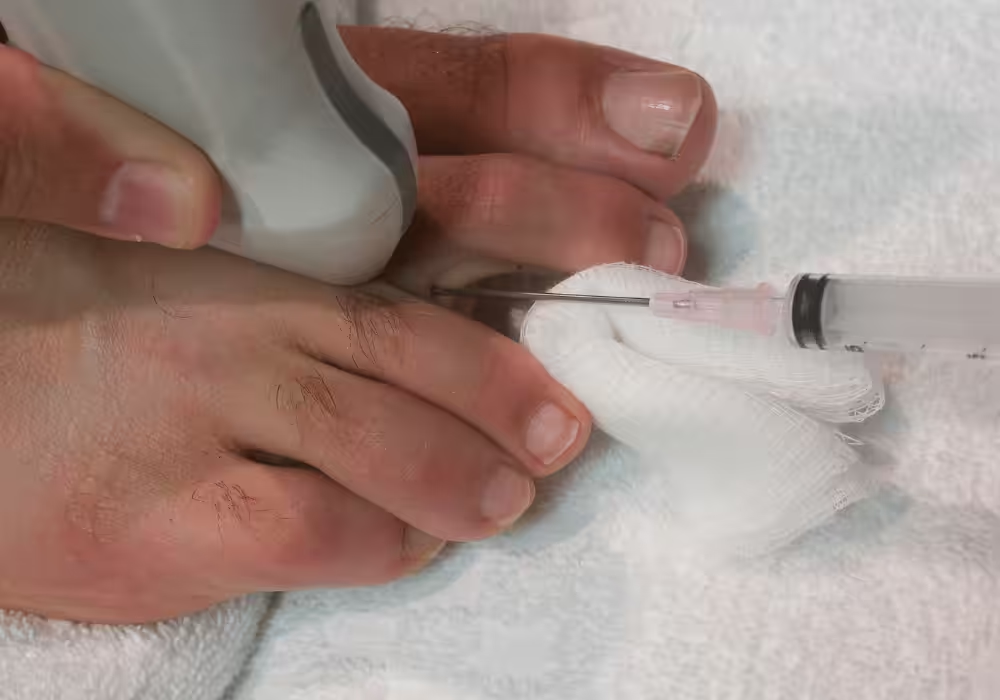
A Morton’s neuroma that doesn’t respond to metatarsal pads and wider shoes within 6-8 weeks usually needs a cortisone injection or — for stubborn cases — alcohol sclerosing or nerve decompression. Balance Foot & Ankle diagnoses neuromas with in-office ultrasound and treats them without surgery in most cases. Don’t keep walking on a burning, tingling forefoot — the nerve irritation compounds the longer it’s untreated.
Call Balance Foot & Ankle: (810) 206-1402 · Book online · Offices in Howell & Bloomfield Hills
In-Office Treatment at Balance Foot & Ankle
When conservative care isn’t enough, Dr. Tom Biernacki and the team at Balance Foot & Ankle offer advanced, same-day options — including Morton’s Neuroma Treatment Michigan at our Howell and Bloomfield Hills clinics.
Same-day appointments available. Call (810) 206-1402 or book online.
Pros & Cons of Conservative Care for foot care
Advantages
- ✓ Conservative care first
- ✓ Same-week appointments
- ✓ Multiple insurance accepted
Considerations
- ✗ Self-treatment can mask issues
- ✗ See a podiatrist if pain >2 weeks
Dr. Tom’s Recommended Products for foot care
Affiliate disclosure: As an Amazon Associate, Balance Foot & Ankle earns from qualifying purchases. We only recommend products we use with patients.
Footnanny Heel Cream Dr. Tom’s Pick
Best for: Daily moisturizer for cracked heels
Ready to Get Back on Your Feet?
Same-day appointments in Howell + Bloomfield Hills. Most insurance accepted. Dr. Tom Biernacki, DPM & team.
Book Today — Same-Day Appointments Available
Call Now: (810) 206-1402
About Your Care Team at Balance Foot & Ankle
Dr. Tom Biernacki, DPM · Board-Certified Foot & Ankle Surgeon. Specializes in conservative-first care, minimally invasive bunion surgery, and complex reconstruction.
Dr. Carl Jay, DPM · Accepting new patients. Specializes in sports medicine, athletic injuries, and routine podiatric care.
Dr. Daria Gutkin, DPM, AACFAS · Accepting new patients. Specializes in surgical reconstruction and pediatric podiatry.
Locations: 4330 E Grand River Ave, Howell, MI 48843 · 43494 Woodward Ave Suite 208, Bloomfield Hills, MI 48302
Hours: Mon–Fri 8:00 AM – 5:00 PM · (810) 206-1402
Frequently Asked Questions
When should I see a doctor?
See a podiatrist if pain persists past 2 weeks, prevents normal activity, or is accompanied by red-flag symptoms (warmth, swelling, numbness, inability to bear weight).
Can I treat this at home?
Mild cases respond to RICE protocol (rest, ice, compression, elevation), supportive shoes, and OTC anti-inflammatories. Persistent symptoms need professional evaluation.
How long does it take to heal?
Most soft tissue injuries resolve in 2-6 weeks with appropriate care. Bone injuries take 6-12 weeks. Chronic conditions need longer-term management.
What is Sesamoiditis?
Sesamoiditis is a common foot/ankle condition that affects mobility and quality of life. Understanding the underlying cause is the first step in successful treatment. Our podiatrists at Balance Foot & Ankle perform a hands-on biomechanical exam, review your activity history, and use diagnostic imaging when appropriate to identify the root cause—not just treat the symptom. Many patients have been told to “rest and ice” without a deeper diagnostic workup; our approach is different.
Symptoms and warning signs
Common signs of sesamoiditis include pain that worsens with activity, morning stiffness, swelling, tenderness when palpated, and difficulty bearing weight. If you experience sudden severe pain, inability to walk, visible deformity, numbness or color change, contact our office the same day or visit urgent care—these can signal a more serious injury such as a fracture, tendon rupture, or vascular compromise. Diabetics with any foot wound should seek same-day care.
Conservative treatment options
Most cases of sesamoiditis respond to non-surgical care: structured rest, supportive footwear changes, custom orthotics, targeted stretching and strengthening protocols, anti-inflammatory medications when medically appropriate, and in-office procedures such as ultrasound-guided injections. We also offer advanced therapies including MLS laser therapy, EPAT/shockwave, regenerative injections, and image-guided procedures. Treatment is sequenced from least invasive to most invasive, and we explain the rationale at every step.
When is surgery considered?
Surgery is reserved for cases that fail 3-6 months of well-structured conservative care, when there is structural pathology (severe deformity, complete tear, advanced arthritis), or when imaging shows damage that will not heal without intervention. Our surgeons have performed 3,000+ foot and ankle procedures and prioritize minimally-invasive techniques whenever appropriate. We discuss recovery timelines, return-to-activity milestones, and realistic outcome expectations before any procedure is scheduled.
Recovery timeline and prevention
Recovery from sesamoiditis varies based on severity and chosen treatment path. Conservative cases often improve within 4-8 weeks with consistent adherence to the protocol. Post-procedural recovery may range from a few days (in-office procedures) to several months (reconstructive surgery). Long-term prevention involves footwear assessment, activity modification, structured strengthening, and regular check-ins with your podiatrist if you have a history of recurrence. We provide written home-exercise plans and digital follow-up support.
Ready to feel better?
Same-week appointments available in Howell and Bloomfield Hills, Michigan.
Book Your VisitIn-Office Treatment at Balance Foot & Ankle
If home treatment isn’t providing relief for your sesamoiditis, our podiatry team at Balance Foot & Ankle can help with same-day evaluations and advanced in-office care.
Same-day appointments available. (810) 206-1402
Ready for Expert Care?
Same-day appointments in Howell & Bloomfield Hills, MI.
4.9★ | 1,123 Reviews | 3,000+ Surgeries
Or call: (810) 206-1402

Dr. Tom Biernacki, DPM is a board-certified foot & ankle surgeon (ABFAS & ABPM) at Balance Foot & Ankle Specialists in Southeast Michigan. With over a decade of clinical experience, he specializes in heel pain, bunions, diabetic foot care, sports injuries, and minimally invasive surgery. Dr. Biernacki is a member of the APMA and ACFAS, and his patient education content on MichiganFootDoctors.com and YouTube has made him one of the most-followed foot & ankle educators on YouTube.