
Heel pain evaluation · same-week appointments
Sharp heel pain on your first steps in the morning? Book online
Board-Certified Podiatric Foot & Ankle Surgeon · Last reviewed: May 5, 2026
Board-certified podiatric surgeon | Balance Foot & Ankle, Howell and Bloomfield Township, MI
Last reviewed: May 2026
Quick answer: Heel spurs and plantar fasciitis are related but different. Plantar fasciitis is inflammation of the plantar fascia ligament — the actual source of pain. A heel spur is a calcium deposit that forms as a result of that chronic tension. Most heel spurs are painless. The real culprit in 95% of heel pain cases is plantar fasciitis, not the spur.
Your doctor just told you that you have a heel spur on your X-ray. Now you are wondering: is the spur causing my pain, or is it plantar fasciitis? Do I need surgery to remove it? Is this going to get worse? These are exactly the right questions — and the answers will probably surprise you.
At Balance Foot & Ankle, we diagnose and treat heel pain every day. The heel spur versus plantar fasciitis confusion is one of the most common misunderstandings we encounter — and it matters because getting it wrong leads to the wrong treatment. Let me clear it up.
Table of Contents

- What Is Plantar Fasciitis?
- What Is a Heel Spur?
- Key Differences: Heel Spur vs Plantar Fasciitis
- How Are They Diagnosed?
- Treatment: What Actually Works
- Do You Need Surgery for a Heel Spur?
- Warning Signs You Need to See a Podiatrist
- Frequently Asked Questions
What Is Plantar Fasciitis?
Plantar fasciitis is inflammation or degeneration of the plantar fascia — the thick band of connective tissue that runs along the bottom of your foot, connecting your heel bone (calcaneus) to your toes. It acts like a bowstring, maintaining the arch of your foot under load.
When the fascia is repeatedly overstretched — due to tight calves, flat feet, high arches, unsupportive footwear, or sudden increases in activity — micro-tears develop at the insertion point on the heel bone. The body’s attempt to repair those micro-tears creates inflammation, and that inflammation causes the classic sharp, stabbing heel pain that is worst with the first steps in the morning.
Plantar fasciitis is the diagnosis in approximately 80% of all heel pain cases we see in our clinic. It is one of the most common musculoskeletal complaints in adults.
What Is a Heel Spur?
A heel spur (technically a calcaneal spur) is a calcium deposit that forms on the underside of the heel bone. It is not a spike or a sharp object — on X-ray, it looks like a small hook or ledge extending from the calcaneus, typically 0.5 to 2 centimeters long.
Here is the key fact most patients do not know: heel spurs form as a response to chronic plantar fascia tension, not the other way around. When the fascia repeatedly pulls on the heel bone over months or years, the body deposits calcium along the lines of stress. The spur is a marker that chronic tension has been present — it is the body trying to reinforce a repeatedly stressed area.
Studies show that roughly 10–15% of the general population has a heel spur on X-ray, but the majority of those people have zero pain. The spur itself is almost never the direct cause of pain.
Key takeaway: A heel spur is evidence that plantar fascia tension has existed for a long time. It is a consequence of the problem, not the cause of it.
Key Differences: Heel Spur vs Plantar Fasciitis

The distinction between heel spurs and plantar fasciitis comes down to a few critical points. Here is a side-by-side comparison of what we look for in our clinical evaluation:
| Plantar Fasciitis | Heel Spur | |
|---|---|---|
| What it is | Inflammation/degeneration of the plantar fascia | Calcium deposit on the heel bone |
| Primary cause of pain? | Yes — in 95% of heel pain cases | Rarely, if ever, the direct cause |
| Visible on X-ray? | No (soft tissue) | Yes |
| Visible on ultrasound? | Yes — fascia thickening | Yes — bony prominence |
| Morning pain | Classic symptom | Not specific to spur |
| Responds to conservative care? | 90%+ within 12 months | Does not need treatment |
| Needs surgery? | Rarely (<5% of cases) | Almost never |
How Are They Diagnosed?
Diagnosing heel pain accurately requires more than just an X-ray. In our clinic, we use a combination of clinical examination and imaging to determine what is actually causing pain — because the source of pain drives the treatment decision.
Clinical Examination
The most reliable test for plantar fasciitis is point tenderness at the medial calcaneal tubercle — the bony bump where the fascia attaches to the heel. We press that spot; if it reproduces your exact pain, plantar fasciitis is the working diagnosis. We also assess calf flexibility, arch type, foot mechanics, and gait pattern to identify contributing factors.
X-Ray
X-rays are useful for ruling out stress fractures and other bony pathology, and they will show a heel spur if present. However, a heel spur on X-ray does not change the diagnosis or treatment if the clinical picture is plantar fasciitis. We do not treat the spur — we treat the fascia.
Diagnostic Ultrasound

Ultrasound is our preferred imaging tool for plantar fasciitis because it shows the soft tissue directly. A plantar fascia thickness greater than 4mm (normal is about 3–3.5mm) confirms pathology. It also shows whether the tissue is actively inflamed versus showing degenerative change — which is important because those two conditions need different treatments. Ultrasound can also guide injections to the exact site of pathology.
Treatment: What Actually Works
Because the heel spur is not the pain source, treatment targets the plantar fascia exclusively. The good news: plantar fasciitis responds very well to conservative care in the vast majority of cases.
First-Line Treatment (Weeks 1–6)
- Plantar fascia-specific stretching: Before your first step each morning, pull your toes back toward your shin for 30 seconds. Repeat 3 times. This is the single most evidence-backed home treatment for reducing morning pain.
- Calf stretching: Tight calf muscles are the most common biomechanical driver. Stretch against a wall, 3 sets of 30 seconds, both straight-knee and bent-knee.
- Supportive footwear: A shoe with a firm midsole, deep heel cup, and 8–12mm heel-to-toe drop. Avoid flip-flops, flat shoes, and barefoot walking on hard floors.
- Over-the-counter orthotics: Look for a firm arch support with a deep heel cup. Superfeet Green or similar semi-rigid insoles are a reasonable starting point.
- Activity modification: Reduce high-impact loading (running, jumping). Swimming and cycling are excellent substitutes.
Second-Line Treatment (Months 2–4)
- Night splints: Keep the fascia and calf in a stretched position overnight. Most patients see a measurable reduction in morning pain within 2–3 weeks.
- Custom foot orthotics: For patients with flat feet, high arches, or significant overpronation, custom orthotics address the underlying mechanical cause and reduce recurrence.
- Eccentric calf exercises: Single-leg heel drops off a step, 3 sets of 15 daily — the most effective exercise-based treatment for chronic cases.
- Corticosteroid injection: Provides short-term relief but should not be used more than 2–3 times; repeated injections can weaken the fascia.
Advanced Treatment for Chronic Cases (6+ Months)
- Extracorporeal shockwave therapy (ESWT): Sound-wave technology that stimulates tissue repair. Strong evidence for chronic plantar fasciosis. No incision, no downtime.
- Platelet-rich plasma (PRP) injection: Concentrates your own growth factors and injects them into degenerating tissue. Increasingly preferred over cortisone for chronic cases.
- Minimally invasive plantar fasciotomy: A small release of the fascia under ultrasound guidance, done in-office under local anesthesia. Reserved for cases that have failed all of the above.
Do You Need Surgery to Remove a Heel Spur?
Almost certainly not. This is one of the most common questions I get after a patient sees a heel spur on their X-ray, and the answer is almost always the same: the spur is not causing your pain, so removing it will not fix your pain.
Studies examining outcomes of heel spur removal consistently show no benefit over treating the plantar fascia alone. When surgeons do perform plantar fasciotomy for refractory plantar fasciitis, they do not remove the spur — they release the fascia. The spur stays and the pain resolves.
There is a specific and rare variant called a Haglund deformity (a heel spur at the back of the heel, where the Achilles tendon inserts) that can cause insertional Achilles tendinitis and may occasionally need surgical treatment. But the classic inferior heel spur seen on the bottom of the heel in the context of plantar fasciitis pain? It is almost never operated on.
Key takeaway: Surgically removing a heel spur does not resolve plantar fasciitis pain. Treat the fascia, not the spur.
Warning Signs: When to See a Podiatrist
⚠️ See a podiatrist if you have:
- Heel pain that has not improved after 6–8 weeks of home treatment
- Pain that wakes you from sleep (stress fracture must be ruled out)
- Swelling, bruising, or acute onset after a specific injury
- Pain that is getting worse despite rest
- Numbness or tingling in the heel or bottom of the foot
- Bilateral heel pain (both feet simultaneously) — may indicate a systemic cause
Frequently Asked Questions
Can a heel spur go away on its own?
Heel spurs do not dissolve once formed — calcium deposits are permanent bony changes. However, because the spur itself is not the pain source, this does not matter for your recovery. Successfully treating plantar fasciitis resolves the pain, and the spur remains on X-ray without causing any further problems.
Can you have a heel spur without plantar fasciitis?
Yes. Studies show that 10–15% of the population has a heel spur on X-ray with no heel pain whatsoever. The spur is simply a radiographic finding — it does not require treatment in the absence of symptoms. Many patients discover their spur incidentally during imaging for an unrelated issue.
Is plantar fasciitis worse than a heel spur?
This framing is a bit of a false comparison since a heel spur is typically a consequence of longstanding plantar fasciitis. In terms of what needs treatment, plantar fasciitis is the clinical problem requiring management. A heel spur in isolation almost never needs treatment. If both are present — which is common — treating the plantar fasciitis is what resolves the pain.
What does a heel spur feel like?
The classic description of plantar fasciitis pain (which usually coexists with a heel spur when one is present) is a sharp, stabbing pain at the bottom of the heel, worst with the first steps in the morning or after prolonged sitting. The pain typically eases after a few minutes of walking, then can return with extended time on your feet. The spur itself does not have a unique pain signature separate from the associated plantar fasciitis.
How long does it take to recover from a heel spur?
Recovery time depends on the severity of the plantar fasciitis, not the spur. Mild cases resolve in 6–8 weeks with appropriate treatment. Moderate cases take 3–6 months. Severe or chronic cases can take 6–18 months. The spur remains throughout — recovery means resolving the plantar fasciitis pain, not eliminating the bony deposit.
The bottom line: If you have been told you have a heel spur, do not let it distract you from treating the real problem — plantar fasciitis. The spur is a bystander. The fascia is the patient. Focus your treatment there, and in the vast majority of cases you will make a full recovery without surgery. If you are in Michigan and want an accurate diagnosis and a treatment plan tailored to your specific anatomy, we offer same-day appointments at both our Howell and Bloomfield Township locations.
Sources
- Johal KS, Milner SA. Plantar fasciitis and the calcaneal spur: Fact or fiction? Foot Ankle Surg. 2012;18(1):39–41.
- Trojian T, Tucker AK. Plantar Fasciitis. Am Fam Physician. 2019;99(12):744–750.
- Cutts S, Obi N, Pasapula C, Chan W. Plantar fasciitis. Ann R Coll Surg Engl. 2012;94(8):539–542.
- Saber N, Diab H, Nassar W, Razaak HA. Ultrasound guided local steroid injection versus extracorporeal shockwave therapy in the treatment of plantar fasciitis. Alexandria J Med. 2012;48(1):35–42.
- League AC. Current concepts review: plantar fasciitis. Foot Ankle Int. 2008;29(3):358–366.
Get an Accurate Heel Pain Diagnosis
Same-day appointments available in Howell & Bloomfield Township, MI
4.9★ | 1,193 Reviews | 3,000+ Surgeries
Or call: (810) 206-1402
Podiatrist-Recommended Products for Heel Pain & Heel Spurs
- PowerStep Pinnacle — deep heel cup and arch support offloads the plantar fascia insertion where heel spurs form
- Doctor Hoy’s Natural Pain Relief Gel — topical anti-inflammatory gel for heel spur pain and plantar fasciitis soreness between clinic visits
- PowerStep Maxx — maximum-depth heel cup for severe heel spur pain with additional medial arch collapse
These are the same products Dr. Biernacki recommends in clinic. Available through our partner Foundation Wellness.
Questions About Your Visit
When should I see a podiatrist?
If symptoms persist past 2 weeks, affect your normal activity, or are accompanied by red-flag symptoms (warmth, redness, swelling, inability to bear weight).
What does treatment cost?
Most diagnostic visits and conservative treatments are covered by Medicare and major insurers. Out-of-pocket costs vary by your specific plan.
How quickly can I get an appointment?
Most non-urgent cases see us within 5 business days. Urgent cases (sudden pain, possible fracture) typically same or next business day.
Looking for heel spur treatment near you? Balance Foot & Ankle treats heel spurs and the heel pain that comes with them — using orthotics, shockwave (EPAT) therapy, and surgery only when truly needed — at our Bloomfield Township office (Oakland County) and Howell office (Livingston County). Book online or call (810) 206-1402.
Clinical sources
- Heel Pain — Plantar Fasciitis: Clinical Practice Guidelines, Revision 2023. Journal of Orthopaedic & Sports Physical Therapy. PubMed
- Management of plantar heel pain: a best-practice guide informed by a systematic review. PMC
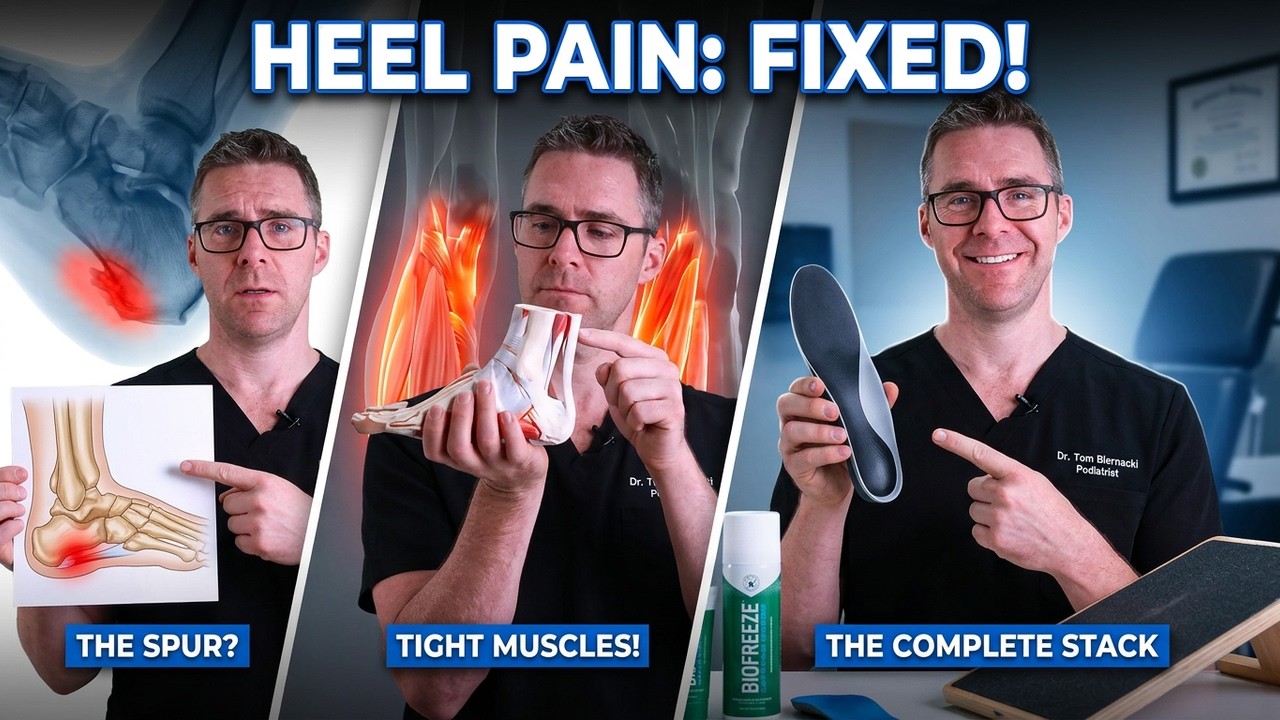
Watch: Heel Spur Pain? Here’s What Actually Works
Best Shoes for Heel Spurs & Plantar Fasciitis
Get treated locally: Balance Foot & Ankle treats heel spurs and the heel pain they cause at our Howell and Bloomfield Hills offices. Most insurance accepted — same-week appointments available.
For the longer version of why the spur on your X-ray is usually not the thing that hurts, and what that means for treatment, see heel spurs explained on Dr. Biernacki’s heel-pain site.
Getting Care at Balance Foot & Ankle
Treated at our Howell and Bloomfield Township offices — same-week appointments available.
- Foot Pain Relief: What Works for Common Foot Conditions
- Sudden Foot Pain No Injury 2026 | Podiatrist
- Foot Pain from Standing at Work | Solutions for Michigan Workers
- Orthotics for Work Boots 2026: Custom 3D Insoles for MI Workers
- Best Orthotics for Standing All Day & Work Boots 2026 — Podiatrist Guide
- Foot Pain Relief Products Guide 2026 | DPM
Heel spurs and plantar fasciitis usually arrive together, so the footwear questions are the same ones. Hoka comes up more often than any other brand, and our guide to the Hoka models that suit plantar fasciitis works through which of them hold up under a heel that hurts worst on the first few steps of the morning.