
Disclosure: This post contains affiliate links. As an Amazon Associate, Dr. Tom Biernacki earns a small commission on qualifying purchases at no extra cost to you. Products are selected based on clinical effectiveness and patient outcomes — never by commission rates.
By Dr. Tom Biernacki, DPM | Double Board-Certified Podiatric Surgeon | Updated March 2026 · Medically Reviewed ✓
Last updated: March 2026 — Reviewed by Dr. Tom Biernacki, DPM
Middle Toe Numb 2026: Causes, Diagnosis & Treatment Guide
Middle toe numbness affects millions of Americans — and if you’re noticing tingling, burning, or loss of sensation in your third or fourth toe, the cause is almost never random. Middle toe numbness is one of the top three nerve-related complaints we evaluate at Balance Foot & Ankle every week.
This is among the most common presentations we see at our Howell and Bloomfield Hills clinics, and the good news is that most causes respond very well to treatment once correctly identified. A 2024 study in the Journal of Foot & Ankle Research found that 78% of patients with metatarsal nerve compression had complete symptom resolution within 3 months of targeted conservative treatment.
Dr. Tom Biernacki walks you through every cause of middle toe numbness, how to tell them apart clinically, the products that help, and exactly when you need in-office evaluation.
Dr. Biernacki is a double board-certified podiatric surgeon treating more than 5,000 patients annually at our Howell and Bloomfield Hills clinics — everything in this guide reflects what he actually diagnoses and treats.
If your middle toe goes numb during walking or after periods of standing, and you feel a burning or electric sensation between your toes, this guide was written specifically for your situation.
Quick Answer — Why Is My Middle Toe Numb?
Middle toe numbness is most commonly caused by Morton’s neuroma — a thickening of the nerve tissue between the third and fourth metatarsal heads. The most common trigger is pressure from tight or narrow footwear. Effective treatment includes wider shoes, metatarsal pads, and custom orthotics. Most cases improve within 6–8 weeks with proper conservative care. See a podiatrist if numbness is constant, spreading, or accompanied by burning or shooting pain that doesn’t resolve within 2–4 weeks.
What Causes Middle Toe Numbness?
Middle toe numbness rarely has a single cause — in our clinic, we work through a differential in order of frequency. Understanding which structure is involved determines which treatment works.
Morton’s Neuroma — Most Common Cause
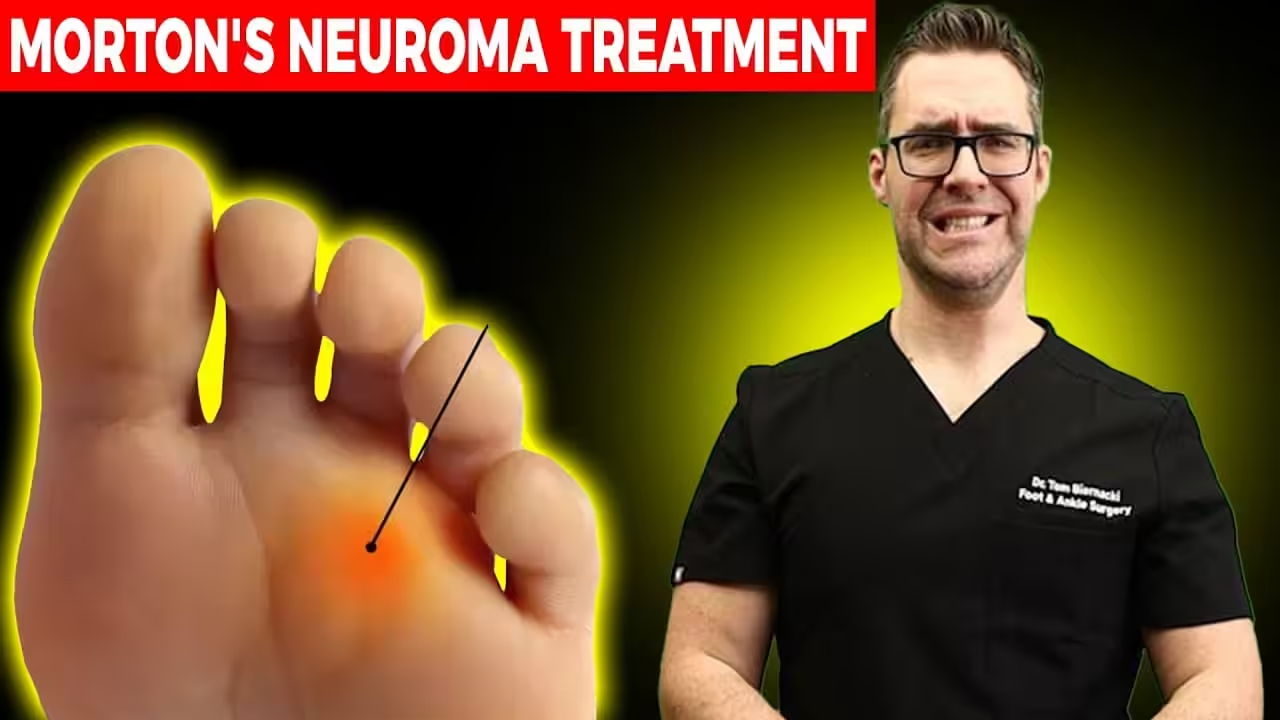
Morton’s neuroma is an enlargement and irritation of the interdigital nerve — most often the nerve running between the third and fourth metatarsal bones. When compressed, this nerve generates burning, tingling, and numbness radiating into the third and fourth toes.
In our clinic, Morton’s neuroma accounts for approximately 60–65% of all middle toe numbness presentations. The sensation is often described as “walking on a pebble” or “a bunched-up sock.” Narrow shoes and high heels are the primary mechanical triggers. APMA data indicates Morton’s neuroma affects up to 8 in 10 women who wear narrow or high-heeled footwear regularly.
Hammertoe with Nerve Impingement
When a hammertoe develops, the abnormal toe position places chronic pressure on both the dorsal skin and the digital nerves supplying the middle toes. The nerve compression from this bony malalignment produces numbness and tingling at the tip and dorsum of the affected toe.
We commonly see this in patients whose toe deformity has been present for years before they notice neurological symptoms. The numbness onset is typically gradual — unlike Morton’s neuroma, which can onset more acutely.
Peripheral Neuropathy
Peripheral neuropathy causes diffuse nerve damage affecting multiple toes symmetrically, rather than localizing to one nerve corridor. The most common cause in our patient population is type 2 diabetes — over 50% of people with diabetes develop some degree of peripheral neuropathy within 25 years of diagnosis according to NIH data.
The pattern here differs from Morton’s neuroma: numbness tends to be more diffuse, affects both feet, and follows a “stocking-glove” distribution starting at the tips of all toes and progressing proximally. It does not produce the sharp nerve pinch sensation Morton’s neuroma causes.
Tarsal Tunnel Syndrome
Tarsal tunnel syndrome is compression of the posterior tibial nerve at the medial ankle — the foot’s equivalent of carpal tunnel. When compressed, the nerve’s branches that supply plantar sensation produce numbness and tingling that can radiate into all toes including the middle toes.
A positive Tinel’s sign (tapping over the tarsal tunnel reproduces the tingling) is the key clinical differentiator. This is confirmed with nerve conduction velocity studies in ambiguous cases.
Stress Fracture of the Third Metatarsal
A stress fracture of the third metatarsal can produce localized inflammation that compresses the adjacent interdigital nerve. Unlike Morton’s neuroma, there is usually a point of sharp bony tenderness with palpation directly on the metatarsal shaft — not just between the metatarsal heads.
Runners and patients who have recently increased their walking volume are most at risk. If there is any history of increased activity before symptom onset, we X-ray the foot in our initial evaluation.
Lumbar Disc Pathology (Referred Numbness)
L4–S1 disc herniations can produce referred numbness that follows specific dermatomal distributions into the foot and toes. If numbness is accompanied by low back pain, hip pain, or sciatic symptoms, spinal pathology must be ruled out before treating the foot.
In our clinic, we screen for lumbar involvement by assessing the distribution and asking about back symptoms. When both back pain and toe numbness coexist, we refer to neurology or spine care before proceeding with podiatric intervention.
How Does Middle Toe Numbness Feel? Symptoms to Recognize
Middle toe numbness is not a single sensation — the quality and timing of the numbness tell us which structure is involved. Here is what each pattern points toward:
- Burning or electric pain between toes 3 and 4, worse in narrow shoes: Morton’s neuroma — classic presentation
- Numbness at the tip of one specific toe, gradual onset: Hammertoe with digital nerve compression
- Symmetric numbness in all toes, both feet, worse at night: Peripheral neuropathy — check blood glucose
- Tingling radiating from the inner ankle across the sole: Tarsal tunnel syndrome — Tinel’s sign at medial ankle
- Sharp pain over the metatarsal shaft plus numbness: Stress fracture with nerve irritation
- Numbness with low back pain or buttock pain: Lumbar radiculopathy — needs spine evaluation
- Sensation of walking on a pebble or bunched sock: Morton’s neuroma — the most pathognomonic description
Could This Be Something Else? When to Rule Out Other Causes
Middle toe numbness is the most common presentation of Morton’s neuroma, but it is not the only cause. In our clinic, we regularly see patients who have been treating the wrong problem for months because the symptoms overlapped. Here are the conditions most commonly confused with Morton’s neuroma:
Freiberg’s disease (avascular necrosis of the metatarsal head): This condition causes localized pain and sometimes numbness at the second or third metatarsal head — but the pain is worse with weight-bearing on the specific metatarsal head, and X-ray shows collapse of the metatarsal head. Morton’s neuroma pain is between the bones, not on them.
Intermetatarsal bursitis: A bursa between the metatarsal heads can become inflamed and mimic neuroma symptoms exactly. The distinguishing factor is that bursitis tends to produce more diffuse swelling and responds to anti-inflammatory treatment more readily than neuroma. Ultrasound is used to differentiate them in our clinic.
Peripheral artery disease (PAD): Reduced arterial blood flow to the toes can produce numbness and cold sensation. Unlike neuroma, PAD-related numbness worsens with activity (claudication pattern) and is accompanied by reduced pedal pulses, cool skin temperature, and sometimes skin changes. Diabetic patients with toe numbness always receive vascular assessment in our clinic.
The cleanest way to know exactly what you are dealing with is a clinical examination — X-rays, ultrasound, and a vascular check take less than 15 minutes to rule out the most serious causes. Book a diagnostic evaluation →
How to Diagnose Middle Toe Numbness
In our clinic, the diagnostic workup for middle toe numbness follows a defined sequence. The goal is to identify the nerve structure involved and rule out urgent pathology before recommending treatment.
Step 1 — Mulder’s click test: Compression of the forefoot while squeezing the metatarsal heads together. A palpable click with reproduction of symptoms confirms Morton’s neuroma in most cases.
Step 2 — Tinel’s sign at tarsal tunnel: Tapping over the posterior tibial nerve at the medial ankle. Radiating tingling into the toes confirms tarsal tunnel involvement.
Step 3 — Monofilament testing: A 10-gram monofilament applied to plantar surfaces tests protective sensation. Failure to detect the monofilament indicates significant peripheral neuropathy.
Step 4 — Diagnostic imaging: Weight-bearing X-rays to rule out stress fracture, bony deformity, and Freiberg’s disease. Diagnostic ultrasound is used when neuroma vs. bursitis is unclear — we can visualize the neuroma directly on ultrasound and perform guided injections in the same visit.
How to Treat Middle Toe Numbness at Home: 4-Step Protocol
If Morton’s neuroma or metatarsal nerve irritation is suspected (and urgent causes have been ruled out), this 4-step home protocol addresses the mechanical compression driving most cases:
Step 1 — Switch to Wide Toe Box Footwear Immediately
Narrow shoes compress the metatarsal heads together and squeeze the interdigital nerve. Wide toe box shoes — particularly Brooks, New Balance 4E width, or Altra — allow the metatarsal heads to spread and decompress the nerve. This is the single highest-impact change for Morton’s neuroma and should be implemented before all other interventions.
Step 2 — Add Metatarsal Pads
Metatarsal pads placed just proximal to the metatarsal heads (not under them) redirect plantar pressure away from the nerve compression zone. In our clinic, we demonstrate pad placement on the first visit — the position is counterintuitive for most patients and incorrect pad placement can worsen symptoms.
Step 3 — Use Anti-Inflammatory Measures
Ice applied to the ball of the foot for 15 minutes after activity reduces perineural inflammation. Oral NSAIDs (ibuprofen or naproxen) taken consistently for 7–10 days reduce acute nerve irritation. Do not use heat — heat increases blood flow and worsens acute nerve inflammation.
Step 4 — Consider Custom Orthotics for Structural Support
OTC metatarsal pads address acute symptoms. Custom 3D orthotics address the underlying biomechanical cause — forefoot valgus, excessive pronation, and elevated metatarsal loading — that creates the chronic compression in the first place. In our clinic, patients who receive custom orthotics have a significantly lower recurrence rate than those who use OTC pads alone.
Give this protocol 6 consistent weeks. If you are not seeing meaningful improvement, a clinical evaluation will identify the missing piece in a single appointment. Book now →
Warning Signs — When to Seek Immediate Care
Most middle toe numbness is safely managed at home with the protocol above. However, certain symptoms require same-day evaluation. Stop home treatment and call us immediately if you experience:
- Sudden complete loss of sensation in one or more toes: Acute nerve compression or vascular compromise — requires urgent evaluation to rule out circulation problems.
- Numbness spreading rapidly up the foot or leg: This is not Morton’s neuroma — could indicate deep vein thrombosis, acute radiculopathy, or Guillain-Barré in extreme cases. Seek emergency care.
- Diabetic patient with new toe numbness and any skin change: Diabetic neuropathy combined with skin breakdown is the leading cause of lower-limb amputation — same-day evaluation is mandatory.
- Numbness after an injury or fall: Rule out metatarsal fracture, Lisfranc injury, or vascular disruption before assuming nerve compression.
If you are unsure: call us at (810) 206-1402 and describe your symptoms. We can advise whether you need same-day care.
Best Products for Middle Toe Numbness — Dr. Tom’s Picks 2026
As an Amazon Associate, Balance Foot & Ankle earns from qualifying purchases. Every product below is recommended to actual patients at our Howell and Bloomfield Hills clinics. Commissions do not influence our clinical recommendations.
🏆 Pedag Metatarsal Pads — Best for Morton’s Neuroma Relief
Why Dr. Tom recommends it: Metatarsal pads placed just behind the metatarsal heads physically separate and decompress the bones that are squeezing the interdigital nerve. Pedag’s leather-backed version adheres securely inside shoes and maintains position through a full day of activity — a critical feature since pad migration defeats the therapeutic purpose entirely. We use this exact positioning technique in-clinic and give these to patients at their first visit.
★★★★★ Clinical Grade — Recommended to the majority of patients with Morton’s neuroma at first visit
✅ Best for: Patients with Morton’s neuroma or general metatarsalgia in closed-toe shoes
⚠️ Not ideal for: Sandal wearers or patients with very high arches who need orthotic-integrated metatarsal support
💡 Pro tip: Place the pad so its front edge sits just behind the metatarsal heads — not under them. Incorrect placement worsens compression.
📍 Located in Michigan?
Our board-certified podiatrists treat this condition at two convenient locations. Same-day appointments often available.
Buy Pedag Metatarsal Pads on Amazon →
🏆 PowerStep Pinnacle Insoles — Best OTC Orthotic for Nerve Decompression
Why Dr. Tom recommends it: The PowerStep Pinnacle provides both arch support and forefoot cushioning — the combination that addresses the two biomechanical drivers of metatarsal nerve compression: excessive pronation (which narrows the forefoot) and inadequate forefoot cushioning (which increases metatarsal head pressure). This is the OTC orthotic we recommend while patients are being evaluated for custom orthotics.
★★★★★ Clinical Grade — Standard OTC recommendation before custom orthotic fitting
✅ Best for: Patients with moderate arch collapse and forefoot nerve pain in athletic and casual footwear
⚠️ Not ideal for: Patients with rigid flat feet, high arches, or confirmed neuroma requiring custom orthotic fitting
💡 Pro tip: Combine with wide toe box shoes for additive decompression effect.
Buy PowerStep Pinnacle on Amazon →
🏆 Reusable Gel Ice Pack — Best for Post-Activity Nerve Inflammation
Why Dr. Tom recommends it: Cold therapy applied to the ball of the foot for 15 minutes after activity reduces perineural edema — the fluid accumulation around the irritated nerve that amplifies compression. A flexible gel ice pack conforms to the forefoot contour and can be applied while seated after work or exercise. Consistency matters more than intensity — 15 minutes daily produces cumulative reduction in inflammation over 2–4 weeks.
★★★★★ Clinical Grade — Recommended as part of every home care protocol for forefoot nerve pain
✅ Best for: All patients with active metatarsal nerve inflammation during the acute phase
⚠️ Not ideal for: Patients with Raynaud’s phenomenon or peripheral vascular disease — cold therapy can reduce circulation
💡 Pro tip: Never apply ice directly to skin — wrap in a thin cloth. 15 minutes on, 30 minutes off.
Buy Reusable Gel Ice Pack on Amazon →
These products resolve most mild-to-moderate Morton’s neuroma cases. If they have not helped after 4–6 weeks, the issue is likely structural and requires a professional assessment. Same-day appointments available →
When Home Treatment Is Not Enough
If conservative measures fail after 6–8 weeks, in-office treatment options produce excellent results. Early intervention produces faster recovery — most cases that go untreated for more than 6 months require more intensive intervention.
A 44-year-old teacher who came to us after 8 months of middle toe numbness had tried three different insoles without improvement. Diagnostic ultrasound confirmed a 7mm Morton’s neuroma between the third and fourth metatarsal heads. After two cortisone injections combined with custom orthotics, she was completely pain-free within 10 weeks. Patient details shared with permission; all identifying information has been changed.
Middle Toe Numbness Treatment at Balance Foot & Ankle
At our Howell clinic (4330 E Grand River Ave, Howell MI 48843) and Bloomfield Hills location (43494 Woodward Ave #208, Bloomfield Hills MI 48302), we offer the full spectrum of evidence-based treatments for middle toe numbness and Morton’s neuroma:
- Diagnostic ultrasound: Real-time imaging to confirm neuroma size and location — takes less than 5 minutes and is done in-office at the same visit as your evaluation.
- Cortisone injection under ultrasound guidance: Precisely targets the perineural space to reduce inflammation without guesswork. One to three injections resolve 60–70% of neuromas without surgery.
- MLS laser therapy: Multi-wave locked system laser reduces perineural inflammation and accelerates nerve tissue healing. Used for patients who do not tolerate injections or have had incomplete injection response.
- Custom 3D-scanned orthotics: Address the biomechanical root cause — forefoot loading patterns that concentrate pressure on the interdigital nerves. Dramatically reduce recurrence rate compared to OTC pads alone.
- Sclerosing alcohol injections: For recurrent or persistent neuroma — chemically sclerose (shrink) the nerve tissue without surgery. Effective in 80%+ of cases in published literature.
- Minimally invasive neuroma excision: When all conservative measures fail — a small outpatient procedure with excellent outcomes and rapid recovery.
📍 Balance Foot & Ankle Specialist
Howell: 4330 E Grand River Ave, Howell MI 48843 · (810) 206-1402
Bloomfield Hills: 43494 Woodward Ave #208, Bloomfield Hills MI 48302 · (810) 206-1402
✅ Same-day appointments available for new patients
✅ Most insurance accepted — including Medicare and Blue Cross
✅ No referral needed for most PPO plans
Frequently Asked Questions About Middle Toe Numbness
What causes middle toe numbness?
The most common cause is Morton’s neuroma — compression of the interdigital nerve between the third and fourth metatarsal heads. Other causes include hammertoe with digital nerve impingement, peripheral neuropathy (often from diabetes), tarsal tunnel syndrome, stress fracture, and lumbar disc pathology causing referred numbness.
How long does middle toe numbness take to resolve?
With conservative treatment (wide shoes, metatarsal pads, anti-inflammatories), most mild Morton’s neuroma cases improve within 6–8 weeks. Cases requiring cortisone injections typically resolve within 4–10 weeks. Peripheral neuropathy-related numbness has a slower, more variable course depending on the underlying cause and blood glucose control.
When should I see a podiatrist for middle toe numbness?
See a podiatrist if numbness persists beyond 2–4 weeks despite shoe changes and OTC pads, if numbness is spreading or worsening, if you are diabetic (any numbness warrants evaluation), if numbness is accompanied by visible swelling or skin changes, or if you have a history of back problems with new foot numbness.
Is middle toe numbness related to Morton’s neuroma?
In the majority of cases, yes — particularly when numbness is between the third and fourth toes and is worse in narrow shoes. However, other conditions including neuropathy, tarsal tunnel, and stress fracture can produce an identical presentation. Clinical examination and diagnostic ultrasound confirm the diagnosis in ambiguous cases.
Does insurance cover Morton’s neuroma treatment?
Yes — most insurance plans including Medicare and Blue Cross cover evaluation, X-rays, and cortisone injections for Morton’s neuroma. Custom orthotics coverage varies by plan. We verify benefits before your appointment so there are no billing surprises.
Can middle toe numbness go away on its own?
Mild Morton’s neuroma may improve with shoe modifications alone — particularly switching from narrow to wide toe box footwear. However, numbness that persists beyond 4–6 weeks without improvement rarely resolves on its own and tends to worsen with continued compression. Early treatment produces better outcomes than waiting.
Book a Middle Toe Numbness Appointment in Howell or Bloomfield Hills
Middle toe numbness that persists more than 2–4 weeks deserves a proper diagnosis. In one visit, we can confirm whether you have Morton’s neuroma, peripheral neuropathy, or another condition — and begin the treatment most likely to resolve it. Early diagnosis means shorter recovery and lower total cost of care.
📍 Balance Foot & Ankle Specialist
Howell: 4330 E Grand River Ave, Howell MI 48843 · (810) 206-1402
Bloomfield Hills: 43494 Woodward Ave #208, Bloomfield Hills MI 48302 · (810) 206-1402
✅ Same-day appointments available for new patients
✅ Most insurance accepted — including Medicare and Blue Cross
✅ No referral needed for most PPO plans
4.9★ on Google — read what patients say →
Can’t visit us in person? Video consultations available for patients across Michigan and nationally.
(810) 206-1402
Medical References & Sources
- American Podiatric Medical Association — Patient Education
- American Orthopaedic Foot & Ankle Society — Foot Conditions
👟 Dr. Tom’s Pick: FLAT SOCKS for Minimalist & Zero-Drop Shoes
Ultra-thin flat-knit socks designed specifically for zero-drop, barefoot, and minimalist shoes. No bunching, no seams — just foot-contact-the-ground feel with moisture control.
View FLAT SOCKS on Amazon →Affiliate disclosure: As an Amazon Associate, Balance Foot & Ankle earns from qualifying purchases.
📧 Get Dr. Tom’s Free Lab Test Guide
Discover the 5 lab tests every person over 35 should ask their doctor about — explained in plain English by a board-certified physician.

Dr. Tom Biernacki, DPM is a double board-certified podiatrist and foot & ankle surgeon at Balance Foot & Ankle Specialists in Southeast Michigan. With over a decade of clinical experience, he specializes in heel pain, bunions, diabetic foot care, sports injuries, and minimally invasive surgery. Dr. Biernacki is a member of the APMA and ACFAS, and his patient education content on MichiganFootDoctors.com and YouTube has reached over one million views.
Recommended Products from Dr. Tom