
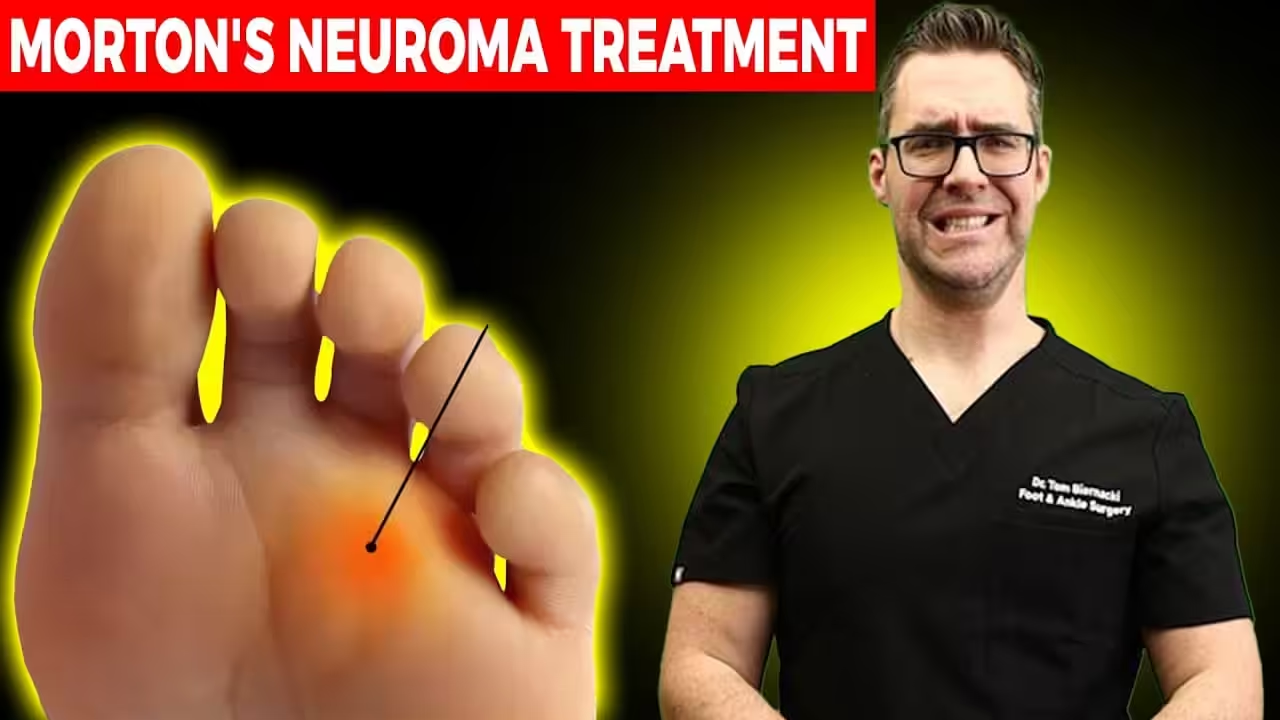

Quick answer: A pinched nerve in the foot or toe comes from compression somewhere along the nerve path, most commonly a Morton neuroma between the third and fourth toes, tarsal tunnel compression at the inner ankle, or pressure from a tight shoe across the top of the foot. Finding the level of compression is what makes treatment work, because identical burning, tingling or numbness can come from three different places and each one is relieved differently. Call (810) 206-1402.
https://www.youtube.com/watch?v=XsQhGOzPggcPinched Nerve in the Foot or Toe [Causes & Best Home Treatment]
95% of the time a pinched nerve in the foot or toe will cause sharp, shooting or tingling type pain. The #1) Cause is a Neuroma: FIX IT FAST!
Look:
- Ball of the foot pain and Morton’s neuroma pain can be improved with a few simple treatment changes.
- We are foot doctors & we see this problem get better almost every day.
- The goal is to solve this problem without medication or surgery if at all possible.
So, let’s GO!
Pinched Toe Nerve and Pinched Foot Nerve Treatment:
This video is the comprehensive guide to neuroma pain in the ball of the foot.
We go over everything you need for foot and toe nerve pain!
https://youtu.be/XsQhGOzPggcPinched Nerve in the Foot or Toe Symptoms:
The most common symptoms of a pinched nerve in the foot or toe are:
- Sharp pain
- Shooting pain
- Tingling pain.
- Pain at night.
- Usually this type of pain is not a deeping aching throb or a soreness type pain.

Causes:
- The most common cause of a pinched nerve in the foot is called a Morton’s neuroma.
- But there are other causes.
- For the other causes browse through the below list!
Pinched nerve in the toe causes:
The most common causes of a pinched nerve in the toes are:
- If you have a bent big toe, a bunion can really compress and cause you pain in this area. This is a definite cause of pain on the inside of the big toe.
- If your big toe is stiff and does not bend, this can cause nerve pain.
Pain in Small Toes (2-4th Toes).
- Click this link if you feel like you have pinching in your smaller toes.
- If you jammed your big toe and it is radiating up the foot, this may be a cause of that pain.
- This could cause neuroma and compression like pain. See if this is a cause for you.
- If your pain is mostly in the big toe, this may be a cause of pressure and pinching of the nerve as well.
Pinched nerve in the foot causes:
Plantar fasciitis can cause significant nerve pain in the feet, this is a very common cause of injury to this site.
If you have fat pad atrophy to the bottom of your foot, this can cause much more frequent compression to the front of the foot.
Posterior Tibial Nerve Entrapment:
This can happen with pain on the inside of the ankle. This can then radiate more and more through the ankles.
If you landed and bruised your heel, this is not so much a nerve injury, but more of a constant compression to the nerves in your heel.
A plantar fibroma can result in extensive compression of the nerves at the bottom of the foot and the nerves under the lump.
If your sprained your arch, this throbbing and swelling will cause extensive nerve pain.
If you strain the muscles in your arch, this will cause compression to your arch.
If you experience cramping at night, check out this article.
Home treatment of Morton’s Neuroma:
- If you are lucky enough to catch this serious problem in the early stages, there are things you can do to prevent any type of more invasive treatment.
- The goal of home treatment is to stabilize nerve and to relieve pressure from it.
- Your body can heal then let the inflammation and nerve pain decrease in size.
- The key predictor to success is a nerve <5mm in diameter. If you are worried your foot is too bad, then go see your podiatrist!
Good Shoes:
- Another thing we have seen frequently is people switching from a pair of high heels, a pair of flats, a pair of flexible and unsupportive shoes.
- The switch is made into a good supportive running shoe.
- A great running shoe combined with a great choice for an affordable over-the-counter orthotic lead to a near instant offloading of pain.
- This orthotic with an issue takes almost all the pressure off the second metatarsal joint.
- This leads to a near instant relief of pressure, along the joint to heal over the next few weeks or months.
Rest and ice:
- Ice for 20 minutes at a time.
- Ice this as long as possible to get the foot feeling better.
- Take a 1 hour break in between.
Stretching:
- The number one cause of second toe capsulitis and front of the foot pain is high arched foot in a tight Achilles tendon.
- We have great success to relieve this pain by stretching Achilles tendon, it is practical that over 3 to 4 weeks this condition can improve enough to remove the paint from the front of the foot.
- As your foot has more flexibility in bending up, it makes sense that there is less pressure on the front of the foot.
Morton’s Neuroma Research Review:
- This is a great article of a meta-analysis on all Morton’s neuroma treatment options.
- The most successful options were orthotics, injections and offloading.
- https://www.ncbi.nlm.nih.gov/pubmed/31718949
Related Treatment Guides
📧 Get Dr. Tom’s Free Lab Test Guide
Discover the 5 lab tests every person over 35 should ask their doctor about — explained in plain English by a board-certified physician.
📍 Located in Michigan?
Our board-certified podiatrists treat this condition at two convenient locations. Same-day appointments often available.
Think You Have a Pinched Nerve in Your Foot?
Pinched nerves in the foot cause burning, tingling, numbness, and shooting pain. Our podiatrists diagnose nerve entrapment conditions like tarsal tunnel syndrome, Morton’s neuroma, and Baxter’s nerve entrapment with precision testing.
References
- Ahmad M, et al. Tarsal tunnel syndrome: a thorough review. Foot Ankle Spec. 2012;5(2):141-145.
- Dellon AL. The four medial ankle tunnels: a critical review of perceptions of tarsal tunnel syndrome and neuropathy. Neurosurg Clin N Am. 2008;19(4):629-648.
- Baxter DE, Pfeffer GB. Treatment of chronic heel pain by surgical release of the first branch of the lateral plantar nerve. Clin Orthop Relat Res. 1992;279:229-236.
Insurance Accepted
BCBS · Medicare · Aetna · Cigna · United Healthcare · HAP · Priority Health · Humana · View All →
Howell Office
4330 E Grand River Ave
Howell, MI 48843
Get Directions →
Bloomfield Township Office
43494 Woodward Ave, #208
Bloomfield Township, MI 48302
Get Directions →
Your Board-Certified Podiatrists



Ready to Get Back on Your Feet?
Same-week appointments available at both locations.
Book Your AppointmentPodiatrist-Recommended Products
🏆 Doctor Hoy’s Natural Pain Relief Gel — Top recommendation for reducing foot pain and inflammation naturally.
PowerStep Pinnacle Orthotic Insoles — Physician-grade arch support in an OTC package.
CURREX Support Insoles — Dynamic arch support in multiple profiles.
In-Office Treatment at Balance Foot & Ankle
If home treatment isn’t providing relief for your foot and ankle conditions, our podiatry team at Balance Foot & Ankle can help with same-day evaluations and advanced in-office care.
Get Expert Care at Balance Foot & Ankle
Same-week appointments at our Howell and Bloomfield Township offices. Board-certified podiatric surgeons. Most insurance accepted.

Dr. Tom Biernacki, DPM is a board-certified foot & ankle surgeon (ABFAS & ABPM) at Balance Foot & Ankle Specialists in Southeast Michigan. With over a decade of clinical experience, he specializes in heel pain, bunions, diabetic foot care, sports injuries, and minimally invasive surgery. Dr. Biernacki is a member of the APMA and ACFAS, and his patient education content on MichiganFootDoctors.com and YouTube has made him one of the most-followed foot & ankle educators on YouTube.