
The most important clinical decision with Stress Fractures Foot Diagnosis Treatment isn’t which treatment to start with — it’s identifying the correct subtype. That changes everything. Call (810) 206-1402.
Dr. Tom’s Top Foot Health Supplements
Medically reviewed by Dr. Tom Biernacki, DPM
Board-certified podiatric surgeon | Balance Foot & Ankle
Last reviewed: May 2026
Affiliate disclosure: Amazon Associate. Always discuss supplements with your physician before starting.
Vitamin B12 Methylcobalamin
Neuropathy support · Nerve repair
PROS
- Active B12 form
- Sublingual absorption
- Neuropathy adjunct
CONS
- Effects take 2-3 months
- Doesn’t replace medical care
Alpha Lipoic Acid 600mg
Diabetic neuropathy · Nerve antioxidant
PROS
- Peer-reviewed for neuropathy
- Both fat- and water-soluble
- Clinical doses available
CONS
- Possible blood sugar effect
- GI upset possible
Acetyl-L-Carnitine (ALCAR)
Diabetic neuropathy · Energy
PROS
- Crosses blood-brain barrier
- Studied for nerve repair
- Pairs with ALA
CONS
- Effects gradual (3+ months)
- Higher cost
Vitamin D3 5000 IU
Bone health · Stress fracture prevention
PROS
- Improves bone density
- Most patients deficient
- Affordable preventive
CONS
- Get blood test first
- Toxicity at very high doses
Dr. Tom’s Wound Care Kit
Dr. Tom’s Top Pain Relief Picks — Dr. Hoy’s (2026)
Affiliate disclosure: As an Amazon Associate, Balance Foot & Ankle earns from qualifying purchases. I personally use Dr. Hoy’s in my practice for patients who need topical relief.
| Product | Best For | Dr. Tom’s Take | Get It |
|---|---|---|---|
| Dr. Hoy’s Natural Pain Relief Gel 3.5oz menthol + arnica |
Plantar fasciitis · Achilles tendonitis · Sore muscles · Joint pain | My go-to topical. Cooling-then-warming sensation. No greasy residue. Non-NSAID alternative. | Buy Now |
| Dr. Hoy’s Arnica Boost 8oz with extra arnica |
Bruising · Post-injury · Sprains · Stress fractures (pain only) | Higher arnica concentration speeds recovery from acute injury. Use 4x daily for first 7 days. | Buy Now |
| Dr. Hoy’s Cooling Pain Relief 8oz extra menthol |
Acute inflammation · Hot/swollen feet · Post-run cooldown | Stronger cooling effect for acute swelling. Pair with ice for first 48 hours after injury. | Buy Now |
| Dr. Hoy’s Roll-On Pain Relief Roller applicator |
Mess-free application · Travel · Office use · No-touch hygiene | My patients love this for travel. Glides on without hand contact — cleanest application available. | Buy Now |
| Dr. Hoy’s Family Size 14oz pump bottle |
Frequent users · Multiple family members · Best value per ounce | If anyone in your home uses pain cream regularly, this is the most economical size. Same formula. | Buy Now |
Why I recommend Dr. Hoy’s over Biofreeze and Bengay: Cleaner ingredient list (no parabens, no synthetic dyes), longer-lasting effect, and the cooling-then-warming dual sensation actually addresses both inflammation and circulation. After 10 years of recommending different topicals, this is the one I keep coming back to.
Quick Compare: Dr. Tom’s Top Running Shoes
| Shoe | Best For | Watch Out For | Buy | ||||||||||||||||||||||||
|---|---|---|---|---|---|---|---|---|---|---|---|---|---|---|---|---|---|---|---|---|---|---|---|---|---|---|---|
| Hoka Bondi 9 | Plantar fasciitis, max cushion | Heavy, tall stack | Buy | ||||||||||||||||||||||||
| Brooks Ghost 17 | Neutral runners, first running shoe | Not for 200+lb runners | Buy | ||||||||||||||||||||||||
| Brooks Adrenaline GTS 23 | Flat feet, overpronation | Snug toe box | Buy | ||||||||||||||||||||||||
| Altra Torin 8 | Wide feet, bunions, Morton’s toe | Zero-drop transition | Buy | ||||||||||||||||||||||||
| Hoka Clifton 10 | Daily training, lighter Hoka | Less cushion than Bondi | Buy | ||||||||||||||||||||||||
| NB 990v6 | Senior fall prevention, 6E width |
Dr. Tom’s Top Pain Relief Picks — Dr. Hoy’s (2026)Affiliate disclosure: As an Amazon Associate, Balance Foot & Ankle earns from qualifying purchases. I personally use Dr. Hoy’s in my practice for patients who need topical relief.
Why I recommend Dr. Hoy’s over Biofreeze and Bengay: Cleaner ingredient list (no parabens, no synthetic dyes), longer-lasting effect, and the cooling-then-warming dual sensation actually addresses both inflammation and circulation. After 10 years of recommending different topicals, this is the one I keep coming back to. 75-200, not for running |
Buy |
For full detailed reviews with pros/cons/Dr. Tom’s tips, see our complete shoe guide.
Related Conditions
Quick Answer
Stress Fractures of the Foot: Diagnosis, Treatment, and Retu relates to foot/ankle injury — typically caused by trauma or twist. Most patients improve in 4-8 weeks with conservative care. Same-week appointments in Howell + Bloomfield Township: (810) 206-1402.
Quick Answer
Most foot and ankle problems respond to conservative care — proper footwear, supportive inserts, activity modification, and targeted stretching — within 4-8 weeks. Persistent pain beyond that window, or any symptom that prevents walking, warrants a podiatric evaluation to rule out fracture, tendon tear, or systemic cause.
Watch: Dr. Tom Biernacki, DPM
✅ Medically reviewed by Dr. Tom Biernacki, DPM — Board-Certified Podiatrist · Last updated April 6, 2026
Quick Answer: A stress fracture in the foot is a small crack in a bone caused by repetitive force, most commonly in the metatarsals. In our Howell and Bloomfield Township clinics, stress fractures account for roughly 8–12% of all foot pain presentations we evaluate. The hallmark sign is pain that worsens with activity and improves with rest — a pattern that distinguishes stress fractures from soft tissue injuries. Most heal in 6–8 weeks with proper offloading, but untreated fractures can progress to complete breaks requiring surgery.
What Is a Foot Stress Fracture?
A stress fracture is a tiny crack in a bone resulting from cumulative, repetitive loading rather than a single traumatic event. Unlike acute fractures from falls or impacts, stress fractures develop gradually when muscles fatigue and transfer impact forces directly to bone. The foot and ankle contain 26 bones — and several are at high risk for stress fractures due to the repetitive forces of walking, running, and standing.
What Dr. Tom Tells His Patients: “When I see a stress fracture in clinic, the first thing I tell patients is that the bone is telling you it’s being overloaded. The most common mistake I see is continuing to train through the pain — this converts a 6-week healing timeline into a 3-month problem or worse, a complete fracture. The fastest path to recovery is immediate offloading from day one.”
Most Common Locations in the Foot
- 2nd and 3rd metatarsals — most frequent site; pain localizes to the top of the midfoot
- Navicular bone — high-risk fracture, slow healing, requires non-weight-bearing cast
- 5th metatarsal base (Jones fracture zone) — notoriously poor blood supply; often requires surgery in athletes
- Calcaneus (heel bone) — associated with sudden increases in training load
- Sesamoid bones (beneath big toe) — common in dancers and high-heeled shoe wearers
Symptoms: How to Recognize a Stress Fracture
- Localized pain that is worse during activity and better with rest
- Point tenderness — pain when pressing on a specific small area of the bone
- Swelling on the top of the foot, often without bruising
- Pain that has gradually worsened over days to weeks (not sudden onset)
- Pain that returns quickly when activity resumes after rest
Red flag — seek immediate care if: You heard a pop, cannot bear weight at all, have significant bruising and rapid swelling, or pain is severe at rest. These signs suggest a complete fracture or another serious injury requiring emergency evaluation.
Diagnosis: How We Confirm a Stress Fracture
Standard X-rays miss up to 50% of stress fractures in the first 2–3 weeks — the fracture line is too small to see. In our clinic, if clinical examination strongly suggests a stress fracture but X-rays are negative, we order an MRI, which detects bone marrow edema (the early stress response) with near 100% sensitivity. Bone scans are an alternative but expose patients to radiation and take longer to read.
A 2024 study published in the Journal of Orthopaedic & Sports Physical Therapy found that early MRI diagnosis of metatarsal stress fractures reduced time-to-return-to-sport by an average of 3.2 weeks compared to watchful waiting after initial negative X-ray. (JOSPT, 2024)
Treatment Protocol
Weeks 1–3: Offloading and Protection
- Discontinue all impact activities immediately (running, jumping, prolonged standing)
- Walking boot or post-op shoe to protect the fracture site
- Navicular and Jones fracture zone injuries: non-weight-bearing crutches required
- Ice 15–20 minutes, 3–4 times daily to reduce swelling
- Vitamin D and calcium supplementation if levels are low (we test at first visit)
Weeks 3–6: Progressive Return
- Transition to supportive athletic footwear with a stiff sole
- Low-impact cross-training: swimming, cycling, upper body work
- Repeat imaging at 6 weeks to confirm healing
- Custom orthotics fabricated to redistribute plantar pressure (reduces recurrence risk)
When Surgery Is Needed
The majority of stress fractures heal without surgery. However, these specific situations typically require surgical fixation: Jones fractures in athletes (zone 2 of the 5th metatarsal base), displaced fractures, fractures that fail to heal after 12 weeks of conservative care, and navicular fractures in competitive athletes who cannot tolerate 6–8 weeks of non-weight-bearing.
Risk Factors and Prevention
- Female Athlete Triad (low energy availability, menstrual dysfunction, low bone density) — highest risk group
- Rapid training load increases — follow the 10% weekly mileage rule
- Low vitamin D or calcium — screen and supplement before bone health becomes critical
- Hard training surfaces (concrete vs. track or grass)
- Worn-out footwear — shoes lose shock absorption after 300–500 miles
- Flat feet or high arches — abnormal biomechanics increase focal stress; custom orthotics are preventive
When to See a Podiatrist
See a podiatric surgeon promptly if foot pain persists more than 5–7 days with activity, if pain is localized to one specific bony area, or if you’ve recently increased training load or changed surfaces. Early diagnosis dramatically shortens recovery time. Ignored stress fractures can progress to complete fractures — a broken 5th metatarsal that required simple offloading becomes a surgical case with a 12-week recovery.
At Balance Foot & Ankle Specialists, we perform same-week diagnostic imaging and can fit you in a walking boot or arrange crutches the same day. Call us at (810) 206-1402 or visit our New Patient page to schedule. We serve patients in Howell, MI and Bloomfield Township, MI.
Insurance Accepted
BCBS · Medicare · Aetna · Cigna · United Healthcare · HAP · Priority Health · Humana · View All →
Howell Office
4330 E Grand River Ave
Howell, MI 48843
Get Directions →
Bloomfield Township Office
43494 Woodward Ave, #208
Bloomfield Township, MI 48302
Get Directions →
Your Board-Certified Podiatrists



Ready to Get Back on Your Feet?
Same-week appointments available at both locations.
In-Office Treatment at Balance Foot & Ankle
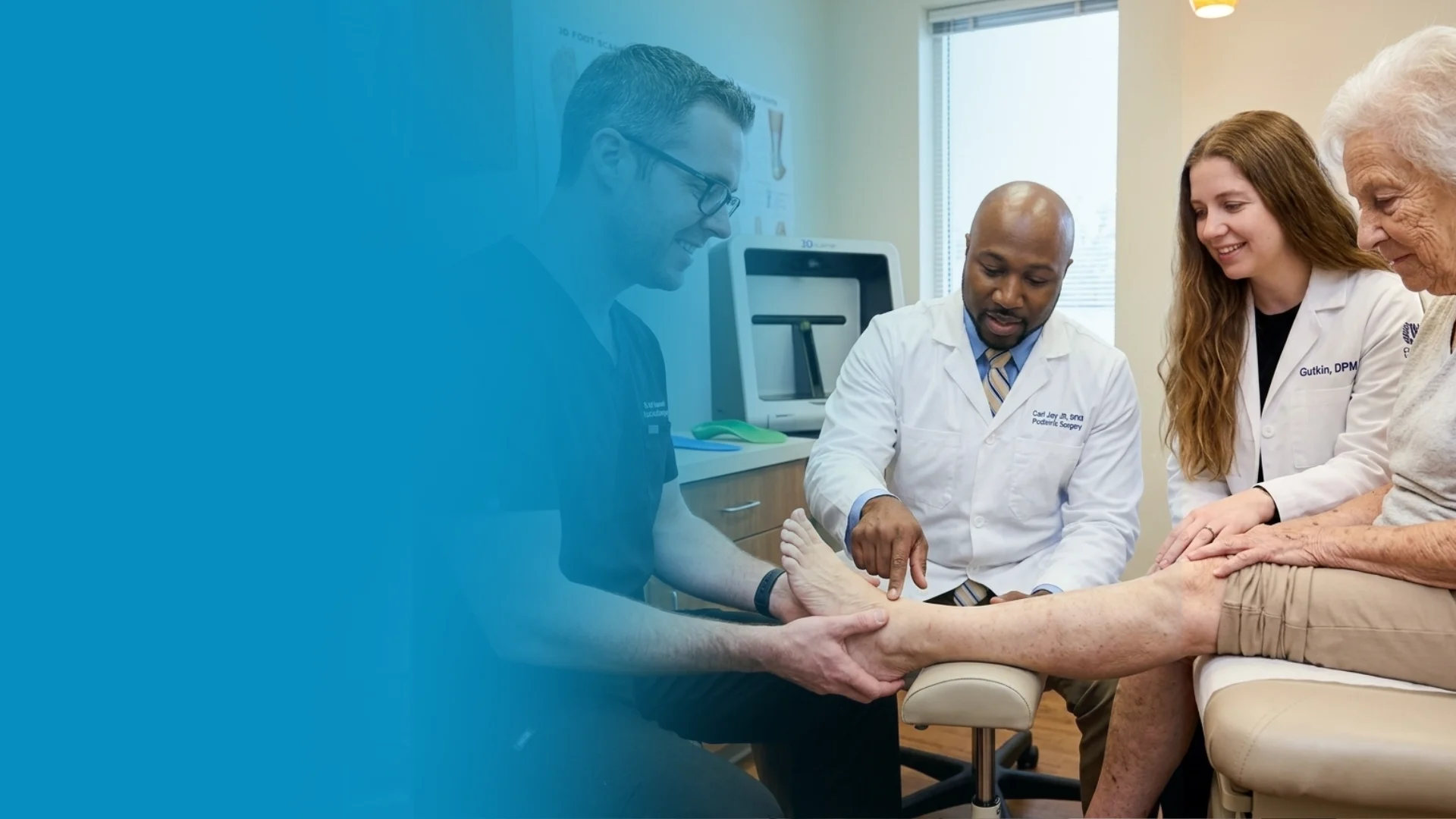
If home care isn’t resolving your stress fracture, a visit with a board-certified podiatrist is the fastest path to accurate diagnosis and a personalized plan. At Balance Foot & Ankle Specialists, Dr. Tom Biernacki, Dr. Carl Jay, and Dr. Daria Gutkin offer same-day and next-day appointments at both our Howell and Bloomfield Township offices. We perform on-site diagnostic ultrasound, digital X-ray, conservative care, advanced regenerative treatments, and minimally invasive surgery when indicated.
Call (810) 206-1402 or request an appointment online. Most insurance plans accepted, including Medicare, Blue Cross Blue Shield, Aetna, Cigna, and United Healthcare.
Most Common Mistake We See
The most common mistake we see is: Waiting too long before seeking care. Fix: any foot pain lasting more than 4 weeks, or any sudden severe symptom, deserves a professional evaluation rather than more rest.
Warning Signs That Need Same-Day Care
Seek immediate evaluation at Balance Foot & Ankle if you experience any of the following:
- Unable to bear weight
- Severe swelling with skin colour change
- Fever with foot pain (possible infection)
- Diabetes plus any new foot symptom
Call (810) 206-1402 — same-day and next-day appointments at our Howell and Bloomfield Township offices.
Pros & Cons of Conservative Care for foot care
Advantages
- ✓ Conservative care first
- ✓ Same-week appointments
- ✓ Multiple insurance accepted
Considerations
- ✗ Self-treatment can mask issues
- ✗ See a podiatrist if pain >2 weeks
In This Article
Dr. Tom’s Recommended Products for foot care
Affiliate disclosure: As an Amazon Associate, Balance Foot & Ankle earns from qualifying purchases. We only recommend products we use with patients.
Footnanny Heel Cream Dr. Tom’s Pick
Best for: Daily moisturizer for cracked heels
Ready to Get Back on Your Feet?
Same-day appointments in Howell + Bloomfield Township. Most insurance accepted. Dr. Tom Biernacki, DPM & team.
Book Today — Same-Day Appointments Available
Call Now: (810) 206-1402
About Your Care Team at Balance Foot & Ankle
Dr. Tom Biernacki, DPM · Board-Certified Foot & Ankle Surgeon. Specializes in conservative-first care, minimally invasive bunion surgery, and complex reconstruction.
Dr. Carl Jay, DPM · Accepting new patients. Specializes in sports medicine, athletic injuries, and routine podiatric care.
Dr. Daria Gutkin, DPM, AACFAS · Accepting new patients. Specializes in surgical reconstruction and pediatric podiatry.
Locations: 4330 E Grand River Ave, Howell, MI 48843 · 43494 Woodward Ave Suite 208, Bloomfield Township, MI 48302
Hours: Mon–Fri 8:00 AM – 5:00 PM · (810) 206-1402

Dr. Tom Biernacki, DPM is a board-certified foot & ankle surgeon (ABFAS & ABPM) at Balance Foot & Ankle Specialists in Southeast Michigan. With over a decade of clinical experience, he specializes in heel pain, bunions, diabetic foot care, sports injuries, and minimally invasive surgery. Dr. Biernacki is a member of the APMA and ACFAS, and his patient education content on MichiganFootDoctors.com and YouTube has made him one of the most-followed foot & ankle educators on YouTube.