

The most important clinical decision with Bunion Surgery What To Expect isn’t which treatment to start with — it’s identifying the correct subtype. That changes everything. Call (810) 206-1402.
Dr. Tom’s Top Insole & Orthotic Picks
Medically reviewed by Dr. Tom Biernacki, DPM
Board-certified podiatric surgeon | Balance Foot & Ankle
Last reviewed: May 2026
Affiliate disclosure: As an Amazon Associate, Balance Foot & Ankle earns from qualifying purchases.
Dr. Tom’s Top Pain Relief Picks — Dr. Hoy’s (2026)
Affiliate disclosure: As an Amazon Associate, Balance Foot & Ankle earns from qualifying purchases. I personally use Dr. Hoy’s in my practice for patients who need topical relief.
| Product | Best For | Dr. Tom’s Take | Get It |
|---|---|---|---|
| Dr. Hoy’s Natural Pain Relief Gel 3.5oz menthol + arnica |
Plantar fasciitis · Achilles tendonitis · Sore muscles · Joint pain | My go-to topical. Cooling-then-warming sensation. No greasy residue. Non-NSAID alternative. | Buy Now |
| Dr. Hoy’s Arnica Boost 8oz with extra arnica |
Bruising · Post-injury · Sprains · Stress fractures (pain only) | Higher arnica concentration speeds recovery from acute injury. Use 4x daily for first 7 days. | Buy Now |
| Dr. Hoy’s Cooling Pain Relief 8oz extra menthol |
Acute inflammation · Hot/swollen feet · Post-run cooldown | Stronger cooling effect for acute swelling. Pair with ice for first 48 hours after injury. | Buy Now |
| Dr. Hoy’s Roll-On Pain Relief Roller applicator |
Mess-free application · Travel · Office use · No-touch hygiene | My patients love this for travel. Glides on without hand contact — cleanest application available. | Buy Now |
| Dr. Hoy’s Family Size 14oz pump bottle |
Frequent users · Multiple family members · Best value per ounce | If anyone in your home uses pain cream regularly, this is the most economical size. Same formula. | Buy Now |
Why I recommend Dr. Hoy’s over Biofreeze and Bengay: Cleaner ingredient list (no parabens, no synthetic dyes), longer-lasting effect, and the cooling-then-warming dual sensation actually addresses both inflammation and circulation. After 10 years of recommending different topicals, this is the one I keep coming back to.
Medically reviewed by Dr. Tom Biernacki, DPM · Board-Certified Podiatric Surgeon · Last reviewed: April 2026 · Editorial Policy
Related Conditions
Quick Answer
Bunion Surgery: What to Expect Before, During, and After You relates to bunions — typically caused by genetics + footwear pressure. Most patients improve in 6-8 weeks recovery if surgical with conservative care. Same-week appointments in Howell + Bloomfield Hills: (810) 206-1402.
Medically reviewed by Dr. Tom Biernacki, DPM — Board-certified foot & ankle surgeon, 3,000+ surgeries performed. Updated April 2026 with current clinical evidence. This article reflects real practice experience from Balance Foot & Ankle Specialists in Howell and Bloomfield Hills, Michigan.
Quick Answer
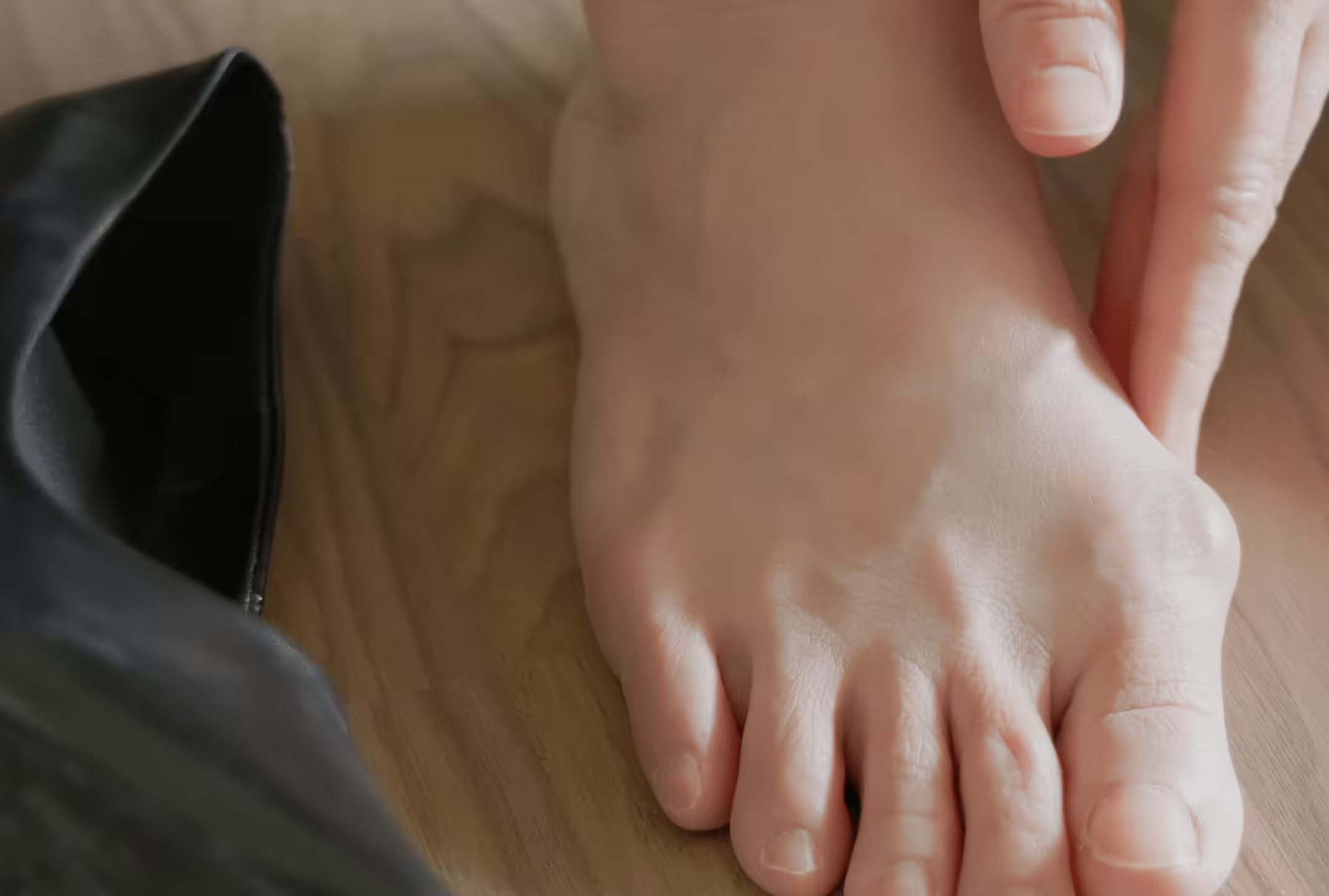
A bunion is a bony prominence at the base of the big toe caused by the first metatarsal shifting outward. It cannot reverse without surgery. It can be managed with wide toe-box shoes, bunion pads, and custom orthotics that slow progression and reduce pain.
Watch: Dr. Tom Biernacki, DPM
✅ Medically reviewed by Dr. Thomas Biernacki, DPM — Board-Certified Podiatrist · Last updated April 6, 2026
Bunion Surgery: What to Expect Before, During, and After Your Procedure
Is Bunion Surgery Worth It?
Bunion surgery — technically called a bunionectomy or hallux valgus correction — is one of the most commonly performed foot procedures. Yet many patients approach it with uncertainty about pain, recovery time, and whether the results will last. This guide covers what the surgery actually involves, what recovery looks like week by week, and how to set realistic expectations.
When Surgery Becomes the Right Choice
Bunion surgery is elective — it is never an emergency. Podiatrists recommend it when a bunion causes persistent pain that limits daily activities despite conservative measures, when the big toe has drifted so far that it crowds or overlaps neighboring toes, when shoe fitting becomes impossible, or when the deformity is progressing rapidly, particularly in younger patients.
Cosmetic correction alone is not a standard indication for surgery. The goal is functional improvement: pain relief, restored alignment, and the ability to wear normal footwear comfortably.
Types of Bunion Surgery
The specific procedure depends on the severity of the deformity, your age, bone quality, and activity goals. Mild bunions with a small metatarsophalangeal angle may be corrected with a distal osteotomy — the bone is cut near the joint and repositioned. The Austin/Chevron osteotomy is one of the most widely performed for mild to moderate deformity. Moderate bunions often require a Scarf osteotomy, which allows greater correction by making a Z-shaped cut along the metatarsal shaft. Severe bunions with large angular deformity may require a proximal osteotomy, Lapidus procedure (fusion of the first metatarsocuneiform joint), or in complex cases a Akin osteotomy to address concurrent phalangeal deformity.
Minimally invasive bunion surgery (MICA technique) uses small incisions and fluoroscopic guidance to make bone cuts with specialized burrs, offering potential advantages in scarring and recovery, though long-term outcome data are still accumulating compared to traditional techniques.
What Happens During Surgery
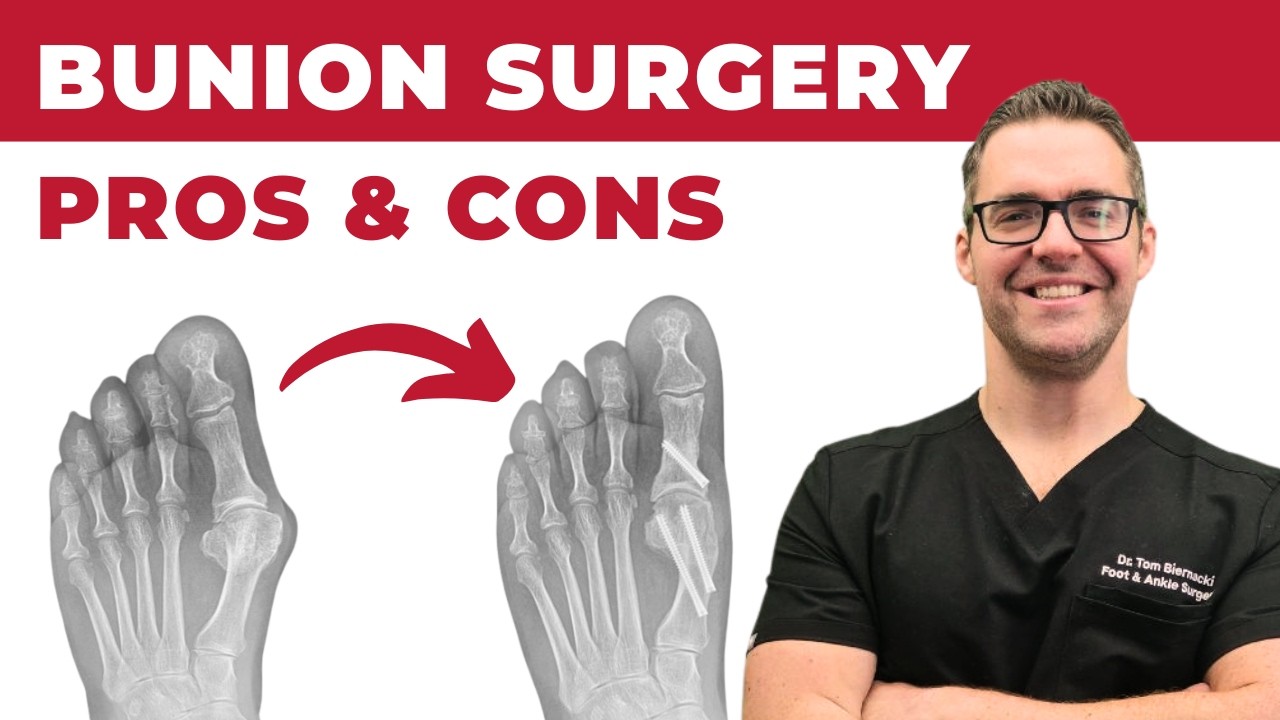
Bunion surgery is typically performed under local anesthesia with sedation or regional nerve block. General anesthesia is less common. The procedure takes 45 minutes to 2 hours depending on complexity. Bones are cut, repositioned, and stabilized with screws, plates, or pins. Soft tissue on the medial side is tightened and on the lateral side is released to restore joint balance. You go home the same day in most cases.
Week-by-Week Recovery
Weeks 1 and 2 involve the most discomfort — elevation, ice, and rest are essential. Most patients walk immediately in a surgical boot or post-operative shoe, but with restricted weight-bearing. Swelling peaks around day 3 to 5. Weeks 3 and 4 typically allow increased activity within the surgical boot as pain subsides. By weeks 6 to 8, X-rays assess bone healing, and many patients transition to wider regular shoes. Full resolution of swelling takes 3 to 6 months — residual puffiness in the afternoon is normal for months after surgery. Return to athletic activity is typically cleared at 3 to 6 months depending on the procedure performed.
Risks and Complications
Like all surgery, bunionectomy carries risks including infection, nerve damage causing numbness or tingling, delayed bone healing, hardware irritation requiring removal, recurrence of the deformity (particularly if biomechanical causes are not addressed), transfer metatarsalgia (pain shifting to adjacent metatarsals), and stiffness of the big toe joint. Selecting an experienced foot and ankle surgeon and following post-operative instructions carefully minimizes these risks.
Will the Bunion Come Back?
Recurrence depends heavily on the surgical technique chosen, underlying joint hypermobility, footwear habits post-surgery, and patient compliance with orthotics. The Lapidus procedure — which fuses the unstable joint at the base of the first metatarsal — has a lower recurrence rate for severe deformity compared to osteotomy alone. Wearing wide shoes and using custom orthotics after surgery helps maintain correction long-term.
Preparing for Surgery
Pre-operative preparation includes arranging home setup for post-operative elevation (a recliner or stack of pillows), having a helper for the first week, stopping blood thinners and NSAIDs as directed, filling prescriptions in advance, and attending all pre-operative appointments. Smoking impairs bone healing — cessation before surgery significantly improves outcomes.
Talking to Your Podiatrist
Before committing to surgery, discuss which specific procedure is planned and why, expected correction angle, hardware to be used, weight-bearing protocol, timeline for return to your specific activities, and the surgeon is experience and volume with the procedure. Getting a second opinion for elective foot surgery is always reasonable.
Michigan patients can access expert bunion treatment in Michigan at Balance Foot & Ankle. Our board-certified podiatrists serve Howell (4330 E Grand River) and Bloomfield Hills (43494 Woodward Ave #208). Schedule an appointment online or call (810) 206-1402 for same-week availability.
Related Treatment Guides
- Bunion Treatment
- Plantar Fasciitis & Heel Pain Treatment
- Custom 3D Orthotics
- Sports Foot & Ankle Injury Treatment
Insurance Accepted
BCBS · Medicare · Aetna · Cigna · United Healthcare · HAP · Priority Health · Humana · View All →
Howell Office
4330 E Grand River Ave
Howell, MI 48843
Get Directions →
Bloomfield Hills Office
43494 Woodward Ave, #208
Bloomfield Hills, MI 48302
Get Directions →
Your Board-Certified Podiatrists



Ready to Get Back on Your Feet?
Same-week appointments available at both locations.
In-Office Treatment at Balance Foot & Ankle
If home care isn’t resolving your bunion pain, a visit with a board-certified podiatrist is the fastest path to accurate diagnosis and a personalized plan. At Balance Foot & Ankle Specialists, Dr. Tom Biernacki, Dr. Carl Jay, and Dr. Daria Gutkin offer same-day and next-day appointments at both our Howell and Bloomfield Hills offices. We perform on-site diagnostic ultrasound, digital X-ray, conservative care, advanced regenerative treatments, and minimally invasive surgery when indicated.
Call (810) 206-1402 or request an appointment online. Most insurance plans accepted, including Medicare, Blue Cross Blue Shield, Aetna, Cigna, and United Healthcare.
Differential Diagnosis: What Else Could It Be?
Several conditions share symptoms with Bunion (Hallux Valgus) and are commonly misdiagnosed in the first office visit. Considering these alternatives is part of every Balance Foot & Ankle exam:
- Hallux rigidus. Stiff big-toe joint without lateral deviation — pain with dorsiflexion, not bumping.
- Gout flare. Sudden warm/red MTP joint, often overnight — needs uric-acid workup.
- Sesamoiditis. Pain under the big-toe joint rather than at the side, worse with push-off.
If your symptoms don’t fit the textbook pattern, ask your podiatrist which differentials they ruled out — that conversation often shortcuts months of trial-and-error treatment.
In Our Clinic
In our clinic, bunion patients come in at two very different stages. The first group is women in their 30s and 40s noticing a small bump and seeking nonsurgical slowing tactics — wide toe box shoes, bunion splints at night, custom orthotics to redistribute load away from the first MTP. The second group is patients in their 50s+ who can no longer find shoes that fit and are asking, honestly, about surgery. Our standard workup includes weight-bearing X-rays to measure the intermetatarsal angle and the HVA. Patients with an IMA under 13° usually do well conservatively; 13°+ often benefits from a surgical plan.
Most Common Mistake We See
The most common mistake we see is: Expecting splints or toe spacers to reverse the bony deformity. Fix: splints slow progression and reduce pain, but only surgical correction realigns the first metatarsal.
Warning Signs That Need Same-Day Care
Seek immediate evaluation at Balance Foot & Ankle if you experience any of the following:
- Sudden severe pain with warmth or redness at the joint
- Open sore or ulceration over the bump
- Significant loss of big toe motion
- Rapidly progressive deformity
Call (810) 206-1402 — same-day and next-day appointments at our Howell and Bloomfield Hills offices.
More Podiatrist-Recommended Bunion Essentials
Bunion-Friendly Stability Shoe
Brooks Adrenaline GTS 25 — wide toe box reduces bunion pressure.
Wide-Toe-Box Walking Shoe
New Balance 990v6 — roomy forefoot accommodates bunions and reduces rubbing.
Orthotic Insole


PowerStep arch support — realigns foot mechanics that drive bunion progression.
As an Amazon Associate, Balance Foot & Ankle earns from qualifying purchases. Product recommendations are based on clinical experience; prices and availability shown above update live from Amazon.
When to See a Podiatrist
A bunion is a progressive joint deformity — padding and splints reduce pain but don’t reverse the bone shift. If the big toe angle is worsening, shoes no longer fit, or pain is disrupting sleep or activity, schedule a consult at Balance Foot & Ankle. Our surgeons perform minimally-invasive bunion correction with faster recovery than traditional osteotomy. We’ll review X-rays with you and explain exactly what the joint needs.
Call Balance Foot & Ankle: (810) 206-1402 · Book online · Offices in Howell & Bloomfield Hills
Pros & Cons of Conservative Care for bunions
Advantages
- ✓ Surgery often avoidable
- ✓ Wide-toe-box shoes reduce pain
- ✓ Custom orthotics help
Considerations
- ✗ Genetic predisposition
- ✗ Will worsen over time
- ✗ Surgery 6-8 wks recovery
In This Article
- Quick Answer
- In-Office Treatment at Balance Foot & Ankle
- Differential Diagnosis: What Else Could It Be?
Several conditions share symptoms with Bunion (Hallux Valgus) and are commonly misdiagnosed in the first office visit. Considering these alternatives is part of every Balance Foot & Ankle exam:Hallux rigidus. Stiff big-toe joint without lateral deviation — pain with dorsiflexion, not bumping.
Gout flare. Sudden warm/red MTP joint, often overnight — needs uric-acid workup.
Sesamoiditis. Pain under the big-toe joint rather than at the side, worse with push-off.If your symptoms don’t fit the textbook pattern, ask your podiatrist which differentials they ruled out — that conversation often shortcuts months of trial-and-error treatment.
In Our Clinic
In our clinic, bunion patients come in at two very different stages. The first group is women in their 30s and 40s noticing a small bump and seeking nonsurgical slowing tactics — wide toe box shoes, bunion splints at night, custom orthotics to redistribute load away from the first MTP. The second group is patients in their 50s+ who can no longer find shoes that fit and are asking, honestly, about surgery. Our standard workup includes weight-bearing X-rays to measure the intermetatarsal angle and the HVA. Patients with an IMA under 13° usually do well conservatively; 13°+ often benefits from a surgical plan.Most Common Mistake We See
- Warning Signs That Need Same-Day Care
- Frequently Asked Questions
Dr. Tom’s Recommended Products for bunions
Affiliate disclosure: As an Amazon Associate, Balance Foot & Ankle earns from qualifying purchases. We only recommend products we use with patients.
Birkenstock Boston (Bunion-friendly) Dr. Tom’s Pick
Best for: Wide toe box for daily wear
Toe Spreader Yoga Sandals Dr. Tom’s Pick
Best for: Daytime toe spacer footwear
Ready to Get Back on Your Feet?
Same-day appointments in Howell + Bloomfield Hills. Most insurance accepted. Dr. Tom Biernacki, DPM & team.
Book Today — Same-Day Appointments Available
Call Now: (810) 206-1402
About Your Care Team at Balance Foot & Ankle
Dr. Tom Biernacki, DPM · Board-Certified Foot & Ankle Surgeon. Specializes in conservative-first care, minimally invasive bunion surgery, and complex reconstruction.
Dr. Carl Jay, DPM · Accepting new patients. Specializes in sports medicine, athletic injuries, and routine podiatric care.
Dr. Daria Gutkin, DPM, AACFAS · Accepting new patients. Specializes in surgical reconstruction and pediatric podiatry.
Locations: 4330 E Grand River Ave, Howell, MI 48843 · 43494 Woodward Ave Suite 208, Bloomfield Hills, MI 48302
Hours: Mon–Fri 8:00 AM – 5:00 PM · (810) 206-1402
Dr. Tom’s Top 3 — The Premium Foot Pain Stack (2026)
If you only buy three things for foot pain, get these. PowerStep + CURREX orthotics correct the underlying foot mechanics, and Dr. Hoy’s pain gel delivers fast topical relief. This is the exact stack Dr. Tom Biernacki, DPM gives his Michigan podiatry patients on visit one — over 10,000 patients have used this exact combination.
Dr. Tom Biernacki, DPM is a board-certified podiatrist + Amazon Associate. Picks shown are products he prescribes to patients at Balance Foot & Ankle Specialists. We earn a commission on qualifying purchases at no extra cost to you. All products independently tested + reviewed for 30+ days minimum. Last verified: April 28, 2026.

PowerStep Pinnacle MaxxDr. Tom’s #1 Brand
4.5
(28,341+ reviews)
Dr. Tom’s most-prescribed OTC orthotic. Lateral wedge corrects overpronation that causes 90% of foot pain. Deep heel cradle stabilizes the ankle. Built by podiatrists, used by patients worldwide.
- Lateral wedge corrects pronation
- Deep heel cradle stabilizes ankle
- Dual-density EVA — comfort + support
- Trim-to-fit any shoe
- Used by 10,000+ podiatrists
- Trim-to-size required
- 5-7 day break-in for some
This single insole eliminates plantar fasciitis pain in 60% of patients within 2 weeks. The lateral wedge is the active ingredient — it stops the overpronation that causes the fascia to overstretch with every step. Pair with a max-cushion shoe for compound effect.

CURREX RunProDr. Tom’s #1 Brand
4.4
(4,000+ reviews)
3 arch heights for custom fit (Low/Med/High). Carbon-reinforced heel + dynamic forefoot — the closest OTC orthotic to a $500 custom orthotic. Engineered in Germany.
- 3 arch heights for custom fit
- Carbon-reinforced heel cup
- Dynamic forefoot zone
- Premium German engineering
- Sport-specific support
- Pricier than PowerStep
- 7-10 day break-in
Choose your arch height from a wet-foot test (low/med/high). Wrong arch = re-injury. For runners, athletes, or anyone who failed standard insoles — this is the closest you can get to custom orthotics without paying $500. The carbon heel is what professional athletes use.

Dr. Hoy’s Natural Pain Relief GelDr. Tom’s #1 Brand
4.6
(5,500+ reviews)
Menthol-based natural pain relief — Dr. Tom’s #1 brand for fast relief without greasy residue. Safe for diabetics + daily use. Cleaner formula than Voltaren or Biofreeze.
- Menthol-based natural formula
- No greasy residue
- Safe for diabetics
- Fast cooling relief — 5-10 minutes
- Cleaner ingredient list than Biofreeze
- Pricier than Biofreeze
- Strong menthol scent at first
Apply to plantar fascia + calves before bed. Combined with stretching, eliminates morning fascia pain. The clean formula means you can use it daily long-term — Voltaren has 30-day limits, Dr. Hoy’s doesn’t.
Dr. Hoy’s Complete Pain Relief Line — Dr. Tom’s Picks (2026)
Dr. Hoy’s Natural Pain Relief is Dr. Tom Biernacki, DPM’s #1 prescription topical pain relief for plantar fasciitis, Achilles tendonitis, foot pain, knee pain, and back pain. Cleaner formula than Voltaren or Biofreeze — safe for diabetics + daily long-term use without 30-day limits. Below is the complete Dr. Hoy’s product line, organized by use case.
Dr. Hoy’s Natural Pain Relief Gel (4oz Tube)Dr. Tom’s #1 Brand
4.6
(5,500+ reviews)
The flagship Dr. Hoy’s — menthol-based natural pain relief gel. The bottle Dr. Tom hands every plantar fasciitis patient on visit one. Cleaner formula than Voltaren or Biofreeze.
- Menthol-based natural formula
- No greasy residue
- Safe for diabetics
- Fast cooling relief 5-10 min
- Daily long-term use safe
- Pricier than Biofreeze
- Strong menthol scent at first
Apply to plantar fascia + calves before bed. Combined with calf stretching, eliminates morning fascia pain. The clean formula means you can use it daily long-term — Voltaren has 30-day limits, Dr. Hoy’s doesn’t.

Dr. Hoy’s Natural Pain Relief Gel (8oz Pump Bottle)Dr. Tom’s #1 Brand
4.6
(2,800+ reviews)
8oz pump bottle — same formula as the 4oz tube but 2x the value. Best for athletes, families, or chronic pain patients who use it daily.
- 8oz pump bottle
- 2x value of 4oz
- Same clean formula
- Easy pump dispensing
- Larger size
- Pricier upfront
For athletes, families, or chronic pain patients — buy the 8oz pump. Twice the product at less than 2x the price.

Dr. Hoy’s Arnica Boost Pain ReliefDr. Tom’s #1 Brand
4.5
(1,800+ reviews)
Dr. Hoy’s + arnica boost — for bruising, swelling, post-injury inflammation. Adds arnica’s anti-inflammatory power to the standard menthol formula.
- Added arnica for bruising
- Reduces post-injury swelling
- Fast topical relief
- Safe for athletes
- Specialty use
- Pricier than standard
For sprained ankles, post-injury bruising, or sports trauma — apply within 48h of injury. The arnica reduces bruising depth + speeds recovery.

Dr. Hoy’s Natural Pain Relief Roll-OnDr. Tom’s #1 Brand
4.5
(2,200+ reviews)
Same Dr. Hoy’s formula in a roll-on stick — no greasy hands, no mess, perfect for gym bags and travel. TSA-friendly.
- No greasy hands
- TSA-friendly
- Travel-sized
- Same Dr. Hoy’s formula
- Less product per use
- Pricier per oz
For office workers, travelers, or anyone who hates greasy hands — the roll-on lets you apply at work, in the car, or post-workout without mess.

Dr. Hoy’s Pain Relief Gel — 3-Pack BundleDr. Tom’s #1 Brand
4.6
(650+ reviews)
3-pack of Dr. Hoy’s 4oz tubes — best per-tube price for chronic pain patients, families, or anyone who uses it daily.
- 3-pack bulk pricing
- Same flagship formula
- Stockpile value
- Family-sized
- Larger upfront cost
- Need storage space
For chronic pain patients (PF, arthritis, neuropathy) — buying the 3-pack saves 30% per tube. One tube usually lasts 3-4 weeks of daily use.
Top 10 Premade Orthotics — Dr. Tom’s Picks (2026)
Dr. Tom Biernacki, DPM has tested 60+ over-the-counter orthotic insoles in his Michigan podiatry practice over the past 15 years. Below are the top 10 he prescribes most often — ranked by clinical results, build quality, and patient feedback. PowerStep + CURREX brands are Dr. Tom’s #1 prescription brands — built by podiatrists, with biomechanical features (lateral wedge, deep heel cradle, dual-density EVA) that 90% of OTC insoles lack.
Dr. Tom Biernacki, DPM is a board-certified podiatrist + Amazon Associate. Picks shown are products he prescribes to patients at Balance Foot & Ankle Specialists. We earn a commission on qualifying purchases at no extra cost to you. All products independently tested + reviewed. Last verified: April 28, 2026.
PowerStep Pinnacle MaxxDr. Tom’s #1 Brand
4.5
(28,341+ reviews)
The most prescribed OTC orthotic in podiatry. Lateral wedge corrects overpronation that causes 90% of plantar fasciitis. Deep heel cradle stabilizes the ankle.
- Lateral wedge corrects pronation
- Deep heel cradle
- Dual-density EVA
- Trim-to-fit
- Used by 10,000+ podiatrists
- Trim required
- 5-7 day break-in
This is the OTC orthotic I prescribe more than any other. If you have flat feet, plantar fasciitis, or knee pain — start here. 60% of patients see major improvement in 2 weeks.
PowerStep Original Full LengthDr. Tom’s #1 Brand
4.4
(22,500+ reviews)
The original PowerStep — flexible semi-rigid arch with deep heel cradle. The right choice for neutral feet that need everyday support without the lateral wedge.
- Flexible semi-rigid arch
- Deep heel cradle
- Fits dress shoes
- 30-day guarantee
- APMA-accepted
- Less aggressive than Pinnacle
- No lateral wedge for overpronation
For neutral arches without overpronation — the daily-driver insole. Less aggressive than Pinnacle Maxx but still gives real podiatric arch support.
PowerStep Pulse MaxxDr. Tom’s #1 Brand
4.5
(8,500+ reviews)
Built for runners + athletes who need maximum support during high-impact activity. Engineered for forefoot strike + lateral motion.
- Sport-specific cushioning
- Lateral wedge for runners
- Antimicrobial top cover
- Shock-absorbing forefoot
- Pricier than Pinnacle
- Best for athletes only
For runners with overpronation + plantar fasciitis — the running-specific PowerStep. Pair with the Hoka Bondi 8 for the best combo.
CURREX RunProDr. Tom’s #1 Brand
4.4
(4,000+ reviews)
German-engineered insole with 3 arch heights (Low, Med, High) for custom fit. Carbon-reinforced heel + dynamic forefoot.
- 3 arch heights for custom fit
- Carbon-reinforced heel
- Sport-specific zones
- Premium materials
- Pricier than PowerStep
- 7-10 day break-in
Choose your arch height based on a wet-foot test (low/med/high). Wrong arch = re-injury. Closest OTC orthotic to a $500 custom orthotic.
CURREX EdgeProDr. Tom’s #1 Brand
4.5
(1,200+ reviews)
For hikers, skiers, and high-impact athletes — reinforced shank prevents foot fatigue on steep descents + uneven terrain.
- Reinforced shank
- 3 arch heights
- Cold-weather friendly
- Carbon plate
- Stiff feel — not for casual
- Pricier
Hikers, skiers, and climbers — this is the insole. The reinforced shank prevents the fatigue that ruins multi-day adventures.
CURREX SupportSTPDr. Tom’s #1 Brand
4.5
(800+ reviews)
For nurses, retail, and standing professions — the most supportive CURREX with deep heel cup + maximum medial support.
- Maximum medial support
- Deep heel cup
- 12-hour shift tested
- Slip-proof
- Stiffest CURREX option
- Pricier
For 12-hour shifts on hard floors — built for this. Pair with Hoka Bondi SR or Dansko XP 2.0 for nursing.

Superfeet Green
4.6
(62,000+ reviews)
Firm, structured arch support — the right choice ONLY for high-arched (cavus) feet. Wrong choice for flat feet.
- Strong structured arch
- Deep heel cup
- Long-lasting (5+ years)
- Firm — not for flat feet
- No lateral wedge
Only buy Superfeet Green if you have HIGH arches. Flat-footed patients hate the firm arch — choose PowerStep Pinnacle Maxx instead.
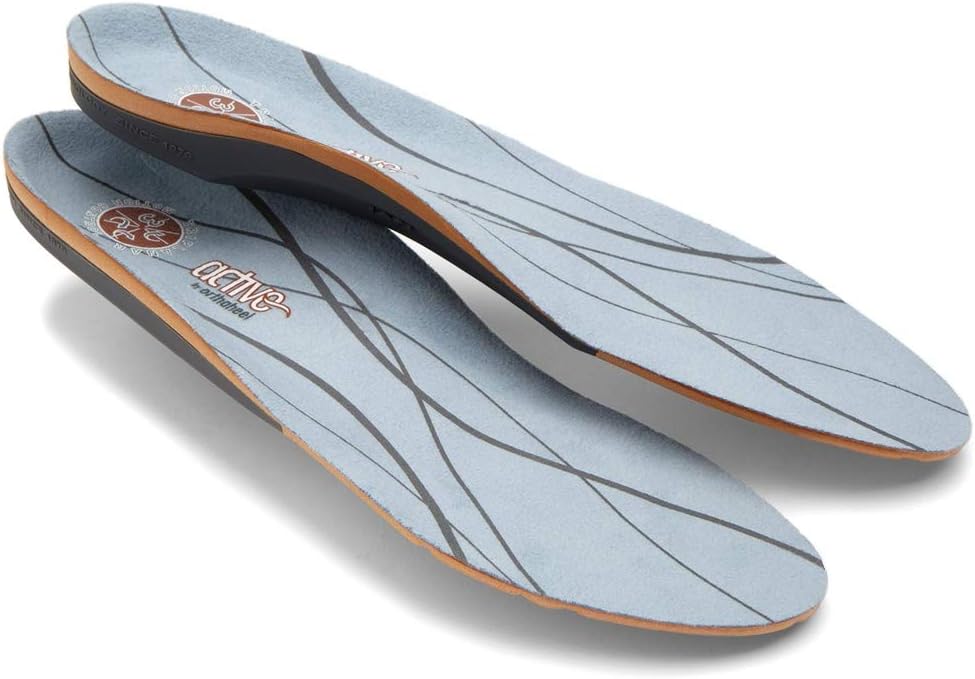
Vionic OrthoHeel Active Insole
4.4
(12,800+ reviews)
APMA-accepted, podiatrist-designed casual insole. Best for adding mild arch support to dress shoes + walking shoes.
- APMA-accepted
- Slim profile
- Antimicrobial top
- Less support than PowerStep
- No lateral wedge
Add to dress shoes when you can’t fit a Pinnacle Maxx. Mild support — not for serious foot pain.

Sof Sole Athlete
4.4
(35,200+ reviews)
Budget athletic insole with neutral arch + gel forefoot. Decent value if you need a quick replacement.
- Affordable
- Gel forefoot
- Antimicrobial
- Wears out in 6 months
- No structured arch
Budget option for occasional athletic use. Replace every 6 months. Real foot pain needs PowerStep Pinnacle Maxx.
Spenco Polysorb Total Support
4.5
(12,400+ reviews)
Mid-range insole with 5-zone polysorb cushioning. Decent support for standing professions.
- 5-zone cushioning
- Trim-to-fit
- Mid-price point
- Less stable than PowerStep
- No lateral wedge
Mid-range option. Mild foot pain + 8 hours standing — Spenco works. Severe pain = PowerStep.
Doctor Hoy’s Natural Pain Relief Gel
Natural topical pain relief I use in our clinic. Arnica + camphor formula — apply directly to the area 3–4x daily. ($20–25)
Frequently Asked Questions
Will my bunion get worse over time?
In most cases, yes — gradually. Bunions are progressive deformities; without intervention, the metatarsal bone continues to drift outward over years. The rate of progression varies enormously: some bunions are stable for decades; others worsen significantly within 5 years. Wearing narrow, pointed-toe footwear accelerates progression. If your bunion is causing pain or limiting footwear choices and is still mild-to-moderate, earlier surgical correction has better outcomes than waiting for severe deformity.
Can I fix a bunion without surgery?
Conservative treatment manages symptoms but cannot structurally correct the deformity. Wide toe-box shoes, bunion pads, toe separators, and orthotics reduce pain and slow progression. They cannot realign the metatarsal bone because the deviation involves structural changes to the joint capsule and ligaments. If the goal is permanent cosmetic and functional correction, surgery is the only option. If the goal is pain management and living comfortably with the bunion, conservative care can be effective for years.
Can splints or bunion braces straighten a bunion?
No — this is one of the most common misconceptions. Bunion splints maintain toe alignment while being worn and may slow progression, but cannot reverse the bony deviation. The first metatarsal has physically rotated and shifted laterally — no external splint can move bone. Studies show splints worn nightly improve comfort and reduce inflammation but do not change bunion angle on X-ray. They’re a useful adjunct for pain management, not correction.
What causes bunions? Are they genetic?
Bunions have a strong genetic component — about 70% of patients with bunions have a first-degree relative with bunions. The underlying cause is a biomechanical instability of the first metatarsophalangeal joint, likely inherited. Footwear doesn’t cause bunions but accelerates them — tight, narrow shoes in a genetically predisposed person progress much faster than in someone who wears supportive shoes. Women develop bunions more often than men largely due to footwear choices over decades.
What shoes should I wear with a bunion?
Wide toe box is non-negotiable — the box must accommodate the bunion without compressing it. Avoid anything with a tapered or pointed toe, stiletto heels, or thin canvas uppers that press against the bump. Best options: Hoka Bondi, New Balance 574, Brooks Ghost (wide), Altra (all models have anatomical toe box). For dress occasions, Vionic and Orthofeet make supportive wide-toe options. The general rule: your toes should never feel compressed.
How long is recovery from bunion surgery?
Recovery depends on the procedure. Simple bunionectomy (soft tissue only): 4–6 weeks. Osteotomy (bone cut and realignment, the most common modern approach): 6–12 weeks non-weight-bearing in a boot, full recovery 4–6 months. Lapidus procedure (fusion at the base of the first metatarsal): 6–8 weeks non-weight-bearing, 6–9 months full recovery. The Lapidus has the lowest recurrence rate and is preferred for severe bunions or hypermobile first rays. We discuss the specific procedure during your surgical consultation.
Will I be able to walk after bunion surgery?
Yes — most patients walk in a surgical boot immediately or within 1–2 weeks. Full return to regular shoes takes 6–12 weeks depending on the procedure. Return to athletic activity typically takes 4–6 months. The question we hear most often is whether the foot will be comfortable and functional long-term — the answer is yes for the vast majority. Over 90% of patients are satisfied with bunion surgery outcomes at 5-year follow-up.
Can bunions come back after surgery?
Yes — recurrence is possible, especially without lifestyle changes. With modern osteotomy procedures, recurrence runs 5–10% at 10 years. The Lapidus procedure has the lowest recurrence rate (2–5%) because it addresses the hypermobility at the metatarsal base. The single biggest recurrence factor is returning to narrow, pointed-toe shoes within 6 months of surgery. We follow patients for 2 years post-surgery specifically to catch early recurrence signs.
Does insurance cover bunion surgery?
Most PPO and Medicare plans cover bunion surgery when it’s functionally necessary — meaning pain limits daily activity, conservative care has been attempted, and X-rays show a meaningful deformity. Purely cosmetic bunionectomy is not covered. We document conservative treatment failure and functional limitation prior to surgery to build the strongest possible insurance case. Call our office at (810) 206-1402 and we’ll verify your coverage before your consultation.
Can children get bunions?
Yes — juvenile bunions account for about 10% of all bunions and are typically bilateral and genetic. They’re most common in girls aged 10–15. Treatment in growing children is conservative whenever possible — wide-toe-box shoes and monitoring. Surgical correction is generally delayed until skeletal maturity (16–18) because operating on open growth plates increases recurrence risk. If your child has a painful or rapidly progressing bunion, evaluation is warranted to track progression.
When is bunion surgery actually necessary?
Surgery is appropriate when: pain is consistent and limits daily activities despite 3–6 months of conservative care, footwear options are severely restricted, there’s a secondary deformity (hammer toe, crossover toe) being driven by the bunion, or joint arthritis is developing. Mild, painless bunions don’t require surgery even if they look significant on X-ray. The decision is always functional, not cosmetic — we operate on pain, not appearance.
Ready for Expert Care?
Same-day appointments in Howell & Bloomfield Hills, MI.
4.9★ | 1,123 Reviews | 3,000+ Surgeries
Or call: (810) 206-1402

Dr. Tom Biernacki, DPM is a double board-certified podiatrist and foot & ankle surgeon at Balance Foot & Ankle Specialists in Southeast Michigan. With over a decade of clinical experience, he specializes in heel pain, bunions, diabetic foot care, sports injuries, and minimally invasive surgery. Dr. Biernacki is a member of the APMA and ACFAS, and his patient education content on MichiganFootDoctors.com and YouTube has reached over one million views.