
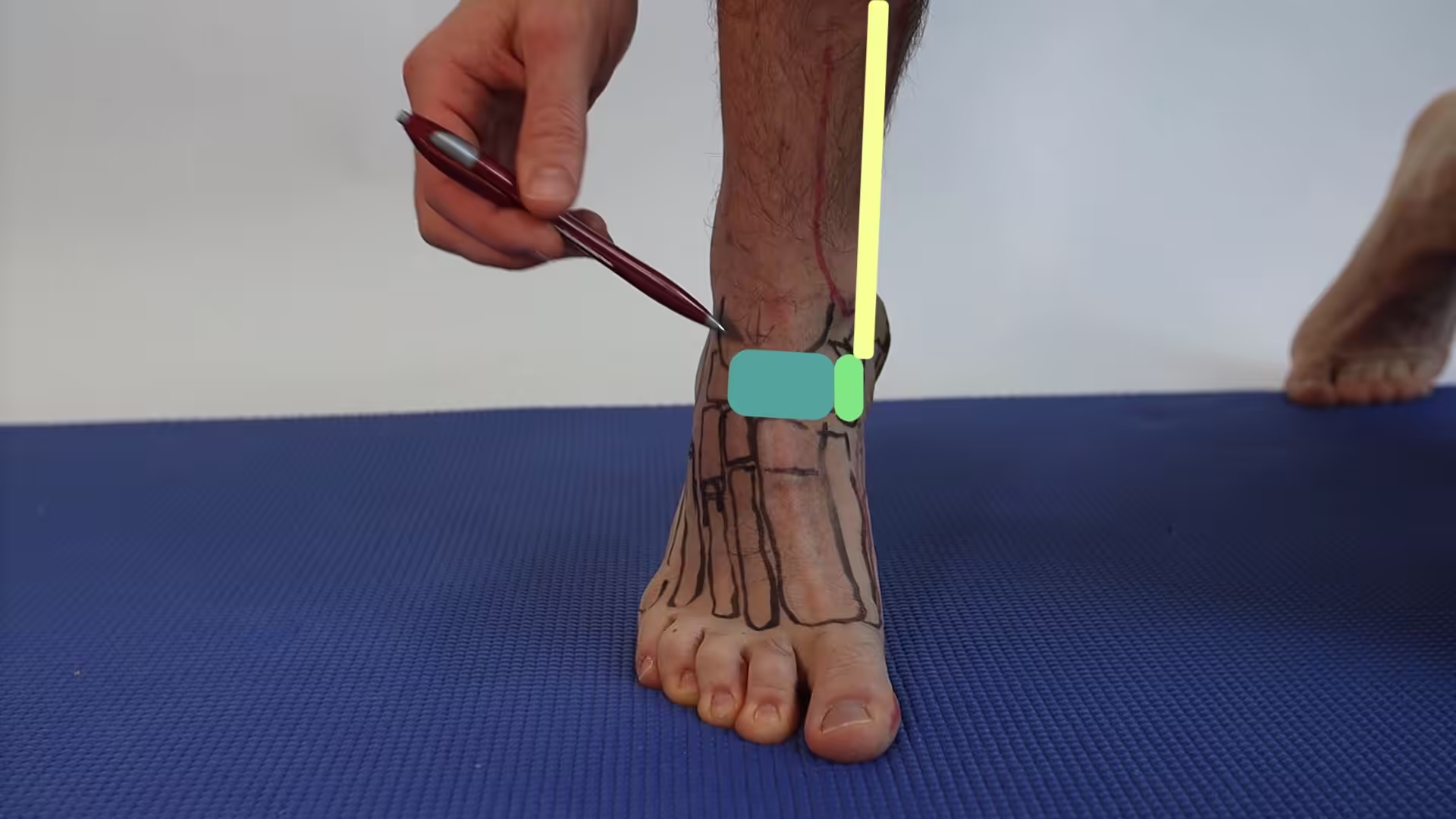

Quick answer: Treatment for accessory navicular syndrome treatment follows a stepwise approach: 1) conservative care first (rest, ice, supportive footwear, OTC anti-inflammatories), 2) physical therapy and targeted exercises, 3) in-office treatments (injections, custom orthotics) if conservative fails at 4-6 weeks, 4) surgery for refractory cases. Most patients resolve at step 1 or 2. Call (810) 206-1402.
Medically reviewed by Dr. Tom Biernacki, DPM — Board-Certified Podiatric Surgeon — Balance Foot & Ankle, Howell & Bloomfield Township, MI. Last updated April 2026.
▶ Watch
What Is an Accessory Navicular?
An accessory navicular is an extra piece of cartilage or bone located on the inner side of the foot, just above the arch. It sits adjacent to the navicular bone—one of the key bones of the midfoot—and is present in approximately 10–14% of the population. While many people have an accessory navicular and never experience problems, a significant subset develop accessory navicular syndrome: a painful condition in which the extra bone causes irritation, inflammation, and arch dysfunction.
Types of Accessory Navicular
Podiatrists classify accessory naviculars into three types based on radiographic appearance. Type I is a small sesamoid bone embedded within the posterior tibial tendon, rarely symptomatic. Type II is the most clinically significant—a triangular or heart-shaped accessory bone connected to the main navicular by fibrocartilage; this synchondrosis (fibrocartilaginous junction) is prone to micro-motion and inflammation, causing the majority of symptomatic cases. Type III represents a fused accessory navicular that has become incorporated into the main navicular, creating a prominent navicular tuberosity—sometimes called a cornuate navicular.
Causes and Risk Factors
The accessory navicular is a congenital variant, meaning it forms during fetal development and is present from birth. Symptoms most commonly emerge during adolescence (ages 10–16) when rapid growth and increased sports participation stress the accessory bone. Adults may develop symptoms after trauma, prolonged standing occupations, or changes in footwear. Flat feet (pes planus) significantly increase risk because the posterior tibial tendon—which attaches to or near the accessory navicular—is placed under greater tension with every step in a flatfooted individual.
Symptoms
The hallmark presentation is a prominent, bony bump on the inner midfoot with overlying redness and tenderness. Pain worsens with activity, shoe pressure on the prominence, and prolonged weight-bearing. Many patients note arch fatigue and medial ankle weakness. Acute flares of swelling and sharp pain can occur following minor trauma or after starting a new sport or activity.
Diagnosis
Diagnosis is confirmed with weight-bearing foot X-rays that clearly demonstrate the accessory bone and its relationship to the navicular. MRI is valuable for assessing the integrity of the synchondrosis (looking for bone marrow edema and fibrocartilage disruption) and evaluating posterior tibial tendon health.
Conservative Treatment
Non-surgical management is successful in the majority of patients, particularly children and adolescents. Rest and activity modification reduce stress on the painful area. Custom foot orthotics with a medial arch support and navicular padding offload the accessory bone and correct the flatfoot biomechanics that perpetuate symptoms. Immobilization in a walking boot for 4–6 weeks allows the inflamed synchondrosis to calm. Physical therapy strengthens the posterior tibial tendon and intrinsic foot muscles. Corticosteroid injection may be used selectively to reduce acute inflammation.
Surgical Treatment: The Kidner Procedure
When conservative care fails to provide lasting relief, the Kidner procedure is the gold standard surgical treatment. Named for the surgeon who described it, this procedure involves excising the accessory navicular, reattaching the posterior tibial tendon firmly to the native navicular, and reshaping any bony prominence. Performed as an outpatient under ankle block anesthesia, the surgery has excellent outcomes with patient satisfaction rates consistently above 85%. Recovery involves 4–6 weeks non-weight-bearing followed by physical therapy, with return to sports typically achieved by 4–6 months postoperatively.
Ready to Relieve Your Foot Pain?
Board-certified podiatrists serving Southeast Michigan. Same-week appointments available.
Book Your AppointmentAccessory Navicular Treatment in Michigan
An accessory navicular — a painful extra bone on the inner arch — causes chronic arch pain and difficulty with footwear. Dr. Tom Biernacki provides custom orthotics, immobilization, and surgical excision (Kidner procedure) for symptomatic accessory navicular at Balance Foot & Ankle.
Learn About Our Arch & Flat Foot Treatments | Book Your Appointment | Call (810) 206-1402
Clinical References
- Kiter E, Erdag N. “Accessory navicular and clinical significance.” Foot Ankle Int. 2005;26(5):415-417.
- Chiu NT, et al. “Clinical use of technetium-99m methylene diphosphonate bone scan to evaluate accessory navicular syndrome.” Clin Nucl Med. 2000;25(6):442-446.
- Kidner FC. “The pre-hallux (accessory scaphoid) in its relation to flat-foot.” J Bone Joint Surg Am. 1929;11(4):831-837.
Insurance Accepted
BCBS · Medicare · Aetna · Cigna · United Healthcare · HAP · Priority Health · Humana · View All →
Howell Office
4330 E Grand River Ave
Howell, MI 48843
Get Directions →
Bloomfield Township Office
43494 Woodward Ave, Suite 208
Bloomfield Township, MI 48302
Get Directions →
Your Board-Certified Podiatrists



Ready to Get Back on Your Feet?
Same-week appointments available at both locations.
Book Your AppointmentDifferential Diagnosis: What Else Could It Be?
Not every case of accessory navicular syndrome is straightforward. In our clinic we routinely rule out three look-alike conditions before confirming the diagnosis. If your symptoms don’t match the classic presentation, one of these may explain the pain — which is why physical exam matters more than self-diagnosis.
| Condition | How It Differs |
|---|---|
| Posterior tibial tendon dysfunction | Pain along the tendon course with progressive flatfoot; may coexist. |
| Medial midfoot sprain | Ligamentous tenderness without a prominent bony bump. |
| Navicular stress fracture | Dorsal midfoot pain with impact; confirmed on MRI, not an accessory bone. |
Red Flags — When to See a Podiatrist Now
Seek same-day evaluation at Balance Foot & Ankle if you notice any of the following:
- Visible bony bump on the medial midfoot with redness
- Collapsing arch in a child or adolescent
- Pain preventing participation in sport
- Failed 6 weeks of orthotic and activity modification
Call (810) 206-1402 or request an appointment. Our Howell and Bloomfield Township offices reserve same-day slots for urgent foot and ankle issues.
In Our Clinic: What We See
Clinical perspective from Dr. Tom Biernacki, DPM — Balance Foot & Ankle, Howell & Bloomfield Township, MI:
Accessory navicular syndrome shows up in active adolescents and sometimes adults with a visible medial bump. In our clinic the exam finding is tenderness directly over the ossicle and pain with resisted inversion. X-rays confirm the accessory bone; MRI shows whether the ossicle is inflamed. Most patients respond to custom orthotics, activity modification, and short-term boot immobilization over 6-12 weeks. When conservative care fails, a Kidner procedure — excising the ossicle and re-attaching the posterior tibial tendon — restores arch function. Dr. Biernacki counsels families to try orthotics for 6 weeks first; surgery when needed is predictable but usually preventable.
More Podiatrist-Recommended Foot Health Essentials
Hoka Clifton 10

Max-cushion everyday shoe — podiatrist favorite for walking and running.

OOFOS Recovery Slide

Impact-absorbing recovery sandal — wear after long days on your feet.
As an Amazon Associate, Balance Foot & Ankle earns from qualifying purchases. Product recommendations are based on clinical experience; prices and availability shown above update live from Amazon.

When to See a Podiatrist
If foot or ankle pain has been bothering you for more than a few weeks, home care alone may not be enough. Balance Foot & Ankle offers same-week appointments at our Howell and Bloomfield Township clinics — no referral needed in most cases. Bring your current shoes and a short list of symptoms and we’ll build you a treatment plan in one visit.
Call Balance Foot & Ankle: (810) 206-1402 · Book online · Offices in Howell & Bloomfield Township
🦶 Dr. Tom’s Recommended Products
These are the at-home products I recommend most often to patients at Balance Foot & Ankle in Howell, MI.
The OTC orthotic I recommend most in our clinic. Medical-grade arch support at a fraction of custom orthotic cost.
View on Amazon →
Natural topical pain relief I use in our clinic. Arnica + menthol formula — apply directly to the area 3-4x daily. FSA-eligible.
View on Amazon →
FTC Disclosure: As an Amazon Associate and Foundation Wellness affiliate, we earn from qualifying purchases. This never affects our clinical recommendations.
In-Office Treatment at Balance Foot & Ankle
If home treatment isn’t providing relief for your flat feet, our podiatry team at Balance Foot & Ankle can help with same-day evaluations and advanced in-office care.
Same-day appointments available. (810) 206-1402
Get Expert Care at Balance Foot & Ankle
Same-week appointments at our Howell and Bloomfield Township offices. Board-certified podiatric surgeons. Most insurance accepted.

Dr. Tom Biernacki, DPM is a board-certified foot & ankle surgeon (ABFAS & ABPM) at Balance Foot & Ankle Specialists in Southeast Michigan. With over a decade of clinical experience, he specializes in heel pain, bunions, diabetic foot care, sports injuries, and minimally invasive surgery. Dr. Biernacki is a member of the APMA and ACFAS, and his patient education content on MichiganFootDoctors.com and YouTube has made him one of the most-followed foot & ankle educators on YouTube.