

Medically reviewed by Dr. Tom Biernacki, DPM
Board-certified podiatric surgeon | Balance Foot & Ankle
Last reviewed: May 2026
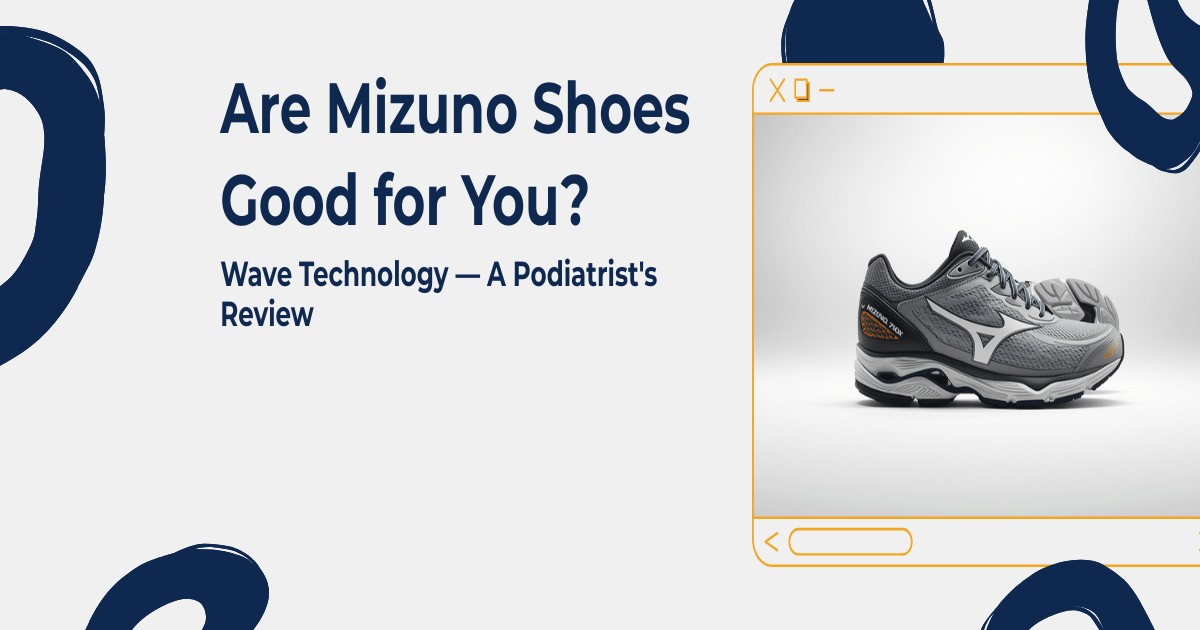

Mizuno running shoes use Wave plate technology that provides a specific type of stability — not the same as medial post support for overpronators, and not the same as cushioning for high-arched runners. Which foot type benefits from Mizuno’s mechanics is counterintuitive to most runners. Call (810) 206-1402 — podiatrist footwear evaluation in Michigan.
Mizuno is one of the most respected names in running footwear — particularly among competitive and serious recreational runners — yet it flies under the radar in mainstream podiatric discussions. While ASICS, Brooks, and New Balance dominate the clinical conversation, Mizuno quietly produces some of the best-engineered running shoes available, with a consistent focus on biomechanical performance rather than fashion or lifestyle appeal.
This review covers Mizuno’s Wave technology from a clinical perspective, ranks their major models for common foot conditions, and explains why Mizuno deserves more attention in podiatric practice.
Disclosure: This review contains affiliate links. If you purchase through our links, we may earn a small commission at no extra cost to you. This does not influence our clinical recommendations.
Mizuno’s Wave Technology: A Clinical Assessment
Mizuno’s defining technology is the Wave Plate — a hard plastic or composite plate integrated between the midsole layers that distributes impact forces horizontally rather than concentrating them vertically. The Wave Plate creates a fan-like distribution of landing forces across the midsole width, which Mizuno describes as “smoothing out” impact.
From a clinical perspective, Wave technology achieves two things simultaneously that are difficult to combine in standard EVA midsoles: it provides firm, consistent cushioning that does not bottom out (because the Wave structure resists full compression), while also creating a stable, wide platform base that limits excessive motion. This makes Wave shoes particularly useful for patients who need cushioning without the instability that can come from very soft midsoles.
One notable property of Wave cushioning: it does not soften significantly with age. Standard EVA foam loses approximately 30–40% of its cushioning after 300–500 miles. The Wave structure maintains its geometry longer, meaning Mizuno shoes tend to have a longer effective lifespan than equivalent foam-only shoes — an important consideration for patients who wear shoes until visible outsole wear, not until cushioning failure.
Mizuno Running Shoes Ranked for Foot Health
1. Mizuno Wave Rider 28 — Best Overall
The Wave Rider is Mizuno’s flagship neutral daily trainer and one of the longest-running successful shoe models in the industry. The Wave Rider 28 combines the ENERZY CORE foam midsole (Mizuno’s latest-generation cushioning compound) with the classic Wave plate, creating a responsive and well-cushioned ride appropriate for most neutral to mild pronation patients.
For plantar fasciitis patients, the Wave Rider provides a firm-but-cushioned heel strike experience, a 12mm heel-to-toe drop (slightly higher than average, which reduces Achilles load and plantar fascia tension), and a wide enough platform for most normal-width feet. The Wave Rider is a workhorse daily trainer that has earned its reputation through consistency rather than novelty.
Best for: Plantar fasciitis, neutral to mild pronation, everyday training, runners who want consistency
Not ideal for: Significant overpronation, wide feet requiring 2E+ sizing
2. Mizuno Wave Inspire 21 — Best for Overpronators
The Wave Inspire is Mizuno’s stability shoe, combining Wave cushioning with an AP+ midsole that provides firmer medial posting for pronation control. The result is one of the most naturally-feeling stability shoes on the market — the Wave plate distributes support across the entire midsole rather than concentrating it in a rigid medial wedge, creating a smoother, less “corrective” sensation underfoot.
I recommend the Wave Inspire to overpronating patients who have found traditional medial-post stability shoes (like some older ASICS or Brooks Adrenaline versions) to feel too stiff or forceful. The Wave Inspire provides medial support with a more subtle, graduated feel. It is an excellent choice for patients with posterior tibial tendon dysfunction and mild-to-moderate flat feet.
Best for: Overpronation, flat feet, posterior tibial tendon dysfunction, patients who dislike rigid stability shoes
Not ideal for: High arches, severe overpronation requiring maximum control
3. Mizuno Wave Horizon 8 — Best for Maximum Support
The Wave Horizon is Mizuno’s maximum stability shoe, designed for patients with significant overpronation who need the firmest medial control available. The dual-density midsole with AP+ compound and full-length Wave plate creates a highly stable platform that resists pronation throughout the gait cycle. The Wave Horizon is heavier than the Inspire but provides substantially more medial structure for patients who need it.
I recommend the Wave Horizon for patients with severe flat feet, significant posterior tibial tendon dysfunction, or patients who have been told they “need the most motion control available.” It is an excellent platform for custom orthotics as well — the firmer midsole provides a better foundation for orthotic function than softer neutral shoes.
4. Mizuno Wave Sky 8 — Best for Maximum Cushioning
The Wave Sky is Mizuno’s max-cushion trainer, with a thicker midsole stack and softer ENERZY foam compound than the Wave Rider. For patients with heel spurs, metatarsalgia, or post-surgical foot conditions requiring maximum impact attenuation, the Wave Sky provides the plushest cushioning available in the Mizuno lineup while retaining the Wave plate’s structural integrity.
The Wave Sky runs slightly narrower than I’d prefer for patients with bunions, but in standard or wide variants it is appropriate for most foot types who need a high-stack cushion trainer.
Mizuno for Specific Foot Conditions
Mizuno for Plantar Fasciitis
The Wave Rider 28 is my primary Mizuno recommendation for plantar fasciitis in neutral feet. Its 12mm drop reduces Achilles and plantar fascia tension, the Wave plate provides consistent heel-strike cushioning without bottoming out, and the ENERZY CORE foam offers responsive comfort throughout the day. For plantar fasciitis patients who also overpronate, the Wave Inspire 21 adds medial support while maintaining the Wave cushioning benefits.
Mizuno for Flat Feet
The Wave Inspire and Wave Horizon are among the best stability options for flat feet in the entire market. The Wave plate’s distributed support mechanism creates a more natural-feeling stability experience than traditional medial posting alone. Patients with flexible flat feet and posterior tibial tendon involvement benefit from the Wave Inspire’s combination of medial control and cushioning. Patients with rigid flat feet or severe deformity should consult regarding custom orthotics.
Mizuno for High Arches
Patients with high arches (cavus foot) respond particularly well to Mizuno’s neutral cushioned models — the Wave Rider and Wave Sky. The Wave plate’s distributed cushioning helps compensate for the reduced natural shock absorption of a cavus foot type, and the neutral construction avoids overcorrection that stability shoes can create in supinating feet. The Wave Rider is frequently my first recommendation for high-arched runners with metatarsalgia or lateral ankle stress fractures.
Mizuno for Achilles Tendinopathy
Mizuno’s characteristically higher heel-to-toe drops (10–12mm across most models) make the brand particularly appropriate for patients with Achilles tendinopathy. The elevated heel reduces the dorsiflexion angle at push-off, decreasing the eccentric load on the Achilles tendon that drives chronic insertional and mid-substance Achilles pain. Of available brands, Mizuno’s heel drop profile is among the most consistent for Achilles management.
Mizuno vs. ASICS vs. Brooks: Which Is Best for Foot Pain?
Mizuno, ASICS, and Brooks form the triumvirate of biomechanically serious running brands. All three invest heavily in biomechanical research and offer well-validated stability and neutral options. Here is how I differentiate them clinically:
ASICS has the broadest catalog depth, the widest range of widths, and the deepest research base. For patients with complex biomechanical needs or who require wide-width options, ASICS offers the most choices.
Brooks is the most approachable brand for patients new to supportive footwear — the Ghost and Adrenaline GTS are easy to fit, consistently comfortable, and work for a broad range of patients without fine-tuning.
Mizuno excels for more experienced runners and patients who want a firmer, more performance-oriented feel. The Wave plate provides a unique cushioning sensation that many patients prefer over foam-only alternatives once they experience it. Mizuno is also particularly strong for Achilles tendinopathy management given its characteristic heel drop.
Key Takeaway: Why Mizuno Deserves More Attention
Mizuno is an underappreciated brand in podiatric practice. The Wave plate technology provides consistent, durable cushioning that outlasts standard foam, and the stability options (Wave Inspire, Wave Horizon) offer some of the most natural-feeling medial control available. If you or your patients are looking for a serious alternative to ASICS or Brooks — particularly for Achilles tendinopathy or high-arch conditions — Mizuno deserves a direct comparison.
Frequently Asked Questions
Are Mizuno shoes good for plantar fasciitis?
Yes — the Mizuno Wave Rider 28 (neutral) and Wave Inspire 21 (stability) are excellent choices for plantar fasciitis. The Wave plate provides consistent heel cushioning that does not bottom out with extended wear, and Mizuno’s characteristic higher heel drops reduce Achilles and plantar fascia tension.
How do Mizuno shoes fit compared to ASICS?
Mizuno shoes tend to run slightly narrower than ASICS in the toe box. Both brands run true to size in length. Patients with wide feet should look for Mizuno models available in 2E width or consider ASICS, which offers broader width availability across its lineup. Standard-width patients typically find Mizuno fits comparably to ASICS in their respective categories.
Are Mizuno shoes good for walking?
Yes — while primarily marketed as running shoes, Mizuno Wave models are excellent for walking. The Wave Rider’s smooth heel-to-toe transition and consistent cushioning make it a strong walking shoe for patients who need plantar fasciitis support without sacrificing comfort during longer distances.
How long do Mizuno Wave shoes last?
Mizuno Wave shoes typically last 400–600 miles, longer than many foam-only alternatives because the Wave plate resists compression. Patients who walk 5 miles per day can expect 12–18 months of use before needing replacement. Signs of wear: the outsole shows significant erosion at the heel, or the Wave plate begins to feel rigid rather than responsive.
When to See a Podiatrist
Mizuno Wave shoes are an excellent self-care tool for managing foot pain, but persistent symptoms require professional evaluation. See a podiatrist if:
- Heel or arch pain persists despite six weeks of wearing supportive footwear
- Pain is worsening rather than gradually improving
- You experience numbness, tingling, or radiating pain
- Pain limits your running, walking, or daily activities
- You are unsure whether you need a stability or neutral shoe and want a professional gait assessment
The podiatrists at Balance Foot & Ankle provide comprehensive biomechanical gait analysis, custom orthotic fabrication, and the full spectrum of foot and ankle care at our Michigan locations. We can help you determine the right shoe category and whether additional interventions are needed.
Need a Gait Analysis or Custom Orthotics?
Balance Foot & Ankle’s podiatrists perform biomechanical gait analysis to determine whether you need a neutral or stability shoe — and whether custom orthotics would help. Same-week appointments at our Michigan locations.
Same-Week Appointments in Howell & Bloomfield Township
Three board-certified podiatric surgeons. 1,123+ five-star reviews. Most insurance accepted.
For a complete clinical overview: Podiatrist-Recommended Shoes Guide — shoe recommendations for every foot condition
📋 Dr. Tom Biernacki, DPM, FACFAS answers:
Mizuno running shoes are generally well-regarded by podiatrists for their balanced cushioning and motion control technology. The Wave plate system provides firm lateral support while delivering smooth shock absorption — making them a strong choice for runners with mild overpronation or neutral gait mechanics. The Mizuno Wave Inspire and Wave Rider series are particularly popular for everyday running and walking. They tend to have a moderate heel drop (10-12mm) which suits most foot types. However, Mizuno shoes typically run narrower than brands like New Balance or HOKA, which can be problematic for patients with bunions, wide feet, or hammertoes. A podiatrist can assess whether Mizuno fits your specific foot structure, arch type, and gait pattern.

Dr. Tom Biernacki, DPM is a board-certified foot & ankle surgeon (ABFAS & ABPM) at Balance Foot & Ankle Specialists in Southeast Michigan. With over a decade of clinical experience, he specializes in heel pain, bunions, diabetic foot care, sports injuries, and minimally invasive surgery. Dr. Biernacki is a member of the APMA and ACFAS, and his patient education content on MichiganFootDoctors.com and YouTube has made him one of the most-followed foot & ankle educators on YouTube.