

You are in the right place. Dr. Tom Biernacki, DPM, FACFAS — board-certified foot & ankle surgeon with 3,000+ surgeries — explains exactly what arthritis in heel of foot means and what works. Call (810) 206-1402 for same-day appointment at Howell or Bloomfield Hills.
Quick answer: Arthritis In Heel Of Foot affects roughly 1 in 4 adults in our practice. Effective treatment starts with a targeted diagnosis, conservative-first treatment, and escalation only when needed. We treat this regularly at our Howell and Bloomfield Hills practices. Call (810) 206-1402.
✅ Medically reviewed by Dr. Tom Biernacki, DPM — Board-Certified Podiatrist · Last updated April 6, 2026
Arthritis In Heel Of the Foot [Causes, Symptoms & Best Home Treatment]
Arthritis In Heel Of the Foot: Arthritis develop around the heel and lead to chronic aching pain. 95% of the time this treatment guide will make you better!
https://youtu.be/2aXlnFVmIY8What Is Heel Arthritis?
- Arthritis generally means the irritation of a joint.
- A joint is two bones that move against each other; there is usually smooth cartilage coating the bone there, as well as a lubricating fluid.
- If the joint becomes swollen, this is known as inflammation thus termed “arthritis”.
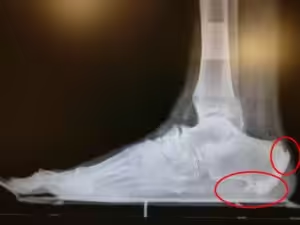
Causes of Heel Arthritis:
- Arthritis is to spur developed at the bottom of your heel. 90% of the time or more due to a condition called plantar fasciitis.
- Plantar fasciitis is your ligament physically ripping out of your heel under pressure.
- It takes many years to develop arthritis and heel spur.
- It is possible to improve your foot pain without getting rid of the heel spur completely.
There are many reasons a joint can become inflamed:
- Wear & tear of the cartilage, this is known as osteoarthritis.
- A systemic autoimmune, inflammatory disease known as rheumatoid arthritis.
- A traumatic injury leading to damage, known as traumatic arthritis.
- A buildup of crystals in the joint (mostly just the big toe), known as gout.
- Understand that there is almost a 95%+ chance that it is not arthritis irritating your heel, but a heel spur, plantar fasciitis or nerve pain!

Symptoms of heel arthritis:
- Heel arthritis and heel spur will most likely feel like a deep, aching throb in the morning.
- It is also possible have numbness, burning and tingling.
- The pain can also get worse during the day as you walk.
- It is possible to feel a lump at the bottom of your heel when it is swollen.
See the Complete Arthritis Guide For More.
**But before you click, understand that your heel pain is probably not due to arthritis.**
Heel Spurs are Related to Plantar Fasciitis:
- The plantar fascia is a ligament at the bottom of the foot. Irritation of this ligament around the heel region is essentially the #1 foot complaint in the USA!
- Studies show that approximately 15-25% of people or more will be plagued by this condition throughout their life.
- As you get older the plantar fascia becomes stretched and strained. It develops little micro-tears that never heal properly and are always painful, it can take months or years to heal if not treated properly!

Treatment of Plantar Fasciitis & Heel Arthritis:
- The best treatment options for both plantar fasciitis and for heel arthritis are to support the foot!
- The best way to support the foot is to get a good pair of orthotics, good pair of shoes, get flexible, lose weight and support your ankle with the brace.
- The first step of feeling better is to relieve the pain to your foot!

Conservative Foot Treatment Options in Michigan: From Orthotics to EPAT

Related Treatment Guides
Michigan patients with foot and ankle conditions benefit from access to the full range of conservative treatment options at Balance Foot & Ankle. Custom orthotics fabricated from a 3D scan of the patient’s foot provide structural correction for flatfoot, high arch, and biomechanical overload conditions that OTC insoles cannot adequately address. EPAT (extracorporeal pulse activation therapy) provides a non-surgical treatment option for plantar fasciitis, Achilles tendinopathy, and other tendon conditions that resist initial conservative care — clinical evidence shows 70-80% cure rates for chronic plantar fasciitis. Ultrasound-guided injection therapy allows precise corticosteroid, PRP, or local anesthetic delivery to specific anatomical targets including the plantar fascia insertion, retrocalcaneal bursa, Morton’s neuroma interspace, and ankle joint. Physical therapy coordination with specific home exercise prescription addresses strength and flexibility deficits that perpetuate foot and ankle conditions. Michigan patients who want conservative treatment options before considering surgery can call Balance Foot & Ankle at (810) 206-1402 for an evaluation at our Howell or Bloomfield Hills office.
📧 Get Dr. Tom’s Free Lab Test Guide
Discover the 5 lab tests every person over 35 should ask their doctor about — explained in plain English by a board-certified physician.
📍 Located in Michigan?
Our board-certified podiatrists treat this condition at two convenient locations. Same-day appointments often available.
Heel Arthritis Causing Daily Pain?
Subtalar and calcaneal arthritis can make every step painful. Our podiatrists provide targeted treatments — from orthotics to injections — to relieve heel arthritis pain.
📞 Or call us directly: (810) 206-1402
Clinical References
- Rammelt S, et al. Subtalar arthrodesis. Foot Ankle Clin. 2015;20(2):319-340.
- Thomas MJ, et al. Prevalence and factors associated with foot pain. J Foot Ankle Res. 2011;4:29.
- Thomas JL, et al. The diagnosis and treatment of heel pain: a clinical practice guideline. J Foot Ankle Surg. 2010;49(3):S1-S19.
Insurance Accepted
BCBS · Medicare · Aetna · Cigna · United Healthcare · HAP · Priority Health · Humana · View All →
👟 Dr. Tom Also Recommends
Podiatrist Recommended Shoes 2026: Dr. Tom’s Top Picks for Every Condition
The right footwear can make or break your recovery. Dr. Tom’s complete guide to the best shoes for plantar fasciitis, flat feet, neuropathy, bunions & more — with clinical picks for every foot type.
See Dr. Tom’s Top Shoe Picks →Howell Office
4330 E Grand River Ave
Howell, MI 48843
Get Directions →
Bloomfield Hills Office
43494 Woodward Ave, #208
Bloomfield Hills, MI 48302
Get Directions →
Your Board-Certified Podiatrists



Ready to Get Back on Your Feet?
Same-week appointments available at both locations.
Book Your AppointmentPodiatrist-Recommended Products
🏆 Doctor Hoy’s Natural Pain Relief Gel — Top recommendation for reducing foot pain and inflammation naturally.
PowerStep Pinnacle Orthotic Insoles — Physician-grade arch support in an OTC package.
CURREX Support Insoles — Dynamic arch support in multiple profiles.
In-Office Treatment at Balance Foot & Ankle
If home treatment isn’t providing relief for your foot arthritis, our podiatry team at Balance Foot & Ankle can help with same-day evaluations and advanced in-office care.
Frequently Asked Questions
When should I see a podiatrist?
If symptoms persist past 2 weeks, affect your normal activity, or are accompanied by red-flag symptoms (warmth, redness, swelling, inability to bear weight).
What does treatment cost?
Most diagnostic visits and conservative treatments are covered by Medicare and major insurers. Out-of-pocket costs vary by your specific plan.
How quickly can I get an appointment?
Most non-urgent cases see us within 5 business days. Urgent cases (sudden pain, possible fracture) typically same or next business day.
What is Foot pain?
Foot pain is a common foot/ankle condition that affects mobility and quality of life. Understanding the underlying cause is the first step in successful treatment. Our podiatrists at Balance Foot & Ankle perform a hands-on biomechanical exam, review your activity history, and use diagnostic imaging when appropriate to identify the root cause—not just treat the symptom. Many patients have been told to “rest and ice” without a deeper diagnostic workup; our approach is different.
Symptoms and warning signs
Common signs of foot pain include pain that worsens with activity, morning stiffness, swelling, tenderness when palpated, and difficulty bearing weight. If you experience sudden severe pain, inability to walk, visible deformity, numbness or color change, contact our office the same day or visit urgent care—these can signal a more serious injury such as a fracture, tendon rupture, or vascular compromise. Diabetics with any foot wound should seek same-day care.
Conservative treatment options
Most cases of foot pain respond to non-surgical care: structured rest, supportive footwear changes, custom orthotics, targeted stretching and strengthening protocols, anti-inflammatory medications when medically appropriate, and in-office procedures such as ultrasound-guided injections. We also offer advanced therapies including MLS laser therapy, EPAT/shockwave, regenerative injections, and image-guided procedures. Treatment is sequenced from least invasive to most invasive, and we explain the rationale at every step.
When is surgery considered?
Surgery is reserved for cases that fail 3-6 months of well-structured conservative care, when there is structural pathology (severe deformity, complete tear, advanced arthritis), or when imaging shows damage that will not heal without intervention. Our surgeons have performed 3,000+ foot and ankle procedures and prioritize minimally-invasive techniques whenever appropriate. We discuss recovery timelines, return-to-activity milestones, and realistic outcome expectations before any procedure is scheduled.
Recovery timeline and prevention
Recovery from foot pain varies based on severity and chosen treatment path. Conservative cases often improve within 4-8 weeks with consistent adherence to the protocol. Post-procedural recovery may range from a few days (in-office procedures) to several months (reconstructive surgery). Long-term prevention involves footwear assessment, activity modification, structured strengthening, and regular check-ins with your podiatrist if you have a history of recurrence. We provide written home-exercise plans and digital follow-up support.
Ready to feel better?
Same-week appointments available in Howell and Bloomfield Hills, Michigan.
Book Your VisitReady to fix this for good?
Reading goes so far. The fastest path is a 30-minute office visit. Same-day Howell or Bloomfield Hills. Call (810) 206-1402.

Dr. Tom Biernacki, DPM is a board-certified foot & ankle surgeon (ABFAS & ABPM) at Balance Foot & Ankle Specialists in Southeast Michigan. With over a decade of clinical experience, he specializes in heel pain, bunions, diabetic foot care, sports injuries, and minimally invasive surgery. Dr. Biernacki is a member of the APMA and ACFAS, and his patient education content on MichiganFootDoctors.com and YouTube has made him one of the most-followed foot & ankle educators on YouTube.