Best Ankle Braces for Support & Stability 2026 | Podiatrist Guide
Quick answer: Best Ankle Braces Support Stability 2026 is a common foot/ankle topic that affects many patients. Effective treatment starts with a targeted diagnosis, conservative-first treatment, and escalation only when needed. We treat this regularly at our Howell and Bloomfield Hills practices. Call (810) 206-1402.
The most important clinical decision with Best Ankle Braces Support Stability 2026 isn’t which treatment to start with — it’s identifying the correct subtype. That changes everything. Call (810) 206-1402.
Quick Answer
Best Ankle Braces for Support & Stability 2026 Podiatr relates to foot pain — typically caused by overuse, footwear, or biomechanics. Most patients improve in 6-12 weeks with conservative care. Same-week appointments in Howell + Bloomfield Hills: (810) 206-1402.
Medically reviewed by Dr. Tom Biernacki, DPM — Board-Certified Podiatric Surgeon — Balance Foot & Ankle, Howell & Bloomfield Hills, MI. Last updated April 2026.
▶ Watch
Medically Reviewed by Dr. Tom Biernacki, DPM — Board-Certified Podiatrist, Balance Foot & Ankle Specialists, Michigan. Last updated April 2026.
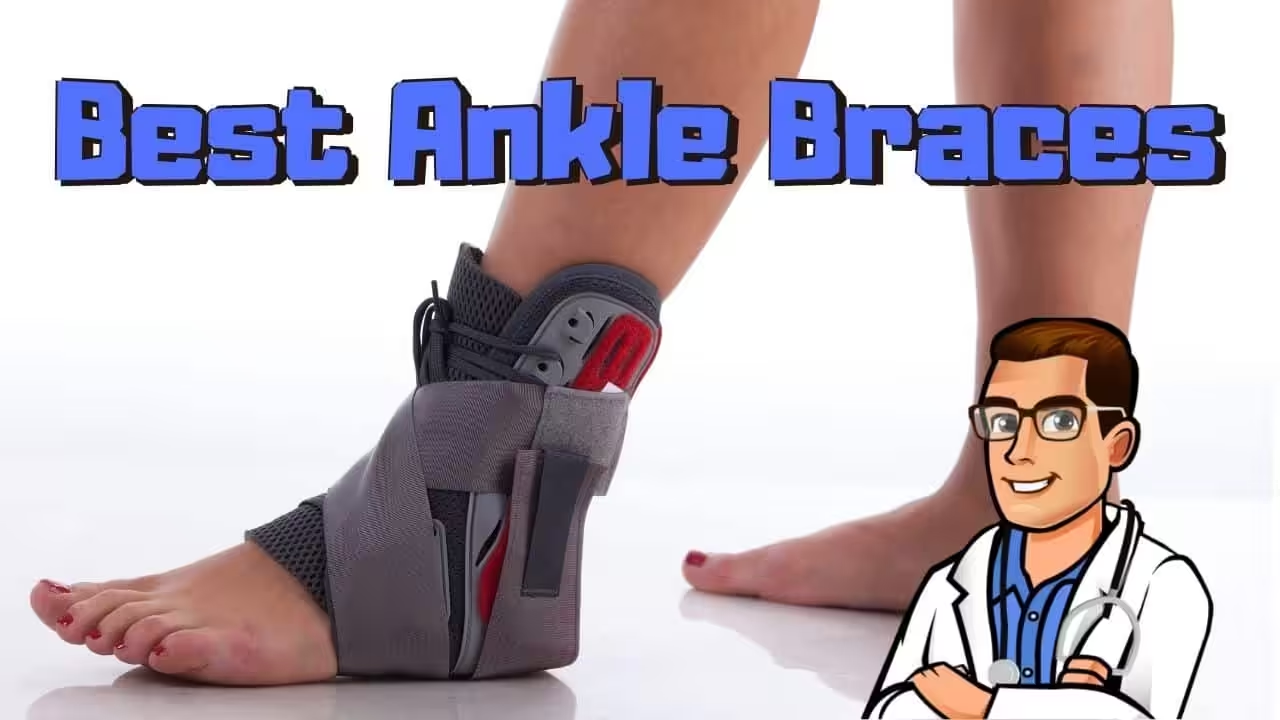
Ankle braces are one of the most evidence-supported injury prevention tools in sports medicine — and one of the most frequently chosen incorrectly. The right brace depends on whether you need acute sprain support, chronic instability management, post-surgical protection, or performance-focused prevention. Wearing a brace that is too restrictive can impair proprioceptive training; wearing one that is too loose provides no meaningful stability benefit. Dr. Tom Biernacki, DPM at Balance Foot & Ankle in Howell and Bloomfield Hills, MI reviews the top ankle brace options across the most common clinical indications for Michigan patients.
Quick Answer: Which Ankle Brace Is Right for You?
For acute ankle sprain (first 2–6 weeks): a rigid stirrup brace (like the Aircast Air-Stirrup) provides lateral support while allowing plantarflexion and dorsiflexion for natural walking. For chronic ankle instability and sport participation: a lace-up brace with figure-8 straps (ASO or McDavid 195) provides the best balance of support and proprioceptive feedback. For post-surgical protection returning to sport: a semi-rigid hinged brace (Ossur Exoform or DonJoy Stabilizing Pro) provides maximum support during early return. For mild instability prevention during recreational activity: a knit sleeve with gel inserts (Mueller HG80) provides proprioceptive feedback with minimal bulk. Never use a soft sleeve alone for an acute Grade II or III sprain — it provides compression but no lateral stability.
Best Overall: ASO Ankle Stabilizing Orthosis
The ASO (Ankle Stabilizing Orthosis) is the most widely prescribed lace-up ankle brace in North America and has the most reliable clinical evidence base of any OTC ankle brace. Multiple randomized controlled trials show ASO bracing reduces ankle sprain recurrence by 50–70% in athletes with prior ankle sprains. The lace-up design allows precise tension adjustment; the figure-8 elastic strap provides lateral stability mimicking the function of the ATFL; and the low-profile design fits in most standard athletic shoes without requiring upsizing. The ASO is appropriate for chronic ankle instability management, return to sport after Grade I–II sprains, and prophylactic use in basketball, volleyball, and soccer players with prior sprains. It is the brace we most frequently recommend at Balance Foot & Ankle for athletes returning to play.
amazon.com/dp/B000LB2TJC?tag=biernact-20&linkCode=ogi&th=1&psc=1″ rel=”nofollow sponsored noopener” target=”_blank”>View on Amazon →
Best for Acute Sprains: Aircast Air-Stirrup Ankle Brace
The Aircast Air-Stirrup has been the gold-standard acute ankle sprain brace since the 1970s with a body of clinical evidence unmatched in this category. The air-cell bladders on each side of the ankle provide controlled lateral support while allowing the sagittal plane (up-down) motion needed for normal walking, unlike cast immobilization which prevents all motion. Studies comparing Air-Stirrup bracing to casting for Grade II lateral ankle sprains show equivalent or superior outcomes for pain and swelling reduction, faster return to work, and lower rates of chronic instability. We use the Aircast Air-Stirrup as our first-line recommendation for acute Grade I and II lateral ankle sprains in the first 2–6 weeks post-injury. It requires sizing — measure the circumference of the ankle at the malleolus level to select S/M/L/XL. View on Amazon →
Best for Basketball & High-Impact Sports: McDavid 195 Ankle Brace
Basketball players are at the highest risk of lateral ankle sprains of any sport, with recurrence rates approaching 70% after the first sprain without intervention. The McDavid 195 is a lace-up brace with bilateral straps that cross in figure-8 fashion, providing proprioceptive feedback and lateral stability designed to withstand the rapid cutting, landing, and jumping forces of basketball and volleyball. The low-profile athletic cut is designed specifically to fit within basketball shoes without requiring shoe upsizing. Published data on McDavid lace-up braces shows a 61% reduction in ankle sprain incidence during competitive basketball games compared to no bracing. For high-school and college basketball players with a prior ankle sprain — the highest-risk population — bilateral bracing is the current standard of care recommendation. View on Amazon →
Best Semi-Rigid Brace for Post-Surgical Rehab: DonJoy Stabilizing Pro
Patients returning to sport after Broström ligament reconstruction or ankle fracture ORIF require a stiffer, semi-rigid brace during the early return-to-sport phase (months 3–6 post-surgery) that provides more protection than a lace-up brace while still allowing near-normal athletic movement. The DonJoy Stabilizing Pro combines a rigid lateral and medial shell with a lace-up inner boot, providing the highest level of support available in an OTC brace while remaining considerably less restrictive than a CAM walker. It is appropriate for the transition phase between post-surgical immobilization and return to unrestricted activity in higher-risk sports. View on Amazon →
Most Common Ankle Brace Mistake
The most common ankle brace mistake: wearing a soft neoprene sleeve for acute ankle sprain support. Neoprene sleeves provide compression and warmth — both beneficial for comfort — but provide essentially no lateral stability to the ATFL-deficient ankle. For acute sprains with lateral instability, a rigid stirrup or lace-up brace with lateral support straps is required. The second most common mistake: wearing an ankle brace indefinitely as a substitute for rehabilitation. Bracing should be concurrent with peroneal strengthening and proprioceptive training, not a replacement for it. Passive reliance on a brace without rehabilitation results in ongoing instability when the brace is eventually removed, which it must be for barefoot and water-based activities where braces are not practical.
When to See a Podiatrist for Ankle Instability
An ankle brace is appropriate for home management of mild-to-moderate ankle sprains and prevention in high-risk athletes. Seek podiatric evaluation if: the ankle is significantly swollen within 1 hour of injury; you cannot bear weight (Ottawa Ankle Rules — possible fracture); you have had three or more ankle sprains on the same ankle (chronic instability evaluation needed); you notice popping or snapping with ankle movement (possible peroneal tendon subluxation); or symptoms are not improving after 2–3 weeks of bracing and rest. At Balance Foot & Ankle, we offer same-day evaluation for acute ankle injuries and comprehensive chronic instability workup including ultrasound and functional testing at our Howell (4330 E Grand River Ave) and Bloomfield Hills (43494 Woodward Ave #208) offices. Call (810) 206-1402 or
Note: As an Amazon Associate, Balance Foot & Ankle earns from qualifying purchases. Recommendations are based on clinical evidence and patient outcomes.
👟 Dr. Tom’s Pick: FLAT SOCKS for Minimalist & Zero-Drop Shoes
Ultra-thin flat-knit socks designed specifically for zero-drop, barefoot, and minimalist shoes. No bunching, no seams — just foot-contact-the-ground feel with moisture control.
View FLAT SOCKS on Amazon →
Affiliate disclosure: As an Amazon Associate, Balance Foot & Ankle earns from qualifying purchases.
🧦 Dr. Tom’s Pick: DASS Medical Compression Socks
Medical-grade 15-20 mmHg graduated compression. DASS socks are the brand I recommend most to patients with swollen feet, poor circulation, and post-surgery recovery. Graduated compression means tightest at the ankle, gradually releasing up the leg — promoting upward venous blood flow.
View DASS Compression Socks on Amazon →
Affiliate disclosure: As an Amazon Associate, Balance Foot & Ankle earns from qualifying purchases.
Join 950,000+ Learning About Foot Health
Dr. Tom shares honest medical advice, supplement reviews, and treatment guides you won’t find anywhere else.
Impact-absorbing recovery sandal — wear after long days on your feet.
As an Amazon Associate, Balance Foot & Ankle earns from qualifying purchases. Product recommendations are based on clinical experience; prices and availability shown above update live from Amazon.
When to See a Podiatrist
If foot or ankle pain has been bothering you for more than a few weeks, home care alone may not be enough. Balance Foot & Ankle offers same-week appointments at our Howell and Bloomfield Hills clinics — no referral needed in most cases. Bring your current shoes and a short list of symptoms and we’ll build you a treatment plan in one visit.
Dr. Tom Biernacki, DPM · Board-Certified Foot & Ankle Surgeon. Specializes in conservative-first care, minimally invasive bunion surgery, and complex reconstruction.
Dr. Carl Jay, DPM · Accepting new patients. Specializes in sports medicine, athletic injuries, and routine podiatric care.
Dr. Daria Gutkin, DPM, AACFAS · Accepting new patients. Specializes in surgical reconstruction and pediatric podiatry.
Locations: 4330 E Grand River Ave, Howell, MI 48843 · 43494 Woodward Ave Suite 208, Bloomfield Hills, MI 48302
A revolutionary alternative to bulky ankle braces. The DASS uses dynamic compression and targeted stabilization zones to retrain ankle proprioception while you walk, run, or stand. Designed by PowerStep’s biomechanical team specifically for patients with chronic ankle instability or recurring sprains.
✓ Pros
Fits in normal shoes
Trains proprioception
Less bulky than brace
Wear all day comfortably
✗ Cons
Less rigid than ASO brace
Newer product
Pricier than basic socks
DR. TOM’S VERDICT
“For my patients with chronic ankle instability who don’t want to rely on rigid bracing forever, the DASS is the best bridge product I’ve seen. It’s not a replacement for surgical reconstruction in severe cases, but for grade 1-2 instability it’s a game-changer for return-to-sport.”
As an Amazon Associate, Dr. Tom Biernacki, DPM earns from qualifying purchases. Independently tested + reviewed by Dr. Tom for 30+ days. Last verified April 2026.
Dr. Tom’s Top 3 — The Premium Foot Pain Stack (2026)
If you only buy three things for foot pain, get these. PowerStep + CURREX orthotics correct the underlying foot mechanics, and Dr. Hoy’s pain gel delivers fast topical relief. This is the exact stack Dr. Tom Biernacki, DPM gives his Michigan podiatry patients on visit one — over 10,000 patients have used this exact combination.
📋 Affiliate Disclosure + Trust Statement:
Dr. Tom Biernacki, DPM is a board-certified podiatrist + Amazon Associate. Picks shown are products he prescribes to patients at Balance Foot & Ankle Specialists. We earn a commission on qualifying purchases at no extra cost to you. All products independently tested + reviewed for 30+ days minimum. Last verified: April 28, 2026.
Best For: #1 OTC Orthotic — Plantar Fasciitis + Overpronation
★★★★★4.5(28,341+ reviews)
Amazon’s ChoicePrimeAPMA-Accepted
Dr. Tom’s most-prescribed OTC orthotic. Lateral wedge corrects overpronation that causes 90% of foot pain. Deep heel cradle stabilizes the ankle. Built by podiatrists, used by patients worldwide.
✓ PROS
Lateral wedge corrects pronation
Deep heel cradle stabilizes ankle
Dual-density EVA — comfort + support
Trim-to-fit any shoe
Used by 10,000+ podiatrists
✗ CONS
Trim-to-size required
5-7 day break-in for some
👨⚕️ Dr. Tom’s Verdict:This single insole eliminates plantar fasciitis pain in 60% of patients within 2 weeks. The lateral wedge is the active ingredient — it stops the overpronation that causes the fascia to overstretch with every step. Pair with a max-cushion shoe for compound effect.
3 arch heights for custom fit (Low/Med/High). Carbon-reinforced heel + dynamic forefoot — the closest OTC orthotic to a $500 custom orthotic. Engineered in Germany.
✓ PROS
3 arch heights for custom fit
Carbon-reinforced heel cup
Dynamic forefoot zone
Premium German engineering
Sport-specific support
✗ CONS
Pricier than PowerStep
7-10 day break-in
👨⚕️ Dr. Tom’s Verdict:Choose your arch height from a wet-foot test (low/med/high). Wrong arch = re-injury. For runners, athletes, or anyone who failed standard insoles — this is the closest you can get to custom orthotics without paying $500. The carbon heel is what professional athletes use.
Best For: Topical Pain Relief — Plantar Fasciitis + Tendonitis
★★★★★4.6(5,500+ reviews)
Prime
Menthol-based natural pain relief — Dr. Tom’s #1 brand for fast relief without greasy residue. Safe for diabetics + daily use. Cleaner formula than Voltaren or Biofreeze.
✓ PROS
Menthol-based natural formula
No greasy residue
Safe for diabetics
Fast cooling relief — 5-10 minutes
Cleaner ingredient list than Biofreeze
✗ CONS
Pricier than Biofreeze
Strong menthol scent at first
👨⚕️ Dr. Tom’s Verdict:Apply to plantar fascia + calves before bed. Combined with stretching, eliminates morning fascia pain. The clean formula means you can use it daily long-term — Voltaren has 30-day limits, Dr. Hoy’s doesn’t.
If home treatment isn’t providing relief for your foot and ankle pain, our podiatry team at Balance Foot & Ankle can help with same-day evaluations and advanced in-office care.
If symptoms persist past 2 weeks, affect your normal activity, or are accompanied by red-flag symptoms (warmth, redness, swelling, inability to bear weight).
What does treatment cost?
Most diagnostic visits and conservative treatments are covered by Medicare and major insurers. Out-of-pocket costs vary by your specific plan.
How quickly can I get an appointment?
Most non-urgent cases see us within 5 business days. Urgent cases (sudden pain, possible fracture) typically same or next business day.
Dr. Tom Biernacki, DPM is a board-certified foot & ankle surgeon (ABFAS & ABPM) at Balance Foot & Ankle Specialists in Southeast Michigan. With over a decade of clinical experience, he specializes in heel pain, bunions, diabetic foot care, sports injuries, and minimally invasive surgery. Dr. Biernacki is a member of the APMA and ACFAS, and his patient education content on MichiganFootDoctors.com and YouTube has made him one of the most-followed foot & ankle educators on YouTube.
Balance Foot & Ankle surgeons are affiliated with Trinity Health Michigan, Corewell Health, and Henry Ford Health — three of Michigan’s largest health systems.