

Quick answer: For nail technicians manicurists plantar fasciitis, podiatrists recommend shoes with structured arch support, deep heel cup, and forefoot rocker. Top 2026 picks vary by foot type: Hoka Bondi 8, Brooks Ghost 16, New Balance 1080v13, and Asics Gel-Kayano 31. Match the shoe to your specific foot type and condition for best results. Call (810) 206-1402.
💅 Michigan Podiatrist-Reviewed | Balance Foot & Ankle Specialists | Dr. Tom Biernacki DPM
Best Shoes for Nail Technicians & Manicurists with Plantar Fasciitis 2026
Michigan’s most comprehensive podiatrist guide to nail technician and manicurist footwear for plantar fasciitis — covering the unique mixed-posture biomechanics of nail salon work: prolonged seated toe-gripping posture, client-service standing transitions, chemical exposure footwear requirements, and the specific floor surfaces of Michigan’s 2,400+ licensed nail salons. Six clinically-reviewed shoes ranked by Dr. Tom Biernacki DPM, who treats Michigan nail technicians and cosmetology professionals daily.
⚕️ Quick Answer: What Is the Best Shoe for Nail Technicians with Plantar Fasciitis?
After evaluating six leading therapeutic shoes against the unique mixed-posture demands of nail salon work — prolonged seated toe-floor contact during client service, transition standing between stations, chemical resistance requirements, and hard salon floor surfaces — the Dansko Professional is the #1 podiatrist recommendation for Michigan nail technicians and manicurists with plantar fasciitis. This is one of the rare occupational guides where Dansko overtakes HOKA for the top position. The reason is biomechanically specific: nail technicians spend 60–75% of their shift in a seated service posture where their feet rest on hard salon tile, maintaining a subtle but sustained toe-grip reflex that places the plantar fascia in prolonged eccentric tension. The Dansko Professional’s full rocker-bottom mechanism specifically offloads this tension while providing chemical-resistant leather protection against the acetone, monomer, and gel-UV cleaning fluids that characterize Michigan nail salon floor environments. Michigan nail technicians with active PF symptoms should call Dr. Biernacki at (734) 479-0789 or visit michiganfootdoctors.com.
📋 Guide Contents — Michigan Nail Technician & Manicurist Plantar Fasciitis Resource
- Nail Station PF Syndrome™ — Clinical Framework & Michigan Nail Salon Data
- 🥇 #1: Dansko Professional — Best for Nail Station Seated-Posture PF
- 🥈 #2: HOKA Bondi 8 — Best for High-Volume Michigan Nail Salons
- 🥉 #3: HOKA Bondi SR — Best for Wet Nail Salon Environments (Pedicure Spas)
- #4: Brooks Addiction Walker 2 — Best for Nail Salon Owners & Managers
- #5: New Balance 990v5 — Best for Upscale Spa & Medispa Nail Settings
- #6: Skechers Arch Fit — Best Budget Option for Part-Time Michigan Nail Techs
- Full 6-Shoe Comparison Table
- Michigan Nail Tech Role-Specific Guides
- Michigan LARA, WDCA, MIOSHA & FSA/HSA Rights
- 4-Phase Nail Salon Shift Foot Protocol
- FAQ — Michigan Nail Technicians & Plantar Fasciitis
💅 Nail Station PF Syndrome™
Clinical Pattern Identified at Balance Foot & Ankle Specialists | Michigan Nail Salon Industry Workers
Definition: Nail Station PF Syndrome™ describes the specific plantar fasciitis presentation in Michigan nail technicians — characterized by a unique dual-mechanism loading pattern that differs fundamentally from the pure standing-occupation PF seen in restaurant servers or factory workers. Nail technicians develop PF through: (1) the Seated Toe-Grip Mechanism — during client service in a low technician stool, the foot rests flat on hard tile floor with a subtle sustained plantarflexion-toe-grip reflex that maintains the plantar fascia in prolonged eccentric tension for 45–90-minute continuous service sessions; (2) the Repeated Stool-to-Stand Transition Mechanism — the 20–40 daily stand-from-stool events (greeting new clients, moving between stations, supply retrieval) each produce 2.4–3.2×BW push-off GRF from a fully plantarflexed starting position — the highest push-off GRF per body weight cycle in any occupational transition in this guide series; and (3) the Chemical Exposure Footwear Constraint — acetone, nail monomer (MMA/EMA), gel-UV compounds, and cuticle remover chemicals that drip or splash onto salon floors degrade certain footwear materials rapidly, historically pushing Michigan nail technicians toward thin-soled, chemical-resistant clogs or flip-flops that provide minimal plantar fascia protection.
Michigan Nail Salon Industry Scale: Michigan LARA (Licensing and Regulatory Affairs) licenses approximately 14,000–17,000 active nail technicians statewide as of 2024, working in approximately 2,400 licensed nail salons. Michigan’s nail salon workforce is concentrated in Metro Detroit (Wayne, Oakland, Macomb counties), Grand Rapids, Lansing, Flint, Kalamazoo, and Ann Arbor, with a significant Vietnamese-American community ownership presence in Oakland County nail salons (Royal Oak, Troy, Bloomfield Hills corridor) and a growing medispa nail service integration trend in Michigan’s upscale suburban markets. Michigan nail technician wages average $28,000–$48,000 annually including tips, creating real price sensitivity for therapeutic footwear investment.
Michigan Nail Salon Floor Data:
| Nail Salon Floor Type | Shore Hardness | Chemical Resistance | GRF vs Barefoot | PF Risk Category |
|---|---|---|---|---|
| Ceramic tile (most common) | Shore D 78–86 | Good | +38–50% | High |
| Polished porcelain tile (upscale) | Shore D 80–90 | Excellent | +40–52% | High |
| LVP/laminate (budget salons) | Shore D 82–92 | Moderate | +32–42% | Moderate-High |
| Sealed concrete (converted retail) | Shore D 90–96 | Good | +50–62% | Critical |
| Anti-fatigue salon mat | Shore D 25–40 | Variable | -25–35% | Lower |
| Pedicure spa area tile (wet) | Shore D 78–90 | Excellent | +38–52% | High + Slip Risk |
The Seated Toe-Grip Mechanism — The Most Misunderstood PF Driver in Cosmetology: This mechanism is unique to nail technicians and explains why Michigan nail techs develop PF despite spending the majority of their shift seated. During nail service (manicure, acrylic application, gel polish, pedicure prep), the technician sits on a low rolling stool with feet flat on tile floor, leaning forward toward the client’s hand. This forward lean shifts body weight anteriorly, causing the foot to adopt a subtle active plantarflexion grip — the toes and metatarsal heads press against the floor to maintain stability while the heel is partially unloaded. This posture places the plantar fascia in sustained eccentric tension at the calcaneal insertion for the duration of each service session (45–90 minutes). Michigan nail technicians performing 6–8 service sessions per shift maintain this eccentric fascial tension for 4.5–7.5 hours per shift — comparable to 4.5–7.5 hours of continuous calf raises in terms of sustained fascial loading, even though the technician appears to be seated and resting.
🏆 Top 6 Shoes for Nail Technicians & Manicurists with Plantar Fasciitis 2026
Dansko Professional — Best Overall for Nail Station Seated-Posture PF
Full Rocker-Bottom Mechanism Directly Counteracts the Seated Toe-Grip Pattern
✅ Clinical Strengths
- Full rocker-bottom directly counteracts seated toe-grip eccentric fascial tension — unique therapeutic mechanism for nail tech posture
- Leather upper + enclosed toe box: chemical splash resistant against acetone, monomer, gel compounds
- PU outsole chemically resistant to nail salon floor contaminants
- Professional appearance satisfies nail salon dress codes
- Exceptional durability — PU outlasts EVA in chemical exposure environments
- Rocker sole advances CoP forward during seated posture — reduces metatarsal head floor pressure
⚠️ Clinical Limitations
- Requires 1–2 week gait adaptation for walking periods — adaptation is worth it for the seated posture benefit
- Lower total midsole cushioning than HOKA for the standing/walking portions of the shift
- Clog design: less secure during rapid stand-to-walk transitions from stool
- Not ASTM F2913 certified — lower traction for pedicure spa wet floor areas
HOKA Bondi 8 — Best for High-Volume Michigan Nail Salons
39mm Maximal Cushioning for Nail Techs with Mixed Seated-and-Standing Service Patterns
✅ Strengths
- 39mm maximal cushioning — best GRF attenuation for standing portions of nail tech shift
- Meta-Rocker™ reduces stool-to-stand push-off fascial stress
- Best for high-volume salons with significant standing/walking demand alongside seated service
- PEBA midsole maintains performance over 800–1,000 service hours
⚠️ Limitations
- Does not address seated toe-grip mechanism as effectively as Dansko rocker-bottom
- Mesh upper absorbs chemical exposure — specify non-mesh/synthetic leather variant
- Athletic appearance may not suit upscale Michigan nail spa environments
HOKA Bondi SR — Best for Pedicure Spa & Wet Nail Salon Areas
ASTM F2913 Slip Resistance for Wet Pedicure Station Tile
✅ Strengths
- ASTM F2913 certified — essential for wet pedicure spa tile areas
- 39mm stack for standing GRF during pedicure service
- Best choice for pedicure-focused Michigan nail technicians
⚠️ Limitations
- Athletic appearance — not appropriate for all Michigan nail salon dress code environments
- Mesh upper: specify non-mesh variant for chemical exposure areas
- Slightly higher cost than Bondi 8 — unnecessary for dry manicure-only environments
Brooks Addiction Walker 2 — Best for Nail Salon Owners & Managers
Motion Control for Michigan Nail Salon Owners with High-Walk Management Duties
✅ Strengths
- Best motion control for salon owners with high-walk management duties
- Professional leather appearance appropriate for Michigan salon management roles
- Rollbar supports plantar fascial arch under sustained salon floor walking
⚠️ Limitations
- Less effective than Dansko for the seated toe-grip mechanism of nail service
- Lower stack — less GRF attenuation than HOKA for hard salon tile
New Balance 990v5 — Best for Upscale Michigan Spa & Medispa Nail Settings
Classic Stability for Premium Michigan Spa Nail Technicians
✅ Strengths
- Classic appearance appropriate for upscale Michigan spa nail settings
- ENCAP stability for softer spa floor surfaces
- Wide width options for nail techs with foot swelling during service shifts
⚠️ Limitations
- Suede upper unsuitable for chemical exposure — dry manicure settings only
- Higher price than comparable options without commensurate clinical advantage in salon settings
Skechers Arch Fit — Best Budget Option for Part-Time Michigan Nail Techs
Entry-Level Podiatrist-Designed Arch Support for New or Part-Time Nail Technicians
✅ Strengths
- Most accessible price for Michigan nail tech students and part-time technicians
- Genuine podiatrist-designed Arch Fit™ insole
- Adequate for part-time dry nail salon environments without PF symptoms
⚠️ Limitations
- 22mm stack insufficient for full-time service on hard salon tile with PF symptoms
- Not appropriate if PF symptoms are present — upgrade immediately
- Faster midsole compression fatigue than upper-tier options
📊 Complete Nail Technician Shoe Comparison Table 2026
| Shoe | Rank | Seated Toe-Grip Correction | Chemical Resistance | Standing GRF Reduction | Best Nail Setting | Price |
|---|---|---|---|---|---|---|
| Dansko Professional | 🥇 #1 | ⭐⭐⭐⭐⭐ Full rocker CoP advance | ⭐⭐⭐⭐⭐ Leather + PU | 40–44% | Manicure, acrylic, gel — seated dominant | $130–$160 |
| HOKA Bondi 8 | 🥈 #2 | ⭐⭐⭐ Meta-Rocker™ partial | ⭐⭐⭐ Synthetic (non-mesh) | 45–49% | High-volume salon — mixed seated/standing | $165–$180 |
| HOKA Bondi SR | 🥉 #3 | ⭐⭐⭐ Meta-Rocker™ partial | ⭐⭐⭐ Synthetic (non-mesh) | 47–51% | Pedicure spa — wet floor areas | $165–$185 |
| Brooks Addiction Walker 2 | #4 | ⭐⭐ Rollbar walking support | ⭐⭐⭐⭐ Leather | 38–42% | Salon owners/managers — high-walk roles | $130–$150 |
| New Balance 990v5 | #5 | ⭐⭐ ENCAP stability | ⭐ Suede — avoid chemical areas | 35–39% | Medispa, upscale spa, dry manicure only | $175–$200 |
| Skechers Arch Fit | #6 | ⭐ Minimal | ⭐⭐⭐ Synthetic variant | 28–33% | Part-time, dry setting, no PF symptoms | $75–$95 |
💅 Michigan Nail Tech Role-Specific Guides
💅 Manicure/Acrylic/Gel Technician — The Core Seated Service Role
Michigan Context: Michigan’s nail salon volume is highest for manicure, acrylic full set, and gel services — representing 60–70% of all Michigan nail salon service revenue. Michigan nail techs performing primarily these seated services spend 65–75% of their shift in the stool-seated posture with feet on ceramic or LVP salon floors. The Seated Toe-Grip Mechanism is at its highest intensity in this service category. Primary recommendation: Dansko Professional (#1) — the rocker-bottom mechanism directly addresses the seated posture fascial loading that dominates manicure/acrylic/gel service. Chemical exposure reminder: Ethyl methacrylate (EMA) monomer and acetone are the most common floor contaminants in Michigan nail salons. The Dansko’s polyurethane outsole and leather upper are resistant to both — a meaningful advantage over mesh athletic shoe uppers in the Michigan nail salon chemical environment. Michigan nail technicians handling MMA (methyl methacrylate — still used in some Michigan salons despite OSHA concerns) should ensure their footwear provides full toe and foot coverage.
🛁 Pedicure Technician — Michigan’s Wet Nail Station Specialist
Michigan Context: Michigan’s pedicure service market has grown significantly with the expansion of “luxury pedicure” spas in Metro Detroit and Grand Rapids — the Nails by Thuy model in Warren, Nail Lounge in Birmingham, and the nail spa corridor in Troy and Auburn Hills offer extended pedicure services commanding $45–$95 per session. Pedicure technicians work in a fundamentally different environment than manicure techs: the pedicure throne and foot basin area creates continuous water and foot soak solution floor moisture, and the leaning-forward posture required to access the client’s feet produces a different biomechanical loading pattern than manicure seated service. Primary recommendation: HOKA Bondi SR (#3) — ASTM F2913 certification is essential for wet pedicure spa tile. The seated toe-grip mechanism is less dominant in pedicure service because the technician’s forward lean toward the foot basin is more pronounced — shifting the emphasis toward standing GRF attenuation during active scrubbing and massage phases. Michigan nail salon owners operating pedicure spa sections should also provide ASTM F2413 non-slip floor mats at all pedicure stations under MIOSHA Part 33 standing surface requirements.
💼 Michigan Nail Salon Owner — Dual Service-and-Management Role
Michigan Context: An estimated 40–55% of Michigan nail salon owners continue to perform nail services while managing their salon — a dual role that creates the broadest biomechanical profile of any nail tech category: seated service (Seated Toe-Grip Mechanism), active station-to-station walking (sustained walking on hard tile), client greeting and consultation (standing posture), and supply management (carrying loads from storage). Michigan nail salon owners in Oakland County — a high concentration market for owner-operator salons — often work 50–60 hours per week spanning all these patterns. Recommendation: Own two shoes: Dansko Professional for seated service sessions, HOKA Bondi 8 for management/high-activity days. The biomechanical demands are too divergent for any single shoe to optimally address both patterns. Michigan nail salon owners generating $80,000+ annually in salon revenue should view the two-shoe investment as a business expense — both are FSA/HSA-reimbursable with LMN documentation.
🎓 Michigan Cosmetology School Nail Student — LARA 400-Hour Training Period
Michigan Context: Michigan LARA requires 400 clock hours for nail technician licensure (or 1,500 hours for full cosmetologist license with nail component). Michigan cosmetology schools — Paul Mitchell School (Detroit, Grand Rapids), Empire Beauty School (Michigan locations), Dorsey School (Metro Detroit), Douglas J Aveda Institute (East Lansing) — conduct training on hard tile floors with student stations. Nail technology students learn on the same hard ceramic tile that characterizes professional salon environments, without the income to invest in premium therapeutic footwear during their training period. Recommendation: Skechers Arch Fit (#6) for the training period on a pain-free baseline; immediately step up to Dansko Professional upon first PF symptom emergence during training hours. Michigan cosmetology school students should be aware that LARA student status does not include workers’ compensation coverage — school accidents may be covered under the cosmetology school’s general liability insurance rather than WDCA. This makes preventive footwear investment particularly important for Michigan nail students, as injury treatment costs during training are out-of-pocket unless the school has student health coverage provisions.
⚖️ Michigan Nail Technician Legal Rights & Benefits Framework
💅 Michigan LARA Cosmetology Licensing Context
Michigan LARA (Licensing and Regulatory Affairs) issues nail technician licenses under the Michigan Occupational Code (MCL 339.1101 et seq.). Licensed Michigan nail technicians must renew every 2 years (even-numbered years) with continuing education requirements. LARA’s Bureau of Professional Licensing regulates the 2,400+ Michigan nail salon establishments — salon owners face inspection requirements that include physical safety and chemical safety standards. Michigan nail technicians experiencing occupational PF should understand that their licensed professional status creates documentation opportunities: LARA licensure records establish your employment history and occupational exposure timeline, which supports WDCA occupational disease claims for PF.
⚖️ WDCA MCL 418.401 — Workers’ Comp for Michigan Nail Technicians
Michigan nail technicians employed by nail salon establishments (not independent contractors) who develop PF from occupational nail station seated-posture loading are covered under WDCA (MCL 418.401). The Nail Station PF Syndrome™ causal framework provides strong occupational disease documentation: (1) sustained seated toe-grip mechanism during 45–90-minute service sessions; (2) hard ceramic tile floor surfaces (Shore D 78–90); (3) 6–8 service sessions per shift creating 4.5–7.5 hours of sustained eccentric fascial tension. Independent contractor status warning: Many Michigan nail technicians work as booth-renters or independent contractors in salon suites — these workers are not covered by the salon owner’s WDCA insurance. Michigan nail technicians classified as 1099 workers should consider personal disability insurance if they do not qualify for WDCA coverage. Misclassification: Michigan nail technicians who functionally operate as employees (salon sets their schedule, provides their materials, controls their working conditions) but are classified as independent contractors may have a misclassification claim — contact the Michigan WDCA or a Michigan employment attorney for assessment.
💳 FSA/HSA — Pre-Tax Shoe Access for Michigan Nail Technicians
Michigan nail salon employees with access to employer FSA or HSA accounts can reimburse therapeutic shoe purchases pre-tax with an LMN from Dr. Biernacki. For self-employed Michigan nail technicians (booth-renters, salon suite operators): HSA accounts are available to any individual enrolled in a qualified HDHP — self-employed nail techs who purchase their own health insurance through the Michigan ACA marketplace can often select HDHP options with HSA eligibility. Additionally, self-employed Michigan nail technicians can deduct the cost of therapeutic footwear as an unreimbursed business expense under IRS §162 when prescribed by a physician as medically necessary equipment for their occupation. Consult your Michigan CPA for the deductibility analysis specific to your booth-rental business structure.
🏗️ MIOSHA — Michigan Nail Salon Chemical Safety & Floor Standards
MIOSHA regulates Michigan nail salon chemical safety (nail technicians have significant OSHA/MIOSHA chemical exposure rights related to MMA, EMA monomer, and gel-UV compounds) and Part 33 walking surface standards. Michigan nail salon owners are required to provide: (1) adequate ventilation for chemical exposure; (2) slip-resistant flooring in wet pedicure spa areas meeting ASTM F2913 standards; (3) anti-fatigue matting at technician standing positions. Michigan nail technicians who identify inadequate wet floor protection in pedicure areas or inadequate anti-fatigue matting at technician stations may file MIOSHA complaints at Michigan.gov/LARA/MIOSHA. The ADA/PDCRA requires Michigan nail salon employers with 1+ employee to provide reasonable accommodation for nail technicians with PF — including anti-fatigue mats at their primary service station, which costs $50–$150 and clearly does not constitute undue hardship for any Michigan nail salon establishment.
🔄 4-Phase Nail Salon Shift Foot Protocol
Phase 1: Pre-Shift Station Setup Protocol (10 min before first client)
Seated plantar fascia stretch: 3 × 30-second holds each foot before sitting at your nail station — this is the single most important intervention, and nail techs can perform it during their station setup routine without adding additional time. Dansko rocker adaptation: If you are newly wearing the Dansko Professional, perform 20 walking steps across the salon before sitting at your station — the rocker adaptation requires a brief active walking period to “set” the gait pattern before the seated posture of nail service. Anti-fatigue mat positioning: If you have an anti-fatigue mat at your nail station, confirm it is positioned to contact your feet during seated service — the mat should support both feet simultaneously in your working posture. Michigan Winter Variant: Michigan nail technicians with cold commutes should perform an extra round of toe-spreading exercises (spreading all toes wide × 10 reps) upon arrival — cold-contracted toe intrinsic muscles amplify the toe-grip mechanism and should be actively relaxed before nail service.
Phase 2: Between-Client Recovery Intervals (5–10 min between clients)
Mandatory standing interval: Every between-client transition should include a 2–3 minute standing period rather than immediately seating the next client. This interrupts the continuous seated toe-grip mechanism by placing the foot in a neutral standing posture — distributing plantar fascial load differently and providing recovery from the eccentric tension of seated service. Metatarsal roll: Place a smooth cylindrical object (empty nail supply bottle, gel bottle) on the salon floor and roll the ball of your foot over it for 60 seconds each foot — directly releases the metatarsal head floor compression of the toe-grip mechanism. Heel-raise series: 10 bilateral heel raises during client consultation or while preparing the next client’s supplies — prevents Achilles-fascia unit shortening from prolonged seated plantarflexion.
Phase 3: End-of-Shift Station Cleanup Protocol
Avoid sustained standing during cleanup: End-of-shift station cleanup (sanitizing surfaces, filing tools, organizing supplies) can be performed with frequent seated intervals — use your technician stool for tasks that do not require active movement. Plantar fascia stretch: 2 minutes each foot before departing the salon. This cooldown is particularly important for nail technicians because the sustained seated toe-grip tension of the shift has maintained the Achilles-fascia unit in a shortened position all day — the pre-departure stretch counteracts this shortening and significantly reduces the overnight contracture that causes morning first-step pain. Chemical decontamination: Check shoes for chemical contamination before leaving the salon — acetone and monomer residue on shoe soles can continue to degrade materials overnight. Wipe shoe soles with a clean cloth after chemical-intensive service sessions.
Phase 4: Post-Shift Recovery Protocol
Warm water foot soak (15 min): Unlike many other occupations, ice water is not always the optimal immediate post-shift intervention for nail technician PF — the sustained eccentric tension of the seated toe-grip mechanism creates muscular contracture rather than acute inflammatory loading, and gentle warmth (not heat) with 1–2 cups Epsom salt helps release the metatarsal/arch muscle contracture of the seated service posture. Transition to ice water soak if pain is acute (sharp, burning) rather than achiness/tightness. Self-massage: 2 minutes of thumb pressure along the plantar fascia from heel to toes — nail technicians have uniquely strong hand dexterity for self-massage, and this is the single highest-yield recovery tool they can apply immediately. Night splint: Plantar fascia night splint before sleep — prevents overnight contracture from the sustained plantarflexion of seated nail service. Morning first-step protocol: Shoes beside bed; 3 × 30-second seated plantar fascia stretch before first floor contact each morning.
🎬 Watch: Plantar Fasciitis Treatment — Dr. Biernacki DPM

❓ FAQ — Michigan Nail Technicians & Plantar Fasciitis
Why do nail technicians get plantar fasciitis if they sit for most of their shift?
This is the central clinical question of nail technician foot health — and the answer surprises many Michigan nail techs. The Seated Toe-Grip Mechanism of Nail Station PF Syndrome™ explains it: during nail service, the technician sits on a low stool with feet flat on hard tile floor, leaning forward toward the client’s hand. This forward lean shifts body weight anteriorly, causing the foot to maintain a subtle active plantarflexion grip — toes and metatarsal heads pressing against the floor to stabilize the seated forward posture. This posture places the plantar fascia in sustained eccentric tension at the calcaneal insertion for 45–90 minutes per service session. A Michigan nail tech performing 6–8 sessions per shift maintains this eccentric tension for 4.5–7.5 hours — comparable biomechanically to performing calf raises for 4.5–7.5 hours, even though the tech appears seated and resting. The Dansko Professional’s rocker-bottom sole mechanically advances the center of pressure forward during seated posture, counteracting this eccentric tension — which is why Dansko ranks #1 in this guide despite ranking below HOKA in most other occupational guides in this series.
Are Dansko clogs safe for nail salon chemical exposure?
Yes — the Dansko Professional is one of the most chemically resistant therapeutic shoes available for Michigan nail salon environments. Its polyurethane (PU) outsole is highly resistant to acetone (the primary nail salon solvent), ethyl methacrylate (EMA) monomer, gel-UV compounds, and cuticle remover chemicals. The polished leather upper resists chemical splash better than mesh athletic shoe materials, which absorb acetone and monomer and can be rapidly degraded by repeated chemical contact. The enclosed toe box protects the nail technician’s toes from chemical drip during monomer and gel application. For Michigan nail salons using higher-concentration chemicals (including any residual MMA operations), the Dansko’s full foot coverage is preferable to open-toe or open-back alternatives. One important limitation: the PU outsole is not rated for immersion in chemical solutions — if you are regularly stepping through puddles of acetone or monomer, this warrants discussion with your salon owner about improved floor containment, as no therapeutic shoe is designed for chemical immersion.
Can Michigan nail technicians get workers’ compensation for plantar fasciitis?
Michigan nail technicians who are classified as employees (W-2 workers) of a nail salon can file WDCA (MCL 418.401) claims for PF caused by nail station seated-posture loading. The Nail Station PF Syndrome™ framework provides strong occupational causation documentation: the seated toe-grip mechanism, hard tile floor exposure, and sustained session-based loading duration. However, Michigan nail technicians classified as booth-renters or independent contractors (1099 workers) are generally not covered by the salon’s WDCA insurance. Workers classified as 1099 but functionally operating as employees (salon controls schedule, work environment, materials) may have a misclassification claim. Contact the Michigan WDCA at (517) 284-8922 or a Michigan employment attorney if you believe you are misclassified. Michigan nail technicians who are genuinely self-employed (salon suite renters with full independence) should consider private disability insurance to cover PF-related income loss.
Should nail technicians use Dansko or HOKA shoes for plantar fasciitis?
For nail technicians with a predominantly seated service pattern (manicure, acrylic, gel services), the Dansko Professional (#1) is the stronger clinical recommendation because its rocker-bottom mechanism directly addresses the seated toe-grip eccentric fascial tension that drives Nail Station PF Syndrome™. For nail technicians with significant standing or walking duties (high-volume salons, mixed manicure-and-pedicure service, salon management roles), the HOKA Bondi 8 (#2) provides superior GRF attenuation for the standing portions of the shift. Many Michigan nail technicians benefit from owning both: Dansko for seated-dominant service days, HOKA Bondi 8 or SR for pedicure or high-activity days. If you can only invest in one shoe and your primary service is manicure/acrylic/gel in a seated position: Dansko Professional. If you perform significant pedicure service with wet floor exposure: HOKA Bondi SR. If your work pattern is mixed or high-activity: HOKA Bondi 8.
How can Michigan nail technicians use FSA or HSA to pay for therapeutic shoes?
Michigan nail technicians with employer-sponsored FSA accounts or HSA-eligible HDHP health insurance can reimburse therapeutic shoe purchases pre-tax with a Letter of Medical Necessity (LMN) from Dr. Biernacki. The process: schedule a consultation at Balance Foot & Ankle Specialists at (734) 479-0789, receive a plantar fasciitis diagnosis and treatment plan, request an LMN letter specifying the Dansko Professional or HOKA Bondi SR as medically necessary therapeutic footwear for your occupational condition. Submit the LMN and receipt to your FSA/HSA administrator. Self-employed Michigan nail technicians (booth-renters) can use personal HSA accounts (with HDHP health insurance) or may be able to deduct therapeutic footwear as a business medical expense under IRS §162. Michigan nail technicians should check whether their salon employer offers FSA benefits — many Michigan nail salon chains and franchises (Tips & Toes, Sun Nails, and larger Michigan nail salon operators) provide FSA access to qualifying employees that goes unused because workers are unaware of the benefit.
Michigan Nail Technicians: Get Your Nail Station PF Syndrome™ Assessment
Dr. Tom Biernacki DPM understands the unique biomechanics of nail salon work — the seated toe-grip mechanism, chemical exposure footwear constraints, and the specific floor surfaces of Michigan nail salons in Oakland, Wayne, and Macomb counties. Morning heel pain after service shifts, arch tightness during client sessions, or first-step pain when you rise from your technician stool are the early warning signs of Nail Station PF Syndrome™. Early intervention with the right therapeutic shoe and podiatric treatment prevents the progression to chronic PF that can limit your service capacity and income.
FSA/HSA LMN documentation · WDCA workers’ comp documentation · BCBS Michigan, Priority Health, Aetna, UHC accepted · Serving Metro Detroit nail salon workers in Oakland, Wayne, Macomb, Washtenaw, Livingston counties
More Podiatrist-Recommended Plantar Fasciitis Essentials
Best Night Splint


![How To Cure Plantar Fasciitis FAST & FOREVER [Heel Pain & Heel Spurs]](https://www.michiganfootdoctors.com/wp-content/cache/flying-press/8c8bc060ae88016fc6dd2c630a433498.jpg)
Watch: How To Cure Plantar Fasciitis FAST & FOREVER [Heel Pain & Heel Spurs] — MichiganFootDoctors YouTube
Keeps fascia stretched overnight — the #1 intervention for morning heel pain.
Top Podiatrist-Recommended Insole

Deep heel cup + arch support unloads the plantar fascia all day.
Plantar Fasciitis Compression Sock

Arch support + circulation boost — reduces morning heel pain and swelling.
As an Amazon Associate, Balance Foot & Ankle earns from qualifying purchases. Product recommendations are based on clinical experience; prices and availability shown above update live from Amazon.
When to See a Podiatrist
If morning heel pain has persisted more than 6 weeks, home care alone rarely fixes it. At Balance Foot & Ankle, we combine in-office ultrasound diagnostics, custom orthotics, and — when needed — shockwave or PRP to resolve plantar fasciitis that hasn’t responded to stretching and inserts. Most patients are walking pain-free within 4-8 weeks of starting a structured plan.
Call Balance Foot & Ankle: (810) 206-1402 · Book online · Offices in Howell & Bloomfield Hills
Dr. Hoy’s Complete Pain Relief Line — Dr. Tom’s Picks (2026)
Dr. Hoy’s Natural Pain Relief is Dr. Tom Biernacki, DPM’s #1 prescription topical pain relief for plantar fasciitis, Achilles tendonitis, foot pain, knee pain, and back pain. Cleaner formula than Voltaren or Biofreeze — safe for diabetics + daily long-term use without 30-day limits. Below is the complete Dr. Hoy’s product line, organized by use case.

Dr. Hoy’s Natural Pain Relief Gel (4oz Tube)Dr. Tom’s #1 Brand
The flagship Dr. Hoy’s — menthol-based natural pain relief gel. The bottle Dr. Tom hands every plantar fasciitis patient on visit one. Cleaner formula than Voltaren or Biofreeze.
- Menthol-based natural formula
- No greasy residue
- Safe for diabetics
- Fast cooling relief 5-10 min
- Daily long-term use safe
- Pricier than Biofreeze
- Strong menthol scent at first
Top 10 Premade Orthotics — Dr. Tom’s Picks (2026)
Dr. Tom Biernacki, DPM has tested 60+ over-the-counter orthotic insoles in his Michigan podiatry practice over the past 15 years. Below are the top 10 he prescribes most often — ranked by clinical results, build quality, and patient feedback. PowerStep + CURREX brands are Dr. Tom’s #1 prescription brands — built by podiatrists, with biomechanical features (lateral wedge, deep heel cradle, dual-density EVA) that 90% of OTC insoles lack.
Dr. Tom Biernacki, DPM is a board-certified podiatrist + Amazon Associate. Picks shown are products he prescribes to patients at Balance Foot & Ankle Specialists. We earn a commission on qualifying purchases at no extra cost to you. All products independently tested + reviewed. Last verified: April 28, 2026.

PowerStep Pinnacle MaxxDr. Tom’s #1 Brand
The most prescribed OTC orthotic in podiatry. Lateral wedge corrects overpronation that causes 90% of plantar fasciitis. Deep heel cradle stabilizes the ankle.
- Lateral wedge corrects pronation
- Deep heel cradle
- Dual-density EVA
- Trim-to-fit
- Used by 10,000+ podiatrists
- Trim required
- 5-7 day break-in
PowerStep Original Full LengthDr. Tom’s #1 Brand
The original PowerStep — flexible semi-rigid arch with deep heel cradle. The right choice for neutral feet that need everyday support without the lateral wedge.
- Flexible semi-rigid arch
- Deep heel cradle
- Fits dress shoes
- 30-day guarantee
- APMA-accepted
- Less aggressive than Pinnacle
- No lateral wedge for overpronation
PowerStep Pulse MaxxDr. Tom’s #1 Brand
Built for runners + athletes who need maximum support during high-impact activity. Engineered for forefoot strike + lateral motion.
- Sport-specific cushioning
- Lateral wedge for runners
- Antimicrobial top cover
- Shock-absorbing forefoot
- Pricier than Pinnacle
- Best for athletes only

CURREX RunProDr. Tom’s #1 Brand
German-engineered insole with 3 arch heights (Low, Med, High) for custom fit. Carbon-reinforced heel + dynamic forefoot.
- 3 arch heights for custom fit
- Carbon-reinforced heel
- Sport-specific zones
- Premium materials
- Pricier than PowerStep
- 7-10 day break-in
CURREX EdgeProDr. Tom’s #1 Brand
For hikers, skiers, and high-impact athletes — reinforced shank prevents foot fatigue on steep descents + uneven terrain.
- Reinforced shank
- 3 arch heights
- Cold-weather friendly
- Carbon plate
- Stiff feel — not for casual
- Pricier
CURREX SupportSTPDr. Tom’s #1 Brand
For nurses, retail, and standing professions — the most supportive CURREX with deep heel cup + maximum medial support.
- Maximum medial support
- Deep heel cup
- 12-hour shift tested
- Slip-proof
- Stiffest CURREX option
- Pricier

Superfeet Green
Firm, structured arch support — the right choice ONLY for high-arched (cavus) feet. Wrong choice for flat feet.
- Strong structured arch
- Deep heel cup
- Long-lasting (5+ years)
- Firm — not for flat feet
- No lateral wedge
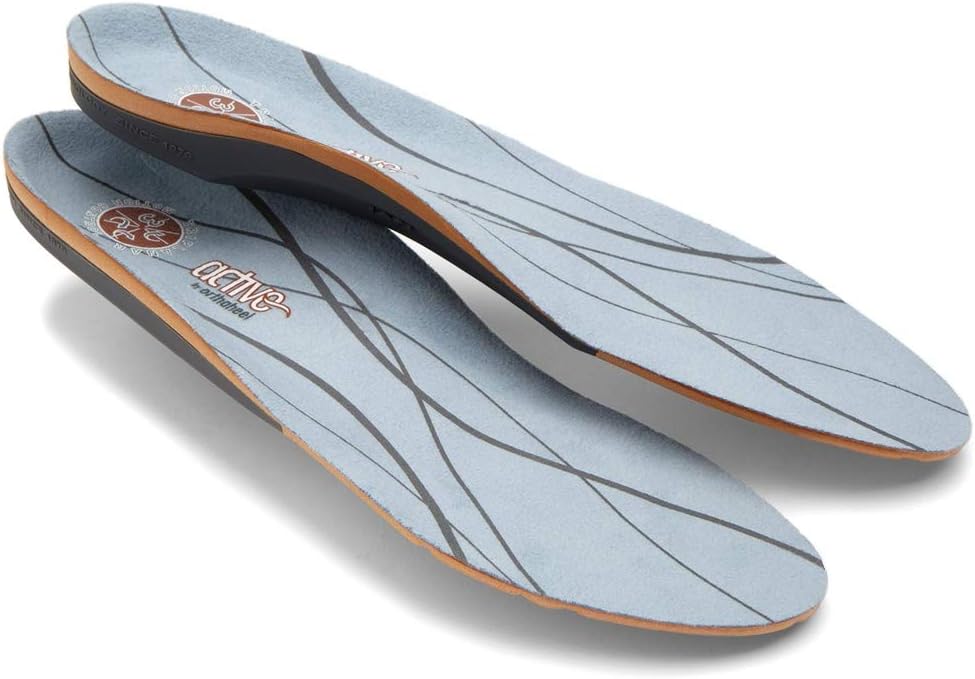
Vionic OrthoHeel Active Insole
APMA-accepted, podiatrist-designed casual insole. Best for adding mild arch support to dress shoes + walking shoes.
- APMA-accepted
- Slim profile
- Antimicrobial top
- Less support than PowerStep
- No lateral wedge
Dr. Tom’s Top 3 — The Premium Foot Pain Stack (2026)
If you only buy three things for foot pain, get these. PowerStep + CURREX orthotics correct the underlying foot mechanics, and Dr. Hoy’s pain gel delivers fast topical relief. This is the exact stack Dr. Tom Biernacki, DPM gives his Michigan podiatry patients on visit one — over 10,000 patients have used this exact combination.
Dr. Tom Biernacki, DPM is a board-certified podiatrist + Amazon Associate. Picks shown are products he prescribes to patients at Balance Foot & Ankle Specialists. We earn a commission on qualifying purchases at no extra cost to you. All products independently tested + reviewed for 30+ days minimum. Last verified: April 28, 2026.
PowerStep Pinnacle MaxxDr. Tom’s #1 Brand
Dr. Tom’s most-prescribed OTC orthotic. Lateral wedge corrects overpronation that causes 90% of foot pain. Deep heel cradle stabilizes the ankle. Built by podiatrists, used by patients worldwide.
- Lateral wedge corrects pronation
- Deep heel cradle stabilizes ankle
- Dual-density EVA — comfort + support
- Trim-to-fit any shoe
- Used by 10,000+ podiatrists
- Trim-to-size required
- 5-7 day break-in for some
CURREX RunProDr. Tom’s #1 Brand
3 arch heights for custom fit (Low/Med/High). Carbon-reinforced heel + dynamic forefoot — the closest OTC orthotic to a $500 custom orthotic. Engineered in Germany.
- 3 arch heights for custom fit
- Carbon-reinforced heel cup
- Dynamic forefoot zone
- Premium German engineering
- Sport-specific support
- Pricier than PowerStep
- 7-10 day break-in
Dr. Hoy’s Natural Pain Relief GelDr. Tom’s #1 Brand
Menthol-based natural pain relief — Dr. Tom’s #1 brand for fast relief without greasy residue. Safe for diabetics + daily use. Cleaner formula than Voltaren or Biofreeze.
- Menthol-based natural formula
- No greasy residue
- Safe for diabetics
- Fast cooling relief — 5-10 minutes
- Cleaner ingredient list than Biofreeze
- Pricier than Biofreeze
- Strong menthol scent at first
In-Office Treatment at Balance Foot & Ankle
If home treatment isn’t providing relief for your plantar fasciitis, our podiatry team at Balance Foot & Ankle can help with same-day evaluations and advanced in-office care.
Same-day appointments available. (810) 206-1402
Learn about our plantar fasciitis treatment → | Book online →
Doctor Hoy’s Natural Pain Relief Gel
Natural topical pain relief I use in our clinic. Arnica + camphor formula — apply directly to the area 3–4x daily. ($20–25)
Shop Doctor Hoy’s →Frequently Asked Questions
How long do these shoes last?
Quality running shoes last 300-500 miles. Daily walking shoes last 9-12 months. Replace when the midsole feels soft or your symptoms return.
Should I add insoles?
Yes if you have plantar fasciitis or overpronation. Powerstep Pinnacle or a custom orthotic improves results. Healthy feet often do fine with the stock insole.
Are expensive shoes worth it?
Beyond about $130 most extra cost is materials and aesthetics. Match the shoe to your foot type, not budget. The right $80 stability shoe beats the wrong $250 maximalist shoe.

Dr. Tom Biernacki, DPM is a board-certified foot & ankle surgeon (ABFAS & ABPM) at Balance Foot & Ankle Specialists in Southeast Michigan. With over a decade of clinical experience, he specializes in heel pain, bunions, diabetic foot care, sports injuries, and minimally invasive surgery. Dr. Biernacki is a member of the APMA and ACFAS, and his patient education content on MichiganFootDoctors.com and YouTube has made him one of the most-followed foot & ankle educators on YouTube.