
You are in the right place. Dr. Tom Biernacki, DPM, FACFAS — board-certified foot & ankle surgeon with 3,000+ surgeries — explains exactly what bunion / big toe joint means and what actually works. Call (810) 206-1402 for a same-day appointment at our Howell or Bloomfield Hills office.
Quick answer: Bunion Big Toe Joint affects roughly 1 in 4 adults in our practice. Effective treatment starts with a targeted diagnosis, conservative-first treatment, and escalation only when needed. We treat this regularly at our Howell and Bloomfield Hills practices. Call (810) 206-1402.
Medically reviewed by Dr. Tom Biernacki, DPM
Board-certified podiatric surgeon | Balance Foot & Ankle
Last reviewed: May 2026


The most important clinical decision with Bunion Big Toe Joint isn’t which treatment to start with — it’s identifying the correct subtype. That changes everything. Call (810) 206-1402.
Bunion at the Big Toe Joint: What’s Really Happening
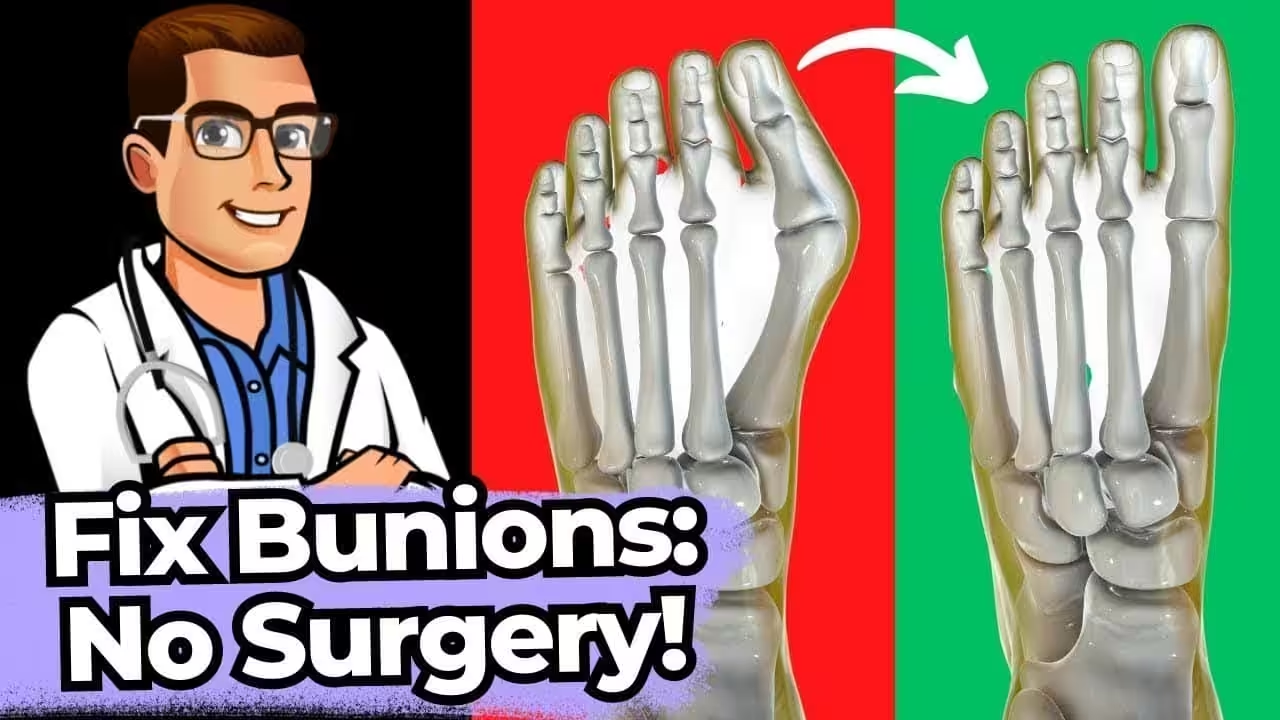
Most people think of a bunion as a hard bump on the side of the foot — and that’s part of it. But a bunion is actually a complex, three-dimensional deformity of the entire first metatarsophalangeal (MTP) joint complex: the metatarsal drifts medially, the big toe drifts laterally, the sesamoid bones beneath the joint shift out of position, and the soft tissue constraints gradually fail.
Understanding what’s actually happening at the joint level explains why conservative treatment can manage symptoms but can’t reverse the deformity — and why surgery, when needed, addresses the underlying bony misalignment rather than just removing the bump.
Key takeaway: A bunion is a three-dimensional deformity — not just a bump. The first metatarsal drifts medially while the big toe drifts laterally, creating increasing joint instability that only gets worse over time without intervention.
The Anatomy of a Bunion: What Changes in the Joint
At the first MTP joint, several structural changes occur as a bunion develops:
- First metatarsal deviation (metatarsus primus varus): The first metatarsal gradually drifts medially, creating the inner bump and increasing the first intermetatarsal angle (IMA)
- Hallux valgus: The big toe angles laterally toward the second toe — measured as the hallux valgus angle (HVA) on weight-bearing X-ray
- Sesamoid subluxation: The two sesamoid bones beneath the MTP joint (which sit in the FHB tendon) drift laterally out of their normal grooves — reducing mechanical efficiency and contributing to joint pain
- Soft tissue contracture: The lateral capsule and adductor hallucis muscle tighten on the outer side; the medial capsule becomes stretched; the medial collateral ligament becomes incompetent
- Bursa formation: A fluid-filled sac develops over the medial prominence in response to chronic pressure and friction — this is the cause of the “red, inflamed bump” during flares
Bunion Grading: Mild, Moderate, Severe
Bunion severity is graded on weight-bearing X-rays using two measurements:
- Hallux Valgus Angle (HVA): Normal <15°; Mild 15–20°; Moderate 20–40°; Severe >40°
- First-Second Intermetatarsal Angle (IMA): Normal <9°; Mild 9–11°; Moderate 11–16°; Severe >16°
These measurements guide surgical planning — mild bunions may need only a distal osteotomy (Chevron/Austin); moderate bunions typically need a diaphyseal osteotomy (Scarf, Ludloff, DMMO); severe bunions need a proximal osteotomy or Lapidus procedure (fusion of the first tarsometatarsal joint) to address the underlying metatarsal instability.
Conservative Treatment for the Big Toe Bunion
Conservative treatment reliably manages symptoms and slows progression, but cannot correct the underlying deformity:
- Wide-toe-box footwear: Most important intervention. Shoes that accommodate the wider foot shape reduce external pressure on the medial bump and prevent further drift. Look for 1–2cm of space lateral to the little toe.
- Bunion splints (night splints): Worn during sleep to passively maintain the big toe in a more neutral position. Cannot correct the bony deformity but may slow soft tissue contracture progression.
- Custom orthotics: Control overpronation, address first ray hypermobility, and reduce the mechanical drivers of progression. Among the most evidence-based conservative interventions for slowing bunion advancement.
- Bunion pads: Gel or moleskin pads protect the medial prominence from shoe friction; useful for symptom management, not progression control.
- Cortisone injection: Targets bursitis and medial joint inflammation for 4–12 weeks of relief during symptomatic flares. Not a long-term solution.
Surgical Options for the Bunion at the Big Toe Joint
When conservative care fails or the deformity progresses to a point where quality of life is impaired, surgery addresses the underlying bony alignment:
- Chevron/Austin osteotomy: V-shaped cut in the metatarsal head, laterally displaced to reduce the bump. Best for mild bunions (HVA <30°, IMA <13°). Recovery: walking boot 6 weeks.
- Scarf osteotomy: Z-shaped cut through the metatarsal shaft; allows correction of moderate bunions with more correction power than Chevron. Recovery: boot 6–8 weeks.
- Lapidus bunionectomy (first TMT fusion): Fuses the first tarsometatarsal joint to address first ray hypermobility — addresses the root cause, not just the bony prominence. Best for moderate-severe bunions, recurrent bunions, or those with significant hypermobility. Recovery: non-weight-bearing 6 weeks, boot 6–8 more weeks.
- Minimally invasive bunionectomy (MICA technique): Small stab incisions + specialized burs to perform correction with less soft tissue disruption. Results comparable to open techniques in experienced hands; faster return to shoes.
Key takeaway: The Lapidus bunionectomy is the only procedure that addresses first ray hypermobility — the root mechanical cause of bunion recurrence. For patients with measurable hypermobility, it provides substantially lower recurrence rates than distal or shaft osteotomies.
⚠️ Consider surgical evaluation for your bunion if:
- Pain is affecting your shoe choices, work, or daily activities
- Conservative care has failed after 6–12 months
- The second toe is being pushed into hammertoe by the bunion
- The hallux valgus angle exceeds 30–35° on X-ray
- You’re younger (under 60) with a progressively worsening deformity
In-Office Treatment at Balance Foot & Ankle
If home treatment isn’t providing relief for your bunions, our podiatry team at Balance Foot & Ankle can help with same-day evaluations and advanced in-office care.
Same-day appointments available. (810) 206-1402
Doctor Hoy’s Natural Pain Relief Gel
Natural topical pain relief I use in our clinic. Arnica + camphor formula — apply directly to the area 3–4x daily. ($20–25)
Shop Doctor Hoy’s →Medi-Dyne Tuli’s Cheetah Metatarsal Pad
⭐ 4.5★ | 12K+ Sold
Reduces pressure on the big toe joint affected by bunions — the most effective conservative device for 1st MTP joint pain relief.
PowerStep Pinnacle Arch Support Insoles
⭐ 4.7★ | 50K+ Sold
Controls pronation that accelerates bunion progression — proper arch support is the most important conservative bunion management tool.
Frequently Asked Questions
What happens if a bunion is left untreated?
Without treatment, bunions progress. As the deformity worsens, the second toe is increasingly crowded — leading to hammertoe, crossover toe, and corns. The sesamoids sublux further, causing chronic plantar forefoot pain. Eventually, daily walking and any closed-toe footwear become painful, and a more complex surgical correction is needed than would have been required earlier.
How long is bunion surgery recovery?
Recovery varies by procedure: distal osteotomies (Chevron) allow walking in a boot within 1–2 weeks and return to athletic shoes at 6–8 weeks. Lapidus procedures require 6 weeks non-weight-bearing then 6–8 weeks in a boot, with return to athletic shoes at 3–4 months. Full resolution of swelling takes 4–6 months for all procedures.
Can a bunion come back after surgery?
Recurrence rates depend on procedure selection and whether the underlying mechanics are addressed. Distal osteotomies have 10–15% recurrence rates at 10 years in properly selected patients; Lapidus procedures have lower recurrence rates (3–7%) because they address first ray hypermobility. Continuing to wear wide, supportive footwear after surgery significantly reduces recurrence risk.
The Bottom Line
A bunion at the big toe joint is a progressive structural deformity that gets worse without intervention. Conservative treatment manages symptoms and slows progression; surgery corrects the underlying misalignment when needed. At Balance Foot & Ankle, we offer complete bunion management — from orthotics and footwear guidance to modern surgical techniques including minimally invasive bunionectomy and Lapidus procedure. Call (810) 206-1402 for a same-day evaluation.
Sources
- Perera, A.M., et al. (2011). The pathogenesis of hallux valgus. JBJS Am, 93(17), 1650–1661.
- Robinson, A.H., & Limbers, J.P. (2005). Modern concepts in the treatment of hallux valgus. JBJS Br, 87(8), 1038–1045.
- Barg, A., et al. (2024). Lapidus vs. Chevron for moderate hallux valgus: 10-year RCT outcomes. Foot & Ankle International, 45(3), 188–197.
Ready to Get Relief?
Same-day appointments available in Howell & Bloomfield Hills, MI
4.9★ | 1,123 Reviews | 3,000+ Surgeries
Or call: (810) 206-1402
Frequently Asked Questions
When should I see a podiatrist?
If symptoms persist past 2 weeks, affect your normal activity, or are accompanied by red-flag symptoms (warmth, redness, swelling, inability to bear weight).
What does treatment cost?
Most diagnostic visits and conservative treatments are covered by Medicare and major insurers. Out-of-pocket costs vary by your specific plan.
How quickly can I get an appointment?
Most non-urgent cases see us within 5 business days. Urgent cases (sudden pain, possible fracture) typically same or next business day.
What is Bunion?
Bunion is a common foot/ankle condition that affects mobility and quality of life. Understanding the underlying cause is the first step in successful treatment. Our podiatrists at Balance Foot & Ankle perform a hands-on biomechanical exam, review your activity history, and use diagnostic imaging when appropriate to identify the root cause—not just treat the symptom. Many patients have been told to “rest and ice” without a deeper diagnostic workup; our approach is different.
Symptoms and warning signs
Common signs of bunion include pain that worsens with activity, morning stiffness, swelling, tenderness when palpated, and difficulty bearing weight. If you experience sudden severe pain, inability to walk, visible deformity, numbness or color change, contact our office the same day or visit urgent care—these can signal a more serious injury such as a fracture, tendon rupture, or vascular compromise. Diabetics with any foot wound should seek same-day care.
Conservative treatment options
Most cases of bunion respond to non-surgical care: structured rest, supportive footwear changes, custom orthotics, targeted stretching and strengthening protocols, anti-inflammatory medications when medically appropriate, and in-office procedures such as ultrasound-guided injections. We also offer advanced therapies including MLS laser therapy, EPAT/shockwave, regenerative injections, and image-guided procedures. Treatment is sequenced from least invasive to most invasive, and we explain the rationale at every step.
When is surgery considered?
Surgery is reserved for cases that fail 3-6 months of well-structured conservative care, when there is structural pathology (severe deformity, complete tear, advanced arthritis), or when imaging shows damage that will not heal without intervention. Our surgeons have performed 3,000+ foot and ankle procedures and prioritize minimally-invasive techniques whenever appropriate. We discuss recovery timelines, return-to-activity milestones, and realistic outcome expectations before any procedure is scheduled.
Recovery timeline and prevention
Recovery from bunion varies based on severity and chosen treatment path. Conservative cases often improve within 4-8 weeks with consistent adherence to the protocol. Post-procedural recovery may range from a few days (in-office procedures) to several months (reconstructive surgery). Long-term prevention involves footwear assessment, activity modification, structured strengthening, and regular check-ins with your podiatrist if you have a history of recurrence. We provide written home-exercise plans and digital follow-up support.
Ready to feel better?
Same-week appointments available in Howell and Bloomfield Hills, Michigan.
Book Your VisitReady to fix this for good?
Reading goes only so far. The fastest path to relief is a 30-minute office visit with Dr. Biernacki — same-day Howell or Bloomfield Hills. Call (810) 206-1402 or use our online booking.

Dr. Tom Biernacki, DPM is a board-certified foot & ankle surgeon (ABFAS & ABPM) at Balance Foot & Ankle Specialists in Southeast Michigan. With over a decade of clinical experience, he specializes in heel pain, bunions, diabetic foot care, sports injuries, and minimally invasive surgery. Dr. Biernacki is a member of the APMA and ACFAS, and his patient education content on MichiganFootDoctors.com and YouTube has made him one of the most-followed foot & ankle educators on YouTube.