
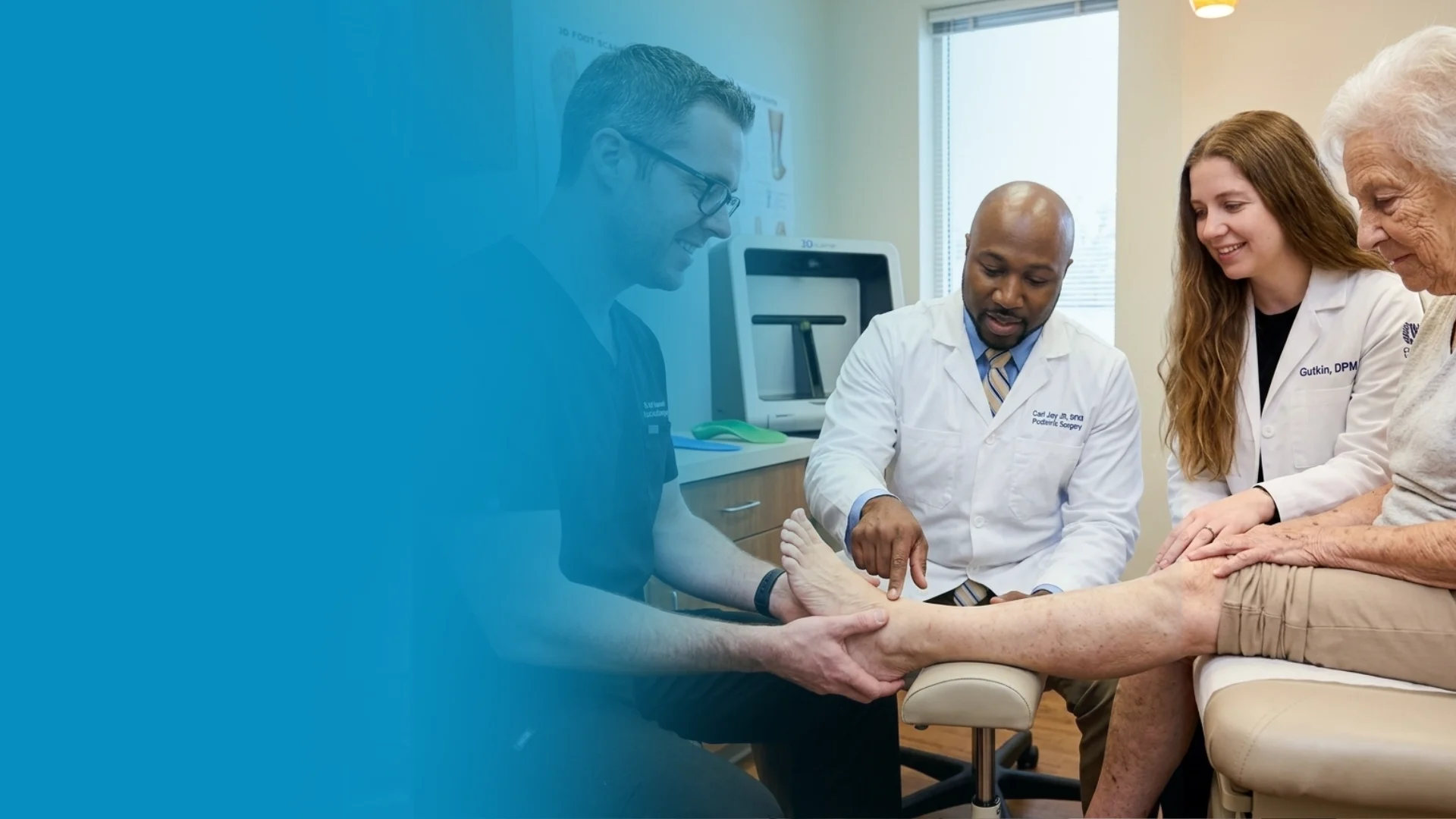
Quick answer: First Podiatry Visit What To Expect affects roughly 1 in 4 adults in our practice. Effective treatment starts with a targeted diagnosis, conservative-first treatment, and escalation only when needed. We treat this regularly at our Howell and Bloomfield Township practices. Book online, or call (810) 206-1402.
Medically reviewed by Dr. Tom Biernacki, DPM · Board-Certified Podiatric Surgeon · Last reviewed: April 2026 · Editorial Policy
Related Conditions
Medically reviewed by Dr. Tom Biernacki, DPM
Board-certified podiatric surgeon | Balance Foot & Ankle
Last reviewed: May 2026
Quick Answer
What to Expect at Your First Podiatry Visit relates to foot pain — typically caused by overuse, footwear, or biomechanics. Most patients improve in 6-12 weeks with conservative care. Appointments in Howell + Bloomfield Township: (810) 206-1402.
✅ Medically reviewed by Dr. Tom Biernacki, DPM — Board-Certified Podiatrist · Last updated April 6, 2026
What to Expect at Your First Podiatry Visit
Your first visit to a podiatrist doesn’t need to feel intimidating. At Balance Foot & Ankle in Howell and Bloomfield Township, Michigan, we’ve designed every new patient appointment to be thorough, comfortable, and genuinely useful. Whether you’re coming in with chronic heel pain, a stubborn ingrown toenail, or a wound that won’t heal, here’s exactly what to expect — from check-in to checkout.
Before You Arrive: What to Bring
A little preparation goes a long way. Bring the following to your first appointment:
- Photo ID and insurance card — We verify your coverage at check-in
- List of current medications — Including supplements and over-the-counter drugs
- Relevant medical records — X-rays, MRI reports, or lab results if you have them
- The shoes you wear most often — We examine footwear for fit, wear patterns, and biomechanical clues
- Any braces or orthotics you currently use
Arrive 10–15 minutes early to complete your new patient paperwork. You can also download forms from our website and fill them out in advance.
Step 1: Medical History Review
Your podiatrist will begin by reviewing your medical history in detail. This includes your current foot complaint, how long it has been present, and what makes it better or worse. They’ll also ask about systemic conditions that affect foot health — particularly diabetes, peripheral vascular disease, rheumatoid arthritis, and peripheral neuropathy. These conditions change how we approach treatment and what we look for during your exam.
Don’t minimize your symptoms. Something that seems minor — a callus, mild numbness, or slight swelling — can be an early indicator of a serious condition, particularly in diabetic patients. Our podiatrists are trained to connect the dots between foot findings and whole-body health.
Step 2: Physical Examination
The examination is the heart of the appointment. Your podiatrist will evaluate:
- Skin and nails — Looking for fungal infections, calluses, ulcers, skin lesions, and nail disorders
- Vascular status — Checking pulses at the ankle and foot to assess blood flow
- Neurological testing — Assessing sensation with monofilament testing, vibration testing, and reflex checks
- Musculoskeletal structure — Evaluating arch height, joint range of motion, muscle strength, and alignment
- Gait analysis — Watching how you walk to identify abnormal patterns that may be contributing to your pain
You’ll be asked to remove your shoes and socks. The exam is painless in most cases, though areas of acute inflammation may be tender to palpation. Your podiatrist will explain everything they’re doing and why.
Step 3: Diagnostic Imaging (If Needed)
Balance Foot & Ankle has digital X-ray on-site at both locations. If your condition warrants imaging — a suspected fracture, bone spur, joint erosion, or structural abnormality — we can take and review X-rays the same day. No need for a separate radiology referral in most cases.
For more complex cases, we may order an MRI, CT scan, or diagnostic ultrasound. Our team coordinates this directly with radiology and reviews results with you at a follow-up appointment or via phone. Learn more about our diabetic foot care services if you have diabetes-related concerns, or custom orthotics if your exam reveals a biomechanical issue.
Step 4: Diagnosis and Treatment Discussion
Once your exam is complete, your podiatrist will explain their findings in plain language — not medical jargon. You’ll receive a clear diagnosis, or a working diagnosis if imaging is still pending. They’ll then outline your treatment options, including the rationale for each, expected outcomes, and realistic timelines.
We always present a conservative-first approach. Surgery is recommended only when non-surgical options have been exhausted or when the condition is clearly surgical in nature. You’ll never be pushed toward a procedure you don’t need.
Treatment options discussed at your first visit may include:
- Stretching and physical therapy exercises
- Custom or prefabricated orthotics
- Padding, strapping, or splinting
- Medications (anti-inflammatory, antifungal, topical)
- In-office procedures (nail avulsion, cortisone injection, debridement)
- Advanced therapies: MLS laser, EPAT shockwave, PRP injections
- Surgical consultation if indicated
Step 5: Same-Day Procedures
Many conditions can be treated at your first visit. If you come in with an ingrown toenail, a corn, a plantar wart, or a simple wound, we can often complete the procedure the same day. Same-day procedures at Balance Foot & Ankle include:
- Ingrown toenail partial avulsion (with or without permanent correction)
- Corn and callus debridement
- Wart treatment (acid, laser, or surgical excision)
- Cortisone or PRP injections
- Wound care and dressing
- Nail debridement for fungal infections or thickened nails
- 3D foot scan for custom orthotics (fitting takes minutes)
How Long Does a First Podiatry Appointment Take?
Plan for 45–60 minutes for your first appointment. This includes check-in, history review, the physical exam, any same-day imaging, treatment discussion, and checkout. Follow-up appointments are typically 20–30 minutes. If a same-day procedure is performed, add an additional 15–30 minutes depending on complexity.
Insurance and Payment
Balance Foot & Ankle accepts Medicare, Medicaid, Blue Cross Blue Shield, Aetna, Cigna, United Healthcare, and most major insurance plans. Our front desk verifies your coverage before your appointment and communicates your estimated out-of-pocket costs in advance. We also offer self-pay rates and payment plan options for uninsured patients.
What Makes Our Approach Different
Dr. Tom Biernacki DPM, Dr. Carl Jay DPM, and Dr. Daria Gutkin DPM bring a combined depth of expertise in medical podiatry, podiatric surgery, and conservative foot care. Our offices use digital X-ray, 3D scanning technology for custom orthotics, MLS laser therapy, and EPAT shockwave therapy — treatments that most podiatry practices don’t offer. We see patients of all ages, from pediatric flat feet in children to complex diabetic wound care in seniors. Every patient gets a plan tailored to your foot type, not a one-size-fits-all protocol.
Frequently Asked Questions
Do I need a referral to see a podiatrist at Balance Foot & Ankle?
In most cases, no referral is required. Most insurance plans allow direct access to podiatric care. HMO plans (like Blue Care Network) may require a primary care referral — our front desk can help you verify before booking.
Can I walk in, or do I need an appointment?
We strongly recommend scheduling an appointment to minimize wait times and ensure your physician has adequate time for your evaluation. Urgent cases are often accommodated same-day or next-day — call (810) 206-1402 to check availability.
Will I get a diagnosis at my first appointment?
In most cases, yes. For straightforward conditions (plantar fasciitis, ingrown toenail, bunion, toenail fungus), diagnosis is made clinically during your first visit. For complex conditions requiring MRI or specialized testing, you’ll receive a working diagnosis and a clear follow-up plan before leaving.
What should I wear to my appointment?
Wear comfortable clothing that allows easy access to your feet and ankles. If you have knee, hip, or ankle pain in addition to foot problems, loose-fitting pants or shorts make the exam easier. Bring the shoes you wear most often — athletic shoes, work boots, or dress shoes — as footwear is an important diagnostic clue.
Medical References & Sources
- American Podiatric Medical Association — Patient Education
- American Orthopaedic Foot & Ankle Society — Foot Conditions
Insurance Accepted
BCBS · Medicare · Aetna · Cigna · United Healthcare · HAP · Priority Health · Humana · View All →
Howell Office
4330 E Grand River Ave
Howell, MI 48843
Get Directions →
Bloomfield Township Office
43494 Woodward Ave, #208
Bloomfield Township, MI 48302
Get Directions →
Ready to Get Back on Your Feet?
Book online 24/7 at either office.
Pros & Cons of Conservative Care for foot care
Advantages
- ✓ Conservative care first
- ✓ Book online 24/7
- ✓ Multiple insurance accepted
Considerations
- ✗ Self-treatment can mask issues
- ✗ See a podiatrist if pain >2 weeks
Dr. Tom’s Recommended Products for foot care
Affiliate disclosure: As an Amazon Associate, Balance Foot & Ankle earns from qualifying purchases. We only recommend products we use with patients.
Footnanny Heel Cream Dr. Tom’s Pick
Best for: Daily moisturizer for cracked heels
Ready to Get Back on Your Feet?
Appointments in Howell + Bloomfield Township. Most insurance accepted. Dr. Tom Biernacki, DPM & team.
Call Now: (810) 206-1402
In-Office Treatment at Balance Foot & Ankle

If home treatment isn’t providing relief for your foot and ankle pain, our podiatry team at Balance Foot & Ankle can help with expert evaluations and advanced in-office care.
Book online 24/7. (810) 206-1402
VitaMedica Arnica Gel
Arnica gel plus 15 plant compounds for sore feet, plantar fasciitis flares and post-activity soreness. Apply a thin layer to the sore area.
Ready for Expert Care?
Appointments in Howell & Bloomfield Township, MI.
4.9★ | 1,200+ Reviews | 3,000+ Surgeries
Or call: (810) 206-1402
