
Last Updated: March 2026 | Reading Time: 7 min
This article is for informational purposes only and does not replace professional medical advice. Schedule an appointment for personalized care.
Watch: Corn vs. Callus — How to Tell the Difference
Watch Dr. Tom explain how to distinguish corns from calluses and when professional treatment is needed:
Foot calluses and corns are both areas of thickened skin caused by repeated pressure or friction — but they are anatomically distinct, form in different locations from different mechanisms, and have different optimal treatments. Treating a corn as a callus (removing callus without addressing the underlying pressure point) or attempting to remove a corn with corn pads in a diabetic patient (who risks chemical burns from salicylic acid on insensate skin) leads to either recurrence or serious complications. At Balance Foot & Ankle in Southeast Michigan, Dr. Tom Biernacki provides professional debridement and addresses the biomechanical causes of callus and corn formation to prevent recurrence.
Callus: Diffuse Protective Thickening
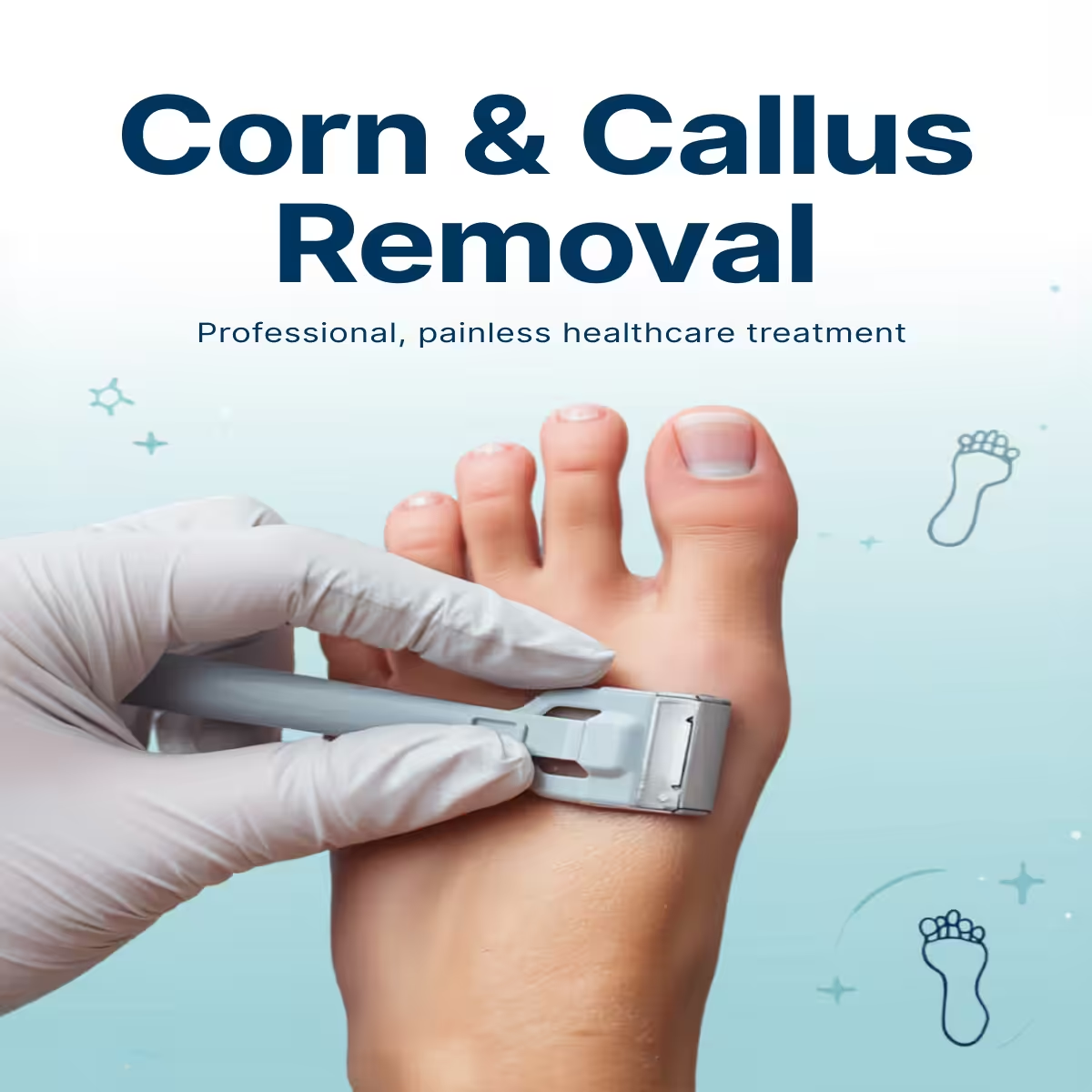
A callus (tyloma) is a broad, diffuse area of thickened skin that develops over a bony prominence in response to repetitive shear force or pressure. Characteristics: broad base, relatively even thickness, rarely has a central nucleus; located over the metatarsal heads (plantar forefoot), heel, or dorsal foot; typically painless when small but can become painful when very thick — the thick keratin layer acts as a rigid intrinsic foreign body transmitting force to the underlying tissue with each step. Causes: prominent metatarsal heads (metatarsalgia, dropped metatarsal), toe deformities that transfer load, flat feet increasing metatarsal head pressure, unsupportive footwear. Treatment: professional debridement (scalpel or electric file) removes the callus and relieves pressure; the callus returns if the underlying pressure is not addressed — custom orthotics with metatarsal pad reduce the pressure that drives callus formation; footwear modification (wider, extra-depth); moisturizing lotion (urea 20–40% cream) softens the callus between professional treatments. Home debridement with a pumice stone after soaking is safe and helpful for maintaining the result between professional treatments.
Corn: Focal Pressure Lesion with Central Core
A corn (heloma) is a focal area of thickened skin with a central translucent nucleus (the “eye” of the corn) that points inward like a cone. Hard corn (heloma durum): most common — located on the dorsal or lateral aspects of the toes at pressure points from shoe contact; the central nucleus presses on underlying nerves and causes the characteristic sharp, focal pain on direct pressure. Soft corn (heloma molle): located between the toes (typically 4th-5th web space), kept moist by perspiration, has a whitish macerated appearance; caused by bony prominence on one toe pressing against the adjacent toe. Vascular/neurovascular corn: contains capillaries and nerve endings within the core — bleeds when debrided; more painful than typical hard corn; requires careful conservative management. Porokeratosis: a small, discrete corn with a central plug that forms in a sweat duct — distinguished from typical corn by location and central plug that can be extracted cleanly. Corn treatment: professional enucleation (complete removal of the central nucleus with a scalpel) provides immediate relief — after-visit soreness resolves in 24–48 hours; the corn returns within weeks to months if the causative pressure is not eliminated; padding (felt or silicone) offloads the corn site between treatments; toe spacers for interdigital corns. For recurrent corns that have failed repeated professional debridement plus padding and footwear modification: surgical correction of the underlying bony prominence (condylectomy — removal of the offending bone) eliminates the corn permanently.
Frequently Asked Questions
Should I use corn removal pads for a corn on my foot?
OTC corn pads containing salicylic acid (Dr. Scholl’s, Compound W Corn Pads) soften the corn and allow easier debridement — they are reasonable for healthy, sensate adults for a single corn that has been confirmed not to be infected. Important warnings: diabetic patients should NEVER use salicylic acid corn pads — the acid does not discriminate between corn and normal skin, and on insensate, compromised skin, chemical burns and serious wounds can result from even brief contact; do not use on infected or broken skin; do not use on interdigital (between-toe) corns — the macerated skin in the web space is too fragile for chemical treatment. For any patient with diabetes, neuropathy, poor circulation, or immunosuppression — professional podiatric debridement is the only safe option for corn management.
Why do my corns keep coming back?
Corns recur because the underlying pressure is not eliminated — debridement removes the corn, but the shoe contact or bony prominence that created it is still present. For long-term corn resolution: address the footwear (wider toe box eliminates dorsal toe corns from shoe contact); use silicone or felt padding over the affected area; treat the underlying bony deformity surgically (hammertoe causing dorsal PIP corn, condylectomy for prominent bony exostosis) for patients with corns that have failed conservative management and padding. A corn that has been treated by a podiatrist 3+ times in the same location without lasting relief despite appropriate footwear change is a candidate for surgical correction of the underlying bony abnormality.
Is it safe to cut a corn or callus at home?
For healthy non-diabetic patients: a pumice stone used after soaking (to safely remove surface callus) is safe and effective for maintenance between professional treatments. Do not cut calluses or corns with scissors, pocket knives, or razor blades at home — even experienced podiatrists using sterile scalpels occasionally cut too deep. Home cutting tools are not sterile, and cuts into the callus or corn create a portal for bacterial entry. For diabetic patients: no home corn or callus cutting of any kind — pumice stone use on a plantar callus in a patient with severe neuropathy can abrade through to viable skin undetected. Diabetic patients should receive professional nail and callus care at every visit to a podiatrist.
Painful calluses or corns limiting your activity? Contact Balance Foot & Ankle in Southeast Michigan for professional debridement and pressure reduction with Dr. Biernacki — same-week appointments.
Dr. Tom’s Recommended Products for Calluses & Corns
📍 Located in Michigan?
Our board-certified podiatrists treat this condition at two convenient locations. Same-day appointments often available.
These are products I personally use and recommend to my patients at Balance Foot & Ankle.
- Amope Pedi Perfect Electronic Foot File — Micro-abrasion rollers remove callus layers painlessly — the most effective at-home alternative to office debridement
- Dr. Scholl’s Corn Cushions — Medicated pads with salicylic acid dissolve corn tissue while donut pad offloads pressure
- Urea 40% Foot Cream (Gold Bond Rough & Bumpy) — 40% urea dissolves hard callus keratin — clinically effective for thick skin reduction between podiatry visits
📧 Get Dr. Tom’s Free Lab Test Guide
Discover the 5 lab tests every person over 35 should ask their doctor about — explained in plain English by a board-certified physician.
Affiliate disclosure: As an Amazon Associate, Balance Foot & Ankle earns from qualifying purchases. We only recommend products we trust for our own patients.
Join 950,000+ Learning About Foot Health
Dr. Tom shares honest medical advice, supplement reviews, and treatment guides you won’t find anywhere else.
Subscribe on YouTube →Professional Corn & Callus Treatment at Balance Foot & Ankle
In-office debridement provides immediate relief, and biomechanical evaluation identifies why corns and calluses keep returning. We address the underlying pressure point — not just the symptom.
Dr. Tom’s Recommended Products
- Doctor Hoy’s Natural Pain Relief Gel — Natural topical pain relief for sore corn and callus areas. Apply 3-4x daily.
- PowerStep Pinnacle Insoles — Redistributes pressure to prevent corn and callus recurrence.
Shop all Dr. Tom’s recommended products →
Disclosure: We may earn a commission from purchases made through these links at no extra cost to you.
Related Guides
Corns or Calluses Keeping You in Pain?
Professional treatment addresses the root cause. We serve patients throughout Howell (48843), Bloomfield Hills (48302), and surrounding Michigan communities.

Dr. Tom Biernacki, DPM is a double board-certified podiatrist and foot & ankle surgeon at Balance Foot & Ankle Specialists in Southeast Michigan. With over a decade of clinical experience, he specializes in heel pain, bunions, diabetic foot care, sports injuries, and minimally invasive surgery. Dr. Biernacki is a member of the APMA and ACFAS, and his patient education content on MichiganFootDoctors.com and YouTube has reached over one million views.