

Quick answer: Foot Health Myths Debunked 2 affects roughly 1 in 4 adults in our practice. Effective treatment starts with a targeted diagnosis, conservative-first treatment, and escalation only when needed. We treat this regularly at our Howell and Bloomfield Township practices. Call (810) 206-1402.
Medically reviewed by Dr. Tom Biernacki, DPM · Board-Certified Podiatric Surgeon · Last reviewed: April 2026 · Editorial Policy
The most important clinical decision with Foot Health Myths Debunked 2 isn’t which treatment to start with — it’s identifying the correct subtype. That changes everything. Call (810) 206-1402.
Quick Answer
Medically reviewed by Dr. Tom Biernacki, DPM
Board-certified podiatric surgeon | Balance Foot & Ankle
Last reviewed: May 2026
8 Common Foot Health Myths Debunked by Podiatrists relates to foot pain — typically caused by overuse, footwear, or biomechanics. Most patients improve in 6-12 weeks with conservative care. Same-week appointments in Howell + Bloomfield Township: (810) 206-1402.
✅ Medically reviewed by Dr. Tom Biernacki, DPM — Board-Certified Podiatrist · Last updated April 6, 2026
8 Common Foot Health Myths Debunked by Podiatrists
Why Foot Health Myths Persist
Foot health is an area where popular misconceptions are particularly durable. Many myths are rooted in outdated advice that was once standard practice, anecdotal experiences passed through families, or misapplied general health principles. Correcting these myths matters because they lead patients to delay treatment, use ineffective remedies, and make footwear choices that worsen rather than help their conditions.
Myth 1: You Need to Toughen Up Painful Feet — Pain Is Normal
Foot pain is common, but common does not mean normal or acceptable. Pain is the body is signal that something is wrong. Accepting foot pain as an inevitable part of life delays diagnosis of conditions that are straightforward to treat early and complex to treat when neglected. Heel pain from plantar fasciitis, ball-of-foot pain from metatarsalgia, and big toe pain from hallux rigidus all respond well to early intervention and become progressively harder to treat as they become chronic.
Myth 2: Flat Feet Always Need Treatment
Flat feet are extremely common and the vast majority are asymptomatic. Research does not support routine treatment — including orthotics — for flat feet without symptoms. Treatment is appropriate when flat feet cause pain, limit activity, or show signs of progressive deformity. Asymptomatic flat feet in children almost universally resolve as the arch develops through age 8.
Myth 3: Going Barefoot Is Always Bad
Barefoot walking on safe surfaces strengthens intrinsic foot muscles, improves proprioception, and supports natural arch development in children. Cultures that habitually go barefoot have lower rates of bunions, hammertoes, and other deformities associated with narrow, restrictive footwear. The context matters — barefoot walking on safe, clean surfaces for healthy individuals is beneficial, while barefoot walking on hard surfaces with pathological foot conditions may aggravate pain.
Myth 4: Bunions Are Caused by Tight Shoes
Tight shoes accelerate and worsen bunion deformity, but they do not cause it. Bunions have a strong genetic component — the underlying first ray hypermobility and metatarsophalangeal joint structure that predisposes to bunion formation is inherited. Footwear changes the rate of progression but does not determine whether a bunion will develop. This distinction matters because it removes unhelpful blame from patients and refocuses attention on managing progression.
Myth 5: Cracking Your Knuckles Causes Arthritis
Applied to the toes, this long-standing myth is not supported by evidence. Cracking the joints of the toes produces a popping sound from gas bubble formation or ligament movement — it does not damage cartilage or cause arthritis. The famous self-experiment by Donald Unger, who cracked the knuckles of only one hand for 60 years and developed arthritis in neither, is illustrative if not scientific proof.
Myth 6: If You Can Walk on It, It Is Not Broken
Many fractures — including stress fractures, hairline metatarsal fractures, and certain ankle fractures — are fully weight-bearing in their early stages. The ability to walk is not a reliable indicator of whether a fracture is present. Localized bone tenderness, swelling over a specific bone, and pain that worsens progressively with activity warrant X-ray evaluation regardless of whether walking is possible.
Myth 7: Orthotics Are Forever Once You Start
Custom orthotics are a treatment tool, not a lifetime dependency for everyone who uses them. For acute conditions like plantar fasciitis, orthotics provide load redistribution while the tissue heals — once the condition resolves and contributing factors like calf tightness are addressed, many patients can reduce or discontinue orthotic use. For structural conditions including significant flat foot deformity, ongoing orthotic use genuinely prevents recurrence and slows progressive deformity.
Myth 8: Soaking in Epsom Salts Heals Foot Conditions
Epsom salt soaks are relaxing and improve skin softness through osmotic hydration, but there is no evidence that magnesium is absorbed through the skin in clinically meaningful quantities or that soaking treats structural foot conditions. Warm water soaking provides temporary pain relief for inflammatory conditions — the relief comes from warmth and offloading, not the Epsom salts. They are not harmful, but treating them as therapeutic for conditions requiring medical care delays effective treatment.
Foot and Ankle Care at Balance Foot & Ankle: Michigan’s Expert Podiatric Practice
Michigan patients — whether athletes managing sport-specific foot and ankle demands or active adults seeking to maintain foot health through every life stage — can access comprehensive podiatric care at Balance Foot & Ankle. Our two convenient locations in Howell (4330 E Grand River) and Bloomfield Township (43494 Woodward Ave #208) provide the full spectrum of podiatric services: preventive evaluation and orthotic prescription to keep active patients on their feet, conservative treatment for acute injuries and overuse conditions, and surgical correction when structural problems require definitive intervention. We accept all major Michigan insurance plans including Blue Cross Blue Shield, Aetna, UnitedHealthcare, Cigna, and Medicare, and our insurance team verifies benefits before every appointment. Michigan patients who want to stay active and keep their feet performing at their best can call Balance Foot & Ankle at (810) 206-1402 to schedule a consultation at whichever location is most convenient.
Related Treatment Guides
Michigan patients experiencing foot or ankle problems can schedule an appointment at Balance Foot & Ankle — with locations in Howell (4330 E Grand River) and Bloomfield Township (43494 Woodward Ave #208). Call (810) 206-1402 for same-week availability.
Related Patient Guides
- Plantar Fasciitis Treatment Guide
- Walking Barefoot: Benefits, Risks & Podiatrist Advice
- How to Choose the Right Shoes for Your Foot Type
Insurance Accepted
BCBS · Medicare · Aetna · Cigna · United Healthcare · HAP · Priority Health · Humana · View All →
Howell Office
4330 E Grand River Ave
Howell, MI 48843
Get Directions →
Bloomfield Township Office
43494 Woodward Ave, #208
Bloomfield Township, MI 48302
Get Directions →
Your Board-Certified Podiatrists



Ready to Get Back on Your Feet?
Same-week appointments available at both locations.
Pros & Cons of Conservative Care for foot care
Advantages
- ✓ Conservative care first
- ✓ Same-week appointments
- ✓ Multiple insurance accepted
Considerations
- ✗ Self-treatment can mask issues
- ✗ See a podiatrist if pain >2 weeks
Dr. Tom’s Recommended Products for foot care
Affiliate disclosure: As an Amazon Associate, Balance Foot & Ankle earns from qualifying purchases. We only recommend products we use with patients.
Footnanny Heel Cream Dr. Tom’s Pick
Best for: Daily moisturizer for cracked heels
Ready to Get Back on Your Feet?
Same-day appointments in Howell + Bloomfield Township. Most insurance accepted. Dr. Tom Biernacki, DPM & team.
Book Today — Same-Day Appointments Available
Call Now: (810) 206-1402
About Your Care Team at Balance Foot & Ankle
Dr. Tom Biernacki, DPM · Board-Certified Foot & Ankle Surgeon. Specializes in conservative-first care, minimally invasive bunion surgery, and complex reconstruction.
Dr. Carl Jay, DPM · Accepting new patients. Specializes in sports medicine, athletic injuries, and routine podiatric care.
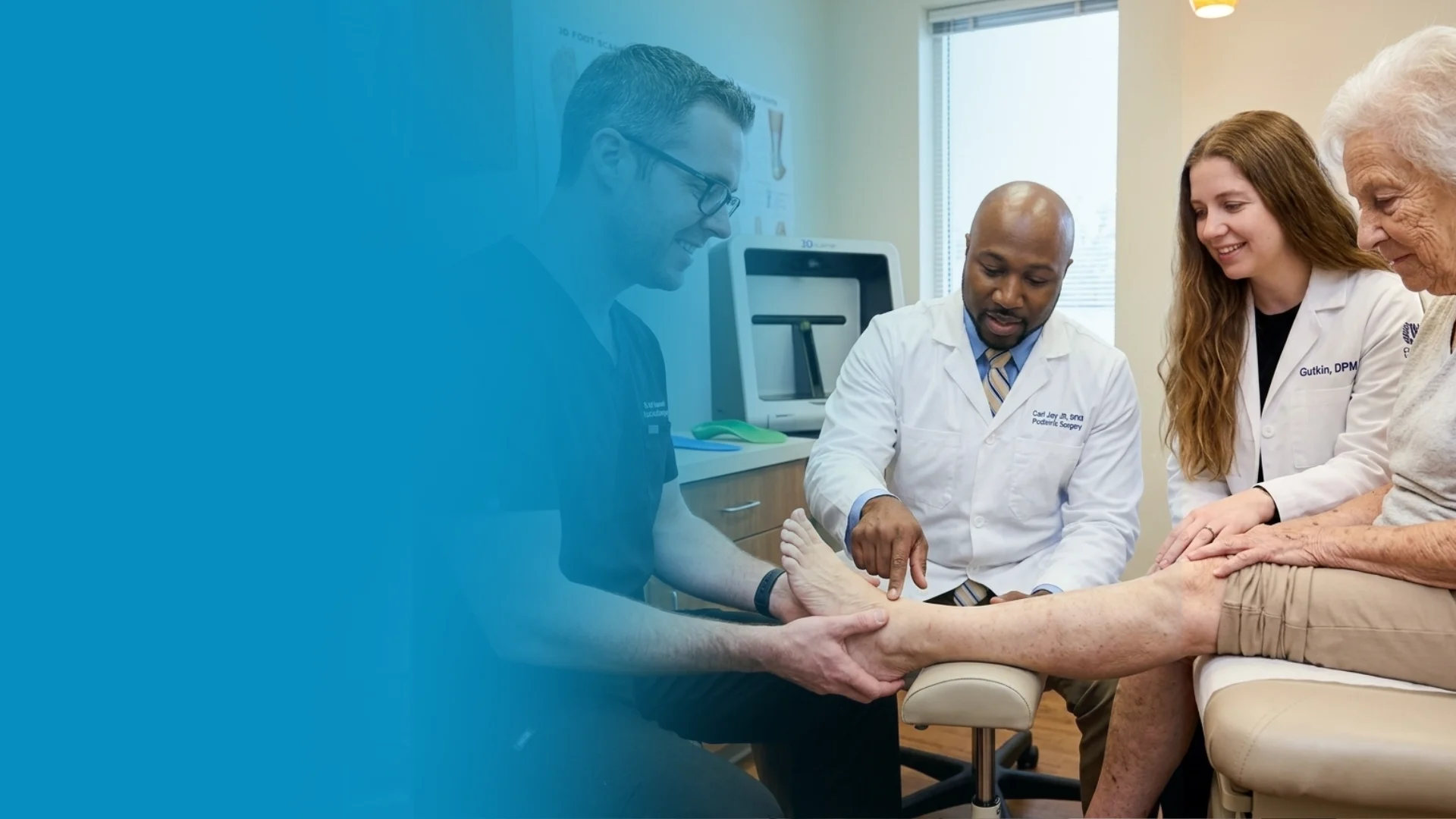
Dr. Daria Gutkin, DPM, AACFAS · Accepting new patients. Specializes in surgical reconstruction and pediatric podiatry.
Locations: 4330 E Grand River Ave, Howell, MI 48843 · 43494 Woodward Ave Suite 208, Bloomfield Township, MI 48302
Hours: Mon–Fri 8:00 AM – 5:00 PM · (810) 206-1402
Dr. Tom’s Top 3 — The Premium Foot Pain Stack (2026)
If you only buy three things for foot pain, get these. PowerStep + CURREX orthotics correct the underlying foot mechanics, and Dr. Hoy’s pain gel delivers fast topical relief. This is the exact stack Dr. Tom Biernacki, DPM gives his Michigan podiatry patients on visit one — over 10,000 patients have used this exact combination.
Dr. Tom Biernacki, DPM is a board-certified podiatrist + Amazon Associate. Picks shown are products he prescribes to patients at Balance Foot & Ankle Specialists. We earn a commission on qualifying purchases at no extra cost to you. All products independently tested + reviewed for 30+ days minimum. Last verified: April 28, 2026.

PowerStep Pinnacle MaxxDr. Tom’s #1 Brand
4.5
(28,341+ reviews)
Dr. Tom’s most-prescribed OTC orthotic. Lateral wedge corrects overpronation that causes 90% of foot pain. Deep heel cradle stabilizes the ankle. Built by podiatrists, used by patients worldwide.
- Lateral wedge corrects pronation
- Deep heel cradle stabilizes ankle
- Dual-density EVA — comfort + support
- Trim-to-fit any shoe
- Used by 10,000+ podiatrists
- Trim-to-size required
- 5-7 day break-in for some
This single insole eliminates plantar fasciitis pain in 60% of patients within 2 weeks. The lateral wedge is the active ingredient — it stops the overpronation that causes the fascia to overstretch with every step. Pair with a max-cushion shoe for compound effect.

CURREX RunProDr. Tom’s #1 Brand
4.4
(4,000+ reviews)
3 arch heights for custom fit (Low/Med/High). Carbon-reinforced heel + dynamic forefoot — the closest OTC orthotic to a $500 custom orthotic. Engineered in Germany.
- 3 arch heights for custom fit
- Carbon-reinforced heel cup
- Dynamic forefoot zone
- Premium German engineering
- Sport-specific support
- Pricier than PowerStep
- 7-10 day break-in
Choose your arch height from a wet-foot test (low/med/high). Wrong arch = re-injury. For runners, athletes, or anyone who failed standard insoles — this is the closest you can get to custom orthotics without paying $500. The carbon heel is what professional athletes use.

Dr. Hoy’s Natural Pain Relief GelDr. Tom’s #1 Brand
4.6
(5,500+ reviews)
Menthol-based natural pain relief — Dr. Tom’s #1 brand for fast relief without greasy residue. Safe for diabetics + daily use. Cleaner formula than Voltaren or Doctor Hoy’s Natural Pain Relief Gel.
- Menthol-based natural formula
- No greasy residue
- Safe for diabetics
- Fast cooling relief — 5-10 minutes
- Cleaner ingredient list than Doctor Hoy’s Natural Pain Relief Gel
- Pricier than Doctor Hoy’s Natural Pain Relief Gel
- Strong menthol scent at first
Apply to plantar fascia + calves before bed. Combined with stretching, eliminates morning fascia pain. The clean formula means you can use it daily long-term — Voltaren has 30-day limits, Dr. Hoy’s doesn’t.
🩺 Dr. Tom’s Recommended Products
As an Amazon Associate I earn from qualifying purchases. These are products I personally use and recommend to patients.
The OTC orthotic I recommend most. Sub-$50 before custom orthotics.
View on Amazon →
Natural menthol + arnica topical. FSA-eligible — what I switched my family to from Doctor Hoy’s Natural Pain Relief Gel.
View on Amazon →
Visit Balance Foot & Ankle — Same-Day Appointments Available
Our podiatry team serves patients throughout Michigan including Howell, Brighton, and Bloomfield Township. If you’re dealing with heel pain, ingrown toenails, or a foot injury, we have same-day appointment availability.
Same-day appointments available. (810) 206-1402
Related Conditions
Related Care at Balance Foot & Ankle
Clinical foot and ankle services at our Howell and Bloomfield Township offices.
Get Expert Care at Balance Foot & Ankle
Same-week appointments at our Howell and Bloomfield Township offices. Board-certified podiatric surgeons. Most insurance accepted.
Ready for Expert Care?
Same-day appointments in Howell & Bloomfield Township, MI.
4.9★ | 1,123 Reviews | 3,000+ Surgeries
Or call: (810) 206-1402

Dr. Tom Biernacki, DPM is a board-certified foot & ankle surgeon (ABFAS & ABPM) at Balance Foot & Ankle Specialists in Southeast Michigan. With over a decade of clinical experience, he specializes in heel pain, bunions, diabetic foot care, sports injuries, and minimally invasive surgery. Dr. Biernacki is a member of the APMA and ACFAS, and his patient education content on MichiganFootDoctors.com and YouTube has made him one of the most-followed foot & ankle educators on YouTube.