
Quick answer: Treatment for lisfranc injury treatment michigan 2 follows a stepwise approach: 1) conservative care first (rest, ice, supportive footwear, OTC anti-inflammatories), 2) physical therapy and targeted exercises, 3) in-office treatments (injections, custom orthotics) if conservative fails at 4-6 weeks, 4) surgery for refractory cases. Most patients resolve at step 1 or 2. Call (810) 206-1402.
Medically reviewed by Dr. Tom Biernacki, DPM · Board-Certified Podiatric Surgeon · Last reviewed: April 2026 · Editorial Policy
The most important clinical decision with a Lisfranc injury isn’t which treatment to start with — it’s identifying the correct subtype. That changes everything. Call (810) 206-1402.
Quick Answer
Lisfranc fracture-dislocations disrupt the midfoot and frequently need surgical fixation to restore alignment. Missed or undertreated injuries commonly lead to midfoot arthritis and lasting deformity. Same-week appointments in Howell + Bloomfield Township: (810) 206-1402.
Medically reviewed by Dr. Tom Biernacki, DPM — Board-Certified Podiatric Surgeon — Balance Foot & Ankle, Howell & Bloomfield Township, MI. Last updated April 2026.
▶ Watch
A Lisfranc injury involves damage to the ligaments and/or bones at the tarsometatarsal (TMT) joint complex — the joints in the midfoot where the metatarsal bones connect to the tarsal bones. These injuries range from a mild ligament sprain (low-energy, often from twisting) to a severe fracture-dislocation (high-energy, from falls or motor vehicle accidents). Lisfranc injuries are one of the most commonly missed diagnoses in foot and ankle medicine: subtle injuries frequently look normal on standard X-rays and are misdiagnosed as “just a foot sprain.” Undertreated Lisfranc injuries reliably progress to midfoot arthritis, flatfoot deformity, and chronic disability. At Balance Foot & Ankle in Southeast Michigan, Dr. Tom Biernacki has specific training in recognizing and treating the full spectrum of Lisfranc injuries.
Symptoms and Why They’re Often Missed
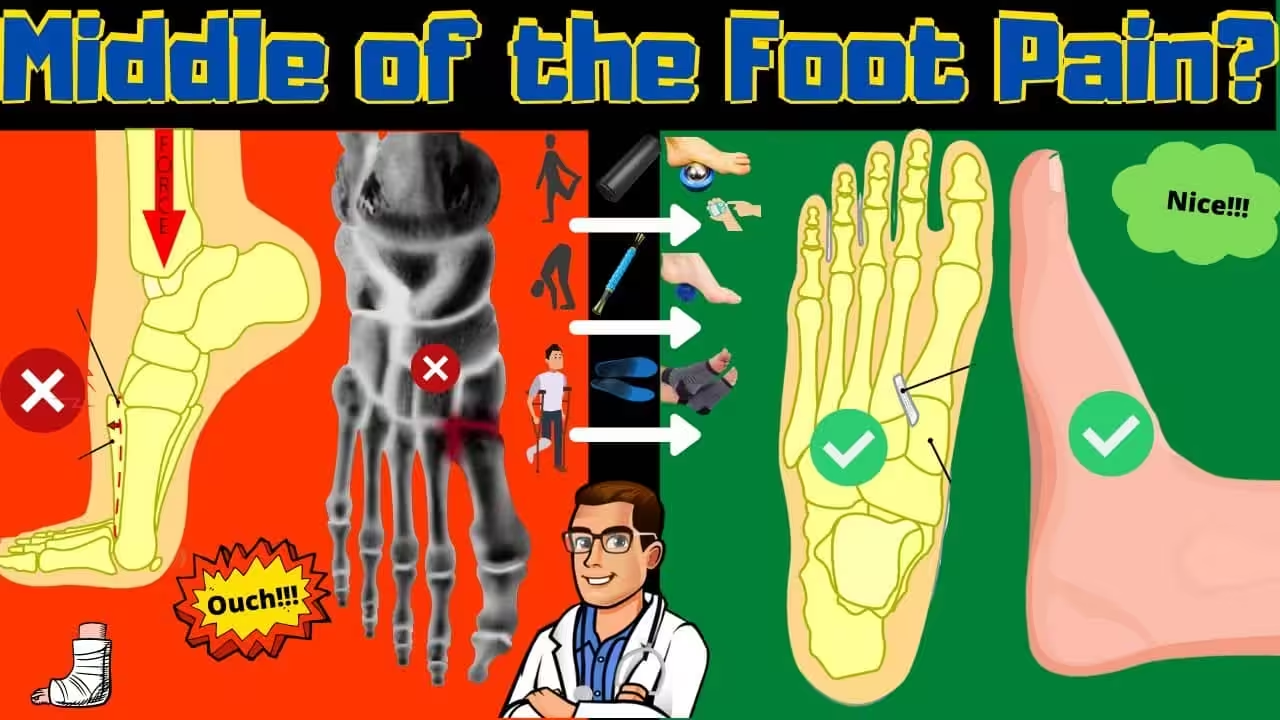
Lisfranc injuries cause pain and swelling across the top of the midfoot, frequently with bruising on the bottom of the foot near the arch (plantar ecchymosis — a very specific sign that should raise immediate concern for Lisfranc injury). The pain is worse with weight-bearing and there is point tenderness over the TMT joints. On standard non-weight-bearing X-rays, subtle Lisfranc injuries may appear normal or show only a small fleck fracture at the base of the second metatarsal (the “fleck sign”) — a ligament avulsion that indicates instability. Weight-bearing X-rays are essential: comparison of the first and second metatarsal-cuneiform alignment on weight-bearing films reveals instability that is not apparent at rest. CT scan provides excellent bony detail. MRI is the most sensitive study for ligamentous Lisfranc injuries in the absence of fracture.
Treatment: Surgical vs. Non-Surgical
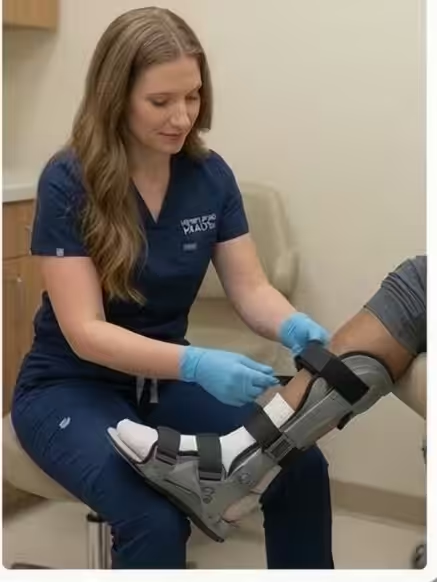
True ligamentous Lisfranc injuries without fracture or instability on weight-bearing X-rays can be treated non-surgically: non-weight-bearing cast immobilization for 6 weeks followed by gradual return to weight-bearing with a rigid-soled boot and custom orthotics. This approach is appropriate only for stable, truly non-displaced injuries — a category that is smaller than many clinicians recognize. Any instability on weight-bearing imaging is a surgical indication. Surgical options include open reduction and internal fixation (ORIF) with plates and screws, and primary arthrodesis (fusion) of the medial column. Recent evidence favors primary arthrodesis for purely ligamentous injuries of the medial column, as it provides more reliable long-term outcomes than ORIF in this subset. Athletic patients with purely ligamentous injuries are a particular group where surgical decision-making is nuanced. Recovery after surgery typically involves 6–12 weeks of non-weight-bearing followed by progressive rehabilitation over 3–6 months.
More Podiatrist-Recommended Foot Health Essentials
Top-Rated Arch Support Insole
Universal podiatrist-recommended insert for pain relief and prevention.
Foot Massage Ball
Daily 3-minute roll reduces most forms of foot and heel pain.
Moisture-Wicking Sock
Prevents fungus, blisters, and odor — the basics matter.
As an Amazon Associate, Balance Foot & Ankle earns from qualifying purchases. Product recommendations are based on clinical experience; prices and availability shown above update live from Amazon.

When to See a Podiatrist
If foot or ankle pain has been bothering you for more than a few weeks, home care alone may not be enough. Balance Foot & Ankle offers same-week appointments at our Howell and Bloomfield Township clinics — no referral needed in most cases. Bring your current shoes and a short list of symptoms and we’ll build you a treatment plan in one visit.
Call Balance Foot & Ankle: (810) 206-1402 · Book online · Offices in Howell & Bloomfield Township
Frequently Asked Questions
How do I know if I have a Lisfranc injury?
Key indicators: midfoot pain and swelling after a twisting injury (even a low-energy one like stepping off a curb), bruising on the bottom of the foot near the arch, and inability to bear weight comfortably. If your X-rays “look normal” but you have significant midfoot pain that isn’t improving, ask specifically about weight-bearing X-ray comparison views and Lisfranc injury. A Lisfranc injury treated as a sprain and not immobilized is one of the most preventable causes of permanent foot disability.
Can you walk on a Lisfranc injury?
Some people can walk on a mild Lisfranc injury, which is part of what makes it easy to misdiagnose. Being able to bear weight does not mean the injury is minor or can be treated like a sprain. Even if you can limp through an activity, walking on an unstable Lisfranc injury accelerates ligament disruption and midfoot collapse — making eventual treatment more difficult and outcomes worse. When in doubt, get it properly evaluated with weight-bearing X-rays.
What happens if a Lisfranc injury is not treated?
Untreated or inadequately treated Lisfranc injuries almost universally progress to midfoot arthritis, arch collapse, and chronic pain with weight-bearing. The severity depends on the original degree of instability — a purely ligamentous injury with subtle instability may take years to become symptomatic arthritis, while a complete fracture-dislocation that is not reduced and stabilized will cause rapid, severe midfoot collapse. Midfoot arthritis from Lisfranc injury is treated with custom orthotics initially and, when that fails, midfoot fusion surgery.
📧 Get Dr. Tom’s Free Lab Test Guide
Discover the 5 lab tests every person over 35 should ask their doctor about — explained in plain English by a board-certified physician.
Midfoot injuries need expert evaluation — don’t let a Lisfranc injury be written off as a sprain. Contact Balance Foot & Ankle in Southeast Michigan for prompt evaluation with Dr. Biernacki.
Join 950,000+ Learning About Foot Health
Dr. Tom shares honest medical advice, supplement reviews, and treatment guides you won’t find anywhere else.
Subscribe on YouTube →📍 Located in Michigan?
Our board-certified podiatrists treat this condition at two convenient locations. Same-day appointments often available.
Medically Reviewed by: Dr. Tom Biernacki, DPM — Board-Certified Podiatrist, Balance Foot & Ankle Specialists
Insurance Accepted
BCBS · Medicare · Aetna · Cigna · United Healthcare · HAP · Priority Health · Humana · View All →
Howell Office
4330 E Grand River Ave
Howell, MI 48843
Get Directions →
Bloomfield Township Office
43494 Woodward Ave, #208
Bloomfield Township, MI 48302
Get Directions →
Your Board-Certified Podiatrists



Ready to Get Back on Your Feet?
Same-week appointments available at both locations.
Book Your AppointmentDifferential Diagnosis: What Else Could It Be?
Not every case of lisfranc (midfoot) injury is straightforward. In our clinic we routinely rule out three look-alike conditions before confirming the diagnosis. If your symptoms don’t match the classic presentation, one of these may explain the pain — which is why physical exam matters more than self-diagnosis.
| Condition | How It Differs |
|---|---|
| Midfoot sprain | No diastasis on X-ray; able to bear weight after initial pain. |
| Navicular stress fracture | Dorsal midfoot pain with impact loading; stress fx confirmed on MRI. |
| Cuboid syndrome | Lateral midfoot pain, often following ankle inversion; relieved by cuboid whip. |
Red Flags — When to See a Podiatrist Now
Seek same-day evaluation at Balance Foot & Ankle if you notice any of the following:
- Pain out of proportion to injury severity
- Plantar bruising across the arch (classic Lisfranc sign)
- Inability to bear weight for >24 hours
- Widening of tarsometatarsal joints on weight-bearing X-ray
Call (810) 206-1402 or request an appointment. Our Howell and Bloomfield Township offices reserve same-day slots for urgent foot and ankle issues.
In Our Clinic: What We See
Clinical perspective from Dr. Tom Biernacki, DPM — Balance Foot & Ankle, Howell & Bloomfield Township, MI:
Lisfranc injury is the most-missed foot injury in primary care and emergency rooms. Patients walk in weeks after a misstep complaining of midfoot pain that never resolves. In our clinic the first clue is often the bruising pattern — plantar bruising across the arch is pathognomonic. Weight-bearing X-rays comparing both feet reveal the widening that non-weight-bearing films miss. Non-displaced Lisfranc sprains can heal in a boot; any displacement requires surgery. Dr. Biernacki has handled dozens of missed Lisfranc injuries and always comments: if a midfoot sprain isn’t significantly better at 3 weeks, get weight-bearing films — don’t wait.
In-Office Treatment at Balance Foot & Ankle
When conservative care isn’t enough, Dr. Tom Biernacki and the team at Balance Foot & Ankle offer advanced, same-day options — including Foot & Ankle Fracture Repair Michigan at our Howell and Bloomfield Township clinics.
Same-day appointments available. Call (810) 206-1402 or book online.
Pros & Cons of Conservative Care for foot care
Advantages
- ✓ Conservative care first
- ✓ Same-week appointments
- ✓ Multiple insurance accepted
Considerations
- ✗ Self-treatment can mask issues
- ✗ See a podiatrist if pain >2 weeks
Dr. Tom’s Recommended Products for foot care
Affiliate disclosure: As an Amazon Associate, Balance Foot & Ankle earns from qualifying purchases. We only recommend products we use with patients.
Footnanny Heel Cream Dr. Tom’s Pick
Best for: Daily moisturizer for cracked heels
Ready to Get Back on Your Feet?
Same-day appointments in Howell + Bloomfield Township. Most insurance accepted. Dr. Tom Biernacki, DPM & team.
Book Today — Same-Day Appointments Available
Call Now: (810) 206-1402
About Your Care Team at Balance Foot & Ankle
Dr. Tom Biernacki, DPM · Board-Certified Foot & Ankle Surgeon. Specializes in conservative-first care, minimally invasive bunion surgery, and complex reconstruction.
Dr. Carl Jay, DPM · Accepting new patients. Specializes in sports medicine, athletic injuries, and routine podiatric care.
Dr. Daria Gutkin, DPM, AACFAS · Accepting new patients. Specializes in surgical reconstruction and pediatric podiatry.
Locations: 4330 E Grand River Ave, Howell, MI 48843 · 43494 Woodward Ave Suite 208, Bloomfield Township, MI 48302
Hours: Mon–Fri 8:00 AM – 5:00 PM · (810) 206-1402
In-Office Treatment at Balance Foot & Ankle
If home treatment isn’t providing relief for your foot fracture, our podiatry team at Balance Foot & Ankle can help with same-day evaluations and advanced in-office care.
Same-day appointments available. (810) 206-1402
Doctor Hoy’s Natural Pain Relief Gel
Natural topical pain relief I use in our clinic. Arnica + camphor formula — apply directly to the area 3–4x daily. ($20–25)
Shop Doctor Hoy’s →Frequently Asked Questions
How long does treatment take to work?
Most patients see improvement in 4-8 weeks with consistent conservative care. Persistent symptoms after 8 weeks need imaging and escalation.
When is surgery needed?
Surgery is reserved for cases that fail 3-6 months of conservative care, structural deformities, or fractures requiring stabilization.
Is this covered by insurance?
Most diagnostic visits and conservative treatments are covered by Medicare and major insurers. Custom orthotics often require diabetic or post-surgical justification.
Ready for Expert Care?
Same-day appointments in Howell & Bloomfield Township, MI.
4.9★ | 1,123 Reviews | 3,000+ Surgeries
Or call: (810) 206-1402

Dr. Tom Biernacki, DPM is a board-certified foot & ankle surgeon (ABFAS & ABPM) at Balance Foot & Ankle Specialists in Southeast Michigan. With over a decade of clinical experience, he specializes in heel pain, bunions, diabetic foot care, sports injuries, and minimally invasive surgery. Dr. Biernacki is a member of the APMA and ACFAS, and his patient education content on MichiganFootDoctors.com and YouTube has made him one of the most-followed foot & ankle educators on YouTube.