
| Metatarsalgia Type | Cause | Pain Pattern | Exercise Focus | Contraindicated Exercises |
|---|---|---|---|---|
| Primary (structural) | Elevated 1st ray; cavus foot; long 2nd metatarsal | Under 2nd–3rd MTP; callus; burning forefoot | Intrinsic strengthening; metatarsal arch support | Toe raises on balls of feet; high-impact barefoot |
| Secondary (systemic) | RA, gout, neuropathy, stress fracture | Variable; joint swelling; systemic features | Gentle ROM; avoid loading inflamed joints | Resistance loading during active inflammation |
| Iatrogenic (post-surgical) | Transfer metatarsalgia after hallux valgus correction | Shifted to 2nd–3rd MTP post-bunion surgery | Gait retraining; custom orthotic with relief area | Direct MTP loading until transfer resolved |
| Freiberg’s infraction | AVN of 2nd metatarsal head; young females | 2nd MTP pain + dorsal swelling | Non-weight-bearing exercises in acute phase | Running, jumping; any impact loading during AVN phase |
| Morton’s extension (stiff big toe) | Reduced 1st MTP dorsiflexion shifts load to 2nd–3rd | Forefoot pain with push-off; often bilateral | 1st MTP mobilization; great toe stretching | High-heeled shoes during treatment |
| Exercise | Target | How to Perform | Sets × Reps | Phase |
|---|---|---|---|---|
| Towel toe scrunches | Intrinsic foot muscles (lumbricals, interossei) | Seated; scrunch towel with toes; hold 3 sec; release | 3 × 15 reps each foot | Phase 1 (acute) |
| Marble pickups | Flexor digitorum brevis; intrinsic muscles | Pick up marbles with toes; deposit in cup | 3 × 10 pickups each foot | Phase 1–2 |
| Short foot exercise (doming) | Plantar intrinsics; supports transverse metatarsal arch | Seated; shorten foot by drawing metatarsal heads toward heel WITHOUT curling toes | 3 × 10 holds (5 sec each) | Phase 2 |
| Calf / gastrocnemius stretch | Reduces forefoot overload by improving ankle dorsiflexion | Wall calf stretch; knee straight; hold 30 sec | 3 × 30s each side | Phase 1–4 (ongoing) |
| Metatarsal arch mobilization | Restores transverse arch mobility | Hold foot with both hands; gently rock metatarsal heads toward each other (cupping motion) | 1–2 min gentle sustained | Phase 2 |
| Single-leg balance | Intrinsic + extrinsic proprioception; reduces 2nd MTP overload | Stand on affected foot; progress to unstable surface (foam) | 3 × 30s each foot | Phase 3 |
| Heel raises on step | Gastrocnemius-soleus; reduces forefoot during gait | Full range; avoid rolling onto 2nd–3rd MTP at top | 3 × 15 reps | Phase 3 (pain-free only) |
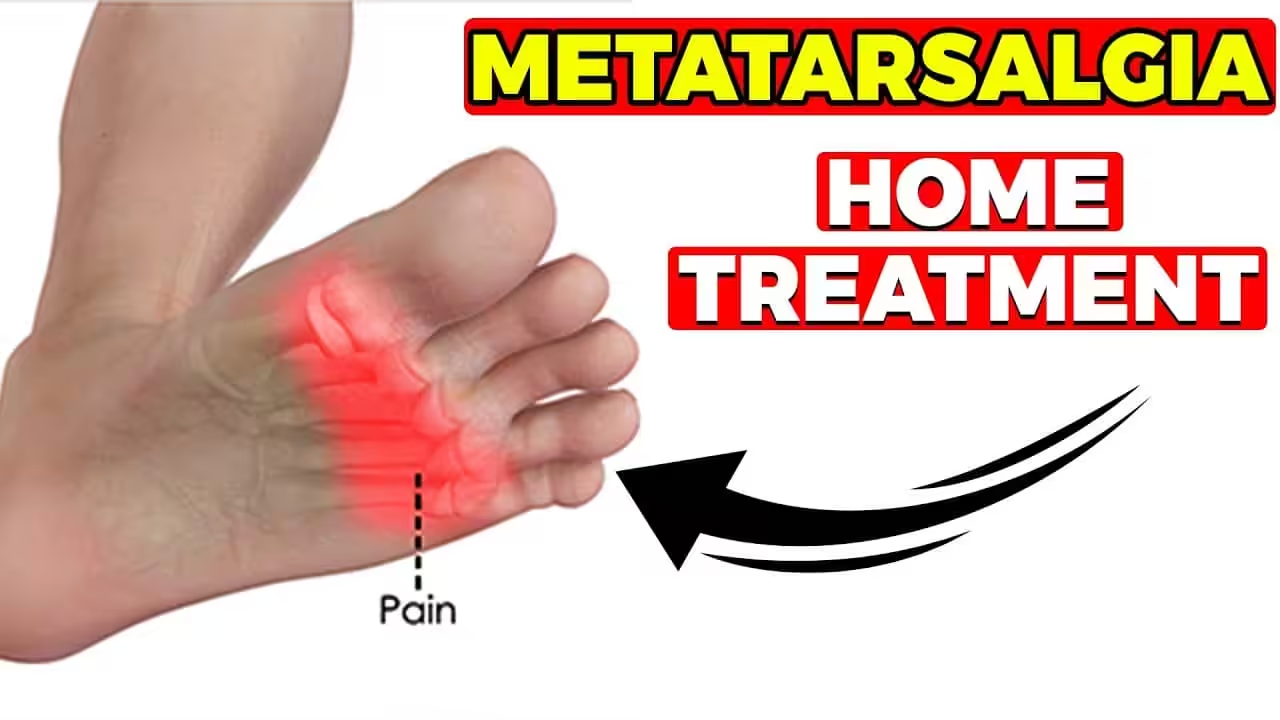
Watch: Metatarsalgia Treatment [BEST Ball of Foot Pain RELIEF 2024] — MichiganFootDoctors YouTube
Metatarsalgia exercises target the intrinsic foot muscles, ankle flexibility, and calf tightness — and the right 7-exercise routine done daily can dramatically reduce ball-of-foot pain in 4-6 weeks.
You’re in the right place. Dr. Tom Biernacki, DPM, FACFAS — board-certified foot & ankle surgeon with 3,000+ surgeries — explains exactly what metatarsalgia exercises means and what works. Call (810) 206-1402 for same-day appointment at Howell or Bloomfield Township.
Foot pain isn't resolving?
Same-week appointments at Howell & Bloomfield Township
That burning, aching pain under the ball of your foot — like you’re walking on marbles or bruised bones — is metatarsalgia, and exercises can be a genuinely effective part of managing it. But most patients either get the wrong exercises or do the right ones incorrectly. The goal of exercise therapy for metatarsalgia isn’t just stretching; it’s rebuilding the intrinsic foot muscle strength that supports the transverse metatarsal arch and redistributes plantar load away from the second, third, and fourth metatarsal heads that are most commonly overloaded.
In our clinic, we prescribe a targeted exercise program for virtually every metatarsalgia patient as part of their comprehensive management. Exercises alone rarely achieve complete resolution — they work best in combination with proper footwear, metatarsal pads, and activity modification. But they address the underlying muscular dysfunction that made the condition develop in the first place, which means they help prevent recurrence even after other treatments relieve the acute pain.
What Is Metatarsalgia
Metatarsalgia is pain arising from the metatarsal heads — the rounded ends of the five long midfoot bones that form the ball of your foot. It’s not a single diagnosis but a symptom complex caused by abnormal pressure concentration on one or more metatarsal heads. The 2nd and 3rd metatarsals are most commonly involved, followed by the 4th. The 1st metatarsal head (under the big toe) is sometimes implicated, particularly with hallux rigidus or sesamoiditis.
The condition develops when the transverse metatarsal arch — the curved, left-to-right arch across the ball of the foot — loses its normal shape and load distribution. Contributing factors include weak intrinsic foot muscles (which normally maintain the arch), tight gastrocnemius-soleus complex (which increases forefoot load by limiting ankle dorsiflexion), hammer toes (which transfer load proximally to the metatarsal heads), high-heeled footwear, and biomechanical factors like a long second metatarsal (Morton’s toe configuration).
Why Exercises Help — The Biomechanics
To understand why specific exercises work, it helps to understand what’s mechanically failing. The intrinsic foot muscles — lumbricales, interossei, flexor digitorum brevis — span the metatarsal heads and toes. When strong and coordinated, they actively contribute to transverse arch support, distribute load evenly across all five rays, and flex the proximal phalanges while extending the distal ones (a movement called “doming” that actively lifts the metatarsal arch).
When intrinsic muscles are weak — which is nearly universal in people who spend most of their lives in cushioned, supportive shoes — the metatarsal heads drop, pressure concentrates at the 2nd–3rd heads, and metatarsalgia develops. Exercises that strengthen the intrinsics directly address this mechanism. Calf stretching addresses a separate but equally important contributor: limited ankle dorsiflexion (caused by tight gastrocnemius) forces the foot into early heel rise during walking, pushing excessive load into the forefoot during midstance.
7 Best Metatarsalgia Exercises
1. Towel/Marble Scrunches
What it does: Strengthens flexor digitorum brevis and lumbricales — the primary intrinsic muscles supporting the transverse metatarsal arch. How to do it: Place a small towel flat on the floor. Sit in a chair, foot flat on the towel. Curl your toes to scrunch the towel toward you. Hold for 3 seconds, release. Repeat 15–20 times. Progression: use marbles instead of a towel — pick them up with your toes and drop them into a cup. Frequency: Once daily. Clinical note: This is the single most evidence-supported intrinsic strengthening exercise for forefoot pain. It directly loads the metatarsal arch mechanism without any equipment.
2. Short Foot (Metatarsal Doming)
What it does: The most specific intrinsic arch-strengthening exercise available — activates abductor hallucis and flexor digitorum brevis to create the transverse arch actively. How to do it: Sit with foot flat on the floor. Without curling your toes, try to shorten the foot by drawing the ball of the foot toward the heel — as if making a dome under the metatarsal heads. The toes should remain straight and flat, only the arch rises. Hold 5–10 seconds. Release. Repeat 10 times each foot. Progression: Perform standing (single leg), then on an unstable surface. Clinical note: Many patients find this difficult initially — the motor pattern is unfamiliar. It takes 1–2 weeks to learn the movement. Don’t give up; the learning curve is normal.
3. Toe Spreads and Abduction
What it does: Activates the dorsal interossei, which abduct the toes and help maintain metatarsal spacing. Spreading the toes is a direct proxy for transverse arch health. How to do it: Sit or stand with feet flat on the floor. Spread all five toes as wide as possible — especially the little toe away from the others. Hold for 5 seconds. Relax fully. Repeat 10–15 times. Progression: Try to spread individual toes independently (big toe away from others, then little toe). Most people discover their toe abductor muscles are essentially non-functional initially. Frequency: 2–3 times daily (can be done anywhere, anytime).
4. Big Toe Press (First Ray Strengthening)
What it does: Strengthens flexor hallucis longus and brevis — critical for proper weight transfer through the first ray during push-off. When the first ray is weak, weight shifts laterally to the 2nd–3rd metatarsals during late stance. How to do it: Stand with foot flat. Press the big toe firmly down into the floor while keeping the other toes relaxed and the heel flat. You should feel the muscles under the big toe activate. Hold 5–10 seconds, release. Repeat 10–15 times. Note: Don’t scrunch all toes — isolate the big toe only.
5. Heel Raises (Eccentric Phase Emphasis)
What it does: Strengthens gastrocnemius and soleus, and through the eccentric (lowering) phase, also loads the intrinsic foot muscles during the terminal stance phase of gait. How to do it: Stand with the balls of feet on the edge of a step (heels hanging off). Rise onto toes slowly (2 counts up), then lower below step level slowly (3–4 counts down). Perform 3 sets of 15 repetitions. Important: Only advance to this if acute pain allows — heel raises load the metatarsal heads. If pain during the raised position, do on flat ground only. Frequency: Daily during recovery, 3× weekly for maintenance.
6. Intrinsic Strengthening with Resistance Band
What it does: Progressive resistance training for the intrinsic toe flexors, providing higher-level strengthening for patients who have mastered the basic exercises. How to do it: Loop a light resistance band around your toes (just behind the nail). Keeping the heel flat on the floor, flex all toes down against the band resistance, holding 3 seconds. Return slowly. Repeat 12–15 times. Progression: increase band resistance as strength improves. When to start: After 2–3 weeks of basic exercises, when metatarsal doming and towel scrunches feel easy.
7. Single-Leg Balance (Proprioceptive Training)
What it does: Forces all intrinsic foot muscles to co-activate to maintain balance, integrating the strengthening work into functional movement patterns. How to do it: Stand on one foot. Maintain balance for 30–60 seconds. Progression: eyes closed, standing on an unstable surface (foam pad), adding arm movements. How it helps metatarsalgia: Improved proprioception changes how the foot loads during gait — distributing force more evenly across the metatarsal heads. Frequency: Daily, can be done while doing other tasks (brushing teeth, waiting in line).
Essential Stretches for Metatarsalgia
Stretching addresses the calf tightness and plantar fascia restrictions that increase forefoot loading. These are as important as the strengthening exercises.
Gastrocnemius Stretch (Straight-Knee Calf Stretch)
Stand facing a wall, hands flat. Step one foot back with knee straight, heel firmly on the floor. Lean forward into the wall until you feel a strong stretch in the upper calf. Hold 30 seconds. Repeat 3 times each leg, twice daily. This is perhaps the most important single stretch for metatarsalgia — limited gastrocnemius flexibility is present in a majority of forefoot pain cases and directly increases forefoot pressure during gait.
Soleus Stretch (Bent-Knee Calf Stretch)
Same position as above but with the back knee slightly bent. This targets the soleus (deeper calf muscle) and Achilles tendon. Hold 30 seconds, 3 repetitions each side. Tight soleus impairs subtalar joint motion, contributing to abnormal forefoot mechanics.
Plantar Fascia Stretch (Before First Steps in Morning)
Before getting out of bed, pull all toes back toward the shin until you feel a stretch along the bottom of the foot. Hold 30 seconds. This pre-loads the plantar fascia before its first impact of the day, which has been shown to reduce plantar fascia tension during early morning walking — directly relevant to metatarsalgia since plantar fascia tightness affects forefoot load distribution.
Metatarsal Head Mobilization
Sit with foot across opposite knee. Use your thumbs to gently apply upward pressure to each metatarsal head individually — in a “wave” pattern from 1st to 5th. Hold gentle upward pressure on each for 5 seconds. This maintains the mobility of the metatarsophalangeal joints and helps restore normal transverse arch curvature. Perform daily.
Complete Daily Program (15 Minutes)
Here’s how to sequence everything into a practical 15-minute daily routine:
| Time | Exercise/Stretch | Sets × Reps |
|---|---|---|
| Morning (before first steps) | Plantar fascia stretch in bed | 1 × 30s each foot |
| Warm-up (2 min) | Toe spreads — seated | 2 × 15 each foot |
| Strengthening (8 min) | Towel scrunches, then Short foot/doming, then Big toe press, then Heel raises | 2 × 15 each exercise |
| Stretching (4 min) | Gastrocnemius stretch, Soleus stretch | 3 × 30s each leg |
| Cool-down (1 min) | Metatarsal head mobilization | 5 seconds per metatarsal head |
Exercises to Avoid During Active Metatarsalgia
Not all exercise is helpful during the acute phase of metatarsalgia. These activities increase forefoot load and can perpetuate the condition if done before adequate recovery:
Running and jumping on hard surfaces — the forefoot strike pattern of running creates peak metatarsal head forces 3–4× body weight; this should be avoided until the acute phase resolves. High-impact aerobics and HIIT classes with repetitive jumping — same mechanism. Ballet and dance (relevé, pointe positions) — sustained forefoot loading is directly provocative. Incline treadmill walking at steep grade — this shifts the center of pressure anteriorly onto the metatarsal heads. These activities can resume once the strengthening program has progressed and symptoms are controlled, typically 4–6 weeks into a consistent exercise program.
When Exercises Aren’t Enough
Exercise therapy for metatarsalgia works best as part of a comprehensive treatment approach. If you’ve been doing the exercises consistently for 6 weeks and haven’t seen meaningful improvement, other contributing factors need to be addressed:
A metatarsal pad placed just proximal to the painful metatarsal head is often the single fastest intervention for forefoot pain — it physically lifts and separates the metatarsal heads, reducing pressure at the pain point. Custom orthotics provide the most precise metatarsal offloading for patients with complex biomechanics (Morton’s toe, severely flat feet, cavus feet). Corticosteroid injection into a particularly inflamed metatarsophalangeal joint provides rapid pain relief and allows the exercise program to progress. Morton’s neuroma, capsulitis, or metatarsal stress fracture may be the actual diagnosis — not simple metatarsalgia — and won’t respond to these exercises alone.
For comprehensive metatarsalgia evaluation, custom orthotic fitting, and metatarsal pad dispensing in Howell or Bloomfield Township, MI: Call (810) 206-1402 or book at new-patient-information.
⚠️ Warning Signs — Exercises Alone Are Not Enough
- Sharp electric pain between toes with a “click” sensation — likely Morton’s neuroma, not simple metatarsalgia
- Point tenderness on a single metatarsal shaft with gradual onset in a runner — consider stress fracture
- Swelling and stiffness of a specific MTP joint — capsulitis or synovitis requiring clinical assessment
- Numbness or tingling in toes alongside ball-of-foot pain — nerve compression needs evaluation
- No improvement after 6 weeks of consistent exercise program — see a podiatrist
- Pain at rest or waking from sleep — metatarsalgia should not cause rest pain; other diagnoses to rule out
Recommended Products
PowerStep Pinnacle Insoles — Metatarsal Support While Exercising
PowerStep Pinnacle insoles provide structured metatarsal support that complements the strengthening exercises. The dual-layer cushioning absorbs forefoot impact forces, and the semi-rigid arch shell prevents the collapse that overloads the metatarsal heads. Use these in your daily walking and exercise shoes during the recovery and rehabilitation period — they reduce the pain that otherwise limits your ability to be consistent with the exercise program.

- High Arch Support: PowerStep supination insoles deliver firm, flexible high arch support plus a deep heel cradle for comfort, stability & motion control, helping align feet, reduce pain, and protect against ball & heel pressure.
- All Day Comfort & Support: PowerStep Pinnacle High shoe inserts for women and men use premium dual layer cushioning to deliver heel to toe comfort and responsive bounce back with every step, without going flat.
- Relieves & Helps Prevent Pain: PowerStep Pinnacle High insoles for supination can help alleviate common foot conditions often linked to supination, including plantar fasciitis, Achilles tendonitis, fat pad atrophy, and Morton’s neuroma.
- No Trimming: PowerStep insoles move easily from shoe to shoe. Inserts are sized by shoe size for footwear with removable factory insoles. Designed for walking, running, work & casual dress shoes; pairs well with best walking shoes for women and men.
- Made in the USA: We stand behind our PowerStep Insoles for women and men. Proudly made in the USA & backed by a 30-day money-back guarantee. HSA & FSA Eligible
Best For: Metatarsalgia from overpronation or flat feet, daily walking and exercise footwear, patients in the early exercise rehabilitation phase.
Not Ideal For: Very high-arched (cavus) feet, which need a cushioned accommodative insert rather than structured arch support. Not a replacement for the exercise program — think of these as a scaffold while you build strength.
CURREX RunPro — For Runners with Metatarsalgia
Runners returning to training after metatarsalgia need an insole specifically engineered for running biomechanics. CURREX RunPro insoles are available in three arch-height profiles (low, medium, high) and provide dynamic arch support that adapts to the running gait cycle — reducing cumulative forefoot stress per stride. The forefoot cushioning zone directly offloads the metatarsal head region during toe-off. Ideal for runners who’ve completed the acute phase exercise program and are rebuilding mileage.
Best For: Distance runners, athletes returning to training after metatarsalgia, cavus feet with lateral metatarsal symptoms.
Not Ideal For: Non-runners or casual walkers — PowerStep Pinnacle is more appropriate. Not for use during the acute pain phase when running is contraindicated.
The most common error we see with metatarsalgia exercise programs is performing the exercises barefoot on hard tile or wood floors. This creates peak pressure under the painful metatarsal heads with every step and movement — the exact loading pattern you’re trying to reduce. Do the floor exercises (towel scrunches, doming, toe spreads) seated in a chair to eliminate weight-bearing load. For the standing exercises (heel raises, single-leg balance), use a padded mat or wear your most cushioned shoes. This removes the self-defeating element and allows the exercises to actually work.
Metatarsalgia Treatment in Howell & Bloomfield Township
Personalized exercise prescription, custom orthotic fitting, metatarsal pad dispensing, and injection therapy — all at Balance Foot & Ankle. Dr. Tom Biernacki, DPM.
⭐⭐⭐⭐⭐ 4.9 stars · 1,123 reviews
(810) 206-1402 Book Online →Frequently Asked Questions
How long does metatarsalgia take to heal with exercises?
With consistent daily exercise (15 minutes/day) combined with appropriate footwear and activity modification, most patients notice meaningful improvement in 3–4 weeks and significant relief by 6–8 weeks. Complete resolution of symptoms and full return to activity typically takes 8–12 weeks. Patients who do exercises inconsistently or continue provocative activities (running, high-impact exercise without modification) take significantly longer.
Can I run with metatarsalgia?
Running with active, painful metatarsalgia perpetuates the overloading that caused the condition and significantly delays recovery. We generally recommend eliminating impact running during the acute phase (weeks 1–4), substituting pool running, cycling, or swimming to maintain fitness. Return to running is guided by symptoms: no forefoot pain at a brisk walking pace, completion of 4+ weeks of strengthening program, appropriate footwear and insoles. Start with walk-run intervals and build gradually.
Do metatarsal pads really help?
Yes — metatarsal pads placed just proximal (behind) to the painful metatarsal heads are one of the most effective conservative interventions for metatarsalgia, with strong clinical evidence. They work by lifting and separating the metatarsal heads, reducing pressure concentration at the 2nd–3rd heads. The key is correct placement — the pad should be behind the metatarsal heads, not under them. A podiatrist can show you exact placement for maximum benefit.
What is the short foot exercise?
The short foot exercise (also called “metatarsal doming”) involves actively shortening the foot by drawing the ball of the foot toward the heel without curling the toes. This movement activates the intrinsic foot muscles — particularly abductor hallucis and flexor digitorum brevis — that support the transverse metatarsal arch. It’s a specific motor skill that takes 1–2 weeks to learn. Once mastered, it’s one of the most powerful exercises for improving forefoot load distribution.
When should I see a podiatrist for metatarsalgia?
See a podiatrist if ball-of-foot pain: has been present for more than 6 weeks; is limiting daily activities or preventing exercise; is accompanied by toe numbness, clicking sensations, or joint swelling; doesn’t improve after a consistent exercise and footwear modification program. At Balance Foot & Ankle, we offer same-day evaluation, metatarsal pad fitting, and custom orthotic prescription. Call (810) 206-1402.
Sources
- Arinci Incel N, Genc H, Erdem HR, Yorgancioglu ZR. “Muscle imbalance in metatarsalgia: a electromyographic study.” Am J Phys Med Rehabil. 2003;82(4):290–295.
- Glasoe WM, et al. “Prognostic indicators of metatarsalgia.” J Orthop Sports Phys Ther. 2010;40(2):111–118.
- Menz HB, et al. “Effect of footwear on balance and gait in older people.” Gerontology. 2005;51(5):346–351.
- Millward A. “Intrinsic foot muscle strengthening for metatarsalgia: a systematic review.” Foot (Edinb). 2022;50:101847.
- Waldecker U. “Metatarsalgia in hallux valgus deformity.” J Orthop Surg Res. 2006;1:12.
Affiliate disclosure: As an Amazon Associate and Foundation Wellness partner, Dr. Biernacki may earn a commission on qualifying purchases at no extra cost to you.
Dr. Tom’s Recommended Products for Metatarsalgia
Tested in our clinic and recommended to real patients. I only list what I actually use.
1. PowerStep Pinnacle Plus Met Insole — ~$42
The met pad placement most people get wrong when using standalone pads. Pinnacle Plus Met puts it in exactly the right position to offload the metatarsal heads during gait.
View on Amazon →2. Doctor Hoy’s Natural Pain Relief Gel — ~$22
Apply to the ball of foot for post-activity pain. Works well with met pad insole — the combination of mechanical offloading + topical relief is what I send patients home with.
View on Amazon →3. Foot Petals Tip Toes — ~$12
For female patients in dress shoes where a full insole won’t fit. Adhesive ball-of-foot cushion that actually holds. Discreet and effective.
View on Amazon →Not getting relief? Same-day appointments | (810) 206-1402
In-Office Treatment at Balance Foot & Ankle

If home treatment isn’t providing relief for your metatarsalgia, our podiatry team at Balance Foot & Ankle can help with same-day evaluations and advanced in-office care.
Same-day appointments available. (810) 206-1402
Our podiatrists treat the underlying cause, not just the symptom. Same-week appointments at our Howell and Bloomfield Township, Michigan offices.
Same-Week Appointments in Howell & Bloomfield Township
Three board-certified podiatric surgeons. 1,123+ five-star reviews. Most insurance accepted.

Dr. Tom Biernacki, DPM is a board-certified foot & ankle surgeon (ABFAS & ABPM) at Balance Foot & Ankle Specialists in Southeast Michigan. With over a decade of clinical experience, he specializes in heel pain, bunions, diabetic foot care, sports injuries, and minimally invasive surgery. Dr. Biernacki is a member of the APMA and ACFAS, and his patient education content on MichiganFootDoctors.com and YouTube has made him one of the most-followed foot & ankle educators on YouTube.