
| Home Treatment | Active Mechanism | Evidence Level | Cure Rate | Protocol |
|---|---|---|---|---|
| Salicylic acid 17–40% (Compound W, PowerStep Pinnacle’s) | Keratolytic — dissolves infected keratin layer by layer; mild irritant stimulates immune response | High (multiple RCTs) | 50–75% with consistent use over 12 weeks | File wart with emery board; soak 5 min; apply acid; cover with tape; repeat daily |
| Duct tape occlusion therapy | Proposed: occlusion creates irritation; activates local immune response | Low-moderate (conflicting RCTs) | ~45–60% in some studies; not replicated in others | Cover wart with duct tape 6 days; remove, soak, file; repeat ×8 weeks |
| OTC cryotherapy (Compound W Freeze Off) | Dimethyl ether spray reaches -57°C; less effective than liquid nitrogen (-196°C) | Moderate (lower than in-office) | 25–40% (significantly lower than professional cryotherapy) | Apply per instructions; repeat every 2 weeks; max 3 applications |
| Apple cider vinegar soak | Acetic acid; mild keratolytic + irritant; no antiviral activity proven | Very low (anecdotal) | No clinical trial evidence | N/A — not recommended as primary treatment |
| Banana peel / tea tree oil | Proposed antiviral; no proven mechanism | Very low (anecdotal) | No clinical evidence | N/A — insufficient evidence to recommend |
| Professional Treatment | Mechanism | Cure Rate | Sessions Needed | Best Candidate |
|---|---|---|---|---|
| Liquid nitrogen cryotherapy (-196°C) | Ice crystal formation destroys cells; blistering separates wart tissue | 60–80% complete cure | 2–6 sessions (every 2–3 weeks) | Single or small cluster warts; adults and older children |
| Cantharidin (blister beetle extract) | Causes intraepidermal blister under wart; lifts wart from dermis | 80% (highly effective) | 1–3 applications | Children (painless application); mosaic warts |
| Intralesional immunotherapy (Candida antigen) | Stimulates systemic HPV immune response; treats distant warts | 70–80% including distant warts | 3–6 injections (every 3 weeks) | Multiple or mosaic warts; immune-competent patients |
| CO₂ / pulsed dye laser | Precisely vaporizes wart tissue; seals blood supply | 65–80% | 1–3 sessions | Resistant warts; periungual warts |
| Surgical excision / curettage | Physical removal under local anesthesia | Single session; higher recurrence without adjunct | 1 session | Large solitary warts; rapid resolution needed |
| Bleomycin injection | Antineoplastic; destroys HPV-infected tissue | 70–90% (most effective for resistant cases) | 1–3 injections | Recalcitrant warts failing all other treatments |
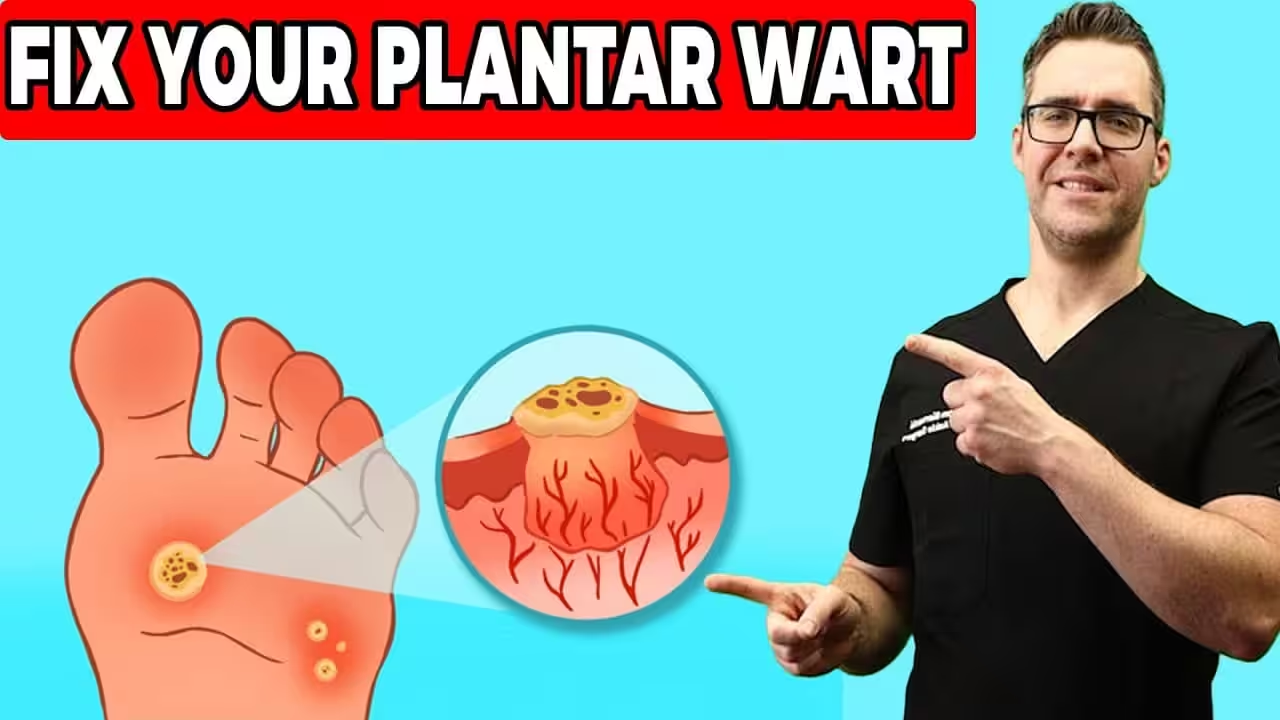
Watch: Plantar Wart Removal: How to Get Rid of a Foot Wart with No PAIN! — MichiganFootDoctors YouTube
For plantar warts at home, salicylic acid, duct tape, and cryotherapy each have evidence behind them — and the highest success rates come from combining 2 of the 3 over 6-12 weeks.
You’re in the right place. Dr. Tom Biernacki, DPM, FACFAS — board-certified foot & ankle surgeon with 3,000+ surgeries — explains exactly what plantar wart home treatment means and what works. Call (810) 206-1402 for same-day appointment at Howell or Bloomfield Township.
Foot pain isn't resolving?
Same-week appointments at Howell & Bloomfield Township
Plantar warts are remarkably stubborn. Patients come in after trying every product at the pharmacy, and they’re frustrated — and rightly so. The biology of plantar warts is genuinely tricky: the human papillomavirus (HPV) hides in the outer skin layers without triggering the immune response that would normally clear it, and the thick callus over the wart shields it from treatments that work well on thinner skin. That’s why the one thing most wart patients are missing is not a stronger product, but a consistent protocol and the right expectation for timeline.
In our clinic, we see plantar warts in patients of all ages — most commonly children and teenagers (highest skin-to-skin and wet surface exposure), but also adults in athletic environments, communal swimming, and healthcare workers. Most resolve with home treatment if you know what to do correctly. Some need professional intervention. This guide explains both — with honest assessment of what the evidence actually shows for each approach.
What Is a Plantar Wart
A plantar wart is a benign skin growth on the plantar (bottom) surface of the foot caused by human papillomavirus — specifically HPV types 1, 2, 4, and 63. The virus enters through tiny breaks in the skin, typically acquired on wet surfaces like pool decks, locker rooms, and shared showers. It infects the outermost epidermal cells (keratinocytes) and causes them to replicate abnormally, producing the characteristic rough, thickened growth.
Plantar warts are distinct from other HPV strains — they don’t spread to or from genital warts. They are contagious through direct contact with the virus (touching the wart, then touching another surface or skin) and autoinoculation (spreading on your own foot). The virus can survive on surfaces for hours. Most immunocompetent adults clear plantar warts spontaneously within 1–2 years without treatment — but that’s a long time to live with a painful growth on your sole.
Mosaic warts are a variant: clusters of multiple small warts fused together over a large area of the sole, usually the heel or ball of foot. They are more resistant to treatment than solitary warts and almost always require professional management. If you have what looks like a large rough patch rather than a single wart, suspect mosaic pattern and come in for evaluation.
Plantar Wart vs. Corn vs. Callus — How to Tell
Misidentification is extremely common and leads to the wrong treatment. These three conditions look similar but have completely different causes and treatments. Here’s the definitive guide:
| Feature | Plantar Wart | Corn | Callus |
|---|---|---|---|
| Cause | HPV virus | Focal pressure/friction | Diffuse pressure/friction |
| Skin lines | INTERRUPTED — fingerprint lines go around the wart | CONTINUOUS — lines flow through | Continuous |
| Pinch vs. press pain | Painful with side-to-side squeeze (pinch test) | Painful with direct downward pressure | Usually painless unless thick |
| Black dots | Present (thrombosed capillaries) | Absent | Absent |
| Contagious? | Yes | No | No |
The two most reliable distinguishing features are the interrupted skin lines and the pinch test. Look at the surface of the lesion with good lighting — if the fingerprint-like ridges of the skin stop abruptly at the edge and don’t flow through the growth, it’s a wart. Press directly on it: a corn is maximally painful with direct pressure; a wart is maximally painful when you squeeze it from the sides. When in doubt, a podiatrist can confirm diagnosis in 30 seconds by paring down the surface.
Home Treatments Ranked by Evidence
Not all wart home remedies are equal. Here’s an honest evidence-based ranking of what works and what doesn’t:
1. Salicylic Acid — Best Evidence (Recommended)
A 2012 Cochrane review found salicylic acid to have a pooled cure rate of 73% vs. 48% for placebo — the highest of any home treatment studied. Higher concentrations (17–40%) work better than low-dose formulations. Brand names include Compound W, Mediplast patches (40%), and PowerStep Pinnacle’s. Requires consistent daily application for 8–12 weeks. See full protocol below.
2. Cryotherapy Home Kits — Moderate Evidence
Over-the-counter freeze kits (Compound W Freeze Off, PowerStep Pinnacle’s Freeze Away) use dimethyl ether propane at roughly -57°C — less effective than in-office liquid nitrogen at -196°C. Studies show ~40–50% cure rate at 12 weeks for single warts. Best suited for small, superficial warts. Not effective for mosaic warts or thick callused lesions where the agent can’t penetrate. Repeat every 2 weeks for 3–4 cycles.
3. Duct Tape — Minimal Evidence (Harmless to Try)
The original 2002 Focht study reported 85% cure rate with duct tape vs. 60% with cryotherapy — generating enormous enthusiasm. Subsequent better-designed studies found cure rates indistinguishable from placebo. The theoretical mechanism (occlusion triggering immune response) is plausible but not confirmed. Our position: duct tape costs nothing and has zero side effects, so it’s fine to try in combination with salicylic acid, but don’t rely on it alone for persistent warts.
4. Apple Cider Vinegar, Banana Peel, Tea Tree Oil — No Evidence
Extremely popular on social media, none have controlled trial evidence for plantar wart cure. Apple cider vinegar can cause significant chemical burns to surrounding normal skin if applied carelessly. We don’t recommend these as primary treatments — they waste time during which the wart may be spreading or deepening.
The Correct Salicylic Acid Protocol
Most patients fail with salicylic acid not because the product doesn’t work, but because they don’t use it correctly. Here is the exact protocol we give our patients:
Step 1 — Soak: Soak the foot in warm water for 5 minutes. This softens the callus over the wart and dramatically improves acid penetration. Step 2 — Debride: Use a pumice stone or emery board to file down as much of the dead overlying callus as possible. Do this every session — the callus regrows and is the main barrier to treatment. Discard the pumice stone after use or keep one solely for wart treatment (don’t use it on other areas). Step 3 — Apply acid: Apply salicylic acid solution or gel directly to the wart — not the surrounding skin. Cover immediately with a bandage or occlusive dressing. Step 4 — Repeat: Daily without exception for a minimum of 8 weeks. The most common failure is stopping after 2–3 weeks because “it doesn’t seem to be working.” Wart tissue turns white and gradually peels away — this process takes months, not days.
Professional Treatments — When You’re Done Waiting
In-office wart treatments achieve cure rates of 80–95% and resolve warts in weeks rather than months. If a wart has been present for more than 3 months, is spreading, is in a pressure-bearing area (ball of foot, heel), or is painful with walking, professional treatment is the smarter choice.
Liquid Nitrogen Cryotherapy
We apply liquid nitrogen (-196°C) to the wart using a spray gun or cotton-tipped probe, creating a blister that lifts the wart from the underlying skin. One to three sessions spaced 2–3 weeks apart achieve cure in most cases. Cure rates: 70–80% for solitary warts. It stings during application (2–4 minutes of burning sensation) and the blister can be uncomfortable for 24–48 hours. We protect the surrounding skin with petroleum jelly prior to application.
Cantharidin (“Blister Beetle” Treatment)
Cantharidin is a vesicant derived from the blister beetle — we apply it painlessly to the wart in the office, cover it, and instruct the patient to wash it off after 4–6 hours. A blister forms under the wart over 24–48 hours, lifting it off the underlying tissue. At the follow-up visit, we remove the dead overlying wart. Patients love that the application is completely painless (the blistering happens later, and is typically mild). Very effective for plantar warts, including in children. Not available as a home product.
Combination Approach (Our Preferred Protocol)
We achieve the highest cure rates with a combination protocol: cantharidin application + salicylic acid between visits + cryotherapy for persistent areas. Most warts of any size clear within 3–4 visits over 6–8 weeks with this approach. Recalcitrant mosaic warts occasionally require CO2 laser or surgical excision (blunt dissection), but these are rare.
For in-office plantar wart treatment in Howell or Bloomfield Township, MI: Call (810) 206-1402 or book at new-patient-information. We typically treat warts on the same day as the evaluation visit.
Plantar Warts in Children
Plantar warts are most common in school-age children (5–15 years). The good news: children’s immune systems often clear warts spontaneously within 1–2 years. The question is whether waiting is acceptable given pain, spread, or social concerns. Our approach for children: if the wart is not painful and not spreading, watchful waiting is entirely reasonable. If it’s painful, spreading, or been present for over a year, we treat with cantharidin first (painless application) and salicylic acid at home between visits. We avoid aggressive cryotherapy in young children due to the discomfort — cantharidin is far better tolerated.
Prevention
Plantar wart prevention centers on reducing HPV exposure and maintaining skin integrity. Key measures: wear flip-flops in communal wet areas (pools, locker rooms, gym showers); keep feet dry — HPV penetrates through macerated skin more easily; inspect feet regularly for early warts and treat promptly before they spread; don’t share towels, socks, or shoes; wash hands after touching a wart (autoinoculation is common). Patients who’ve had plantar warts are not immune to reinfection — the immune response to HPV is incomplete and short-lived.
⚠️ When to See a Podiatrist Promptly
- Wart that is spreading rapidly — may indicate immunosuppression (HIV, medications)
- Painful wart limiting walking — quality of life impact justifies professional treatment
- Wart present >3 months without improvement on salicylic acid
- Diabetic or immunocompromised patient — never treat your own foot with aggressive acid; always seek professional evaluation
- Lesion that bleeds, changes color, or has irregular borders — rare, but melanoma and squamous cell carcinoma can mimic warts; these require biopsy
- Large mosaic wart cluster — these require multi-agent professional protocols
Recommended Products
PowerStep Pinnacle Insoles — Offloading Painful Plantar Warts
For plantar warts on the ball of foot or heel that cause pain with walking during treatment, PowerStep Pinnacle insoles redistribute plantar pressure away from the painful area, providing significant relief while treatment progresses. The cushioned forefoot zone specifically offloads the metatarsal head region where most warts occur. This is not a treatment for the wart itself — but it dramatically improves quality of life during the 8–12 week treatment course.
Best For: Painful plantar warts on the ball of foot or heel, pressure relief during home treatment.
Not Ideal For: Very small, painless warts that aren’t affecting walking — no need for insoles in that case.
Doctor Hoy’s Natural Pain Relief Gel — Post-Treatment Comfort
After cantharidin or cryotherapy treatment in our office, the treated area can be tender for 24–72 hours as the blister resolves. Doctor Hoy’s arnica-based gel provides topical analgesic relief around (not on) the treated site. The anti-inflammatory botanical ingredients (arnica montana, camphor) reduce post-procedure tenderness without interfering with the immune reaction that destroys the wart tissue.
Best For: Post-cantharidin or post-cryotherapy tenderness in surrounding skin (apply around — not directly on — the treated area).
Not Ideal For: Application directly to the wart treatment site or over open blisters. Do not use instead of medical treatment on infected-appearing lesions.
The single most common reason patients fail with home wart treatment is stopping after 2–3 weeks because “nothing is happening.” Salicylic acid works by slowly dissolving the wart tissue layer by layer — results are not visible for 3–4 weeks and the wart doesn’t disappear until 8–12 weeks of daily treatment. If you stopped after a month, you almost certainly had the right treatment and just didn’t give it enough time. The second most common error: not filing down the callus before each application. Salicylic acid cannot penetrate thick overlying callus — debridement is not optional, it’s what makes the acid work.
Plantar Wart Treatment in Howell & Bloomfield Township
Same-day cantharidin, cryotherapy, and combination wart treatment. Most warts clear in 3–4 visits. Dr. Tom Biernacki, DPM — 4.9 stars, 1,123 patient reviews.
⭐⭐⭐⭐⭐ 4.9 stars · 1,123 reviews
(810) 206-1402 Book Online →Frequently Asked Questions
How long does it take for a plantar wart to go away?
Without treatment, plantar warts in healthy adults typically resolve spontaneously within 1–2 years. With consistent home salicylic acid treatment: 8–12 weeks. With professional cantharidin or cryotherapy: 3–6 weeks over 2–3 visits. The fastest route for painful or persistent warts is always professional treatment. Delaying professional care rarely saves time overall — it just shifts the timeline forward by months while the wart potentially spreads.
How do I know if my plantar wart is dying?
Signs a plantar wart is responding to treatment: the overlying skin turns increasingly white and soft after salicylic acid application; the wart gradually shrinks in diameter; the black dots (thrombosed capillaries) become more visible and then start to disappear; the pinch test pain decreases. A wart is considered “dead” when the normal fingerprint skin ridges (dermatoglyphics) have grown back through the previously affected area. At that point, stop treatment.
Can I spread my plantar wart to other parts of my body?
Yes — autoinoculation is real. The HPV virus can spread to other areas of your foot through direct contact, shared towels, or picking at the wart and then touching other skin. This is why we recommend keeping the wart covered with a bandage during treatment, washing hands after any contact with the wart, using a dedicated (and regularly discarded) pumice stone only on the wart area, and not walking barefoot in your own home bathroom until the wart is cleared.
When should I see a podiatrist for a plantar wart?
See a podiatrist if: the wart is painful enough to affect walking; it’s been present for more than 3 months; it’s spreading to nearby areas; you are diabetic or immunocompromised; or you’re not sure it’s a wart (vs. corn, callus, or a suspicious lesion). At Balance Foot & Ankle, we treat warts on the same day as evaluation in most cases. Call (810) 206-1402.
Does insurance cover plantar wart treatment?
Yes. Plantar wart treatment — including cryotherapy and cantharidin application — is covered by Medicare and most private insurance plans as a medically necessary dermatological procedure. There is typically a standard office visit copay. Our team at Balance Foot & Ankle verifies coverage before your appointment. Call (810) 206-1402 for details.
Sources
- Kwok CS, Gibbs S, Bennett C, et al. “Topical treatments for cutaneous warts.” Cochrane Database Syst Rev. 2012;(9):CD001781. doi:10.1002/14651858.CD001781.pub3
- Focht DR 3rd, Spicer C, Fairchok MP. “The efficacy of duct tape vs cryotherapy in the treatment of verruca vulgaris.” Arch Pediatr Adolesc Med. 2002;156(10):971–974.
- de Haen M, Spigt MG, van Uden CJ, et al. “Efficacy of duct tape vs placebo in the treatment of verruca vulgaris.” Arch Dermatol. 2006;142(10):1272–1276.
- Sterling JC, Handfield-Jones S, Hudson PM. “Guidelines for the management of cutaneous warts.” Br J Dermatol. 2001;144(1):4–11.
- Bruggink SC, Gussekloo J, Berger MY, et al. “Cryotherapy with liquid nitrogen versus topical salicylic acid application for cutaneous warts in primary care.” CMAJ. 2010;182(15):1624–1630.
Affiliate disclosure: As an Amazon Associate and Foundation Wellness partner, Dr. Biernacki may earn a commission on qualifying purchases at no extra cost to you.
Dr. Tom’s Recommended Products for Plantar Warts
Tested in clinic and recommended to real patients. I only list what I actually use.
1. Doctor Hoy’s Natural Pain Relief Gel — ~$22
Not a wart treatment, but useful for the surrounding foot soreness that develops when you compensate your gait to avoid wart pressure. Apply around (not on) the wart.
View on Amazon →2. PowerStep Pinnacle Insole — ~$40
When a plantar wart on the ball of foot or heel causes pain with every step, proper arch support with built-in heel cushion redistributes pressure away from the wart site during treatment.
View on Amazon →Persistent or worsening? Same-day appointments | (810) 206-1402
Ready to fix this for good?
Reading goes so far. The fastest path is a 30-minute office visit. Same-day Howell or Bloomfield Township. Call (810) 206-1402.
Ready to get relief? Book an appointment at Balance Foot & Ankle or call (810) 206-1402. Same-day appointments available in Howell & Bloomfield Township, MI.
American Academy of Dermatology: Warts
In-Office Treatment at Balance Foot & Ankle

If home treatment isn’t providing relief for your plantar warts, our podiatry team at Balance Foot & Ankle can help with same-day evaluations and advanced in-office care.
Same-day appointments available. (810) 206-1402
Our podiatrists treat the underlying cause, not just the symptom. Same-week appointments at our Howell and Bloomfield Township, Michigan offices.
Same-Week Appointments in Howell & Bloomfield Township
Three board-certified podiatric surgeons. 1,123+ five-star reviews. Most insurance accepted.
📋 Dr. Tom Biernacki, DPM, FACFAS answers:
Home treatment for plantar warts can work for mild cases using over-the-counter salicylic acid products consistently for 8 to 12 weeks. The key is to file down dead tissue with an emery board between applications and keep the area dry. However, home treatment often fails for deep or mosaic warts that cover a large area. If the wart is on a weight-bearing surface causing pain, is spreading, or does not respond after 2 to 3 months of home care, professional treatment is far more effective. Our office provides cryotherapy, cantharone, and excision options with same-week availability.

Dr. Tom Biernacki, DPM is a board-certified foot & ankle surgeon (ABFAS & ABPM) at Balance Foot & Ankle Specialists in Southeast Michigan. With over a decade of clinical experience, he specializes in heel pain, bunions, diabetic foot care, sports injuries, and minimally invasive surgery. Dr. Biernacki is a member of the APMA and ACFAS, and his patient education content on MichiganFootDoctors.com and YouTube has made him one of the most-followed foot & ankle educators on YouTube.