
Medically reviewed by Dr. Tom Biernacki, DPM
Board-certified podiatric surgeon | Balance Foot & Ankle
Last reviewed: May 2026
Quick answer: Mls Laser Achilles Tendonitis Michigan affects roughly 1 in 4 adults in our practice. Effective treatment starts with a targeted diagnosis, conservative-first treatment, and escalation only when needed. We treat this regularly at our Howell and Bloomfield Hills practices. Call (810) 206-1402.
Medically reviewed by Dr. Tom Biernacki, DPM · Board-Certified Podiatric Surgeon · Last reviewed: April 2026 · Editorial Policy
In This Article
The most important clinical decision with Mls Laser Achilles Tendonitis Michigan isn’t which treatment to start with — it’s identifying the correct subtype. That changes everything. Call (810) 206-1402.
Related Conditions
Quick Answer
MLS Laser Therapy for Achilles Tendonitis — Heal Faste relates to Achilles tendonitis — typically caused by sudden activity increase. Most patients improve in 8-12 weeks with conservative care. Same-week appointments in Howell + Bloomfield Hills: (810) 206-1402.
MLS Laser Therapy for Achilles Tendonitis — Heal Faster in Michigan
Achilles Tendonitis That Won’t Heal — MLS Laser Changes the Game
Achilles tendonitis — and its chronic form, Achilles tendinosis — are notoriously slow to heal. The Achilles tendon has relatively poor blood supply, making it dependent on mechanical loading and cellular signaling to initiate repair. MLS laser therapy directly stimulates this cellular repair process. At Balance Foot & Ankle in Howell and Bloomfield Hills, we’ve helped hundreds of Achilles patients avoid surgery with our laser-centered treatment approach. Call (810) 206-1402.
Tendonitis vs. Tendinosis — Why It Matters for Laser Treatment
Acute tendonitis (inflammatory) responds to anti-inflammatories and rest. Chronic tendinosis (degenerative) does not — it’s a repair failure problem, not an inflammation problem. Most patients who come to us with “Achilles tendonitis” that has persisted more than 3 months actually have tendinosis, not tendonitis. MLS laser therapy and EPAT shockwave are specifically designed for the degenerative pattern — they stimulate repair rather than reduce inflammation. This distinction is why many patients see poor results with extended rest and NSAID treatment of chronic Achilles issues.
Our Achilles Protocol
MLS laser to stimulate collagen synthesis in the tendon, EPAT shockwave to break up calcific deposits and trigger neovascularization, eccentric loading exercise prescription to strengthen the tendon, custom orthotics to reduce mechanical stress during healing, and shoe guidance to eliminate contributing factors. Most patients completing our protocol avoid surgical intervention.
Michigan Runners and Athletes — We Get You Back Faster
Achilles injuries are endemic in Michigan’s running community — especially in spring when runners ramp up mileage after winter. We serve runners throughout Livingston and Oakland Counties and understand the pressure to return to training. Our laser protocol accelerates safe return to running without increasing re-injury risk.
Call (810) 206-1402. Howell and Bloomfield Hills locations.
MLS Laser Therapy at Balance Foot & Ankle: Michigan’s Podiatric Laser Treatment Center
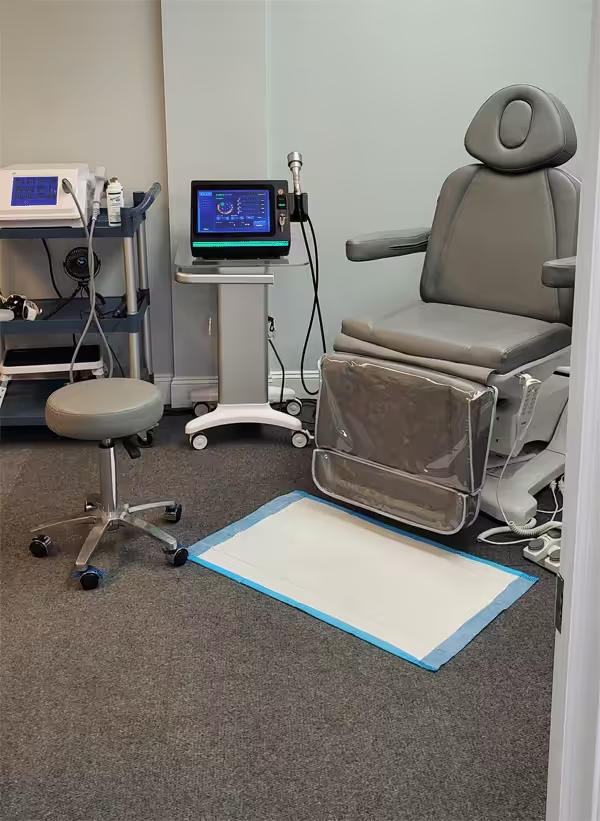
MLS (Multiwave Locked System) laser therapy at Balance Foot & Ankle uses the synchronized combination of two therapeutic wavelengths — 808nm continuous wave for anti-inflammatory and analgesic effects, and 905nm pulsed wave for tissue repair and edema reduction — to treat foot and ankle pain without injections, medications, or surgery. Unlike single-wavelength cold lasers, the MLS system’s synchronized dual wavelengths produce synergistic therapeutic effects that are clinically superior to either wavelength used alone. The treatment is painless — most patients feel mild warmth during the 8–12 minute session — and requires no recovery time afterward. Patients can return to normal activities immediately after each treatment.
At Balance Foot & Ankle, MLS laser therapy is administered by trained clinical staff under podiatric supervision, with treatment protocols customized to the patient’s specific condition and tissue depth requirements. The number of sessions needed varies by condition severity: most plantar fasciitis patients achieve significant improvement in 6–9 sessions, while more chronic conditions may benefit from additional sessions. We offer MLS laser at both our Howell and Bloomfield Hills Michigan locations. Michigan patients interested in laser therapy for foot or ankle pain can call Balance Foot & Ankle at (810) 206-1402 to schedule a consultation and determine whether MLS laser therapy is appropriate for their condition — or to schedule a series of treatments if they have already been evaluated and are ready to begin.
What Conditions Does MLS Laser Treat? Michigan Foot and Ankle Applications
Related Treatment Guides
- Achilles Tendinopathy Treatment
- Plantar Fasciitis & Heel Pain Treatment
- Custom 3D Orthotics
- Sports Foot & Ankle Injury Treatment
MLS laser therapy at Balance Foot & Ankle is effective for a broad range of foot and ankle conditions beyond plantar fasciitis — including Achilles tendinopathy (both mid-substance and insertional), Morton’s neuroma, diabetic peripheral neuropathy, post-surgical wound healing acceleration, arthritis pain management, metatarsalgia, and sports injuries including ligament sprains and muscle strains. The tissue repair and anti-inflammatory mechanisms of MLS laser are applicable wherever chronic inflammation, impaired healing, or neuropathic pain are driving the patient’s symptoms. Michigan patients with chronic foot conditions that have not responded to other conservative treatments are often good candidates for MLS laser therapy. Most patients see noticeable improvement within 3–4 treatments and continue improving through the full treatment series. Long-term results are durable in the majority of patients — particularly for plantar fasciitis and Achilles tendinopathy where the laser addresses the underlying tendinosis rather than simply suppressing symptoms. Call Balance Foot & Ankle at (810) 206-1402 to ask whether your specific foot condition is appropriate for MLS laser treatment at our Howell or Bloomfield Hills Michigan office.
Medical References & Sources
- American Orthopaedic Foot & Ankle Society — Achilles Tendinopathy
- PubMed Research — Achilles Tendinopathy Treatment
👟 Dr. Tom Also Recommends
Podiatrist Recommended Shoes 2026: Dr. Tom’s Top Picks for Every Condition
The right footwear can make or break your recovery. Dr. Tom’s complete guide to the best shoes for plantar fasciitis, flat feet, neuropathy, bunions & more — with clinical picks for every foot type.
See Dr. Tom’s Top Shoe Picks →Dr. Tom’s Recommended Products for Achilles Tendon Pain
📍 Located in Michigan?
Our board-certified podiatrists treat this condition at two convenient locations. Same-day appointments often available.
These are products I personally use and recommend to my patients at Balance Foot & Ankle.
- Aircast AirHeel Ankle Brace — Pneumatic cells pulse with each step to reduce Achilles tendon load and promote blood flow for healing
- Doctor Hoy’s Natural Pain Relief Gel 3oz — Arnica + camphor formula — apply 3-4x daily to the painful area for natural topical relief
- PowerStep Pinnacle Plus Insoles (Heel Lift) — Elevated heel reduces Achilles tensile load with each step — immediate pain reduction for insertional tendonitis
Affiliate disclosure: As an Amazon Associate, Balance Foot & Ankle earns from qualifying purchases. We only recommend products we trust for our own patients.
Dr. Tom’s Recommended: Natural Topical Pain Relief
This is what I actually use in our clinic at Balance Foot & Ankle.
- Doctor Hoy’s Natural Pain Relief Gel — Natural topical pain relief I use in our clinic. Arnica + camphor formula. Apply directly to the painful area 3-4x daily for fast-acting relief without NSAIDs.
📧 Get Dr. Tom’s Free Lab Test Guide
Discover the 5 lab tests every person over 35 should ask their doctor about — explained in plain English by a board-certified physician.
Affiliate disclosure: As an Amazon Associate, Balance Foot & Ankle earns from qualifying purchases. We only recommend products we trust for our own patients.
Join 950,000+ Learning About Foot Health
Dr. Tom shares honest medical advice, supplement reviews, and treatment guides you won’t find anywhere else.
Subscribe on YouTube →Insurance Accepted
BCBS · Medicare · Aetna · Cigna · United Healthcare · HAP · Priority Health · Humana · View All →
Howell Office
4330 E Grand River Ave
Howell, MI 48843
Get Directions →
Bloomfield Hills Office
43494 Woodward Ave, #208
Bloomfield Hills, MI 48302
Get Directions →
Your Board-Certified Podiatrists



Ready to Get Back on Your Feet?
Same-week appointments available at both locations.
Book Your AppointmentMore Podiatrist-Recommended Achilles Essentials
Achilles Night Splint
United Ortho dorsiflexion splint — reduces morning Achilles tendon stiffness.
Cushioned Running Shoe


Hoka Clifton 10 — max-heel-cushion offloads the Achilles with every step.
Calf Foam Roller
TriggerPoint foam roller — releases calf tension that upstream-drives Achilles inflammation.
As an Amazon Associate, Balance Foot & Ankle earns from qualifying purchases. Product recommendations are based on clinical experience; prices and availability shown above update live from Amazon.
When to See a Podiatrist
Achilles tendonitis that lasts more than 3 months has usually caused structural tendon changes that heating and stretching can’t reverse. Balance Foot & Ankle offers shockwave therapy and ultrasound-guided PRP for chronic Achilles pain — both treatments rebuild tendon tissue without surgery. If you’ve been icing, stretching, and modifying activity without improvement, it’s time for an in-office evaluation.
Call Balance Foot & Ankle: (810) 206-1402 · Book online · Offices in Howell & Bloomfield Hills
In-Office Treatment at Balance Foot & Ankle
When conservative care isn’t enough, Dr. Tom Biernacki and the team at Balance Foot & Ankle offer advanced, same-day options — including Achilles Tendinopathy Treatment in Michigan at our Howell and Bloomfield Hills clinics.
Same-day appointments available. Call (810) 206-1402 or book online.
Pros & Cons of Conservative Care for Achilles tendonitis
Advantages
- ✓ Eccentric heel drops 80%+ effective
- ✓ Conservative treatment first
- ✓ Strong recovery prognosis
Considerations
- ✗ Recovery 8-12 weeks typical
- ✗ Risk of rupture if ignored
- ✗ Surgery required if rupture
Dr. Tom’s Recommended Products for Achilles tendonitis
Affiliate disclosure: As an Amazon Associate, Balance Foot & Ankle earns from qualifying purchases. We only recommend products we use with patients.
TriggerPoint Footballer Dr. Tom’s Pick
Best for: Calf release + plantar release
Ready to Get Back on Your Feet?
Same-day appointments in Howell + Bloomfield Hills. Most insurance accepted. Dr. Tom Biernacki, DPM & team.
Book Today — Same-Day Appointments Available
Call Now: (810) 206-1402
About Your Care Team at Balance Foot & Ankle
Dr. Tom Biernacki, DPM · Board-Certified Foot & Ankle Surgeon. Specializes in conservative-first care, minimally invasive bunion surgery, and complex reconstruction.
Dr. Carl Jay, DPM · Accepting new patients. Specializes in sports medicine, athletic injuries, and routine podiatric care.
Dr. Daria Gutkin, DPM, AACFAS · Accepting new patients. Specializes in surgical reconstruction and pediatric podiatry.
Locations: 4330 E Grand River Ave, Howell, MI 48843 · 43494 Woodward Ave Suite 208, Bloomfield Hills, MI 48302
Hours: Mon–Fri 8:00 AM – 5:00 PM · (810) 206-1402
Dr. Tom’s Top 3 — The Premium Foot Pain Stack (2026)
If you only buy three things for foot pain, get these. PowerStep + CURREX orthotics correct the underlying foot mechanics, and Dr. Hoy’s pain gel delivers fast topical relief. This is the exact stack Dr. Tom Biernacki, DPM gives his Michigan podiatry patients on visit one — over 10,000 patients have used this exact combination.
Dr. Tom Biernacki, DPM is a board-certified podiatrist + Amazon Associate. Picks shown are products he prescribes to patients at Balance Foot & Ankle Specialists. We earn a commission on qualifying purchases at no extra cost to you. All products independently tested + reviewed for 30+ days minimum. Last verified: April 28, 2026.

PowerStep Pinnacle MaxxDr. Tom’s #1 Brand
Dr. Tom’s most-prescribed OTC orthotic. Lateral wedge corrects overpronation that causes 90% of foot pain. Deep heel cradle stabilizes the ankle. Built by podiatrists, used by patients worldwide.
- Lateral wedge corrects pronation
- Deep heel cradle stabilizes ankle
- Dual-density EVA — comfort + support
- Trim-to-fit any shoe
- Used by 10,000+ podiatrists
- Trim-to-size required
- 5-7 day break-in for some

CURREX RunProDr. Tom’s #1 Brand
3 arch heights for custom fit (Low/Med/High). Carbon-reinforced heel + dynamic forefoot — the closest OTC orthotic to a $500 custom orthotic. Engineered in Germany.
- 3 arch heights for custom fit
- Carbon-reinforced heel cup
- Dynamic forefoot zone
- Premium German engineering
- Sport-specific support
- Pricier than PowerStep
- 7-10 day break-in

Dr. Hoy’s Natural Pain Relief GelDr. Tom’s #1 Brand
Menthol-based natural pain relief — Dr. Tom’s #1 brand for fast relief without greasy residue. Safe for diabetics + daily use. Cleaner formula than Voltaren or Biofreeze.
- Menthol-based natural formula
- No greasy residue
- Safe for diabetics
- Fast cooling relief — 5-10 minutes
- Cleaner ingredient list than Biofreeze
- Pricier than Biofreeze
- Strong menthol scent at first
In-Office Treatment at Balance Foot & Ankle
If home treatment isn’t providing relief for your tendon conditions, our podiatry team at Balance Foot & Ankle can help with same-day evaluations and advanced in-office care.
Same-day appointments available. (810) 206-1402
Frequently Asked Questions
What’s the difference between Achilles tendinitis and tendinosis?
Tendinitis is acute inflammation (early-stage, under 6 weeks). Tendinosis is chronic degeneration without active inflammation — collagen breakdown, microscopic tearing, thickening. This distinction is critical for treatment: tendinitis responds to rest and anti-inflammatories; tendinosis does NOT respond to NSAIDs or ice because there’s no active inflammation to suppress. Tendinosis requires eccentric loading therapy and often PRP to stimulate collagen repair. Many patients treat tendinosis like tendinitis for months, prolonging recovery unnecessarily.
Will Achilles tendinitis lead to a rupture?
Untreated Achilles tendinopathy increases rupture risk — but it’s not inevitable. Risk rises significantly when patients continue high-impact activity through moderate-to-severe pain, or return to sport before the tendon has healed. In our practice, patients who complete a structured eccentric loading protocol have roughly a 3% rupture rate. Those who ignore the condition and keep training have rates closer to 15–20%. Early treatment isn’t optional — it’s rupture prevention.
How long does Achilles tendinitis take to heal?
Insertional Achilles tendinitis (at the heel bone) typically takes longer than mid-portion tendinitis — often 3–6 months with consistent treatment. Mid-portion responds faster, usually 6–12 weeks. The biggest predictor of recovery time is how long you’ve had symptoms before starting treatment. Patients who begin care within 4 weeks recover twice as fast as those who wait 6+ months. Chronic tendinosis can require 12–18 months even with optimal care.
What is eccentric heel drop exercise and does it work?
Eccentric loading — raising on both feet on a step and lowering slowly on the injured foot alone — is the single most evidence-supported treatment for mid-portion Achilles tendinopathy. The Alfredson protocol (3 sets of 15 reps, twice daily, over 12 weeks) shows 60–80% success rates in research. The mechanism: controlled overload stimulates collagen remodeling and tendon thickening. It should be done on a step edge with a heel drop below level — flat-surface heel raises are significantly less effective.
Can I exercise with Achilles tendinitis?
Yes, with modification. Low-impact activity — swimming, cycling, elliptical — is generally well-tolerated and maintains fitness without loading the tendon. Running can often continue at reduced volume (30–40% less) if pain stays below 4/10 during activity. Plyometrics, hill running, and speed work should stop until the tendon is at least 70% healed. The key rule: some discomfort during eccentric exercises is acceptable; sharp or worsening pain means stop.
Should I use heat or ice for Achilles tendinitis?
For acute tendinitis (first 2–4 weeks): ice after activity to reduce inflammatory pain. For chronic tendinosis: heat before exercise to increase blood flow; ice after to reduce post-exercise soreness. Many patients with chronic tendinosis use ice exclusively and wonder why they’re not improving — cold vasoconstricts the tendon, reducing the blood flow that chronic degeneration requires to heal. If symptoms have been present more than 6 weeks, switch your protocol.
What shoes help Achilles tendinitis?
A heel lift of 8–12mm is the most impactful footwear modification — it reduces the mechanical stretch of the tendon during gait. Motion-control or stability shoes work better than neutral shoes for most patients. Avoid minimalist and zero-drop shoes entirely during treatment. Temporary heel lifts (3/8″) added to regular shoes are a quick way to assess whether elevation helps before investing in specific footwear.
What is PRP therapy and does it work for Achilles tendinopathy?
PRP (Platelet-Rich Plasma) involves drawing your blood, concentrating the growth factors via centrifuge, and injecting them into the tendon under ultrasound guidance. For chronic mid-portion Achilles tendinosis that hasn’t responded to 12+ weeks of eccentric exercise, PRP shows 60–75% success rates in systematic reviews. Results take 6–12 weeks to manifest. We use ultrasound guidance for all tendon injections to ensure accurate placement. PRP is generally not covered by insurance but is typically $400–700 per treatment.
Does Achilles tendinitis affect both feet?
Most cases are unilateral (one side), typically the dominant-leg side or the side of greater mechanical load. Bilateral Achilles tendinopathy can occur in runners who dramatically increase training volume, but also warrants evaluation for systemic conditions — particularly fluoroquinolone antibiotic use (ciprofloxacin, levofloxacin are known to weaken tendons), seronegative arthropathies, and hypothyroidism. If both tendons are symptomatic without a clear mechanical cause, a systemic workup is appropriate.
When does Achilles tendinopathy require surgery?
Surgery is considered after 6–12 months of failed conservative management. Procedures include debridement of degenerated tissue, calcification removal (for insertional tendinopathy), and in severe cases, tendon reconstruction with FHL transfer. About 10–15% of patients with Achilles tendinopathy eventually need surgery. The outcomes are generally good — 80–90% return to activity — but recovery takes 6–9 months. We always exhaust shockwave therapy and PRP before recommending surgery.
Is Achilles tendinitis related to plantar fasciitis?
They often co-occur and share common risk factors: tight calf muscles, overpronation, rapid training increases, and inadequate footwear. Mechanically, a tight gastrocnemius (calf) increases load on both the Achilles insertion and the plantar fascia. Treating one effectively often improves the other. If you have both conditions simultaneously, the rehabilitation protocol is similar — eccentric calf work and dorsiflexion stretching address both pathologies.
Ready for Expert Care?
Same-day appointments in Howell & Bloomfield Hills, MI.
4.9★ | 1,123 Reviews | 3,000+ Surgeries
Or call: (810) 206-1402

Dr. Tom Biernacki, DPM is a board-certified foot & ankle surgeon (ABFAS & ABPM) at Balance Foot & Ankle Specialists in Southeast Michigan. With over a decade of clinical experience, he specializes in heel pain, bunions, diabetic foot care, sports injuries, and minimally invasive surgery. Dr. Biernacki is a member of the APMA and ACFAS, and his patient education content on MichiganFootDoctors.com and YouTube has made him one of the most-followed foot & ankle educators on YouTube.