

Quick answer: Prp Injection Foot Ankle Michigan 2 is a common foot/ankle topic that affects many patients. Effective treatment starts with a targeted diagnosis, conservative-first treatment, and escalation only when needed. We treat this regularly at our Howell and Bloomfield Township practices. Call (810) 206-1402.
Medically reviewed by Dr. Tom Biernacki, DPM · Board-Certified Podiatric Surgeon · Last reviewed: April 2026 · Editorial Policy
The most important clinical decision with Prp Injection Foot Ankle Michigan 2 isn’t which treatment to start with — it’s identifying the correct subtype. That changes everything. Call (810) 206-1402.
Quick Answer
PRP Injection for Foot & Ankle Conditions in Michigan relates to foot pain — typically caused by overuse, footwear, or biomechanics. Most patients improve in 6-12 weeks with conservative care. Same-week appointments in Howell + Bloomfield Township: (810) 206-1402.

Medically reviewed by Dr. Tom Biernacki, DPM — Board-Certified Podiatric Surgeon — Balance Foot & Ankle, Howell & Bloomfield Township, MI. Last updated April 2026.
▶ Watch

Medically Reviewed by Dr. Tom Biernacki, DPM — Board-Certified Podiatrist, Balance Foot & Ankle Specialists, Michigan. Last updated April 2026.
Platelet-rich plasma (PRP) injection therapy uses a concentrated preparation of the patient’s own platelets — containing high concentrations of growth factors including PDGF, TGF-β, VEGF, and IGF — to stimulate tissue repair and reduce chronic inflammation in tendons, ligaments, and joints. At Balance Foot & Ankle in Southeast Michigan, Dr. Tom Biernacki offers PRP as part of a thorough treatment ladder for conditions including chronic plantar fasciitis, Achilles tendinopathy, and ankle arthritis — typically as a next step after corticosteroid injection has provided insufficient or unsustained relief.
How PRP Is Prepared and Administered
A blood sample (30–60 mL) is drawn from the patient’s arm and placed in a centrifuge. The centrifuge separates the blood components by density — red blood cells at the bottom, the platelet-poor plasma layer in the middle, and the platelet-rich plasma (PRP) layer on top. The PRP layer is collected (platelet concentration 3–8x normal blood) and injected under ultrasound guidance into the target tissue. Ultrasound guidance is important for accuracy — tendon injections placed inaccurately have significantly worse outcomes than precisely placed injections. The procedure takes approximately 30–45 minutes. Patients typically experience 24–72 hours of increased soreness (the PRP initiates an inflammatory healing cascade) before pain begins to reduce over 2–6 weeks. Most protocols use a single injection, with a second injection at 6–8 weeks for incomplete responders.
Evidence Summary by Condition
Chronic plantar fasciitis: multiple randomized controlled trials show PRP provides superior pain relief and function compared to corticosteroid injection at 3, 6, and 12 months — the benefit is more durable than cortisone (which provides 4–8 weeks of relief) and does not carry the risk of plantar fascia rupture or fat pad atrophy. A 2020 meta-analysis of 14 RCTs concluded PRP is the superior injectable treatment for chronic plantar fasciitis. Achilles tendinopathy: evidence is positive for mid-substance tendinopathy; results for insertional Achilles tendinopathy are more mixed. PRP preferred over cortisone in Achilles tendinopathy because corticosteroids increase Achilles rupture risk. Ankle osteoarthritis: emerging positive evidence, multiple studies showing superior outcomes vs. hyaluronic acid at 6–12 months. Morton’s neuroma: limited but promising evidence for PRP as an alternative to cortisone — being studied. Ankle ligament injury (chronic instability): preliminary evidence supports PRP as an adjunct to rehabilitation for patients with chronic instability not achieving stability with conservative care alone.
More Podiatrist-Recommended Cortisone Essentials
Post-Injection Support Insole
Maintains the mechanical correction the injection is buying you time to fix.
Semi-Rigid Orthotic


Structural support so the injection’s relief lasts longer.
Wide-Toe-Box Walking Shoe
Reduces the pressure that drove you to the injection in the first place.
As an Amazon Associate, Balance Foot & Ankle earns from qualifying purchases. Product recommendations are based on clinical experience; prices and availability shown above update live from Amazon.
When to See a Podiatrist
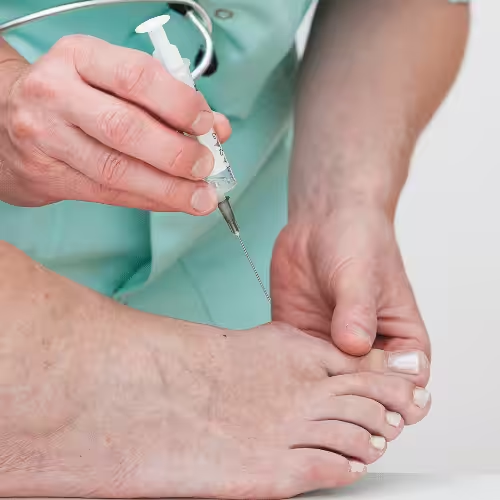
Cortisone injections are most effective when paired with a root-cause fix — orthotic, shoe change, or physical therapy. At Balance Foot & Ankle, we use ultrasound guidance to place every injection exactly in the inflamed space, maximizing relief. And we always discuss the treatment plan that follows, so the pain stays gone.
Call Balance Foot & Ankle: (810) 206-1402 · Book online · Offices in Howell & Bloomfield Township
Frequently Asked Questions
Does PRP injection work for plantar fasciitis?
Yes — PRP injection has the strongest evidence for plantar fasciitis among all foot and ankle conditions. Multiple high-quality RCTs and meta-analyses consistently show PRP produces superior and more durable pain relief than corticosteroid injection. It is most appropriate for: patients with plantar fasciitis lasting more than 6 months that has not adequately responded to conservative treatment and corticosteroid injection, or patients who prefer an injection without the tissue-thinning risks of repeated cortisone. Dr. Biernacki uses ultrasound-guided PRP injection at Balance Foot & Ankle.
How long does PRP injection last for foot pain?
PRP injections for plantar fasciitis show durable effects at 12+ months in most responders — significantly longer than corticosteroid injection (4–8 weeks). Approximately 60–75% of chronic plantar fasciitis patients experience clinically significant improvement after a single PRP injection. Patients who don’t respond fully to the first injection often benefit from a second injection at 6–8 weeks. For ankle arthritis, PRP provides 6–12 months of symptom relief in most responding patients.
Does insurance cover PRP injection?
Most insurance plans including Medicare do not currently cover PRP injection — it is typically an out-of-pocket cost ranging from $400–700 per injection. Some commercial insurance plans cover PRP for specific indications under certain circumstances — call your insurer to check. Despite the out-of-pocket cost, PRP’s longer duration of effect compared to cortisone (12 months vs. 4–8 weeks) makes it cost-effective for many patients with chronic conditions. Balance Foot & Ankle offers PRP — call (810) 206-1402 for current pricing.
📧 Get Dr. Tom’s Free Lab Test Guide
Discover the 5 lab tests every person over 35 should ask their doctor about — explained in plain English by a board-certified physician.
Chronic foot pain that hasn’t responded to cortisone may respond to PRP. Contact Balance Foot & Ankle in Southeast Michigan for a PRP consultation with Dr. Biernacki.
Join 950,000+ Learning About Foot Health
Dr. Tom shares honest medical advice, supplement reviews, and treatment guides you won’t find anywhere else.
Subscribe on YouTube →📍 Located in Michigan?
Our board-certified podiatrists treat this condition at two convenient locations. Same-day appointments often available.

Insurance Accepted
BCBS · Medicare · Aetna · Cigna · United Healthcare · HAP · Priority Health · Humana · View All →
Howell Office
4330 E Grand River Ave
Howell, MI 48843
Get Directions →
Bloomfield Township Office
43494 Woodward Ave, #208
Bloomfield Township, MI 48302
Get Directions →
Your Board-Certified Podiatrists



Ready to Get Back on Your Feet?
Same-week appointments available at both locations.
Book Your AppointmentPros & Cons of Conservative Care for foot care
Advantages
- ✓ Conservative care first
- ✓ Same-week appointments
- ✓ Multiple insurance accepted
Considerations
- ✗ Self-treatment can mask issues
- ✗ See a podiatrist if pain >2 weeks
Dr. Tom’s Recommended Products for foot care
Affiliate disclosure: As an Amazon Associate, Balance Foot & Ankle earns from qualifying purchases. We only recommend products we use with patients.
Footnanny Heel Cream Dr. Tom’s Pick
Best for: Daily moisturizer for cracked heels
Ready to Get Back on Your Feet?
Same-day appointments in Howell + Bloomfield Township. Most insurance accepted. Dr. Tom Biernacki, DPM & team.
Book Today — Same-Day Appointments Available
Call Now: (810) 206-1402
About Your Care Team at Balance Foot & Ankle
Dr. Tom Biernacki, DPM · Board-Certified Foot & Ankle Surgeon. Specializes in conservative-first care, minimally invasive bunion surgery, and complex reconstruction.
Dr. Carl Jay, DPM · Accepting new patients. Specializes in sports medicine, athletic injuries, and routine podiatric care.
Dr. Daria Gutkin, DPM, AACFAS · Accepting new patients. Specializes in surgical reconstruction and pediatric podiatry.
Locations: 4330 E Grand River Ave, Howell, MI 48843 · 43494 Woodward Ave Suite 208, Bloomfield Township, MI 48302
Hours: Mon–Fri 8:00 AM – 5:00 PM · (810) 206-1402
In-Office Treatment at Balance Foot & Ankle
If home treatment isn’t providing relief for your foot and ankle injuries, our podiatry team at Balance Foot & Ankle can help with same-day evaluations and advanced in-office care.
Same-day appointments available. (810) 206-1402
Doctor Hoy’s Natural Pain Relief Gel
Natural topical pain relief I use in our clinic. Arnica + camphor formula — apply directly to the area 3–4x daily. ($20–25)
Shop Doctor Hoy’s →Ready for Expert Care?
Same-day appointments in Howell & Bloomfield Township, MI.
4.9★ | 1,123 Reviews | 3,000+ Surgeries
Or call: (810) 206-1402

Dr. Tom Biernacki, DPM is a board-certified foot & ankle surgeon (ABFAS & ABPM) at Balance Foot & Ankle Specialists in Southeast Michigan. With over a decade of clinical experience, he specializes in heel pain, bunions, diabetic foot care, sports injuries, and minimally invasive surgery. Dr. Biernacki is a member of the APMA and ACFAS, and his patient education content on MichiganFootDoctors.com and YouTube has made him one of the most-followed foot & ankle educators on YouTube.