

Quick answer: Sesamoidectomy Surgical Removal Sesamoid Bone Chronic Pain Fracture has multiple potential causes including mechanical, neurological, vascular, and inflammatory. The most common causes we identify are overuse, ill-fitting shoes, and biomechanical imbalance. Red flags requiring urgent evaluation: warmth/redness (infection), inability to bear weight (fracture), and unilateral swelling without injury (DVT). Call (810) 206-1402.
Medically Reviewed by Dr. Tom Biernacki, DPM — Board-Certified Podiatrist, Balance Foot & Ankle Specialists, Michigan. Last updated April 2026.
▶ Watch

What Are the Sesamoid Bones?
The sesamoid bones are two small, pea-sized bones embedded within the flexor hallucis brevis tendon beneath the first metatarsophalangeal (MTP) joint — the big toe joint. Like the patella (kneecap), the sesamoids act as a pulley, improving the mechanical advantage of the tendon that flexes the big toe. They also protect the tendon from direct pressure during weight-bearing and absorb significant shock during the push-off phase of gait.
Despite their small size, the sesamoids bear substantial forces — up to three times body weight during running — making them susceptible to a range of painful conditions that, when they fail to respond to conservative management, may ultimately require surgical removal.
Indications for Sesamoidectomy
Sesamoid Stress Fracture Non-Union
Sesamoid stress fractures are common in runners, dancers, and athletes who load the forefoot repetitively. Most stress fractures heal with appropriate offloading and rest over six to twelve weeks. However, the fibular (lateral) sesamoid in particular occupies an avascular zone in some patients — meaning its blood supply is insufficient to support reliable healing. When a sesamoid stress fracture progresses to non-union despite extended conservative management, sesamoidectomy provides definitive treatment.
Avascular Necrosis (Osteonecrosis) of the Sesamoid
Avascular necrosis occurs when the blood supply to the sesamoid is disrupted — whether from trauma, repetitive stress, or spontaneous in patients with vascular risk factors. The bone undergoes progressive fragmentation and collapse. Conservative treatment with offloading rarely reverses established AVN. Sesamoidectomy removes the necrotic bone and eliminates the pain source.
Chronic Sesamoiditis Refractory to Conservative Treatment
Chronic sesamoiditis — inflammation of the sesamoid-tendon interface without discrete fracture — can persist despite extended trials of offloading orthotics, sesamoid pads, corticosteroid injection, and activity modification. When symptoms have persisted for six months or longer with appropriate conservative management and continue to limit function significantly, sesamoidectomy is a reasonable surgical option.
Bipartite Sesamoid Painful Fragmentation
Approximately 25 percent of the population has a bipartite tibial sesamoid — a sesamoid divided into two fragments by a fibrocartilaginous junction rather than a single unified bone. This is a normal anatomic variant that is typically asymptomatic. However, following trauma or repetitive stress, the junction between the two fragments can become inflamed and painful, simulating a fracture. When conservative treatment fails to provide lasting relief for symptomatic bipartite sesamoid, sesamoidectomy addresses the painful junction definitively.
Surgical Technique
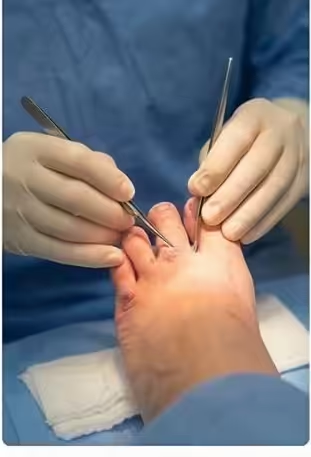
Sesamoidectomy is performed through a small plantar medial (tibial sesamoid) or plantar lateral (fibular sesamoid) incision, or through a dorsal approach. The fibular (lateral) sesamoid is more commonly removed — it is located in a less critical position biomechanically than the tibial sesamoid, and its removal carries lower risk of hallux valgus deformity postoperatively. When removing the tibial (medial) sesamoid, careful preservation of the medial soft tissue structures prevents big toe deviation.
The sesamoid is identified within the tendon substance, and the tendon is carefully split along its length to expose the sesamoid. The bone is excised and the tendon is repaired with absorbable sutures to restore its structural continuity. The incision is closed in layers and the foot is placed in a protective dressing.
Recovery After Sesamoidectomy
Protected weight-bearing in a surgical shoe or boot is maintained for three to four weeks while the tendon heals. Progression to regular footwear begins at four to six weeks. Full return to athletic footwear and activity typically occurs at eight to twelve weeks. Some patients experience altered forefoot mechanics after sesamoidectomy — custom orthotics with metatarsal support can optimize forefoot load distribution and improve functional outcomes.
Consultation for Sesamoid Pain
If you have been experiencing forefoot pain beneath the big toe joint that has not responded to conservative treatment, sesamoid pathology may be the cause. Contact Balance Foot & Ankle for evaluation including clinical examination, weight-bearing X-ray, and advanced imaging when indicated, along with a comprehensive treatment plan.
Ready to Relieve Your Foot Pain?
Board-certified podiatrists serving Southeast Michigan. Book online 24/7.
Insurance Accepted
BCBS · Medicare · Aetna · Cigna · United Healthcare · HAP · Priority Health · Humana · View All →
Howell Office
4330 E Grand River Ave
Howell, MI 48843
Get Directions →
Bloomfield Township Office
43494 Woodward Ave, Suite 208
Bloomfield Township, MI 48302
Get Directions →
Watch: Sesamoidectomy: Sesamoid Removal
Dr. Tom on sesamoidectomy — tibial vs fibular bone indication, stone-in-shoe symptom trigger, hallux valgus transfer risk, 4-6 month recovery, dancer/runner case selection.
Post-Sesamoidectomy Kit
Structured return-to-shoe. Dr. Tom’s kit:
As an Amazon Associate, Balance Foot & Ankle earns from qualifying purchases. This supports our free patient education content.
Weeks 1-4 protection.
Post-op sesamoid offload.
Weeks 4-12 return-to-shoe.
Topical forefoot relief.
Related: Sesamoiditis · Surgery Services · Book Sesamoid Consultation
More Podiatrist-Recommended Surgery Essentials
OOFOS Recovery Slide


![BEST Broken Ankle Fracture & Sprained Ankle Recovery TIPS [Top 25]](https://www.michiganfootdoctors.com/wp-content/cache/flying-press/f73e6fa5ea759889e6c1fb924d4cb0dd.jpg)
Watch: BEST Broken Ankle Fracture & Sprained Ankle Recovery TIPS [Top 25] — MichiganFootDoctors YouTube
Post-op approved — impact-absorbing slide for early recovery.
HOKA Ora 3 Recovery Slide
Max-cushion recovery sandal — comfort for post-surgical swelling.
Hoka Bondi 9
Max-cushion walking shoe — ease into return-to-walking post-surgery.
As an Amazon Associate, Balance Foot & Ankle earns from qualifying purchases. Product recommendations are based on clinical experience; prices and availability shown above update live from Amazon.
When to See a Podiatrist
Foot and ankle surgery in 2026 is dramatically different than a decade ago — most procedures are now minimally-invasive, outpatient, and allow weight-bearing within days. Balance Foot & Ankle surgeons have performed 3,000+ foot/ankle surgeries with modern techniques. If another surgeon has recommended a traditional open procedure, a second opinion may reveal a faster, less-invasive option.
Call Balance Foot & Ankle: (810) 206-1402 · Book online · Offices in Howell & Bloomfield Township
Differential Diagnosis: What Else Could It Be?
Not every case of sesamoiditis is straightforward. In our clinic we routinely rule out three look-alike conditions before confirming the diagnosis. If your symptoms don’t match the classic presentation, one of these may explain the pain — which is why physical exam matters more than self-diagnosis.
| Condition | How It Differs |
|---|---|
| Sesamoid stress fracture | Acute or gradually worsening sharp pain, tender directly over one sesamoid, positive findings on MRI. |
| Hallux rigidus | Stiff, painful big toe joint with limited dorsiflexion — pain is AT the joint, not UNDER the ball. |
| Turf toe (plantar plate injury) | Acute hyperextension mechanism, diffuse swelling of the 1st MTP, positive 1st MTP drawer test. |
Red Flags — When to See a Podiatrist Now
Seek expert evaluation at Balance Foot & Ankle if you notice any of the following:
- Sudden sharp onset (possible fracture)
- Bruising or swelling under the big toe
- Pain at rest or at night
- Inability to push off during gait
Call (810) 206-1402 or request an appointment. For an urgent foot or ankle problem, call (810) 206-1402 and we’ll find the soonest opening.
In Our Clinic: What We See
Clinical perspective from Dr. Tom Biernacki, DPM — Balance Foot & Ankle, Howell & Bloomfield Township, MI:
In our Balance Foot & Ankle clinic, sesamoiditis patients are usually dancers, runners, or women who have spent significant time in heels. They describe pain directly UNDER the big toe joint — not at the joint (that’s hallux rigidus) — which worsens with push-off. On exam we palpate each sesamoid separately (tibial and fibular) and assess for sensitivity. We always get X-rays to look for sesamoid fracture or bipartite sesamoid (a normal variant). Treatment uses a dancer’s pad to offload the sesamoid, stiff-soled footwear to reduce push-off stress, and activity modification.
In-Office Treatment at Balance Foot & Ankle
If home treatment isn’t providing relief for your sesamoiditis, our podiatry team at Balance Foot & Ankle can help with expert evaluations and advanced in-office care.
Book online 24/7. (810) 206-1402
Frequently Asked Questions
When should I see a doctor?
See a podiatrist if pain persists past 2 weeks, prevents normal activity, or is accompanied by red-flag symptoms (warmth, swelling, numbness, inability to bear weight).
Can I treat this at home?
Mild cases respond to RICE protocol (rest, ice, compression, elevation), supportive shoes, and OTC anti-inflammatories. Persistent symptoms need professional evaluation.
How long does it take to heal?
Most soft tissue injuries resolve in 2-6 weeks with appropriate care. Bone injuries take 6-12 weeks. Chronic conditions need longer-term management.
Ready to feel better?
Appointments available in Howell and Bloomfield Township, Michigan.
Book Your Visit
Dr. Tom Biernacki, DPM is a board-certified foot & ankle surgeon (ABFAS & ABPM) at Balance Foot & Ankle Specialists in Southeast Michigan. With over a decade of clinical experience, he specializes in heel pain, bunions, diabetic foot care, sports injuries, and minimally invasive surgery. Dr. Biernacki is a member of the APMA and ACFAS, and his patient education content on MichiganFootDoctors.com and YouTube has made him one of the most-followed foot & ankle educators on YouTube.