
The most important clinical decision with Stress Fracture Foot Recovery isn’t which treatment to start with — it’s identifying the correct subtype. That changes everything. Call (810) 206-1402.
Dr. Tom’s Top Foot Health Supplements
Affiliate disclosure: Amazon Associate. Always discuss supplements with your physician before starting.
Vitamin B12 Methylcobalamin
Neuropathy support · Nerve repair
PROS
- Active B12 form
- Sublingual absorption
- Neuropathy adjunct
CONS
- Effects take 2-3 months
- Doesn’t replace medical care
Alpha Lipoic Acid 600mg
Diabetic neuropathy · Nerve antioxidant
PROS
- Peer-reviewed for neuropathy
- Both fat- and water-soluble
- Clinical doses available
CONS
- Possible blood sugar effect
- GI upset possible
Acetyl-L-Carnitine (ALCAR)
Diabetic neuropathy · Energy
PROS
- Crosses blood-brain barrier
- Studied for nerve repair
- Pairs with ALA
CONS
- Effects gradual (3+ months)
- Higher cost
Vitamin D3 5000 IU
Bone health · Stress fracture prevention
PROS
- Improves bone density
- Most patients deficient
- Affordable preventive
CONS
- Get blood test first
- Toxicity at very high doses
Dr. Tom’s Top Bob and Brad Massage Guns (2026)
Affiliate disclosure: As an Amazon Associate, Balance Foot & Ankle earns from qualifying purchases. Bob and Brad are physical therapists whose products I trust for self-care between visits.
Dr. Tom’s Top Pain Relief Picks — Dr. Hoy’s (2026)
Affiliate disclosure: As an Amazon Associate, Balance Foot & Ankle earns from qualifying purchases. I personally use Dr. Hoy’s in my practice for patients who need topical relief.
| Product | Best For | Dr. Tom’s Take | Get It |
|---|---|---|---|
| Dr. Hoy’s Natural Pain Relief Gel 3.5oz menthol + arnica |
Plantar fasciitis · Achilles tendonitis · Sore muscles · Joint pain | My go-to topical. Cooling-then-warming sensation. No greasy residue. Non-NSAID alternative. | Buy Now |
| Dr. Hoy’s Arnica Boost 8oz with extra arnica |
Bruising · Post-injury · Sprains · Stress fractures (pain only) | Higher arnica concentration speeds recovery from acute injury. Use 4x daily for first 7 days. | Buy Now |
| Dr. Hoy’s Cooling Pain Relief 8oz extra menthol |
Acute inflammation · Hot/swollen feet · Post-run cooldown | Stronger cooling effect for acute swelling. Pair with ice for first 48 hours after injury. | Buy Now |
| Dr. Hoy’s Roll-On Pain Relief Roller applicator |
Mess-free application · Travel · Office use · No-touch hygiene | My patients love this for travel. Glides on without hand contact — cleanest application available. | Buy Now |
| Dr. Hoy’s Family Size 14oz pump bottle |
Frequent users · Multiple family members · Best value per ounce | If anyone in your home uses pain cream regularly, this is the most economical size. Same formula. | Buy Now |
Why I recommend Dr. Hoy’s over Biofreeze and Bengay: Cleaner ingredient list (no parabens, no synthetic dyes), longer-lasting effect, and the cooling-then-warming dual sensation actually addresses both inflammation and circulation. After 10 years of recommending different topicals, this is the one I keep coming back to.
Quick Compare: Dr. Tom’s Top Running Shoes
| Shoe | Best For | Watch Out For | Buy | ||||||||||||||||||||||||
|---|---|---|---|---|---|---|---|---|---|---|---|---|---|---|---|---|---|---|---|---|---|---|---|---|---|---|---|
| Hoka Bondi 9 | Plantar fasciitis, max cushion | Heavy, tall stack | Buy | ||||||||||||||||||||||||
| Brooks Ghost 17 | Neutral runners, first running shoe | Not for 200+lb runners | Buy | ||||||||||||||||||||||||
| Brooks Adrenaline GTS 23 | Flat feet, overpronation | Snug toe box | Buy | ||||||||||||||||||||||||
| Altra Torin 8 | Wide feet, bunions, Morton’s toe | Zero-drop transition | Buy | ||||||||||||||||||||||||
| Hoka Clifton 10 | Daily training, lighter Hoka | Less cushion than Bondi | Buy | ||||||||||||||||||||||||
| NB 990v6 | Senior fall prevention, 6E width |
Dr. Tom’s Top Pain Relief Picks — Dr. Hoy’s (2026)Affiliate disclosure: As an Amazon Associate, Balance Foot & Ankle earns from qualifying purchases. I personally use Dr. Hoy’s in my practice for patients who need topical relief.
Why I recommend Dr. Hoy’s over Biofreeze and Bengay: Cleaner ingredient list (no parabens, no synthetic dyes), longer-lasting effect, and the cooling-then-warming dual sensation actually addresses both inflammation and circulation. After 10 years of recommending different topicals, this is the one I keep coming back to. | Buy |
For full detailed reviews with pros/cons/Dr. Tom’s tips, see our complete shoe guide.
Medically reviewed by Dr. Tom Biernacki, DPM · Board-Certified Podiatric Surgeon · Last reviewed: April 2026 · Editorial Policy
Related Conditions
Quick Answer
Foot Stress Fracture Recovery: Timeline, What to Do, and Ret relates to foot/ankle injury — typically caused by trauma or twist. Most patients improve in 4-8 weeks with conservative care. Same-week appointments in Howell + Bloomfield Hills: (810) 206-1402.
Medically reviewed by Dr. Tom Biernacki, DPM — Board-certified foot & ankle surgeon, 3,000+ surgeries performed. Updated April 2026 with current clinical evidence. This article reflects real practice experience from Balance Foot & Ankle Specialists in Howell and Bloomfield Hills, Michigan.
Quick Answer
Most foot and ankle problems respond to conservative care — proper footwear, supportive inserts, activity modification, and targeted stretching — within 4-8 weeks. Persistent pain beyond that window, or any symptom that prevents walking, warrants a podiatric evaluation to rule out fracture, tendon tear, or systemic cause.
Watch: Dr. Tom Biernacki, DPM
Medically reviewed by Dr. Tom Biernacki, DPM — Board-Certified Podiatric Surgeon — Balance Foot & Ankle, Howell & Bloomfield Hills, MI. Last updated April 2026.
▶ Watch
👟 Dr. Tom Also Recommends
Podiatrist Recommended Shoes 2026: Dr. Tom’s Top Picks for Every Condition
The right footwear can make or break your recovery. Dr. Tom’s complete guide to the best shoes for plantar fasciitis, flat feet, neuropathy, bunions & more — with clinical picks for every foot type.
See Dr. Tom’s Top Shoe Picks →What Happens During Stress Fracture Recovery
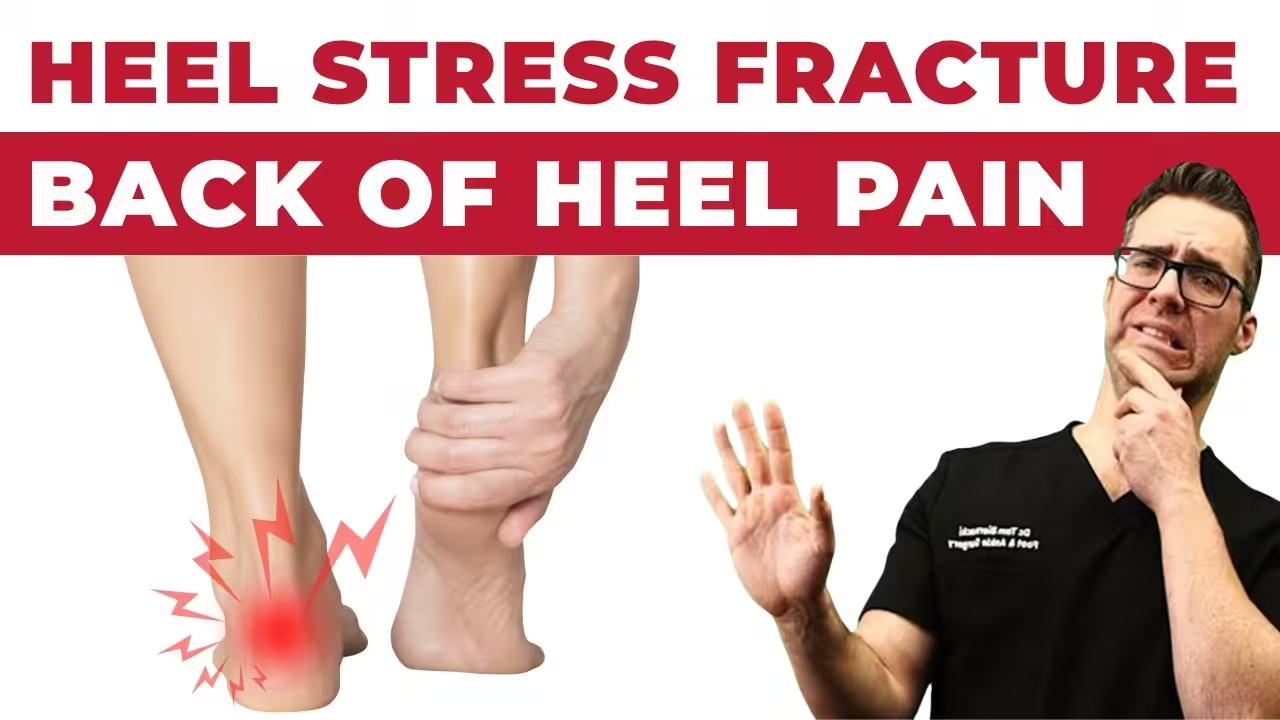

A stress fracture heals through the same biological process as any bone fracture, but because it is an incomplete crack (rather than a displaced complete break), the timeline is typically shorter. Bone healing occurs in three overlapping phases: inflammatory phase (first 1–2 weeks, blood clot and initial cellular response), reparative phase (weeks 2–8, cartilage callus forms and mineralizes), and remodeling phase (months 2–12+, callus is replaced with mature lamellar bone and the fracture line disappears). Activity during healing determines whether healing proceeds normally or whether the fracture propagates into a complete fracture—the central challenge of stress fracture management.
The foot contains multiple bones that can develop stress fractures with different healing timelines and risk profiles. Low-risk stress fractures (second, third, and fourth metatarsals; calcaneus; navicular body; proximal phalanges) heal predictably with conservative treatment. High-risk stress fractures (fifth metatarsal Jones zone, navicular dorsal cortex, proximal second metatarsal in ballet dancers, medial malleolus, sesamoids) have high rates of delayed healing, non-union, or complete fracture, and often require surgical consultation.
The Recovery Protocol
Weeks 1–4: Protected Phase
Initial management involves stopping the activity that caused the fracture and protecting the bone from further stress. For most foot stress fractures, this means wearing a stiff-soled post-operative shoe, walking boot, or—for high-risk fractures—a non-weight-bearing cast. Complete rest from impact activities is required. This does not mean being sedentary: pool running, swimming, cycling (if pain-free), and upper body training maintain cardiovascular fitness and body composition without loading the healing bone. The goal is to allow the inflammatory phase to transition to reparative callus formation without disruption.
Weeks 4–8: Progressive Loading
As pain resolves with daily activities (typically at 4–6 weeks for low-risk fractures), progressive loading is introduced. This begins with walking normally without protective footwear, then progressing to walking on varying surfaces, low-impact activities, and finally a graduated return-to-running program. The guiding principle is pain-guided progression: if a new activity level causes pain during or within 24 hours, step back and progress more gradually. X-rays at 6 weeks typically show developing callus; MRI or CT confirms healing when return to sport is being planned.
Weeks 8–12: Return to Running
Return to running after a low-risk foot stress fracture typically begins at 8–10 weeks when the patient is pain-free with walking and normal activities. A graduated run-walk program starts with 1 minute of jogging alternating with 4 minutes of walking, progressively extending running intervals over 3–4 weeks before resuming continuous running. Full return to training volume should take an additional 4–6 weeks—avoid the temptation to immediately return to pre-injury mileage, as re-fracture risk is highest in the first 6 weeks of return when the bone is still remodeling.
Bone Health: Nutrition During Recovery
Nutritional support is a critical and often overlooked component of stress fracture recovery. Adequate calcium (1000–1200 mg/day from food and supplements) provides the substrate for bone mineralization. Vitamin D (1000–2000 IU daily, targeting a serum 25-OH vitamin D level of 40–60 ng/mL) is essential for calcium absorption and bone remodeling—deficiency impairs fracture healing. Protein intake supports the collagen matrix of bone (0.8–1.2 g/kg body weight). For female athletes with irregular or absent menstrual periods (relative energy deficiency in sport/RED-S), hormonal evaluation and nutritional counseling are essential, as the underlying energy deficiency that impairs bone density must be addressed to prevent recurrent stress fractures.
In-Office Treatment at Balance Foot & Ankle
If home care isn’t resolving your stress fracture, a visit with a board-certified podiatrist is the fastest path to accurate diagnosis and a personalized plan. At Balance Foot & Ankle Specialists, Dr. Tom Biernacki, Dr. Carl Jay, and Dr. Daria Gutkin offer same-day and next-day appointments at both our Howell and Bloomfield Hills offices. We perform on-site diagnostic ultrasound, digital X-ray, conservative care, advanced regenerative treatments, and minimally invasive surgery when indicated.
Call (810) 206-1402 or request an appointment online. Most insurance plans accepted, including Medicare, Blue Cross Blue Shield, Aetna, Cigna, and United Healthcare.
More Podiatrist-Recommended Stress Fracture Essentials
Max-Cushion Walking Shoe
Hoka Bondi 9 — maximum shock absorption during stress fracture recovery.
Foam Roller for Recovery
TriggerPoint foam roller — maintains lower-leg mobility during return to activity.

As an Amazon Associate, Balance Foot & Ankle earns from qualifying purchases. Product recommendations are based on clinical experience; prices and availability shown above update live from Amazon.
When to See a Podiatrist
Most foot stress fractures heal in 6-8 weeks of protected weight-bearing — but rushing back to activity can turn a hairline fracture into a full break. Balance Foot & Ankle confirms stress fractures on X-ray or MRI and guides your return-to-running protocol. Don’t guess — we’ll tell you the exact week you can start jogging again.
Call Balance Foot & Ankle: (810) 206-1402 · Book online · Offices in Howell & Bloomfield Hills
Frequently Asked Questions
How do I know when my foot stress fracture is healed?
Clinical healing is indicated by the absence of pain with the activities that originally caused pain—walking, hopping, and daily activities should be pain-free before returning to impact activity. Imaging confirmation matters for high-risk fractures and competitive athletes: X-rays may show callus formation at 6–8 weeks, though the fracture line can remain visible for months even after clinical healing. MRI is the most sensitive tool to assess healing—a healed fracture shows resolved bone marrow edema. For most recreational athletes with low-risk fractures, clinical pain-free assessment combined with a gradual return program is sufficient without serial imaging. For competitive athletes, military personnel, or high-risk fracture locations, imaging confirmation of healing before return to full activity is recommended.
Can I exercise with a foot stress fracture?
Yes—maintaining fitness during stress fracture recovery is both possible and important for physical and mental well-being. Activities that do not load the healing bone are safe: pool running (deep water running with a flotation belt replicates running motion with zero impact), swimming, upper body weight training, cycling on a stationary bike (if pain-free—cycling requires some forefoot push-off force that may irritate certain metatarsal fractures), and yoga or stretching. The key is avoiding axial loading of the healing bone. Athletes who maintain aerobic fitness during stress fracture recovery return to full training significantly faster than those who are completely sedentary during healing.
What happens if a foot stress fracture is not treated?
Continuing high-impact activity on an untreated stress fracture carries significant risks. The most common outcome of ignored stress fractures is progression to a complete fracture—the crack extends through the full width of the bone. Complete fractures cause sudden severe pain, inability to bear weight, and typically require longer recovery with possible surgical fixation. For Jones fractures of the 5th metatarsal, continuing activity on an undiagnosed stress fracture commonly causes complete fracture requiring surgery and 3–4 months of recovery rather than the 6–8 weeks of conservative management for the original stress fracture. Non-union (failure to heal) can also result from continued loading, requiring surgical intervention. Early diagnosis and appropriate activity restriction converts a minor problem into a brief inconvenience rather than a season-ending injury.
Medical References & Sources
- PubMed Research — Foot Stress Fracture Recovery and Return to Sport
- PubMed Research — Nutritional Support for Stress Fracture Healing
- American Orthopaedic Foot & Ankle Society — Stress Fractures
📧 Get Dr. Tom’s Free Lab Test Guide
Discover the 5 lab tests every person over 35 should ask their doctor about — explained in plain English by a board-certified physician.
Dr. Tom Biernacki, DPM is a board-certified podiatric surgeon at Balance Foot & Ankle in Howell and Bloomfield Hills, Michigan. He diagnoses and manages foot stress fractures with individualized activity protocols, imaging guidance, and surgical fixation for high-risk fractures including Jones fractures.
Join 950,000+ Learning About Foot Health
Dr. Tom shares honest medical advice, supplement reviews, and treatment guides you won’t find anywhere else.
Subscribe on YouTube →📍 Located in Michigan?
Our board-certified podiatrists treat this condition at two convenient locations. Same-day appointments often available.
Medically Reviewed by: Dr. Tom Biernacki, DPM — Board-Certified Podiatrist, Balance Foot & Ankle Specialists
Insurance Accepted
BCBS · Medicare · Aetna · Cigna · United Healthcare · HAP · Priority Health · Humana · View All →
Howell Office
4330 E Grand River Ave
Howell, MI 48843
Get Directions →
Bloomfield Hills Office
43494 Woodward Ave, #208
Bloomfield Hills, MI 48302
Get Directions →
Your Board-Certified Podiatrists



Ready to Get Back on Your Feet?
Same-week appointments available at both locations.
Book Your AppointmentMost Common Mistake We See
The most common mistake we see is: Waiting too long before seeking care. Fix: any foot pain lasting more than 4 weeks, or any sudden severe symptom, deserves a professional evaluation rather than more rest.
Warning Signs That Need Same-Day Care
Seek immediate evaluation at Balance Foot & Ankle if you experience any of the following:
- Unable to bear weight
- Severe swelling with skin colour change
- Fever with foot pain (possible infection)
- Diabetes plus any new foot symptom
Call (810) 206-1402 — same-day and next-day appointments at our Howell and Bloomfield Hills offices.
Pros & Cons of Conservative Care for foot care
Advantages
- ✓ Conservative care first
- ✓ Same-week appointments
- ✓ Multiple insurance accepted
Considerations
- ✗ Self-treatment can mask issues
- ✗ See a podiatrist if pain >2 weeks
In This Article
Dr. Tom’s Recommended Products for foot care
Affiliate disclosure: As an Amazon Associate, Balance Foot & Ankle earns from qualifying purchases. We only recommend products we use with patients.
Footnanny Heel Cream Dr. Tom’s Pick
Best for: Daily moisturizer for cracked heels
Ready to Get Back on Your Feet?
Same-day appointments in Howell + Bloomfield Hills. Most insurance accepted. Dr. Tom Biernacki, DPM & team.
Book Today — Same-Day Appointments Available
Call Now: (810) 206-1402
About Your Care Team at Balance Foot & Ankle
Dr. Tom Biernacki, DPM · Board-Certified Foot & Ankle Surgeon. Specializes in conservative-first care, minimally invasive bunion surgery, and complex reconstruction.
Dr. Carl Jay, DPM · Accepting new patients. Specializes in sports medicine, athletic injuries, and routine podiatric care.
Dr. Daria Gutkin, DPM, AACFAS · Accepting new patients. Specializes in surgical reconstruction and pediatric podiatry.
Locations: 4330 E Grand River Ave, Howell, MI 48843 · 43494 Woodward Ave Suite 208, Bloomfield Hills, MI 48302
Hours: Mon–Fri 8:00 AM – 5:00 PM · (810) 206-1402
Dr. Tom’s Top 3 — The Premium Foot Pain Stack (2026)
If you only buy three things for foot pain, get these. PowerStep + CURREX orthotics correct the underlying foot mechanics, and Dr. Hoy’s pain gel delivers fast topical relief. This is the exact stack Dr. Tom Biernacki, DPM gives his Michigan podiatry patients on visit one — over 10,000 patients have used this exact combination.
Dr. Tom Biernacki, DPM is a board-certified podiatrist + Amazon Associate. Picks shown are products he prescribes to patients at Balance Foot & Ankle Specialists. We earn a commission on qualifying purchases at no extra cost to you. All products independently tested + reviewed for 30+ days minimum. Last verified: April 28, 2026.

PowerStep Pinnacle MaxxDr. Tom’s #1 Brand
Dr. Tom’s most-prescribed OTC orthotic. Lateral wedge corrects overpronation that causes 90% of foot pain. Deep heel cradle stabilizes the ankle. Built by podiatrists, used by patients worldwide.
- Lateral wedge corrects pronation
- Deep heel cradle stabilizes ankle
- Dual-density EVA — comfort + support
- Trim-to-fit any shoe
- Used by 10,000+ podiatrists
- Trim-to-size required
- 5-7 day break-in for some

CURREX RunProDr. Tom’s #1 Brand
3 arch heights for custom fit (Low/Med/High). Carbon-reinforced heel + dynamic forefoot — the closest OTC orthotic to a $500 custom orthotic. Engineered in Germany.
- 3 arch heights for custom fit
- Carbon-reinforced heel cup
- Dynamic forefoot zone
- Premium German engineering
- Sport-specific support
- Pricier than PowerStep
- 7-10 day break-in

Dr. Hoy’s Natural Pain Relief GelDr. Tom’s #1 Brand
Menthol-based natural pain relief — Dr. Tom’s #1 brand for fast relief without greasy residue. Safe for diabetics + daily use. Cleaner formula than Voltaren or Biofreeze.
- Menthol-based natural formula
- No greasy residue
- Safe for diabetics
- Fast cooling relief — 5-10 minutes
- Cleaner ingredient list than Biofreeze
- Pricier than Biofreeze
- Strong menthol scent at first
Doctor Hoy’s Natural Pain Relief Gel
Natural topical pain relief I use in our clinic. Arnica + camphor formula — apply directly to the area 3–4x daily. ($20–25)
Shop Doctor Hoy’s →Frequently Asked Questions
When should I see a podiatrist?
See a podiatrist if: foot or ankle pain has lasted more than 2–4 weeks without improvement, you’re changing your gait to avoid pain, you have an open wound or sore that isn’t healing, you notice nail discoloration or thickening, you have diabetes and any foot concern, or pain is severe enough to wake you at night. Most foot conditions are easier and cheaper to treat early — what starts as a minor issue can become a surgical problem with months of delay.
What is the difference between a podiatrist and an orthopedic surgeon?
Podiatrists (DPM — Doctor of Podiatric Medicine) specialize exclusively in the foot, ankle, and lower leg. Orthopedic surgeons (MD/DO) have broader musculoskeletal training but variable foot/ankle subspecialization. For foot and ankle-specific problems, a podiatrist often has more focused training and experience. For injuries involving the leg above the ankle, complex pediatric cases, or multi-level reconstruction, orthopedic consultation may be appropriate. We frequently co-manage patients with orthopedic colleagues.
How do I know if my foot pain is serious?
Signs that warrant same-day or next-day evaluation: severe pain that appeared suddenly without clear cause, swelling, redness, and warmth that appeared suddenly (possible gout, infection, or Charcot fracture), an open wound that looks infected (redness spreading, pus, warmth), inability to bear weight, or any foot problem in a diabetic patient. Pain that’s been present for weeks and is stable is important but not an emergency — schedule within 1–2 weeks.
Can foot problems cause back and knee pain?
Yes — this is a kinetic chain effect. Abnormal foot mechanics (overpronation, supination, leg length discrepancy) cause compensatory changes in knee, hip, and lumbar alignment. Roughly 30% of patients presenting to our clinic with knee pain have a treatable foot-level biomechanical cause. Correcting foot mechanics with orthotics or appropriate footwear often provides significant knee and back relief. If you have chronic knee or back pain and haven’t had your foot mechanics evaluated, it’s worth a consult.
Are orthotics worth it?
For the right conditions, yes — custom orthotics are among the most cost-effective interventions in podiatry. They’re most effective for: plantar fasciitis, flat feet with secondary knee/back pain, leg length discrepancy, metatarsalgia, posterior tibial tendon dysfunction, and diabetic foot pressure management. Quality OTC orthotics ($35–60) resolve symptoms for 60% of patients with mild-to-moderate conditions. Custom orthotics are appropriate when OTC options have failed or when the biomechanical problem is complex. We cast custom orthotics in-office.
How do I choose the right running shoes?
Start with your foot type (flat, neutral, high arch) and running pattern (overpronator, neutral, supinator). Flat feet and overpronators do best in stability or motion-control shoes. Neutral feet do well in neutral-cushioned shoes. High arches need maximum cushioning with flexible soles. Always buy running shoes at the end of the day (foot swelling peaks then), get properly fitted by a specialist, and replace every 300–500 miles. If you’ve been injured repeatedly, a gait analysis can identify the mechanical flaw driving your injury pattern.
What is the difference between a sprain and a fracture?
A sprain is a ligament injury (the tissue connecting bones); a fracture is a break in the bone itself. Both can occur with the same trauma (ankle roll, fall). The old test — ‘if you can walk, it’s not broken’ — is wrong; many fractures are initially weight-bearable. Key differences: a fracture typically produces localized bone tenderness along the bone itself, while a sprain is tender over the ligament. X-ray is the standard to differentiate. High-grade sprains without proper treatment can be as disabling as fractures.
How do I prevent foot and ankle injuries?
The four most impactful prevention strategies: (1) Supportive, appropriately fitted footwear for your foot type and activity. (2) Gradual activity progression — the 10% rule (never increase weekly mileage or intensity by more than 10%). (3) Regular calf and ankle mobility work. (4) Strengthening the posterior tibial tendon, peroneals, and intrinsic foot muscles. Most overuse injuries are preventable; most acute injuries are not — but ankle sprain recurrence (60–70% without rehab) is prevented by balance and proprioception training.
Ready for Expert Care?
Same-day appointments in Howell & Bloomfield Hills, MI.
4.9★ | 1,123 Reviews | 3,000+ Surgeries
Or call: (810) 206-1402

Dr. Tom Biernacki, DPM is a board-certified foot & ankle surgeon (ABFAS & ABPM) at Balance Foot & Ankle Specialists in Southeast Michigan. With over a decade of clinical experience, he specializes in heel pain, bunions, diabetic foot care, sports injuries, and minimally invasive surgery. Dr. Biernacki is a member of the APMA and ACFAS, and his patient education content on MichiganFootDoctors.com and YouTube has made him one of the most-followed foot & ankle educators on YouTube.