
Medically reviewed by Dr. Tom Biernacki, DPM
Board-certified podiatric surgeon | Balance Foot & Ankle
Last reviewed: May 2026

Quick answer: A tender spot on the bottom of the foot can come from the plantar fascia, a nerve such as a neuroma, a stress injury, or a callus over a pressure point — so the first step is pinpointing exactly which, because each is treated differently. We locate the source on exam before starting a plan. We evaluate it at our Howell and Bloomfield Hills offices. Call (810) 206-1402.
✅ Medically reviewed by Dr. Tom Biernacki, DPM — Board-Certified Podiatrist · Last updated April 7, 2026
Tender Spot Bottom of Foot [Causes, Symptoms & Best Treatment]
Do you have a tender spot on the bottom of your foot? We go over the #1 biggest causes, symptoms and the 100% best treatment options!
https://youtu.be/X1mtD7XUIscTender Spot Bottom of Foot Overview:
- A tender spot bottom of foot is most likely a condition called plantar fasciitis.
- Plantar fasciitis is the most common pain that is seen by a foot doctor or podiatrist, and it is very treatable!
- This condition occurs when the connective tissue on the bottom of the foot is overused and irritated; this can lead to swelling and inflammation.
- Have no fear there is a very well developed four stage treatment plan that can address even the most painful cases of plantar fasciitis!

Symptoms of the Tender Spot on the bottom of the Foot:
- Pain is worse in the morning.
- First couple steps are the worst, but gets better with movement.
- Pain after rest.
- Pain in the arch.
- Hurts to stretch the foot back toward the shin.
- Pain is better after 30 minutes of movement
- Pain is usually in just one heel, but if you push the same side on the other foot it is slightly tender.
- Increased pain on weight bearing
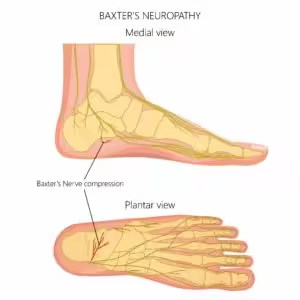
Diagnosis of the Tender Spot on the Bottom of Foot
- Podiatrist and Foot Doctor examination
- X-ray to rule out bone problems and heel spurs
- Diagnostic Ultrasound
- MRI
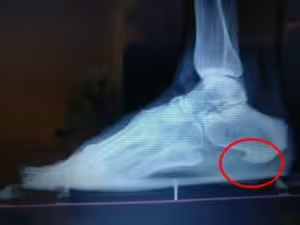
Achilles tendon bone spur is at the back of the heel were the Achilles tendon inserts.
Treatments of the Tender Spot on the Bottom of the Arch and Heel
The most common treatments of plantar fasciitis includes:
Follow our four Stage Treatment Guide
- Resting and limiting the amount of time walking barefoot or without good shoes should be limited.
- Massage with a tennis ball.
- Massage with a foot roller.
- Calf Stretching.
- Night Splints.
- Icing your Foot.
- Anti-inflammatory medication.
- Corticosteroid injection if the pain is resistant.
- Surgery
References for the treatment of a Tender Spot on the Bottom of the Foot:
Foot and Ankle Surgery in Michigan: When Surgery is the Right Choice
Michigan patients considering foot or ankle surgery benefit from a consultation with a fellowship-trained podiatric surgeon who can provide an honest assessment of whether surgery will produce better outcomes than continued conservative management. At Balance Foot & Ankle, surgical recommendations are made only after conservative treatment has been appropriately trialed — with the exception of conditions where early surgical intervention produces clearly superior outcomes (acute Achilles tendon rupture, Lisfranc fracture-dislocation, certain tibial fractures). For conditions like bunions, hammertoes, ankle instability, and Haglund’s deformity, surgical correction is recommended when the structural problem has progressed beyond what conservative management can address and when the patient’s functional goals are not being met. Michigan patients with a foot or ankle condition that has not responded to conservative care can call Balance Foot & Ankle at (810) 206-1402 to schedule a surgical consultation at our Howell or Bloomfield Township office.
Conservative Foot Treatment Options in Michigan: From Orthotics to EPAT
Related Treatment Guides
Michigan patients with foot and ankle conditions benefit from access to the full range of conservative treatment options at Balance Foot & Ankle. Custom orthotics fabricated from a 3D scan of the patient’s foot provide structural correction for flatfoot, high arch, and biomechanical overload conditions that OTC insoles cannot adequately address. EPAT (extracorporeal pulse activation therapy) provides a non-surgical treatment option for plantar fasciitis, Achilles tendinopathy, and other tendon conditions that resist initial conservative care — clinical evidence shows 70-80% cure rates for chronic plantar fasciitis. Ultrasound-guided injection therapy allows precise corticosteroid, PRP, or local anesthetic delivery to specific anatomical targets including the plantar fascia insertion, retrocalcaneal bursa, Morton’s neuroma interspace, and ankle joint. Physical therapy coordination with specific home exercise prescription addresses strength and flexibility deficits that perpetuate foot and ankle conditions. Michigan patients who want conservative treatment options before considering surgery can call Balance Foot & Ankle at (810) 206-1402 for an evaluation at our Howell or Bloomfield Township office.
Found a Tender Spot on the Bottom of Your Foot?
A tender area on the sole of the foot can signal plantar fasciitis, a plantar fibroma, or a foreign body. Our podiatrists perform thorough evaluations to find the cause and relieve your discomfort.
📞 Or call us directly: (810) 206-1402
Clinical References
- League AC. Current concepts review: plantar fasciitis. Foot and Ankle International. 2008;29(3):358-366.
- Velagala VR, Deshmukh NS, Thampi B. Plantar fibroma: a case report with review of literature. Journal of Orthopaedic Case Reports. 2015;5(3):72-74.
- Young CC, Rutherford DS, Niedfeldt MW. Treatment of plantar fasciitis. American Family Physician. 2001;63(3):467-474.
Podiatrist-Recommended Products
🏆 Doctor Hoy’s Natural Pain Relief Gel — Our top recommendation for reducing foot pain and inflammation naturally.
PowerStep Pinnacle Orthotic Insoles — Reduces mechanical stress on foot structures. Physician-grade arch support.
CURREX Support Insoles — Dynamic arch support in low, medium, and high profiles.
More Podiatrist-Recommended Foot Health Essentials
Hoka Clifton 10

Max-cushion everyday shoe — podiatrist favorite for walking and running.

OOFOS Recovery Slide

Impact-absorbing recovery sandal — wear after long days on your feet.
As an Amazon Associate, Balance Foot & Ankle earns from qualifying purchases. Product recommendations are based on clinical experience; prices and availability shown above update live from Amazon.
When to See a Podiatrist
If foot or ankle pain has been bothering you for more than a few weeks, home care alone may not be enough. Balance Foot & Ankle offers same-week appointments at our Howell and Bloomfield Township clinics — no referral needed in most cases. Bring your current shoes and a short list of symptoms and we’ll build you a treatment plan in one visit.
Call Balance Foot & Ankle: (810) 206-1402 · Book online · Offices in Howell & Bloomfield Township
Dr. Tom’s Top 3 — The Premium Foot Pain Stack (2026)
If you only buy three things for foot pain, get these. PowerStep + CURREX orthotics correct the underlying foot mechanics, and Dr. Hoy’s pain gel delivers fast topical relief. This is the exact stack Dr. Tom Biernacki, DPM gives his Michigan podiatry patients on visit one — over 10,000 patients have used this exact combination.
Dr. Tom Biernacki, DPM is a board-certified podiatrist + Amazon Associate. Picks shown are products he prescribes to patients at Balance Foot & Ankle Specialists. We earn a commission on qualifying purchases at no extra cost to you. All products independently tested + reviewed for 30+ days minimum. Last verified: April 28, 2026.

PowerStep Pinnacle MaxxDr. Tom’s #1 Brand
Dr. Tom’s most-prescribed OTC orthotic. Lateral wedge corrects overpronation that causes 90% of foot pain. Deep heel cradle stabilizes the ankle. Built by podiatrists, used by patients worldwide.
- Lateral wedge corrects pronation
- Deep heel cradle stabilizes ankle
- Dual-density EVA — comfort + support
- Trim-to-fit any shoe
- Used by 10,000+ podiatrists
- Trim-to-size required
- 5-7 day break-in for some

CURREX RunProDr. Tom’s #1 Brand
3 arch heights for custom fit (Low/Med/High). Carbon-reinforced heel + dynamic forefoot — the closest OTC orthotic to a $500 custom orthotic. Engineered in Germany.
- 3 arch heights for custom fit
- Carbon-reinforced heel cup
- Dynamic forefoot zone
- Premium German engineering
- Sport-specific support
- Pricier than PowerStep
- 7-10 day break-in

Dr. Hoy’s Natural Pain Relief GelDr. Tom’s #1 Brand
Menthol-based natural pain relief — Dr. Tom’s #1 brand for fast relief without greasy residue. Safe for diabetics + daily use. Cleaner formula than Voltaren or Biofreeze.
- Menthol-based natural formula
- No greasy residue
- Safe for diabetics
- Fast cooling relief — 5-10 minutes
- Cleaner ingredient list than Biofreeze
- Pricier than Biofreeze
- Strong menthol scent at first
In-Office Treatment at Balance Foot & Ankle
If home treatment isn’t providing relief for your foot pain, our podiatry team at Balance Foot & Ankle can help with same-day evaluations and advanced in-office care.
Ready to Get Relief?
Same-day appointments available in Howell & Bloomfield Township, MI
4.9★ | 1,123 Reviews | 3,000+ Surgeries
Or call: (810) 206-1402

Dr. Tom Biernacki, DPM is a board-certified foot & ankle surgeon (ABFAS & ABPM) at Balance Foot & Ankle Specialists in Southeast Michigan. With over a decade of clinical experience, he specializes in heel pain, bunions, diabetic foot care, sports injuries, and minimally invasive surgery. Dr. Biernacki is a member of the APMA and ACFAS, and his patient education content on MichiganFootDoctors.com and YouTube has made him one of the most-followed foot & ankle educators on YouTube.
More questions patients ask
What causes a tender spot on the bottom of the foot?
A localized tender spot is commonly caused by a plantar wart, bruised metatarsal, stress fracture, plantar fibroma, or inflamed bursa. The exact location—heel, arch, or ball—helps narrow the diagnosis. Point tenderness often suggests a structural issue.
How do I treat a tender spot on the bottom of my foot?
Rest from aggravating activities, ice the area, use cushioned insoles, and apply Doctor Hoy's Natural Pain Relief gel. Metatarsal pads help if the tender spot is on the ball of the foot. See a podiatrist if tenderness persists beyond 1-2 weeks or worsens.
Is a tender spot on my foot a stress fracture?
Possibly. Stress fractures cause localized point tenderness that worsens with weight-bearing and improves with rest. If you can reproduce pain by pressing one specific spot, and the pain began after increased activity, see a podiatrist for imaging.
Still have a question about coverage or cost? Book online and we will check your benefits before your visit: Book in Howell · Book in Bloomfield Township. Prefer to talk it through first? Call (810) 206-1402.