
Medically reviewed by Dr. Tom Biernacki, DPM
Board-certified podiatric surgeon | Balance Foot & Ankle
Last reviewed: May 2026

Quick answer: Sore Spot On The Ball Of The Foot has multiple potential causes including mechanical, neurological, vascular, and inflammatory. The patterns we see most often are overuse, poorly-fitted shoes, and biomechanical imbalance. Red flags requiring urgent evaluation: warmth/redness (infection), inability to bear weight (fracture), and unilateral swelling without injury (DVT). Call (810) 206-1402.
✅ Medically reviewed by Dr. Tom Biernacki, DPM — Board-Certified Podiatrist · Last updated April 7, 2026
The most important clinical decision with Sore Spot On The Ball Of The Foot isn’t which treatment to start with — it’s identifying the correct subtype. That changes everything. Call (810) 206-1402.
Do You Have A Sore Spot on the Ball of the Foot? Causes & Best Treatment
Do You Have A Sore Spot on the Ball of the Foot? This can be #1) Metatarsalgia, #2) Morton’s Neuroma, #3) Capsulitis, #4) Plantar plate tears & MORE!
Sore Spot on the Ball of the Foot Overview:
- The condition metatarsalgia refers to overload to the ball of your foot.
- This means there is a large amount of pressure and overload to the site.

Risk Factors:
- The number one cause is overload to the site.
- Heavy hours on your feet.
- Poor shoes.
- No orthotics.
- Increased weight.
- Poor flexbility.
This can lead to:
- Morton’s Neuroma.
- Capsulitis.
- Tendon Pain.
- Irritated nerves.
- Bruises muscle and skin.
Causes:
1) Metatarsal-phalangeal Join Pain:
- Don’t let the huge name scare you!
- This is just generalized pain located in the ball of the foot.
- Sometimes the only real cause is increased pressure.

Metatarsal-phalangeal Join Pain Treatment:
- This focuses on offloading the ball of the foot.
- It also focuses on stretching out the posterior muscle groups.
- This leads to a decrease in ball of foot pressure.
2) Morton’s Neuroma:
- This can cause numbness, burning and tingling.
- This is usually around the 3rd and 4th toes.
- The bottom of the toes may be numb.
- You may even feel an itchy ball of foot.
- There may be a clicking noise often associated with this.

Morton’s Neuroma Home Treatment:
- This guide explains home treatment options.
- Control and cushioning of the ball of the foot is needed.
- It is also necessary to stretch and re-train the posterior muscle groups.
- If these methods do not work, invasive treatment may be necessary.
3)Capsulitis:
- This is pain at the base of the toes.
- If you try and bend the smaller toes back or up, you will feel pain.
- This is inflammation of the flexor tendons that bend the toes down.
- This can be very common in running.

- Decrease inflammation.
- Decrease ball of foot pressure through stretching.
4)Metatarsal Stress Fracture:
- This is a gradual onsetting pain over a few days or weeks.
- It eventually becomes to painful to walk or run.
- This is most common in weekend warriors who start training very hard.
- Usually in people who start running many miles right away.

Metatarsal Stress Fracture Home Treatment:
- Treatment is based on proper diagnosing.
- Imaging and X-rays may be needed to confirm the stress fracture.
- Off-loading will be necessary to let the fracture heal.
5)Painful Callus On Ball Of Foot:
- A callus on the ball of the foot is very common.
- This is a sign of too much pressure on the ball of the foot.
- Calluses develop in relation to the amount of pressure placed on them.
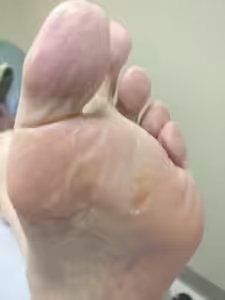
Painful Callus On Ball Of Foot Treatment:
- Soften up the callus through home remedies.
- Remove it after it is softened.
- Take precautions to remove the cause of the callus on ball of foot!
6) Blister On Ball Of Foot:
- A blister will form from shear forces on the ball of the foot.
- They can have both blood or serous fluid.
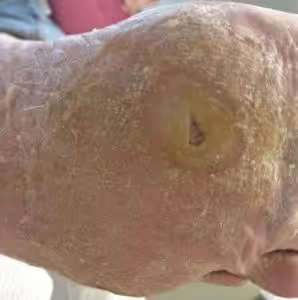
Blister On Ball Of Foot Treatment:
- Learn whether to pop the blister or not.
- Then learn how to cover your blister on the ball of the foot.
- Then how to keep the ball of the foot blister from coming back!
7) Second Toe Longer Than Big Toe:
- This will cause all the pain to be concentrated at the base of the 2nd toe.
- This is perhaps the most common cause of metatarsalgia (generalized ball of foot pain.).
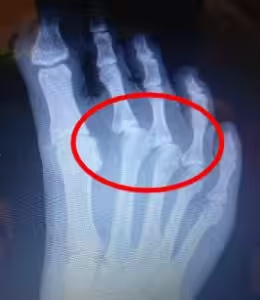
Second Toe Longer Than Big Toe Treatment:
- This is done through controlling pressure on the forefoot.
- The only way to correct the length permanently is through surgery.
- But this is rarely needed.
8) Corn On Ball Of Foot:
- A foot corn on ball of foot can cause deep pinpoint pain.
- A corn is different than a callus, it is thinner and more deep.
- It can feel like a needle digging deep in through the skin.
- It is made from hard keratin tissue.
- It is thought to be a thickened and scarred sweat duct.
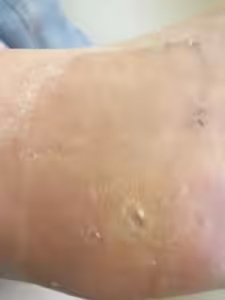
Corn On Ball Of Foot Treatment:
- Treatment of a foot corn on the ball of the foot is usually done by sharp steel!
- Since the corn is very deep, moisturizing does not work as well as for a callus.
- You can always try the skin removal techniques shown for a callus on the ball of the foot.
- But the results will not be as impressive.
9) Hard Skin On Ball Of Foot:
- Hard skin on ball of foot is essentially a callus on the ball of the foot.
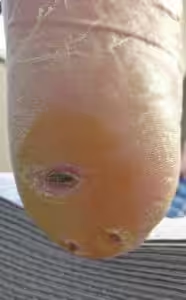
Hard Skin On Ball Of Foot Treatment:
- Treatment can be done almost completely at home!
- There are several home remedies that can soften the skin.
- The skin can then be safely and easily removed.
10) Stone Bruise On Ball Of Foot:
- Stone bruise on ball of foot is simply a deep contusion.
- It gets it’s name from stepping on a stone.
- This can penetrate through the protective fat pad.
- The deep tissue can take numerous weeks to get better!

Stone Bruise On Ball Of Foot Treatment:
- Treatment is based on rest, ice, compression and elevation.
- Ball of foot cushion through padding and gel inserts is most important.
- The first few days are usually the most painful, then it gets better very quickly!
11) Cyst On Ball Of Foot:
- A cyst on the ball of the foot is almost always a ganglion cyst.
- This is an pouching of joint fluid.
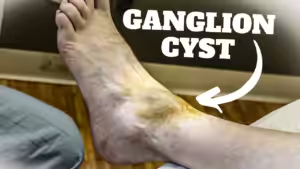
Cyst On Ball Of Foot Treatment:
- This is usually treated by aspirating with a needle.
- Surgical removal can provide more long term results.
12) Hard Lump On Ball Of Foot:
- This is most likely a foot corn on the ball of the foot.
- It can also be a plantar fibroma.
- A plantar fibroma feels like a pebble underneath the skin, but the skin is normal.

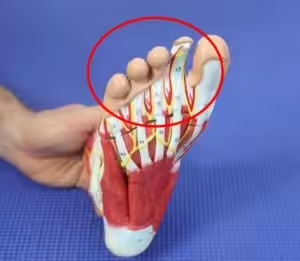
13) Plantar Plate Injury:
- Plantar plate injury can occur when the ligament holding the second metatarsal theology will join together starts to become injured.
- This is one of the most common causes of second toe pain in the bulk of the foot.
Related Treatment Guides
- Morton’s Neuroma Treatment
- Plantar Fasciitis & Heel Pain Treatment
- Custom 3D Orthotics
- Sports Foot & Ankle Injury Treatment
Have a Sore Spot on the Ball of Your Foot?
A painful area on the ball of the foot often indicates metatarsalgia, Morton’s neuroma, or sesamoiditis. Our podiatrists identify the precise cause and provide targeted treatment for relief.
📞 Or call us directly: (810) 206-1402
Clinical References
- Espinosa N, Brodsky JW, Maceira E. Metatarsalgia. Journal of the American Academy of Orthopaedic Surgeons. 2010;18(8):474-485.
- Besse JL. Metatarsalgia. Orthopaedics and Traumatology: Surgery and Research. 2017;103(1S):S29-S39.
- Cohen BE. Hallux sesamoid disorders. Foot and Ankle Clinics. 2009;14(1):91-104.
Podiatrist-Recommended Products
🏆 Doctor Hoy’s Natural Pain Relief Gel — Top recommendation for reducing foot pain and inflammation naturally.
PowerStep Pinnacle Orthotic Insoles — Physician-grade arch support in an OTC package.
CURREX Support Insoles — Dynamic arch support in multiple profiles.
In-Office Treatment at Balance Foot & Ankle
If home treatment isn’t providing relief for your foot pain, our podiatry team at Balance Foot & Ankle can help with same-day evaluations and advanced in-office care.
Frequently Asked Questions
When should I see a doctor?
See a podiatrist if pain persists past 2 weeks, prevents normal activity, or is accompanied by red-flag symptoms (warmth, swelling, numbness, inability to bear weight).
Can I treat this at home?
Mild cases respond to RICE protocol (rest, ice, compression, elevation), supportive shoes, and OTC anti-inflammatories. Persistent symptoms need professional evaluation.
How long does it take to heal?
Most soft tissue injuries resolve in 2-6 weeks with appropriate care. Bone injuries take 6-12 weeks. Chronic conditions need longer-term management.

Dr. Tom Biernacki, DPM is a board-certified foot & ankle surgeon (ABFAS & ABPM) at Balance Foot & Ankle Specialists in Southeast Michigan. With over a decade of clinical experience, he specializes in heel pain, bunions, diabetic foot care, sports injuries, and minimally invasive surgery. Dr. Biernacki is a member of the APMA and ACFAS, and his patient education content on MichiganFootDoctors.com and YouTube has made him one of the most-followed foot & ankle educators on YouTube.
More questions patients ask
What causes a sore spot on the ball of the foot?
A sore spot on the ball of the foot is typically caused by metatarsalgia, a plantar wart, Morton's neuroma, capsulitis, sesamoiditis, or fat pad atrophy. Thin-soled shoes and high-impact activities increase pressure on the metatarsal area.
How do I get rid of a sore spot on the ball of my foot?
Place a metatarsal pad just behind the sore area to redistribute pressure, wear cushioned shoes, ice the spot, and apply Doctor Hoy's Natural Pain Relief gel. PowerStep orthotics with metatarsal support help long-term. See a podiatrist if the spot doesn't improve in 2 weeks.
Can a sore spot on the ball of the foot be a plantar wart?
Yes. Plantar warts on the ball of the foot feel like a sore pebble when walking. They have tiny black dots (thrombosed capillaries) and disrupt skin lines. Unlike calluses, warts hurt when squeezed from the sides. A podiatrist can confirm and treat warts effectively.
Still have a question about coverage or cost? Book online and we will check your benefits before your visit: Book in Howell · Book in Bloomfield Township. Prefer to talk it through first? Call (810) 206-1402.