

![Heel Bursitis & Achilles Tendon Bursitis [Best HOME Treatment!]](https://www.michiganfootdoctors.com/wp-content/cache/flying-press/f2850da852ba9539b6bf4f72ae5062fe.jpg)
Watch: Heel Bursitis & Achilles Tendon Bursitis [Best HOME Treatment!] — MichiganFootDoctors YouTube

Medically Reviewed by Dr. Tom Biernacki, DPM, FACFAS — Board-certified podiatrist & foot surgeon, Howell & Bloomfield Township, MI | Last updated: May 2026
Tendon transfer surgery for foot drop repositions a functioning tendon (most commonly the tibialis posterior) to replace the paralysed tibialis anterior, restoring active ankle dorsiflexion and eliminating the need for a permanent AFO brace. It is most effective when performed within 18–24 months of nerve injury onset, before muscle atrophy becomes irreversible. Recovery takes 6–12 months with intensive physiotherapy; outcomes are best in patients with good motor strength in the donor tendon and no significant joint stiffness.
Foot Drop Treatment Options — Conservative vs. Surgical
| Treatment | Mechanism | Best For |
|---|---|---|
| AFO brace | Mechanically holds ankle at 90° during walking | All foot drop — first-line treatment |
| Physical therapy | Nerve recovery support; compensatory gait training | All stages — essential for recovery |
| Nerve repair/decompression | Restores nerve continuity or removes compression | Recent onset; compressive peroneal palsy |
| Tendon transfer (tibialis posterior) | Reroutes functioning tendon to restore active dorsiflexion | Permanent foot drop, <18–24 months, good donor |
| Ankle fusion (arthrodesis) | Stabilises joint in functional position permanently | End-stage foot drop with severe arthritis |
What the Tibialis Anterior Tendon Transfer Procedure Involves
- Donor tendon selection — the tibialis posterior (most common), peroneus longus, or extensor hallucis longus may be used depending on which muscles retain strength and which foot position needs correction
- Rerouting — the donor tendon is released from its original insertion, passed through a subcutaneous tunnel, and reattached to the dorsum of the foot or lateral cuneiform to reproduce dorsiflexion
- Boot immobilisation — 6–8 weeks in a below-knee cast or boot to allow tendon-to-bone healing before loading
- Gait retraining — the brain must learn to activate the donor muscle for a new movement; this requires 3–6 months of intensive physiotherapy and neuromuscular re-education
- Outcomes — 70–85% of well-selected patients achieve functional dorsiflexion adequate to walk without a brace; athletic-level function requires 12+ months of rehabilitation
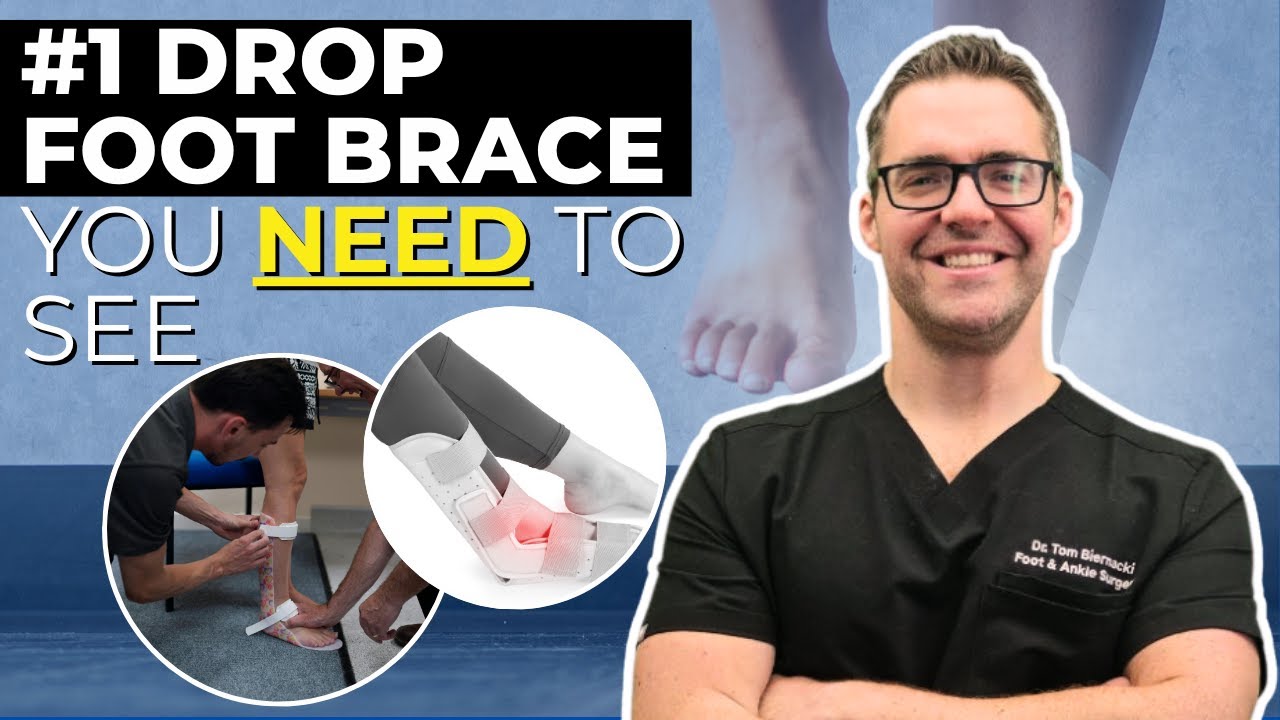
Watch: Foot Drop Braces & Treatment Options Explained
The most damaging mistake patients with foot drop make is waiting too long before seeking surgical evaluation for tendon transfer. The window for optimal tendon transfer outcomes is 12–24 months from onset — after this, the donor muscles begin to atrophy from disuse and the surgical result deteriorates significantly. Many patients spend 2–3 years trying conservative bracing, waiting to “see if the nerve recovers,” before consulting a surgeon — by which point the ideal candidates have missed their best window for a brace-free life. If foot drop shows no meaningful improvement after 6 months of conservative care, surgical consultation is appropriate, not a sign of giving up.
Frequently Asked Questions About Tendon Transfer for Foot Drop
Who is a good candidate for tibialis anterior tendon transfer?
Ideal candidates for tendon transfer have: permanent or stable foot drop from peroneal nerve injury (not actively recovering), at least one functioning donor tendon with grade 4–5 motor strength, no severe ankle arthritis or joint contracture, an absence of spasticity (spastic foot drop from stroke/MS is not typically treated with tendon transfer), and realistic expectations for 6–12 months of post-operative rehabilitation. A comprehensive neuromuscular evaluation and EMG/NCS testing guide candidacy assessment.
Will I still need a brace after tendon transfer surgery?
The goal of tibialis anterior tendon transfer is to eliminate the need for a permanent AFO brace. In well-selected patients, 70–85% achieve functional active dorsiflexion adequate for community walking without a brace. Some patients may still use a lightweight brace for high-demand activities such as running or uneven terrain in the early recovery period. Full brace independence typically takes 9–12 months post-operatively.
How long is recovery from tendon transfer surgery?
The recovery timeline involves: 6–8 weeks in a below-knee cast (non-weight-bearing); 2–4 weeks transitioning to a boot with progressive weight-bearing; 3–6 months of intensive physiotherapy focused on neuromuscular re-education (teaching the brain to activate the rerouted tendon for dorsiflexion); and 6–12 months to achieve full functional walking. Patients should plan for up to 12 months before returning to unrestricted activity.
Can foot drop be cured without surgery?
Foot drop caused by temporary nerve compression (e.g., crossing your legs too long, or positioning during surgery) often resolves spontaneously within weeks to months with nerve recovery. Foot drop caused by permanent peroneal nerve injury, L4/L5 nerve root compression, or trauma does not typically resolve with bracing or physical therapy alone — these patients are surgical candidates. The key question is whether the underlying nerve is recovering: EMG/NCS testing at 3–6 months post-injury objectively answers this.
Does insurance cover tendon transfer surgery in Michigan?
Tibialis anterior tendon transfer (CPT 27690) is covered by most PPO, HMO, and Medicare plans when medically documented as necessary for functional ambulation. Prior authorisation is generally required and documentation of failed conservative treatment (AFO bracing plus physical therapy) is needed. Balance Foot & Ankle accepts most major Michigan insurers — call (810) 206-1402 to verify your specific coverage.
Living With Foot Drop? There May Be a Surgical Solution.
Dr. Tom Biernacki, DPM, FACFAS evaluates tendon transfer candidacy at Balance Foot & Ankle — Howell & Bloomfield Township, MI. Same-day consultations available for complex foot and ankle conditions.
Book a Consultation (810) 206-1402Related: Foot drop treatment · Posterior tibial tendon dysfunction · Peripheral neuropathy · Achilles tendon repair surgery · Custom orthotics Michigan
In-Office Treatment at Balance Foot & Ankle
If home treatment isn’t providing relief for your foot and ankle conditions, our podiatry team at Balance Foot & Ankle can help with expert evaluations and advanced in-office care.
Book online 24/7. (810) 206-1402
VitaMedica Arnica Gel
Arnica gel plus 15 plant compounds for sore feet, plantar fasciitis flares and post-activity soreness. Apply a thin layer to the sore area.
Shop VitaMedica Arnica Gel →Frequently Asked Questions

Dr. Tom Biernacki, DPM is a board-certified foot & ankle surgeon (ABFAS & ABPM) at Balance Foot & Ankle Specialists in Southeast Michigan. With over a decade of clinical experience, he specializes in heel pain, bunions, diabetic foot care, sports injuries, and minimally invasive surgery. Dr. Biernacki is a member of the APMA and ACFAS, and his patient education content on MichiganFootDoctors.com and YouTube has made him one of the most-followed foot & ankle educators on YouTube.