
Medically reviewed by Dr. Tom Biernacki, DPM
Board-certified podiatric physician & surgeon | Balance Foot & Ankle, Howell & Bloomfield Township, MI
Last reviewed: July 2026
Quick answer
The ankle is moved and stabilized by several tendons in three groups: the medial (inner) tendons behind the inner ankle bone — led by the posterior tibial tendon that holds up your arch; the lateral (outer) peroneal tendons that stabilize against rolling; and the Achilles at the back plus the tibialis anterior at the front. The most common tendon problems are posterior tibial tendon dysfunction, peroneal tendonitis, and Achilles tendinopathy. Most respond to rest, bracing, and targeted rehab — but a tendon that is failing (a flattening arch, or an ankle that keeps giving way) needs early treatment. Balance Foot & Ankle: (810) 206-1402.
When people say their ankle “tendon” hurts, they are usually describing one of a handful of specific tendons — and which one it is completely changes the treatment. A failing posterior tibial tendon and an irritated peroneal tendon both cause ankle pain, but one collapses your arch and the other makes your ankle roll. This guide walks through the ankle’s tendons, what each one does, the problems they develop, and how to tell them apart.
The Tendons of the Ankle
A tendon attaches muscle to bone. Around the ankle, the important tendons fall into three groups.
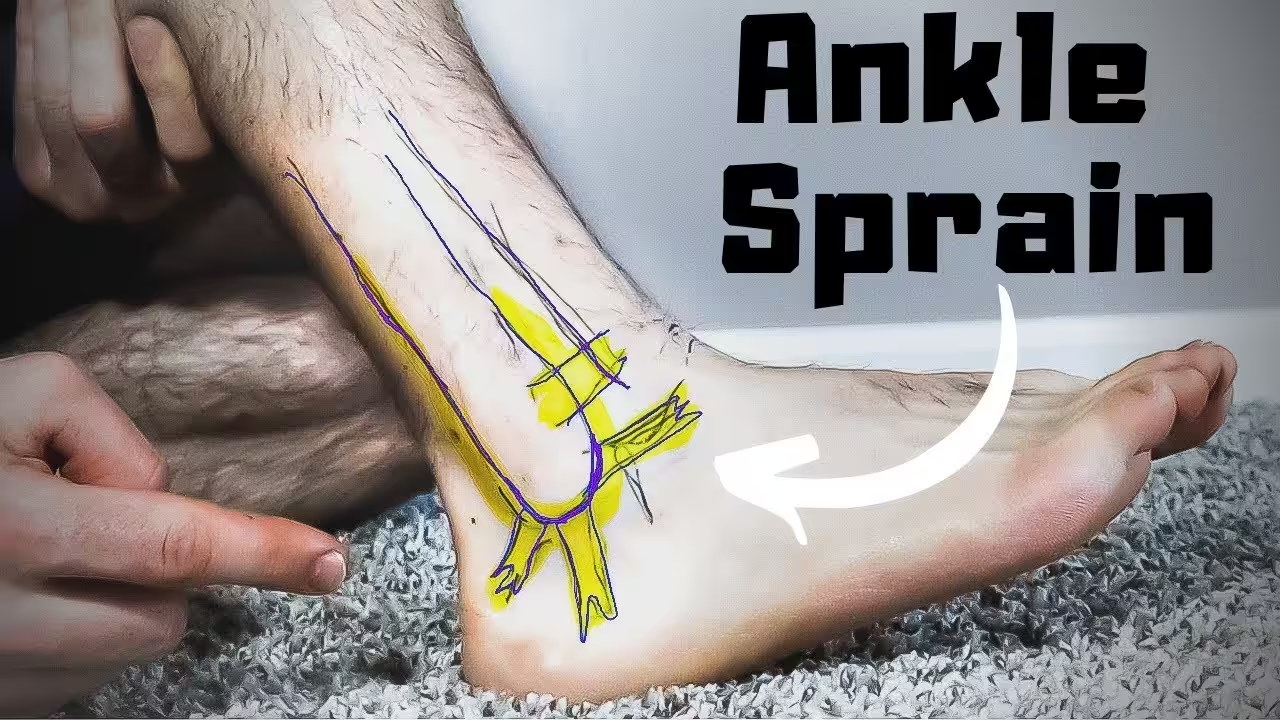
Medial (inner) tendons. Four structures pass behind the inner ankle bone (the medial malleolus) through the tarsal tunnel. A classic mnemonic remembers them front-to-back as “Tom, Dick, and Harry”: Tibialis posterior, flexor Digitorum longus, the neurovascular bundle (Artery, vein, and tibial Nerve), and flexor Hallucis longus. The posterior tibial tendon is the most important — it holds up the arch and locks the foot for push-off.
Lateral (outer) tendons. The two peroneal tendons (peroneus longus and brevis) run behind the outer ankle bone (the lateral malleolus). They evert the foot and are the main dynamic stabilizers that keep the ankle from rolling inward.
Anterior and posterior tendons. The tibialis anterior at the front lifts the foot (dorsiflexion); losing it causes foot drop. The Achilles tendon at the back — the largest tendon in the body — powers push-off and is central to walking, running, and jumping.
Tendons vs. Ligaments — a Quick Distinction
People mix these up constantly. A tendon connects muscle to bone and produces movement; a ligament connects bone to bone and provides passive stability. A rolled ankle usually sprains a ligament (most often the outer ATFL). Pain that builds with activity, swells along a specific cord-like line, and worsens when you resist that tendon’s motion is more likely a tendon problem. Both can happen at once, which is why persistent ankle pain deserves a proper exam.
Posterior Tibial Tendon Dysfunction (PTTD)
PTTD is the most common significant ankle tendon problem in adults, especially women over 40 and anyone with flat feet. As the tendon inflames and degenerates it can no longer support the arch, so the arch gradually collapses and the foot rolls inward. The tell-tale signs are aching and swelling along the inner ankle, a foot that looks flatter than the other side, and difficulty rising onto the ball of one foot (the single-leg heel raise). PTTD is progressive — caught early it responds to bracing and orthotics, but left alone it can become a rigid, arthritic flatfoot that needs surgery. It is the ankle tendon problem you least want to ignore.
Peroneal Tendonitis and Subluxation
The peroneal tendons on the outer ankle are injured by repetitive activity or after an ankle sprain. Peroneal tendonitis causes pain and swelling along the outer ankle and the outer edge of the foot, worse with activity and when you turn the sole outward against resistance. Because these tendons are the ankle’s main dynamic stabilizers, peroneal problems often go hand-in-hand with a feeling that the ankle is unstable or keeps giving way. In some cases the tendons slip out of their groove behind the outer ankle bone (peroneal subluxation), producing a painful snapping sensation. Chronic outer-ankle pain after a sprain that never fully settled is frequently peroneal.
Achilles Tendinopathy
The Achilles is the most commonly injured ankle tendon in active people. It presents as pain and stiffness at the back of the ankle — either 2–6 cm above the heel (mid-portion) or right where it meets the heel bone (insertional). Classic features are morning stiffness that eases as you warm up, and pain that returns after activity. Most cases are an overuse tendinopathy that responds to a structured calf-loading (eccentric) program, heel lifts, and activity modification. A sudden pop with the feeling of being kicked in the calf, and difficulty pushing off, suggests an Achilles rupture — that needs urgent evaluation.
FHL and Tibialis Anterior Tendon Problems
Two less common but real culprits: the flexor hallucis longus (FHL), which can be irritated in dancers and athletes who repeatedly push off the big toe (“dancer’s tendinitis,” felt along the inner and back of the ankle), and the tibialis anterior at the front of the ankle, which can develop tendonitis from downhill running or tight footwear and, when it tears, produces weakness lifting the foot.
⚠️ See a podiatrist promptly if you have:
- An arch that is visibly flattening or a foot that looks flatter than the other side
- An ankle that repeatedly gives way, or a painful snapping behind the ankle bone
- A sudden pop in the back of the ankle with difficulty pushing off (possible Achilles rupture)
- Inability to bear weight, or to rise onto the ball of one foot
- Significant swelling, or pain that steadily worsens over weeks
- Diabetes or poor circulation with any new foot or ankle problem
How Ankle Tendon Problems Are Treated
Most ankle tendon problems are treated conservatively, and the specifics depend on which tendon is involved. General first-line care is relative rest from the aggravating activity, ice, a supportive or braced shoe, and an anti-inflammatory if appropriate for you. Beyond that, treatment is targeted: orthotics or a brace to offload a struggling posterior tibial tendon, a structured eccentric calf-loading program for the Achilles, bracing and peroneal strengthening for outer-ankle instability, and protected activity while an irritated tendon calms down. When a tendon is torn, subluxing, or has failed to respond to months of good conservative care, surgical repair or reconstruction is considered. The key theme across all of them is that early, correct treatment prevents a manageable tendon problem from becoming a structural one.
Frequently Asked Questions
How do I know if my ankle pain is a tendon or a sprain?
A sprain is usually a single rolling event that injures a ligament, with immediate swelling and bruising. A tendon problem tends to build over time, hurts along a specific cord-like line, and gets worse when you resist that tendon’s motion (for example, turning the sole outward for the peroneals). Pain lingering weeks after a “sprain” is often a tendon.
How long do ankle tendon injuries take to heal?
Mild tendonitis often settles in a few weeks with rest and rehab. Established tendinopathy (Achilles, peroneal, posterior tibial) usually needs 6–12 weeks of a structured loading program. Tendon tears or failed tendons can take longer and sometimes need surgery. Tendons heal slowly because their blood supply is limited — consistency matters more than intensity.
Which ankle tendon is most commonly injured?
In active people the Achilles is the most commonly injured. In adults overall, posterior tibial tendon dysfunction is the most consequential because it collapses the arch, and peroneal tendonitis is the most common cause of lingering outer-ankle pain after a sprain.
Can ankle tendon problems heal without treatment?
Mild overuse irritation can settle with rest. But posterior tibial dysfunction and peroneal instability tend to progress if the underlying mechanics aren’t addressed, so pain that persists, recurs, or comes with an arch change or instability should be evaluated rather than waited out.
When should I see a podiatrist for ankle tendon pain?
Same-day or prompt evaluation if you have a flattening arch, an ankle that gives way, a sudden pop with trouble pushing off, or you can’t bear weight. A routine visit is reasonable for aching that persists beyond a couple of weeks of sensible home care.
The Bottom Line
“Ankle tendon pain” is really several distinct problems wearing the same label. Locating it — inner (posterior tibial), outer (peroneal), or back (Achilles) — points to the right treatment, and nearly all of these respond well when caught early. The pattern that should never be ignored is a tendon that is failing: a flattening arch or an ankle that keeps giving way. Treated early, that’s a brace and rehab; ignored, it becomes surgery.
Sources
- Kohls-Gatzoulis J, et al. “Tibialis posterior dysfunction: a common and treatable cause of adult acquired flatfoot.” BMJ. 2004;329(7478):1328-1333.
- Heckman DS, et al. “Managing peroneal tendon disorders.” J Am Acad Orthop Surg. 2009;17(5):306-317.
- Li HY, Hua YH. “Achilles Tendinopathy: Current Concepts.” Biomed Res Int. 2016;2016:6492597.
- Cleveland Clinic: Posterior Tibial Tendon Dysfunction
Ankle Tendon Pain That Won’t Settle?
Get the specific tendon identified — inner, outer, or Achilles — and treated. Appointments in Howell & Bloomfield Township, MI.
4.9★ | 1,200+ Reviews | 3,000+ Surgeries
Or call: (810) 206-1402
Related guides

Dr. Tom Biernacki, DPM is a board-certified foot & ankle surgeon (ABFAS & ABPM) at Balance Foot & Ankle Specialists in Southeast Michigan. With over a decade of clinical experience, he specializes in heel pain, bunions, diabetic foot care, sports injuries, and minimally invasive surgery. Dr. Biernacki is a member of the APMA and ACFAS, and his patient education content on MichiganFootDoctors.com and YouTube has made him one of the most-followed foot & ankle educators on YouTube.