
Ready to be seen? Book a real appointment time online, 24/7 — Howell or Bloomfield Township. Takes about a minute, 24/7.
Quick answer: If your toenail is falling off but still attached, don’t pull it off. Trim any loose edge, tape the nail flat with a breathable bandage, and keep it clean and dry — the old nail protects the nail bed like a natural bandage while the new nail grows in over 6–12 months (12–18 for a big toenail). See a podiatrist promptly if you have diabetes, spreading redness or pus, or a dark streak under the nail.
Medically reviewed by Dr. Tom Biernacki, DPM
Board-certified podiatric surgeon | Balance Foot & Ankle
Last reviewed: May 2026
Watching a toenail detach and fall off is alarming — even when you know something was wrong with it. The visceral reaction is universal, but the clinical meaning varies enormously. A toenail that comes off after a 10-mile hike in tight shoes is almost always a simple trauma response. A toenail that falls off spontaneously in a 55-year-old diabetic with no remembered injury is a different story entirely.
In this guide I’ll explain exactly what causes toenails to fall off, how to tell them apart, what to do when it happens, and precisely when you need a podiatrist same-day versus when watchful waiting is appropriate.
What Causes a Toenail to Fall Off?
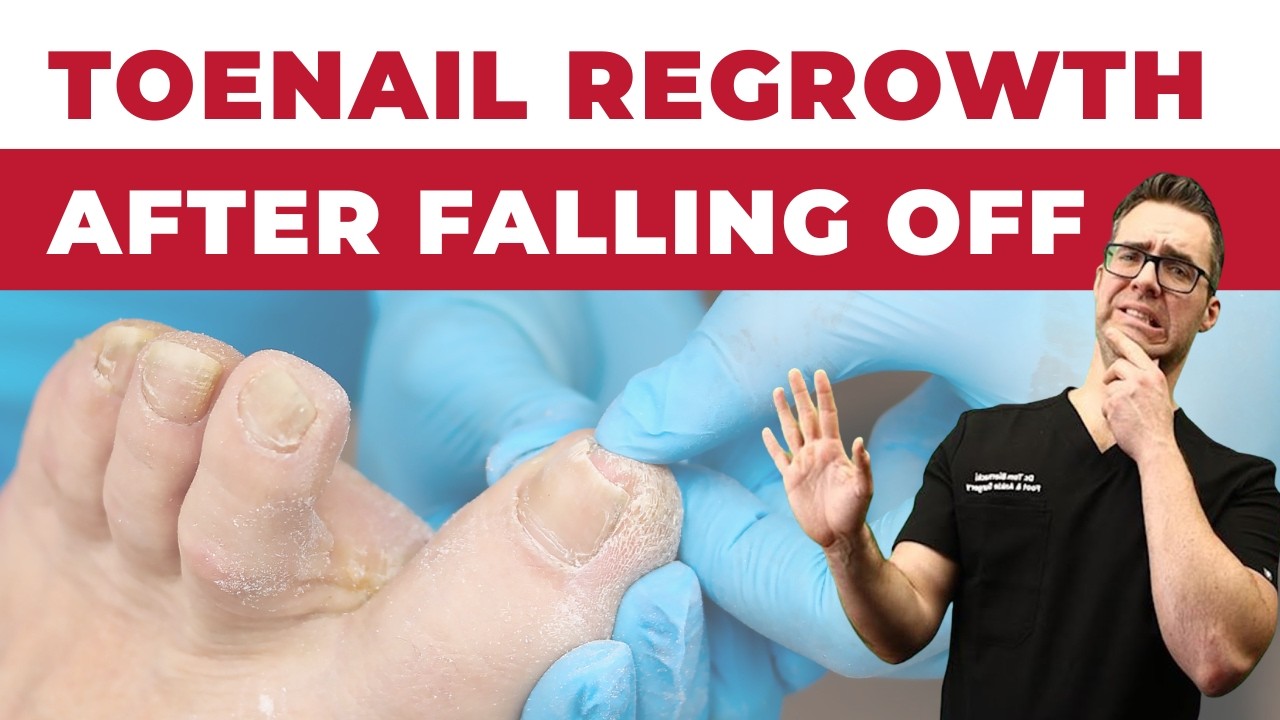
Onychoptosis — the medical term for a toenail falling off — occurs when the nail plate separates from the nail bed at the proximal and lateral attachments. There are six clinically distinct causes, each with different presentations and treatments.
Cause 1: Subungual Hematoma (Trauma)
The most common cause of toenail loss is trauma — specifically a subungual hematoma, a collection of blood between the nail plate and nail bed. When blood pools under the nail, it separates the nail plate from the bed. Over days to weeks, the loosened nail grows forward and eventually detaches completely.
Two mechanisms: acute trauma (dropping something on the toe, stubbing it forcefully) creates sudden intense pain with rapid darkening of the nail. Repetitive microtrauma — running, hiking, or wearing shoes where the toe hits the front — creates chronic nail separation that you may not even notice until the nail begins to loosen.
The classic runner’s black toenail is this mechanism: the 2nd toe (often longest) repeatedly contacts the shoe’s toe box with every stride over 10+ miles. The cumulative microtrauma causes a chronic subungual hematoma. In our clinic, we see this in marathon runners and hikers almost universally — it’s essentially a training marker for shoe fit issues.
Key takeaway: Traumatic toenail loss from subungual hematoma is benign. The nail will regrow fully. The critical question: is there any skin pigmentation (dark streak or spot) at the base of the nail? If yes — even after trauma — a melanoma must be ruled out.
Cause 2: Onychomycosis (Fungal Infection)
Onychomycosis (fungal nail infection) accounts for approximately 50% of all nail disorders seen in clinical practice. Dermatophytes — most commonly Trichophyton rubrum — infect the nail plate and nail bed, causing progressive thickening, discoloration (yellow-white-brown), crumbling, and ultimately separation from the nail bed.
The nail doesn’t usually fall off suddenly in fungal infection. Instead, it progressively loosens over months to years, separating from the nail bed in a process called onycholysis. Eventually, the loosened nail detaches partially or fully. By the time the nail falls off, the fungal infection is usually extensive.
Key identifying features: yellow-white-brown discoloration starting at the tip and advancing proximally; thickening and crumbling of the nail plate; a chalky white or yellow debris under the nail; and often involvement of multiple nails or the surrounding skin (athlete’s foot). A nail fungus infection causing nail loss is treatable but requires systemic oral antifungal therapy for reliable results — topical agents do not penetrate the nail plate adequately once infection is established.
Cause 3: Onycholysis from Repetitive Pressure
Onycholysis refers to the separation of the nail plate from the nail bed without a clear traumatic event or infection. When it affects the toenails, the usual culprit is chronic repetitive pressure — either from footwear (too-short shoe, too-narrow toe box), nail plate thickening from aging, or underlying structural issues like hammertoes or bunions that cause the toe to press against the shoe.
In onycholysis, the nail begins to separate at the distal (front) end, creating a white-appearing nail (the white color is air under the nail, not fungus or trauma). Over time, the separation progresses proximally. If the cause isn’t addressed, the nail continues loosening until it falls off.
The diagnosis is made by the clinical pattern: separation starting at the tip without thickening, crumbling, or the characteristic discoloration of fungal infection. Treatment is addressing the underlying mechanical cause — proper shoe fitting, nail trimming technique, and sometimes orthotics or padding for structural issues.
Cause 4: Nail Psoriasis
Psoriasis affects the nails in approximately 50% of skin psoriasis cases and up to 80% of psoriatic arthritis cases. When psoriasis affects the nail bed, it causes a form of onycholysis — the nail separates from the bed due to the hyperproliferative inflammation underneath. This psoriatic onycholysis often has a distinctive yellow-brown rim at the edge of the separation (the “oil drop” or salmon patch sign).
Psoriatic nail involvement also causes nail pitting, subungual hyperkeratosis (chalky buildup under the nail), and discoloration. When severe, the nail may detach and fall off. The presence of skin psoriasis elsewhere or nail pitting alongside nail loss points toward this cause.
Cause 5: Lichen Planus
Nail lichen planus is among the most destructive nail conditions — it causes scarring of the nail matrix that can result in permanent nail loss. The nail thins progressively, develops longitudinal ridging, and the cuticle may grow forward (pterygium unguis) across the nail surface, fusing with and destroying the matrix. Nail loss in lichen planus can be permanent if the matrix is scarred before treatment is initiated.
If nail loss is accompanied by purple itchy flat-topped skin lesions elsewhere (particularly the wrists, ankles, or oral mucosa), lichen planus should be suspected and prompt dermatologic evaluation obtained.
Cause 6: Subungual Melanoma (Must Rule Out)
This is the cause no one wants to think about — but it must be considered whenever a toenail falls off with dark pigmentation, particularly when the nail loss is spontaneous (not following clear trauma) or when there’s a dark streak (longitudinal melanonychia) at the base of the detached nail or on the nail bed.
Subungual melanoma affects the nail bed or matrix and causes progressive nail plate disruption that eventually leads to nail loss. The average time from a patient first noticing something abnormal to diagnosis is over two years — primarily because patients and clinicians attribute dark nail changes to trauma. Hutchinson’s sign — pigmentation spreading from under the nail onto the cuticle skin — is essentially pathognomonic for melanoma until proven otherwise.
This is not a common cause of nail loss, but it’s the one that requires urgent evaluation when present. If the nail that fell off has dark pigmentation under or on it, or if the underlying nail bed shows brown-black streaking: see a podiatrist or dermatologist promptly.
Key takeaway: Six causes, one critical rule: any dark pigmentation associated with nail loss — especially a longitudinal dark streak at the nail base — requires same-day or next-day evaluation to rule out subungual melanoma. Do not wait.
Toenail Falling Off but Still Attached? Do This First
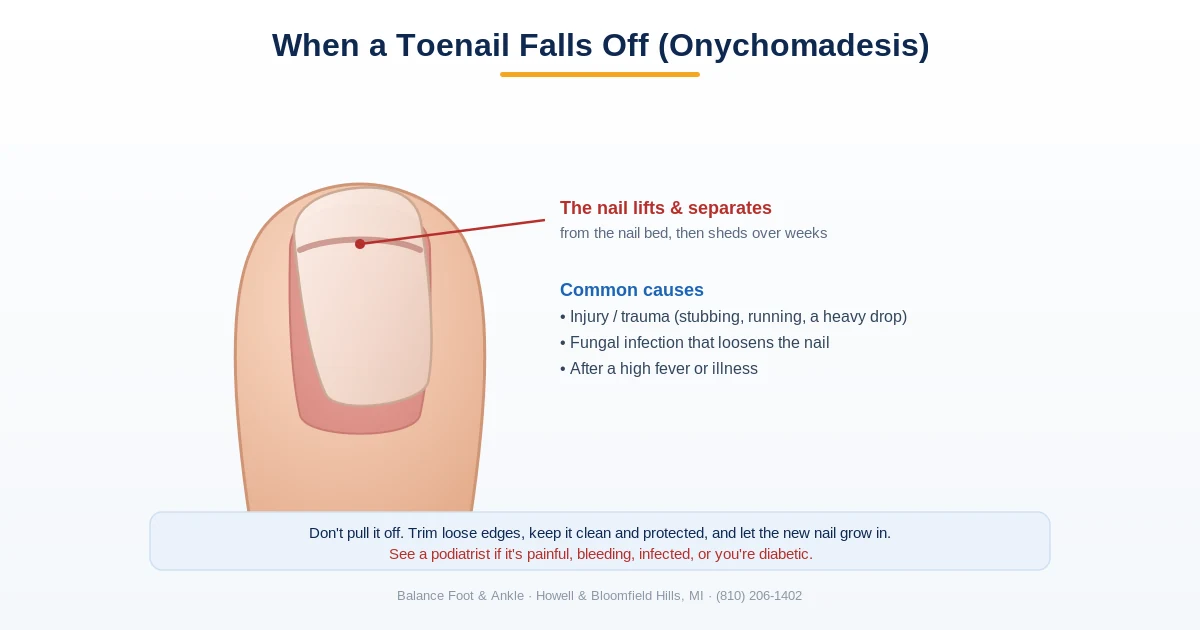
A nail that is lifting but still partly attached is worth protecting — it shields the raw nail bed better than any dressing, and ripping it away can injure the matrix that grows your new nail. Resist the urge to peel it.
- Leave the attached portion in place. Only trim the loose, snag-prone edge with clean clippers.
- Tape it flat. A strip of paper tape or a breathable bandage keeps the nail from catching on socks.
- Keep it clean and dry. Wash daily, pat dry, and change the dressing after showers.
- Cushion the toe. A roomy toe box prevents repeat trauma while the new nail grows in.
If the skin under the lifted nail looks red, weeps, or smells bad — or you have diabetes or poor circulation — skip home care and have the toe evaluated. A podiatrist can painlessly trim or secure the nail in the office.
Some of these need an office visit, not home care
The paragraph above is the one to take seriously. A nail lifting over an infected or broken-down nail bed will not settle on its own, and on a diabetic or poorly circulated foot a lost toenail is a wound rather than a cosmetic problem. In the office the nail can be trimmed back or secured painlessly, the bed underneath can be examined properly, and you leave knowing whether it needs antibiotics or simply time.
Howell — 4330 E Grand River Ave, Howell MI 48843 · Bloomfield Township — 43494 Woodward Ave #208, Bloomfield Township MI 48302
What to Do When a Toenail Falls Off
The moment a toenail detaches, the exposed nail bed is tender and vulnerable. Here’s the step-by-step management for uncomplicated cases (no signs of infection, no dark pigmentation, no systemic illness):
- Clean the nail bed gently: Rinse with clean water. Do not scrub or apply hydrogen peroxide (it damages healing tissue). Pat dry.
- Apply antibiotic ointment: A thin layer of bacitracin or Neosporin prevents infection during the initial days while the surface is exposed and vulnerable.
- Cover with a non-adherent dressing: A non-stick pad (like Telfa) secured with medical tape. Change daily. Avoid bandages that stick to the raw nail bed — removing them is painful and can disrupt healing.
- Wear open-toed footwear if possible: The exposed nail bed is extremely pressure-sensitive. Closed shoes create painful compression. A sandal or open-toe shoe for the first 1–2 weeks reduces discomfort significantly.
- Monitor for infection: Increasing redness, warmth, purulent discharge, or red streaking proximally means infection is developing. This requires antibiotic treatment and podiatric evaluation.
One common question: should you try to remove a partially detached nail? In most cases, do not forcibly remove a nail that’s still partially attached — it provides some protection to the nail bed and removal is painful and risks infection. Trim any portion that’s completely detached and likely to snag on socks. The nail bed will dry and keratinize (harden) over 2–4 weeks, making it much less sensitive.
Toenail Regrowth Timeline
Toenail Regrowth Estimator
The question almost everyone asks first is when will this look normal again. Toenails grow far slower than fingernails, and which nail you lost changes the answer by many months.
| Nail | Nail plate length | Under 30 | 30 to 59 | 60+ |
|---|---|---|---|---|
| Big toe (hallux) | about 20 mm | 10 to 13 months | 11 to 17 months | 14 to 22 months |
| Second to fourth toe | about 12 mm | 6 to 8 months | 7 to 10 months | 9 to 13 months |
| Little toe (pinky) | about 9 mm | 4 to 6 months | 5 to 8 months | 6 to 10 months |
Toenails grow roughly 1.2 to 1.8 mm per month in middle age, against about 3.5 mm per month for fingernails — which is why a fingernail recovers in a season and a big toenail can take well over a year. Growth slows with age and with reduced circulation.
Toenail regrowth is significantly slower than fingernail regrowth. The nail matrix regenerates the nail plate, but the process takes months. Here is the realistic timeline our patients should expect:
- Days 1–14: The exposed nail bed dries and forms a protective surface. It looks rough and yellowish-white — this is normal keratinization, not infection.
- Weeks 2–6: You may see a tiny crescent of new nail at the base (proximal nail fold). This is encouraging — it means the matrix is intact and regenerating. Not all patients see visible new nail this early.
- Months 2–4: The new nail plate is visibly growing forward. It may appear wavy, ridged, or thinner than your old nail — this is normal for regrowth nails and typically normalizes as growth continues.
- Months 6–12: Most patients have approximately half their nail plate regrown. The nail may still be thinner and slightly misshapen.
- Months 12–18: Full nail plate coverage for most causes. Fungal or psoriatic nails may take longer or never fully normalize without treating the underlying disease.
Big toenails take longer than smaller toenails — typically 12–18 months for complete regrowth of the hallux nail versus 6–12 months for lesser toenails. The age of the patient also matters: nail growth slows with age, and regrowth in a 70-year-old takes substantially longer than in a 30-year-old.
Key takeaway: Toenail regrowth takes 6–18 months from complete loss to full regrowth. The underlying cause matters: untreated fungal infection will prevent proper regrowth. Address the cause — not just the lost nail.
Will the Nail Grow Back Normally?
Whether the nail grows back normally depends entirely on the cause and whether the nail matrix was damaged.
Traumatic nail loss: Almost always regrows normally if the matrix is intact. Severe crush injuries that damage the matrix can cause permanent nail dystrophy (misshapen, ridged, or thickened nail). In our practice, most runners who lose nails from shoe trauma regrow perfect nails — provided the shoe fit is corrected.
Fungal nail loss: Regrowth depends completely on treating the infection. Untreated onychomycosis will simply reinfect the regrowth nail. Oral terbinafine (the most effective treatment, with 70–80% mycologic cure rate) is typically started at the time of nail loss to allow the regrowth nail to grow in fungus-free.
Psoriatic nail loss: Regrowth occurs but nails often remain abnormal while psoriasis is active. Biologic therapies for psoriasis can dramatically improve nail involvement.
Lichen planus: If pterygium unguis has formed and the matrix is scarred, permanent nail loss or permanent nail dystrophy is possible. Early treatment before matrix scarring preserves the nail.
⚠️ When a toenail falling off requires urgent evaluation:
- Any dark (brown-black) pigmentation under the nail or on the nail bed
- Spontaneous nail loss without any remembered trauma
- Nail loss in a diabetic, immunocompromised, or peripheral vascular disease patient
- Signs of deep infection: spreading redness, red streaking up the foot, fever, pus
- The nail bed appears exposed bone or has a foul odor (osteomyelitis risk in diabetics)
- Nail loss accompanied by joint pain or skin lesions (psoriatic arthritis, lichen planus)
- Children losing toenails without clear trauma (alopecia areata, systemic causes)
The Most Common Mistake After Losing a Toenail
The most common mistake I see is ignoring the underlying cause while waiting for the nail to regrow. Specifically:
In fungal nail loss: The patient waits for the nail to regrow and is frustrated that the new nail is already yellow and thick by month 6. The fungus never left — it was in the nail bed the entire time, infecting the new nail as it grew. Starting antifungal treatment at the time of nail loss (not after regrowth) gives the best outcome.
In traumatic nail loss from shoe fit: The patient does nothing about the shoes and loses the nail again the following running season. Fixing the shoe fit (half size larger, proper width, running shoe volume match) prevents recurrence.
In spontaneous nail loss: The patient waits to see if it “just grows back” without investigating whether there’s a systemic cause. Spontaneous nail loss — particularly in adults over 40 without any remembered trauma — should always be investigated.
Why Did My Toenail Fall Off Without Pain?
Painless nail loss is common — and the lack of pain is actually a diagnostic clue. When a toenail detaches gradually and painlessly, the cause is usually one of three things: a fungal infection slowly separating the nail from its bed (onycholysis), repetitive micro-trauma from running or tight shoes that loosened the nail over months, or a skin condition such as nail psoriasis. Because these develop slowly, the nail lets go long after the original damage — no dramatic injury, no ache.
Two situations deserve prompt attention even though nothing hurts. If you have diabetes or neuropathy, painlessness may simply mean reduced sensation — have any nail loss checked. And if you see a dark streak or spot on the nail bed that was not caused by an injury you remember, get it evaluated to rule out subungual melanoma (see above). Otherwise, care for a painlessly lost nail the same way: keep the bed clean, covered, and watch the new nail as it grows in. If either of those two describes your nail, that is a visit rather than a wait-and-see. Book a nail evaluation online.
Big Toenail vs. Pinky Toenail: Why It Matters Which One You Lost
Patients often assume a lost toenail is a lost toenail. In practice the two most common ones we see behave quite differently, heal on different timelines, and have different causes worth correcting.
Big toenail fell off
The big toenail takes the most force of any nail on the foot. It is the one that gets crushed against the end of a shoe on downhill runs and long hikes, the one a dropped object lands on, and the one most likely to develop a subungual hematoma — bleeding trapped under the nail — that lifts the plate off its bed over the following weeks.
Two things make the big toe the more consequential loss. First, it has the longest regrowth time of any nail on the body: a full big toenail commonly takes twelve to eighteen months to grow out completely, against roughly six to nine months for the smaller toes. Second, because the nail matrix sits under the base of the nail, a hard enough impact can damage the matrix itself, and matrix damage is what produces a permanently thickened, ridged or split nail rather than a clean regrowth.
Pinky toenail fell off
The fifth toenail comes off for an entirely different reason. It is rarely impact. It is usually chronic friction and pressure — the outside of the little toe rubbing against the seam or upper of a shoe that is too narrow through the toe box, day after day. The nail there is already thin, small and often slightly curved, so it does not take much sustained rubbing to separate it.
Two things worth knowing about the pinky nail specifically. It is the one most often mistaken for fungus, because a repeatedly traumatized small nail becomes thick, yellow and crumbly in a way that looks identical to onychomycosis without testing. And in some people a fifth toenail that has been lost several times regrows only partially, or as a small keratin remnant rather than a proper nail plate. That is a matrix that has been worn out rather than a nail that is still coming.
If a pinky toenail keeps coming off, the shoe is the thing to change. The nail is a symptom of the toe box, not an isolated problem.
When a Lost Toenail Needs Medical Attention Rather Than Time
Most toenails that come off are a nuisance and nothing more. These are the situations where waiting it out is the wrong call.
- You have diabetes, neuropathy or reduced circulation. This is the most important one on the list. A lifted or missing nail leaves exposed nail bed, and if you cannot reliably feel that area you cannot rely on pain to warn you that it has become infected or ulcerated. Do not trim, pull or soak it on your own — have it looked at. What is a minor injury on a healthy foot is a wound that needs monitoring on a neuropathic one.
- Signs of infection. Spreading redness up the toe, warmth, throbbing that worsens rather than settles, pus, or a foul smell. A nail bed left open is an entry point, and toes have a thin soft-tissue envelope with little margin.
- Heavy bleeding, or a cut in the nail bed itself. If the injury tore the skin under the nail, that tissue may need repair. Nail bed lacerations that heal unrepaired are a common cause of permanently deformed regrowth, and the window to address it is early.
- The toe looks crooked, or you cannot bend it. The force that removes a nail is often enough to fracture the tuft of bone underneath it. Deformity, inability to move the toe, or pain out of proportion to the injury all warrant an X-ray.
- It keeps happening. A nail that has come off two or three times is telling you something upstream has not been fixed — a fungal infection weakening the plate, footwear that is too short, or a mechanical issue such as a hammertoe or a long second toe driving the nail into the shoe. Treating the nail without treating the cause just restarts the cycle.
- Nothing regrows after several months. An empty nail bed at six months on a small toe, or twelve on the big toe, is worth assessing rather than continuing to wait.
Have a Lost or Lifting Toenail Assessed
If a nail is hanging on by a corner, has come off more than once, or belongs to a foot with diabetes or neuropathy, it is worth a short visit rather than a guess. We can tell whether the plate should be trimmed back or left alone, whether what is underneath is fungal, and whether the nail is likely to regrow normally.
Balance Foot & Ankle sees patients at our Howell podiatry office and our Bloomfield Township podiatry office. Call (810) 206-1402 or start as a new patient here. If the nail came off in a specific injury, tell us when it happened — the timeline changes what we look for.
How to Prevent Toenail Loss
Toenail loss from pressure and friction is largely preventable with the right footwear and nail care. The key steps: leave a thumb’s width of space between your longest toe and the front of the shoe (buy shoes at the end of the day, when your feet are at their largest); lace firmly enough that your foot doesn’t slide forward on downhills or stairs; keep toenails trimmed straight across and short, just beyond the tip of the toe; and wear moisture-wicking socks, since sweat increases the friction that lifts a nail during long walks or runs.
If you keep losing the same toenail despite a proper shoe fit, a structural evaluation is worth it — a bone spur beneath the nail (subungual exostosis), a toe-length difference, or a hammertoe creating downward pressure can be the underlying driver that footwear alone cannot fix. Our podiatrists at Balance Foot & Ankle can pinpoint and treat the root cause so it stops recurring.
One prevention step gets overlooked because people assume it is cosmetic. If a toenail has thickened to the point where trimming it at home is a struggle, that thickness is itself a risk factor — a nail too thick to cut cleanly is a nail that catches on socks and shoes, lifts at the edge, and eventually separates again. Having the nail plate mechanically thinned as part of a medical pedicure reduces the leverage each step puts on the nail. For anyone with diabetes, neuropathy, or who takes a blood thinner, having that done in a clinical setting rather than a salon also removes the infection risk that comes with shared, unsterilized instruments.
Frequently Asked Questions
Is it bad if a toenail falls off?
It depends entirely on the cause. Traumatic nail loss from a single injury or prolonged running is almost always benign — the nail regrows without intervention. Spontaneous nail loss without clear cause, or nail loss with dark discoloration, requires evaluation to identify and treat the underlying condition.
How long does it take for a toenail to grow back after falling off?
Big toenail: 12–18 months for full regrowth. Smaller toenails: 6–12 months. These timelines assume the underlying cause has been treated. Untreated fungal infection will prevent normal regrowth.
What does a healthy nail bed look like after a nail falls off?
The nail bed starts pink-red and somewhat raw. Over 2–4 weeks it dries and keratinizes to a yellowish-white firm surface. This is normal. If it stays raw, wet, or develops drainage or redness, infection is developing.
Can a toenail grow back after falling off from fungus?
Yes, but only if the fungal infection is treated. Without treatment, the new nail will simply be reinfected. Oral terbinafine started when the nail falls off gives the best chance of clear nail regrowth.
When should I see a podiatrist for a toenail falling off?
Same-day or next-day if: dark pigmentation, diabetic or immunocompromised, signs of infection, spontaneous loss without trauma. Routine appointment if: clear traumatic cause, no dark pigmentation, no systemic illness.
Why did my toenail fall off without pain?
Gradual, painless detachment usually points to a slow process: fungal onycholysis, months of repetitive pressure from footwear or running, or nail psoriasis — rather than a single injury. It is generally not an emergency, but diabetics and anyone who sees a dark streak on the exposed nail bed should be examined promptly.
Toenail Falling Off? Get It Evaluated Today.
Book online 24/7 in Howell & Bloomfield Township, MI
4.9★ | 1,200+ Reviews | 3,000+ Surgeries
Or call: (810) 206-1402
Related Treatments at Balance Foot & Ankle
Our board-certified podiatrists offer advanced treatments at our Bloomfield Township and Howell locations.
Related nail & toenail guides
If a nail is loosening or lifting, these help:
Nail changes often show up together. If you also notice horizontal ridges or dents across the nail (Beau’s lines), that can point to the same trauma or underlying health issue worth having checked.
- Black toenail: causes
- Bruised toenail (subungual hematoma)
- Nail & skin conditions hub
- Keratin granulations (white chalky nails)
- Green toenail discoloration
- Listerine for toenail fungus
- Toenail fungus treatment
If the nail is lifting after an injury and you can see fluid, spreading discoloration, or exposed nail bed underneath, don’t wait for it to detach on its own — our podiatrists in Howell can protect the nail bed, relieve pressure safely, and offer same-week visits.
Related
If the nail lifted after an injury or is discolored, these cover the specific causes:
The Bottom Line
A toenail falling off has a wide range from trivially benign (post-marathon subungual hematoma) to urgently serious (spontaneous loss with dark pigmentation in a diabetic). The key is matching the clinical picture to the right cause and treating the cause — not just waiting for regrowth. Most cases are benign and self-resolving with proper wound care. The cases that require prompt attention are identifiable by a short checklist: dark pigmentation, spontaneous loss, systemic illness, or signs of infection.
Sources
- Lipner SR, Scher RK. “Onychomycosis: Treatment and prevention of recurrence.” J Am Acad Dermatol. 2019.
- Piraccini BM, Alessandrini A. “Onychomycosis: a review.” J Fungi. 2015.
- Perrin C, et al. “Subungual melanoma: molecular analysis of 31 cases from early stage to invasive melanoma.” Histopathology. 2025.
- Tosti A, Piraccini BM. “Biology of nails and nail disorders.” In: Fitzpatrick’s Dermatology. 2019.
- American Academy of Dermatology: Nail Loss — AAD.org
Book an appointment with a podiatrist
A nail that is lifting or has come away needs the nail bed protected while the new one grows in, and it is worth having someone check whether trauma, fungus or a shoe fit problem caused it. Balance Foot & Ankle sees patients at two offices — Howell in Livingston County, and Bloomfield Township in Oakland County.
Book online, 24/7: choose a real appointment time at Howell or Bloomfield Township. Prefer to speak with someone first? Call (810) 206-1402 or use the form below.

Dr. Tom Biernacki, DPM is a board-certified foot & ankle surgeon (ABFAS & ABPM) at Balance Foot & Ankle Specialists in Southeast Michigan. With over a decade of clinical experience, he specializes in heel pain, bunions, diabetic foot care, sports injuries, and minimally invasive surgery. Dr. Biernacki is a member of the APMA and ACFAS, and his patient education content on MichiganFootDoctors.com and YouTube has made him one of the most-followed foot & ankle educators on YouTube.
More questions patients ask
Why is my toenail falling off?
Toenails fall off (onycholysis) due to trauma, fungal infection, repetitive pressure from ill-fitting shoes, psoriasis, or systemic illness. Runners commonly lose toenails from repeated impact. The nail separates from the nail bed and may detach fully over weeks to months.
What should I do if my toenail is falling off?
Keep the area clean and protected with a bandage. Don't forcefully pull off a partially detached nail — trim only what comes off naturally. Watch for signs of infection: increasing redness, swelling, or discharge. See a podiatrist if the nail bed appears infected or if you have diabetes.
Will a toenail grow back after falling off?
Yes — toenails typically regrow after falling off, but it takes 6–12 months for a full toenail to regrow. If the nail matrix (growth center) was damaged by infection, trauma, or disease, the new nail may grow in thickened or misshapen. A podiatrist can assess if regrowth will be normal.
Will my toenail grow back?
Yes — toenails typically grow back fully in 12-18 months once the underlying cause is addressed. Toenails grow approximately 1mm per month. During regrowth: protect with proper-fitting shoes, apply nail oil daily, take biotin and B-complex, treat any underlying fungal/skin disease. New nail comes in healthy if matrix wasnu0027t damaged.
How do you protect a toenail that fell off?
Protection during regrowth: 1) Cover with antibiotic ointment + non-stick gauze daily for first 2 weeks. 2) Wear loose shoes with extra space. 3) Avoid running/impact for 4-6 weeks. 4) Apply nail oil daily once skin healed. 5) Use cotton sock liner inside shoes. 6) See podiatrist if signs of infection (drainage, fever, increasing pain).
Still have a question about coverage or cost? Book online and we will check your benefits before your visit: Book in Howell · Book in Bloomfield Township. Prefer to talk it through first? Call (810) 206-1402.