

For knee pain, the right insole addresses overpronation, leg-length discrepancy, or arch collapse — addressing the upstream foot mechanics often resolves knee pain that physical therapy alone could not.
You’re in the right place. Dr. Tom Biernacki, DPM, FACFAS — board-certified foot & ankle surgeon with 3,000+ surgeries — explains exactly what the best insoles for knee pain means and what works. Call (810) 206-1402 for same-day appointment at Howell or Bloomfield Hills.

Quick Answer: Best Insoles for Knee Pain
The best insoles for knee pain control foot pronation — the excessive inward roll that increases internal tibial rotation and lateral knee stress. In our clinic, PowerStep Pinnacle is the first-line orthotic for patellofemoral syndrome, IT band syndrome, and knee pain caused by flat feet. CURREX RunPro works best for runners experiencing knee pain. A semi-rigid arch support reduces knee loading by controlling the upstream biomechanics that originate at the foot and ankle — correcting the root cause rather than just masking the symptom.
Knee pain is one of the most common complaints in our clinic — and one of the most frequently mismanaged. Patients come in after months of knee injections, physical therapy, and even arthroscopic surgery, only to discover that the true driver of their knee pain was overpronation of the foot. When your foot rolls inward excessively with every step, it creates a chain reaction: increased internal tibial rotation → increased valgus stress at the knee → lateral patellofemoral compression → IT band tightening. Fix the foot, and you frequently fix the knee. An insole is often the fastest, least invasive way to interrupt that chain.
The Foot-Knee Connection
The subtalar joint — the joint beneath the ankle that controls pronation and supination — is the biomechanical link between foot position and knee alignment. When the subtalar joint pronates excessively, it drives internal rotation of the tibia. The tibia rotating inward while the femur remains in place creates a valgus (knock-knee) moment at the patellofemoral joint — compressing the lateral patellar facet, irritating the plica, and tensioning the IT band. This is the biomechanical explanation for why runner’s knee (patellofemoral syndrome) and IT band syndrome are so common in overpronators.
In our clinic, Dr. Biernacki performs a comprehensive kinetic chain assessment for all knee pain patients — examining not just the knee, but the foot posture, subtalar range of motion, and gait pattern. In many cases, we find that a properly fitted orthotic insole provides significant knee pain relief within 2-4 weeks by correcting the foot pronation driving the knee overload, allowing inflamed peri-articular structures to heal.
Knee Conditions Orthotics Insoles Help
Not all knee pain responds to foot orthotics — the intervention is most effective when overpronation or a foot alignment problem is the primary mechanical driver. These are the knee conditions we most commonly treat successfully with orthotic intervention.
- Patellofemoral syndrome (runner’s knee): Lateral patellar compression caused by internal tibial rotation from overpronation. Medial posting insoles reduce valgus knee stress by 15-25% in multiple studies.
- IT band syndrome: Excessive foot pronation increases tibial internal rotation, tensioning the IT band at the lateral femoral condyle. Pronation-controlling insoles reduce IT band tension throughout the gait cycle.
- Medial compartment knee osteoarthritis: Laterally wedged insoles shift ground reaction force laterally, reducing medial compartment loading by 5-12% — a clinically meaningful reduction that slows cartilage wear progression.
- Pes planus (flat feet) with knee valgus: Arch collapse drives tibial internal rotation and knee valgus. Correcting the flat foot posture with a semi-rigid orthotic reduces the downstream knee loading.
- Chondromalacia patellae: Cartilage softening beneath the kneecap aggravated by abnormal patellar tracking from internal tibial rotation — orthotic correction of pronation normalizes patellar tracking mechanics.
What Makes an Insole Effective for Knee Pain
Generic gel insoles and soft foam inserts from pharmacy shelves are not effective for knee pain driven by overpronation. The insole must have specific mechanical properties to control the subtalar motion that creates the downstream knee stress.
- Semi-rigid arch support shell: Polypropylene or carbon fiber shell — not soft foam — to mechanically control subtalar pronation. Soft insoles compress flat within weeks and provide no motion control.
- Medial posting: A small medial wedge under the heel and midfoot tilts the subtalar joint toward neutral, reducing the internal tibial rotation that creates knee valgus stress.
- Deep heel cup (15mm+): Centers the calcaneus and controls the origin point of subtalar pronation — heel cup depth is the most underappreciated feature of a pronation-control orthotic.
- Full-length vs. 3/4: Full-length preferred for knee pain to provide metatarsal cushioning and maintain consistent foot position throughout the gait cycle.
- Activity matching: Running-specific orthotics with heel cushioning for athletes; work orthotics with lower profile for occupational shoe types.
Top Insoles for Knee Pain — Podiatrist Picks
Based on our clinical criteria — arch control, heel cup depth, shell rigidity, and durability — these are the insoles we most frequently recommend to knee pain patients at Balance Foot & Ankle.
Podiatrist-Picked Insoles for Knee Pain
As an Amazon Associate, MichiganFootDoctors.com earns from qualifying purchases. Each pick below targets a specific biomechanical driver of knee pain — we only list products we’d recommend in our own Macomb County clinic.

PowerStep Pinnacle
Best for knee pain from overpronation. The #1 podiatrist-recommended OTC insole. Reduces inward foot collapse — the biomechanical chain that produces knee valgus and patellofemoral pain.
Check Today’s Price →
PowerStep Pinnacle Maxx
Best for severe overpronation and valgus knee. Firmer arch plus an angled heel post. Designed for flat-foot patients whose knees collapse inward under load.
Check Today’s Price →
Superfeet GREEN
Best for high arches and lateral knee pain. Deep heel cup and high-volume arch shell. The right call when a rigid high-arched foot is undercushioning impact and irritating the lateral knee.
Check Price on Amazon →
CURREX RunPro
Best for runner’s knee and IT band pain. Manufacturer-validated to reduce runner’s knee, shin splints, and plantar-fascia irritation. Zero heel drop with arch profile matched to your foot type.
Check Today’s Price →
Spenco PolySorb Cross Trainer
Best for impact and mild knee osteoarthritis. Heel-to-toe cushioning attenuates ground-reaction force transmitted through the tibiofemoral joint. A good first step for knee OA flares before considering bracing or injections.
Check Price on Amazon →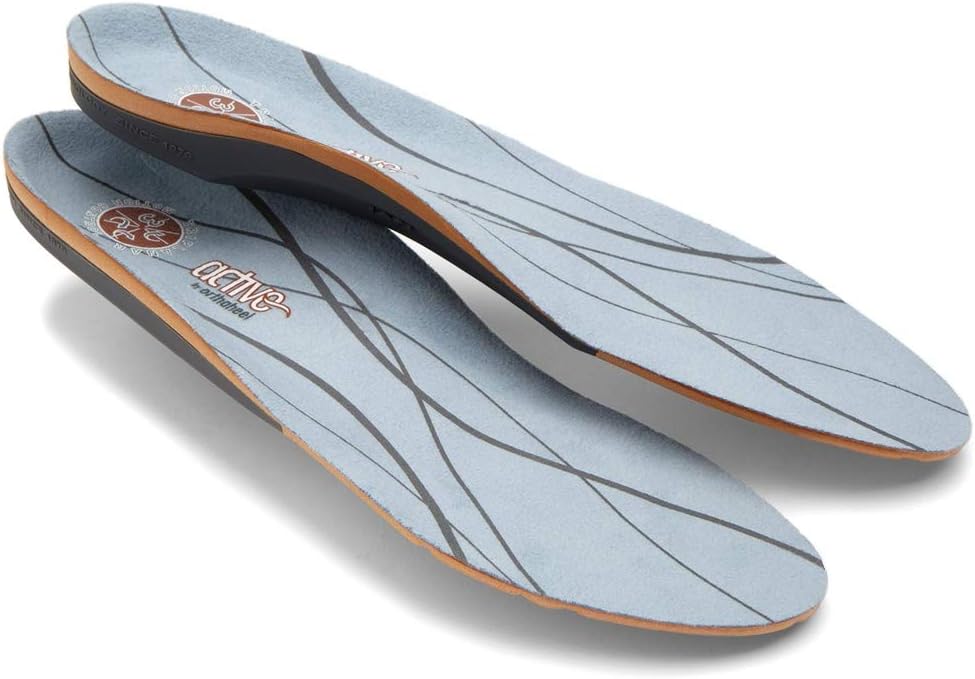
Vionic Active Orthotic
Best daily-wear option for patellofemoral pain. APMA Seal of Acceptance. The 4-degree rearfoot wedge controls pronation that produces knee valgus — a steady, comfortable daily driver.
Check Price on Amazon →
Tread Labs Pace
Best when softer insoles haven’t worked. APMA Seal of Acceptance. The extra-firm shell pushes back hard against severe pronation — reviewers specifically cite knee-pain reduction with prolonged wear.
Check Price on Amazon →Insoles cannot replace a clinical exam. If knee pain persists beyond 2–3 weeks of supportive footwear, or if you have swelling, locking, or instability, schedule an evaluation at Balance Foot & Ankle.
PowerStep Pinnacle — Our Clinical Top Pick for Knee Pain
For knee pain driven by overpronation, PowerStep Pinnacle is the insole we reach for first. Its dual-layer EVA over a semi-rigid polypropylene shell provides the medial arch support and heel control necessary to reduce internal tibial rotation at the source. The 17mm deep heel cup — deeper than most prefabs — locks the calcaneus in a neutral position, controlling the starting point of the pronation chain before it ever reaches the knee. In our clinic, we’ve seen patients with multi-year patellofemoral syndrome respond dramatically to PowerStep Pinnacle within the first 2-3 weeks of consistent use.
PowerStep Pinnacle — Best for Knee Pain from Overpronation
Semi-rigid shell + 17mm heel cup + dual-layer EVA. Controls the subtalar pronation that drives internal tibial rotation and knee valgus stress.
✅ Best for: Patellofemoral syndrome, IT band syndrome, flat-foot-driven knee pain, PFPS
❌ Not ideal for: High-arch cavus feet with supination, lateral compartment knee OA
Shop at Michigan Foot Doctors →For runners experiencing knee pain — particularly IT band syndrome and patellofemoral syndrome — CURREX RunPro offers three arch height variants (low, medium, high) to precisely match your foot type. Its dynamic arch profile flexes during the propulsive phase of running gait, providing motion control without restricting the foot’s natural mechanics. We recommend CURREX RunPro for any knee pain patient logging more than 15 miles per week.
CURREX RunPro — Best for Runners with Knee Pain
Dynamic arch in low/medium/high profiles. Designed for running biomechanics — controls pronation during the propulsive phase without restricting foot motion.
✅ Best for: Runner’s knee, IT band syndrome in runners, patellofemoral pain in athletes
❌ Not ideal for: Work/dress shoes, rigid flatfoot needing maximum posting
Shop at Michigan Foot Doctors →Red Flags — When Insoles Are Not Enough for Knee Pain
- Knee pain accompanied by significant swelling, warmth, or effusion (joint fluid)
- Locking or clicking of the knee that blocks full extension (possible meniscus tear)
- Giving way of the knee with weight-bearing (possible ligament instability)
- Knee pain that fails to improve after 6-8 weeks of proper orthotic use and activity modification
- Acute knee pain following trauma, fall, or sports injury
- Night pain that wakes you from sleep (possible bone pathology or inflammatory arthritis)
FAQ — Insoles for Knee Pain
Can foot insoles really help knee pain? Yes — when knee pain is driven by foot overpronation, orthotic insoles that control subtalar motion have strong evidence for reducing knee pain. Multiple RCTs have demonstrated 15-25% reduction in patellofemoral pain with medial-posting prefabricated orthotics. The key is identifying whether your knee pain has a pronation-driven biomechanical component — a podiatric gait assessment can confirm this.
Should I try orthotics before knee injections or surgery? In most cases, yes — orthotic insoles are low-risk, low-cost, and reversible. For knee pain without structural damage (no meniscus tear, no advanced OA, no ligament instability), a 6-8 week trial of proper orthotic use plus physical therapy should precede injections or surgical consideration. We’ve had many patients avoid surgery after addressing the underlying foot biomechanics.
What type of insole is best for runner’s knee? For patellofemoral syndrome (runner’s knee), a semi-rigid medial posting orthotic — PowerStep Pinnacle for daily use, CURREX RunPro for running-specific use — is the evidence-based first-line orthotic recommendation. Avoid soft foam gel insoles — they provide no motion control and do not address the internal tibial rotation that drives lateral patellar compression.
When should I see a podiatrist for knee pain related to foot issues? See a podiatrist if your knee pain is accompanied by flat feet, excessive foot pronation, or if knee pain worsens with barefoot walking. Dr. Biernacki performs a full kinetic chain assessment from the foot up, identifying whether your knee pain is being driven by foot and ankle mechanics. Same-day appointments at (810) 206-1402.
Knee Pain Driven by Your Feet?
Dr. Tom Biernacki performs a complete kinetic chain biomechanical assessment to determine if your foot mechanics are causing your knee pain — and which orthotic insole will correct it.
Book an Appointment →Howell: 4330 E Grand River Ave | Bloomfield Hills: 43494 Woodward Ave #208
Sources
- Barton CJ, et al. “Foot orthoses for patellofemoral pain syndrome.” Cochrane Database of Systematic Reviews. 2010.
- Nakagawa TH, et al. “Trunk, pelvis, hip, and knee kinematics, hip strength, and gluteal muscle activation during a single-leg squat in males and females with and without patellofemoral pain syndrome.” Journal of Orthopaedic & Sports Physical Therapy. 2012.
- Rodrigues P, et al. “Effectiveness of foot orthotics as an intervention for patellofemoral pain.” Journal of Athletic Training. 2013.
- Hinman RS, et al. “Lateral wedge insoles for medial knee osteoarthritis: 12 months’ randomised controlled trial.” BMJ. 2009.
Related Conditions & Resources
For more on related conditions and treatments:
- Flat feet in adults: causes & treatment
- Podiatrist-recommended orthotics
- Custom orthotics: complete guide
- What causes plantar fasciitis
- Foot pain when walking: causes by location
- Howell podiatrist office
- Bloomfield Hills podiatrist office
Need to see a podiatrist? Call (810) 206-1402 or book online. Same-week availability.
In-Office Treatment at Balance Foot & Ankle
If home treatment isn’t providing relief for your foot support, our podiatry team at Balance Foot & Ankle can help with same-day evaluations and advanced in-office care.
Same-day appointments available. (810) 206-1402
Related Conditions
Get Expert Care at Balance Foot & Ankle
Same-week appointments at our Howell and Bloomfield Hills offices. Board-certified podiatric surgeons. Most insurance accepted.
Same-Week Appointments in Howell & Bloomfield Hills
Three board-certified podiatric surgeons. 1,123+ five-star reviews. Most insurance accepted.
For a complete clinical overview: Custom Orthotics Michigan Guide — how orthotics work, cost, and Michigan providers
Comparing insole brands? See our head-to-head review: PowerStep vs Superfeet — Podiatrist Comparison — Michigan DPM breaks down arch support, durability, and best use case for each brand.
What is the difference between custom orthotics and store-bought insoles?
Custom orthotics are fabricated from a 3D scan or cast of your foot and corrected for your specific biomechanics. Over-the-counter insoles provide generic cushioning. Custom devices are more durable, precise, and clinically indicated for conditions like severe flat feet, plantar fasciitis, and diabetic foot offloading.
How long do custom orthotics last?
Quality custom orthotics typically last 2–5 years depending on activity level and materials. Shell wear and cushioning breakdown are signs replacement is needed. Annual podiatry check-ins can catch excessive wear before it affects your gait.

Dr. Tom Biernacki, DPM is a board-certified foot & ankle surgeon (ABFAS & ABPM) at Balance Foot & Ankle Specialists in Southeast Michigan. With over a decade of clinical experience, he specializes in heel pain, bunions, diabetic foot care, sports injuries, and minimally invasive surgery. Dr. Biernacki is a member of the APMA and ACFAS, and his patient education content on MichiganFootDoctors.com and YouTube has made him one of the most-followed foot & ankle educators on YouTube.