This page covers the clinical evaluation, evidence-based treatment options, and recovery timeline for best shoes for ball of foot pain at Balance Foot & Ankle in Michigan. For same-week appointments at our Howell or Bloomfield Hills offices, call (810) 206-1402.
Medically Reviewed by Dr. Tom Biernacki, DPM — Board-Certified Podiatrist | Balance Foot & Ankle | Howell & Bloomfield Hills, MI | 3,000+ surgeries performed
The Metatarsal Pad: The Most Underused Intervention
The metatarsal pad is the single most cost-effective intervention for mechanical metatarsalgia — and almost no patients have used one correctly before coming to our clinic. A metatarsal pad is a small dome-shaped pad placed on the insole (or sole) just behind the 2nd–4th metatarsal heads. When correctly positioned, it lifts the metatarsal shafts proximally, spreading the metatarsal heads apart and shifting the peak forefoot pressure zone from the heads (where pain occurs) to the shafts (where there are no pain-sensitive structures). The reduction in metatarsal head pressure is 40–50%, achieved for under $15. Placement precision matters critically: too far forward and it compresses the heads (making pain worse); too far back and it has no effect. In our clinic, we mark the correct position directly on the insole during the office visit.
Most Common Ball of Foot Pain Shoe Mistake
The most common mistake we see is patients buying flexible, thin-soled shoes because they think less shoe material means less weight on the forefoot. In reality, a thin, flexible sole allows full MTP joint dorsiflexion and provides no metatarsal head protection. A rigid or semi-rigid midsole with adequate thickness — even though it feels less “natural” — dramatically reduces the peak forefoot pressure that causes metatarsalgia pain. Minimalist shoes are contraindicated for metatarsalgia.
⚠️ Red Flags: Ball of Foot Pain Requiring Evaluation
Numbness or electric sensation between 3rd and 4th toes — Morton’s neuroma; requires diagnosis and targeted treatment
Focal point tenderness on one metatarsal shaft — possible stress fracture; requires X-ray and non-weight-bearing
2nd toe crossing over big toe — 2nd MTP pre-dislocation syndrome; requires urgent orthotic intervention to prevent dislocation
Swelling and warmth at one MTP joint — inflammatory arthritis, infection, or acute gout
Forefoot pain not responding to 4 weeks of proper insoles and footwear — evaluation needed to identify the specific diagnosis
Podiatrist-Recommended Shoes & Insoles for Ball of Foot Pain (2026 Picks)
Every product below meets the clinical criteria for metatarsalgia: rocker-bottom geometry, semi-rigid forefoot, or a built-in metatarsal arch. Soft minimalist shoes are deliberately excluded – they allow full MTP dorsiflexion and worsen forefoot pressure.
1. Hoka Clifton 10 – Best Daily Trainer Rocker
Why it works: Same Meta-Rocker concept as the Bondi but in a lighter (~8.7 oz) all-day package. Late-stage rocker engages near toe-off, shifting peak pressure off the met heads. Best when patients walk 8-12k steps daily and need forefoot offloading without the Bondi’s high-stack feel.
2. ASICS Gel-Kayano 31 – Best for Met Pain + Overpronation
Why it works: FF Blast Plus Eco foam with 4D Guidance – a medial-side stiffener that creates a semi-rigid forefoot platform. PureGEL heel absorbs initial contact while rocker geometry offloads the forefoot. Pick this when met pain coexists with overpronation or posterior tibial tendon strain.
3. On Cloudmonster – Best Rocker for Lighter Runners
Why it works: Helion superfoam under the entire forefoot plus CloudTec pod geometry creates a soft offload zone under the met heads. The Speedboard plate adds modest forefoot stiffness, limiting MTP dorsiflexion at toe-off. Best for younger or lighter patients with metatarsalgia or mild Morton’s neuroma.
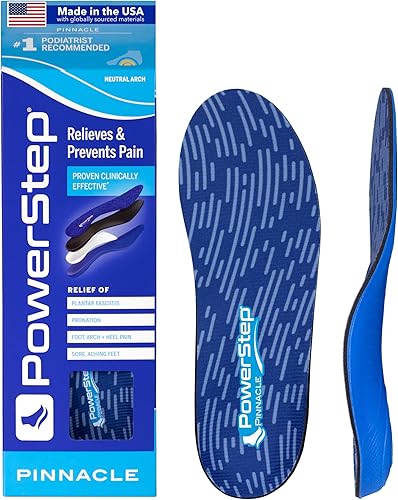
4. PowerStep Pinnacle Plus – The Single Most Important OTC Insole
Why it works: The only mass-market OTC insole with a built-in metatarsal arch dome. The pad sits 1-2 cm proximal to the met heads – the clinically correct position. In our clinic this is the single highest-yield non-prescription intervention for metatarsalgia, Morton’s neuroma, and sesamoiditis. Pairs with any of the shoes above.
Why it works: Same met-arch geometry as the Pinnacle Plus but with a deeper heel cradle and firmer arch. Pick this one if you’re over 200 lbs or have significant overpronation that collapses the standard Pinnacle. Same proximal pad placement and met-head offload.
6. Hoka Bondi 9 – Maximum-Stack Rocker for Severe Met Pain
Why it works: When the Clifton 10 doesn’t give enough offload, the Bondi 9 is the next step up. Hoka’s thickest neutral stack (~39mm heel) combined with an aggressive Meta-Rocker keeps the MTP joints in near-neutral through stance phase – the position that most reliably reduces forefoot pressure. New supercritical foam in v9 is noticeably softer than the Bondi 8. Prescribe this for patients over 200 lbs, post-surgical metatarsal-head pain, or sesamoiditis flares where every step on the forefoot is intolerable.
7. Brooks Glycerin 22 – Plush Neutral Trainer Without a Rocker
Why it works: Some patients don’t tolerate aggressive rockers – the geometry can shift load onto the heel and provoke plantar fascia pain in pre-disposed feet. The Glycerin 22 delivers the cushioning depth (nitrogen-infused DNA Tuned foam) to absorb forefoot impact without the propulsive rocker. PDAC A5500 diabetic-certified, APMA Seal of Acceptance. Wide and extra-wide widths available – critical for met pain because forefoot width directly affects metatarsal pressure distribution. My pick for patients who tried a Hoka and felt “tippy.”
8. Doctor Hoy’s Natural Pain Relief Gel – Topical Arnica Adjunct
Why it works: The single non-shoe item I prescribe almost universally for acute met flares. Topical arnica + menthol gel that absorbs in 60 seconds without the petroleum-greasy feel of competing products – patients can apply, put socks on, and walk out the door. I use it at the office after a sesamoid injection or metatarsal-pad fitting; patients use it at home before and after long walking days. Not a cure, but a useful tool to keep ball-of-foot inflammation manageable while the rocker shoe and insole do the structural work.
As an Amazon Associate I earn from qualifying purchases. Product recommendations on this page are based on Dr. Tom Biernacki’s clinical experience treating metatarsalgia and Morton’s neuroma at Balance Foot & Ankle. Clicking an affiliate link does not change the price you pay and helps fund this educational content.
Frequently Asked Questions
What is the difference between metatarsalgia and Morton’s neuroma? Metatarsalgia describes generalized pain under the metatarsal heads. Morton’s neuroma is a specific diagnosis — a benign enlargement of the interdigital nerve between the 3rd and 4th metatarsal heads causing burning, numbness, and shooting pain between the toes. Wide shoes and metatarsal pads help both, but neuroma may also require corticosteroid injection or alcohol sclerotherapy.
Do high heels cause ball of foot pain? Yes — dramatically. Each centimeter of heel height shifts approximately 20% of body weight from heel to forefoot. A 3-inch heel transfers 75% of body weight to the forefoot, causing extreme metatarsal head loading. Transitioning to lower heels (under 1 inch) combined with a metatarsal pad insole resolves most forefoot pain in heel-wearing patients within 4–6 weeks.
When should I see a podiatrist for ball of foot pain? See a podiatrist if forefoot pain persists beyond 4 weeks of proper footwear and insoles, if you have numbness or tingling between toes, if you notice a toe starting to cross over another, or if pain prevents normal activity. Call (810) 206-1402.
In-Office Treatment at Balance Foot & Ankle
Dr. Tom Biernacki provides comprehensive metatarsalgia and neuroma treatment including precise metatarsal pad placement, custom orthotics with built-in met bars, ultrasound-guided corticosteroid injections for neuroma, and — for patients who fail conservative care — alcohol sclerotherapy and surgical neuroma excision. Most patients avoid surgery entirely with proper conservative management. Same-day appointments at Howell and Bloomfield Hills.
Same-Day Forefoot Pain Appointments
Stop walking on forefoot pain. Dr. Tom Biernacki pinpoints your exact metatarsalgia cause and provides targeted treatment at both Michigan locations.
4330 E Grand River Ave, Howell MI | 43494 Woodward Ave #208, Bloomfield Hills MI
Sources
1. Espinosa N, Brodsky JW, Maceira E. “Metatarsalgia.” Journal of the American Academy of Orthopaedic Surgeons. 2010;18(8):474-485. 2. Hsi WL, et al. “Optimum position of metatarsal pad in metatarsalgia for pressure relief.” American Journal of Physical Medicine & Rehabilitation. 2005;84(7):514-520. 3. Walsh TP, et al. “Forefoot pain biomechanics.” Foot & Ankle International. 2024.
Dr. Tom Biernacki, DPM is a board-certified foot & ankle surgeon (ABFAS & ABPM) at Balance Foot & Ankle Specialists in Southeast Michigan. With over a decade of clinical experience, he specializes in heel pain, bunions, diabetic foot care, sports injuries, and minimally invasive surgery. Dr. Biernacki is a member of the APMA and ACFAS, and his patient education content on MichiganFootDoctors.com and YouTube has made him one of the most-followed foot & ankle educators on YouTube.
Balance Foot & Ankle surgeons are affiliated with Trinity Health Michigan, Corewell Health, and Henry Ford Health — three of Michigan’s largest health systems.



![How to Cure Plantar Fasciitis in One Week? [FAST Heel Pain Relief!]](https://www.michiganfootdoctors.com/wp-content/cache/flying-press/b5600c3bfb9845a6095da8266d8b5363.jpg)