

This page covers the clinical evaluation, evidence-based treatment options, and recovery timeline for best shoes for sciatica at Balance Foot & Ankle in Michigan. For same-week appointments at our Howell or Bloomfield Hills offices, call (810) 206-1402.

Medically Reviewed by Dr. Tom Biernacki, DPM — Board-Certified Podiatrist, Balance Foot & Ankle | Howell & Bloomfield Hills, MI | 4.9 ★ (1,123 reviews) | 3,000+ surgeries performed
Quick Answer: Best Shoes for Sciatica
The best shoes for sciatica provide even, level support with mild heel elevation (8–12mm), motion control to prevent the pelvic tilting from overpronation that aggravates lumbar nerve compression, and enough cushioning to reduce impact-driven spinal loading. Sciatica from lumbar disc herniation or piriformis syndrome is worsened by asymmetric gait, leg length discrepancy, and the excessive lumbar extension caused by flat, unsupportive shoes. Our podiatrist picks address the foot-spine kinetic chain directly.
Sciatica — pain, numbness, or electric sensation radiating from the lower back down the leg along the sciatic nerve distribution — is primarily a spinal and hip condition, not a foot condition. But what you put on your feet profoundly affects the biomechanical environment of the lumbar spine that is compressing the sciatic nerve. Overpronation causes internal tibial rotation → femoral internal rotation → anterior pelvic tilt → increased lumbar lordosis → increased compressive loading on lumbar discs and nerve roots. Footwear that corrects this chain can meaningfully reduce sciatic irritation, particularly in patients whose sciatica is related to posture and gait mechanics rather than acute herniation.
How Foot Mechanics Affect Sciatica
The foot-spine kinetic chain is a well-documented phenomenon in musculoskeletal medicine. When the foot overpronates (rolls inward), the tibia internally rotates, the femur internally rotates at the hip, the pelvis tilts anteriorly, and lumbar lordosis increases — all as a compensatory chain reaction. This increased lumbar lordosis reduces the diameter of the intervertebral foramina through which the sciatic nerve roots exit, increasing the likelihood that an already-compromised nerve root will be irritated with every step. A 2018 study in BMC Musculoskeletal Disorders confirmed that patients with flat feet had significantly higher rates of low back pain — the mechanism that drives sciatica exacerbation in pronating patients.
Top Shoes for Sciatica — Podiatrist Recommended
Key Features for Sciatica-Friendly Shoes
- Stability or motion control category: For patients with overpronation driving their lumbar mechanics, a stability shoe with medial arch support interrupts the overpronation → internal rotation → pelvic tilt chain at its foundation. This is the most biomechanically impactful footwear change for sciatica related to gait mechanics.
- 8–12mm heel-to-toe drop: Mild heel elevation reduces Achilles tension and posterior chain tightness that contributes to anterior pelvic tilt. Zero-drop shoes that demand full ankle dorsiflexion can increase posterior chain tension and aggravate the pelvic mechanics that compress sciatic nerve roots.
- Firm, cushioned midsole: Reduces impact transmission through the axial skeleton. Every step sends a compressive wave up the kinetic chain; a firm-but-cushioned midsole absorbs a meaningful fraction of this force before it reaches the lumbar spine.
- Even, level footbed: Any footwear that creates a functional leg length discrepancy — worn heels on one side, higher platforms on one side — creates a pelvic obliquity that can significantly irritate sciatic nerve roots. Replace worn shoes promptly.
- Removable insole for orthotic use: PowerStep Pinnacle provides the arch support and heel stabilization to correct the pronation component of sciatica-aggravating gait mechanics.
PowerStep Orthotics for Sciatica
In patients whose sciatica is worsened by standing or walking (as opposed to purely positional or at-rest symptoms), adding a PowerStep Pinnacle orthotic to a stability shoe is the most impactful conservative intervention at the foot level. The orthotic corrects the arch collapse and heel misalignment that drives the gait mechanics contributing to lumbar nerve root irritation.
PowerStep Pinnacle — For Gait-Related Sciatica
- Semi-rigid arch support — corrects overpronation driving lumbar pelvic tilt
- Deep heel cup — stabilizes calcaneal alignment reducing tibial internal rotation
- Use in stability shoes with 8-12mm drop for maximum kinetic chain correction
- Not Ideal For: sciatica from acute disc herniation, high-arch feet, piriformis syndrome without pronation component
→ Get PowerStep Pinnacle from our practice shop (30% off retail)
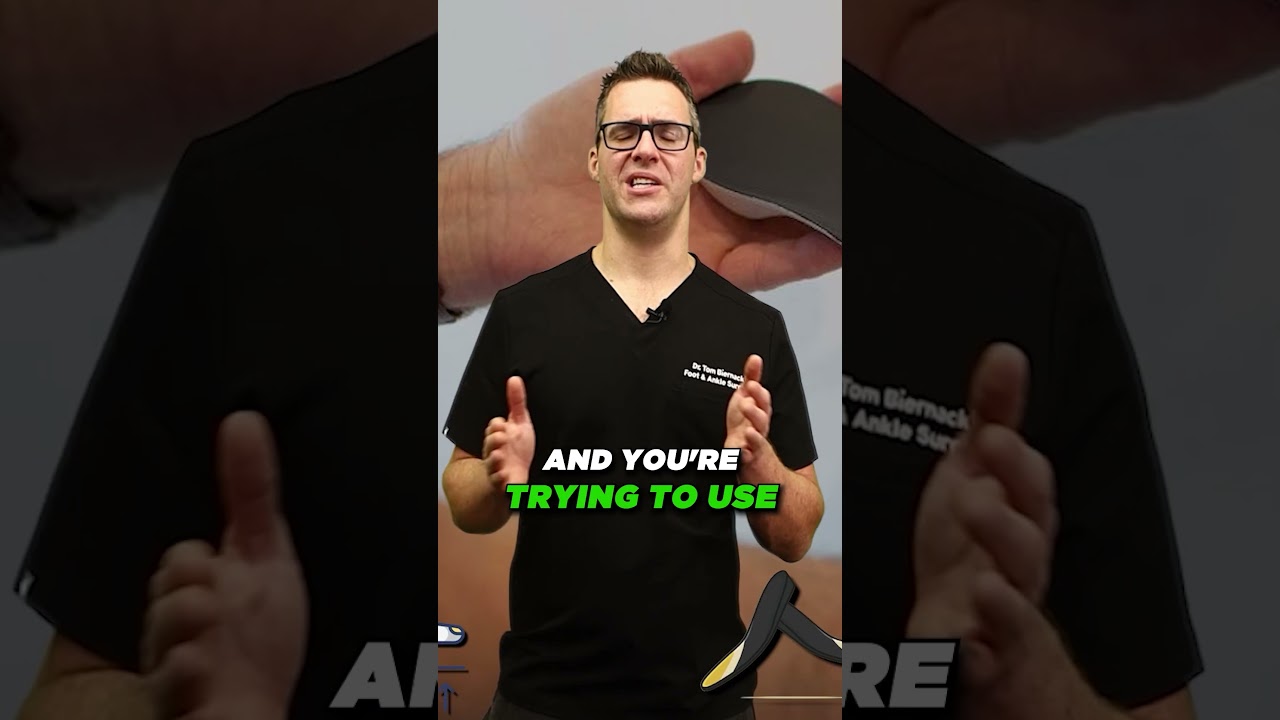
Most Common Shoe Mistake with Sciatica
The most damaging shoe mistake for sciatica is wearing unsupportive flat shoes — ballet flats, flip-flops, or zero-drop minimalist shoes — that maximize overpronation and posterior chain tightness simultaneously. Both factors drive the pelvic mechanics that aggravate lumbar nerve compression. The second most common mistake: wearing worn-out shoes with uneven heel wear that creates a functional leg length discrepancy. A heel that’s worn down by even 5mm on one side creates enough pelvic obliquity to significantly worsen sciatic nerve root irritation.
⚠️ Important: When Sciatica Needs Spine — Not Foot — Care
- Sciatica with bowel or bladder changes — seek emergency care immediately (cauda equina)
- Progressive leg weakness or foot drop — urgent neurological evaluation
- Sciatica at rest, at night, or unrelated to position — rule out non-mechanical cause
- Bilateral leg symptoms — lumbar spinal stenosis or central disc herniation
Shoe changes help sciatica aggravated by gait mechanics — but acute nerve compression from disc herniation requires spine care coordination with your physician.
Can shoes cause sciatica?
Shoes don’t directly cause sciatica — the underlying cause is lumbar disc pathology, piriformis syndrome, or spinal stenosis. But unsupportive shoes that allow overpronation worsen the biomechanical environment that aggravates sciatic nerve compression. Improving foot mechanics with stability shoes and orthotics is one component of a comprehensive sciatica management approach.
What type of shoe is best for sciatica?
Stability shoes with 8–12mm heel drop, firm midsoles, and motion control are best for sciatica with gait mechanical contribution. Brooks Adrenaline GTS, ASICS GT-2000, and New Balance 860 consistently provide the pronation control needed to reduce the lumbar loading chain. Add PowerStep Pinnacle for maximum arch correction.
Gait Analysis for Back & Sciatic Pain
Same-day appointments · Dr. Tom Biernacki DPM · 4.9 ★ (1,123 reviews)
Book Your AppointmentOr call: (810) 206-1402
Howell: 4330 E Grand River Ave · Bloomfield Hills: 43494 Woodward Ave #208
Sources
- Cailliet R. “Foot and Ankle Pain.” 3rd ed. FA Davis Company. 1997.
- Kosashvili Y, Fridman T, Backstein D, et al. “The correlation between pes planus and anterior knee or intermittent low back pain.” Foot & Ankle International. 2008;29(9):910-913.
- Menz HB, Dufour AB, Riskowski JL, et al. “Association of planus foot posture and pronated foot function with foot pain.” Arthritis Care & Research. 2013;65(12):1991-1999.
Related Conditions & Resources
For more on related conditions and treatments:
- Flat feet in adults: causes & treatment
- Podiatrist-recommended orthotics
- Foot pain when walking: causes by location
- Peripheral neuropathy in feet
- Tarsal tunnel syndrome causes
- Howell podiatrist office
- Bloomfield Hills podiatrist office
Need to see a podiatrist? Call (810) 206-1402 or book online. Same-week availability.
How long do these shoes last?
Quality running shoes last 300-500 miles. Daily walking shoes last 9-12 months. Replace when the midsole feels soft or your symptoms return.
Should I add insoles?
Yes if you have plantar fasciitis or overpronation. Powerstep Pinnacle or a custom orthotic improves results. Healthy feet often do fine with the stock insole.
Are expensive shoes worth it?
Beyond about $130 most extra cost is materials and aesthetics. Match the shoe to your foot type, not budget. The right $80 stability shoe beats the wrong $250 maximalist shoe.
Related Conditions
Doctor Hoy’s Natural Pain Relief Gel
Natural topical pain relief I use in our clinic. Arnica + camphor formula — apply directly to the area 3–4x daily. ($20–25)
Shop Doctor Hoy’s →Footwear & Foot Care Products Guide (American Podiatric Medical Association)
In-Office Treatment at Balance F
oot & AnkleIf home treatment isn’t providing relief for your foot pain and footwear, our podiatry team at Balance Foot & Ankle can help with same-day evaluations and advanced in-office care.
Same-day appointments available. (810) 206-1402
Ready to get relief? Book an appointment at Balance Foot & Ankle or call (810) 206-1402. Same-day appointments available in Howell & Bloomfield Hills, MI.
Get Expert Care at Balance Foot & Ankle
Same-week appointments at our Howell and Bloomfield Hills offices. Board-certified podiatric surgeons. Most insurance accepted.
Same-Week Appointments in Howell & Bloomfield Hills
Three board-certified podiatric surgeons. 1,123+ five-star reviews. Most insurance accepted.

Dr. Tom Biernacki, DPM is a board-certified foot & ankle surgeon (ABFAS & ABPM) at Balance Foot & Ankle Specialists in Southeast Michigan. With over a decade of clinical experience, he specializes in heel pain, bunions, diabetic foot care, sports injuries, and minimally invasive surgery. Dr. Biernacki is a member of the APMA and ACFAS, and his patient education content on MichiganFootDoctors.com and YouTube has made him one of the most-followed foot & ankle educators on YouTube.