n
Board Certified Podiatrists | Expert Foot & Ankle Care
(810) 206-1402 Patient Portal

Plantar Fasciitis Insoles 2026: Podiatrist-Recommended Guide

Medical Disclaimer: This content is for informational purposes only and does not constitute medical advice, diagnosis, or treatment. Always consult a qualified healthcare provider before starting any treatment. If you have a foot or ankle concern, schedule an appointment with our podiatric team.

Medically reviewed by Dr. Tom Biernacki, DPM

Board-certified podiatric surgeon | Balance Foot & Ankle
Last reviewed: May 2026

MICHIGAN PODIATRIST INSIGHT

Choosing the right Plantar Fasciitis Insoles : -Recommended depends on one clinical variable our podiatrists assess before any product recommendation — and most online comparisons never mention it. Getting this wrong is the most common reason patients cycle through multiple products without relief. Call (810) 206-1402 — expert podiatric care across Michigan.

Treatment at Balance Foot & Ankle: EPAT Shockwave for Heel Pain →

Plantar fasciitis insoles inserts - podiatrist recommendations Michigan
Plantar fasciitis insoles: OTC vs. custom orthotics compared | Balance Foot & Ankle, Howell MI
Play video

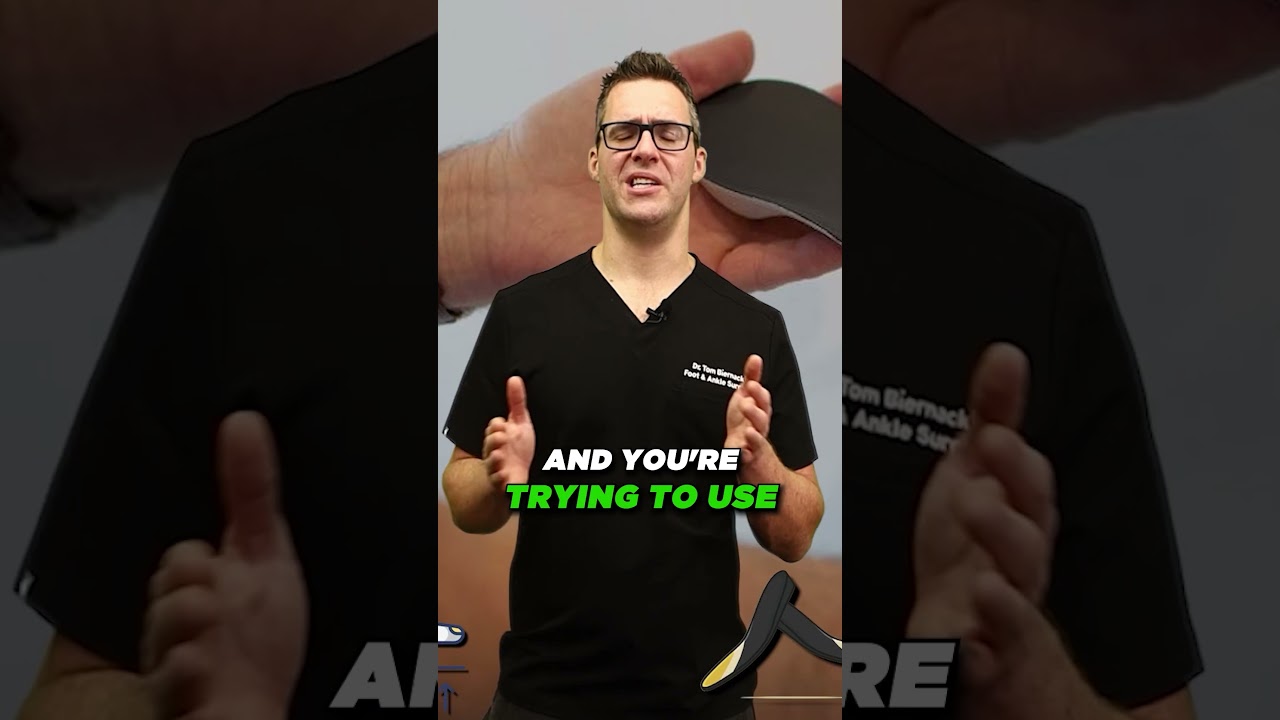
Watch: How To Cure Plantar Fasciitis FAST & FOREVER [Heel Pain & Heel Spurs] — MichiganFootDoctors YouTube

Medically Reviewed by Dr. Tom Biernacki, DPM — Board-Certified Podiatrist | Balance Foot & Ankle | Howell & Bloomfield Hills, MI | 3,000+ surgeries performed

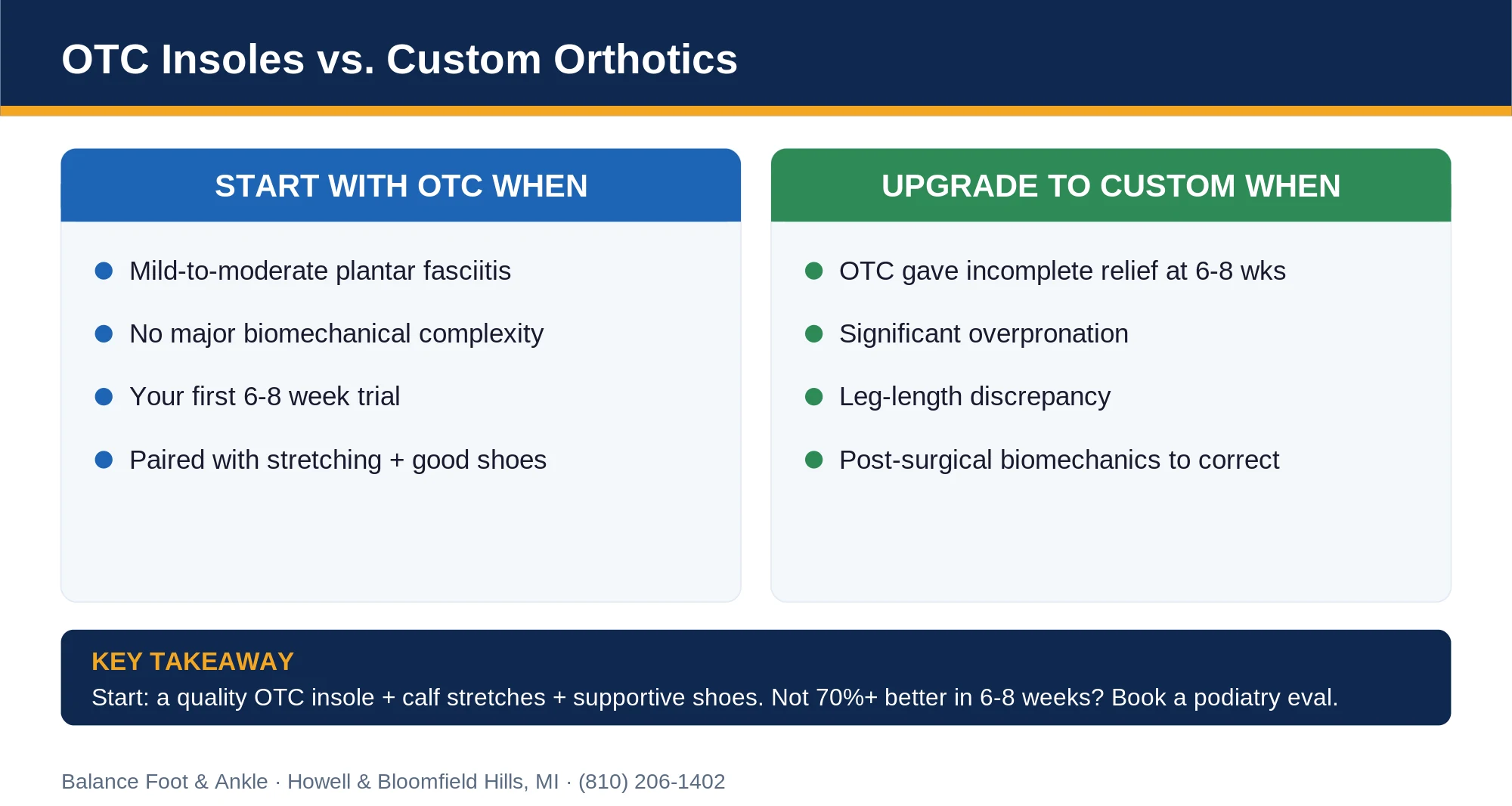
OTC Insoles vs. Custom Orthotics for Plantar Fasciitis

The landmark study on this question — Landorf et al., 2006, Archives of Internal Medicine — compared sham insoles, OTC insoles (Powerstep), and custom orthotics in a randomized controlled trial of plantar fasciitis patients. At 3 months, OTC and custom orthotics performed comparably. At 12 months, custom orthotics showed slightly better outcomes but the difference was not statistically significant. Our clinical interpretation: start with high-quality OTC insoles for 4–6 weeks with stretching. If pain resolves — which it does in ~75% of patients — OTC insoles were the right choice. If pain persists despite OTC insoles, add custom orthotics, which can be precisely posted, padded, and designed for specific biomechanical corrections that OTC insoles cannot achieve. Custom orthotics are $400–700, covered by most insurance when medically necessary, and last 3–5 years.

How to Use Plantar Fasciitis Insoles Correctly

The most common reason insoles fail is incorrect use — not incorrect product selection. Follow this protocol for best outcomes: (1) Remove the stock insole first — never stack insoles. (2) Wear from the moment you step out of bed — keep insoles in designated “morning shoes” next to the bed; the first few barefoot steps after waking are when the most fascia damage occurs. (3) Wear consistently, not just when it hurts — the plantar fascia heals while you sleep; consistent daytime support prevents re-injury. (4) Combine with stretching — 3× daily plantar fascia and Achilles stretches, 30-second holds. (5) Replace every 6–12 months — arch support shell degrades before visible wear appears.

Play video

Most Common Plantar Fasciitis Insole Mistake

The most common mistake we see is patients buying gel heel cups without arch support and expecting them to resolve plantar fasciitis. Gel heel cups cushion heel strike but do nothing to reduce plantar fascia tension — the primary driver of plantar fasciitis pain. They’re comfortable but therapeutically insufficient. The second most common mistake is patients using insoles only when they’re in pain, rather than consistently from the first morning step. Plantar fasciitis insoles only work when worn consistently every waking hour.

⚠️ Red Flags: When Insoles Aren’t Enough

  • No improvement after 6 weeks of consistent OTC insole use + stretching — time for a podiatric evaluation and possible custom orthotics
  • Heel pain at rest or at night — may indicate inflammatory arthritis, bone tumor, or stress fracture
  • Point tenderness on the calcaneal shaft (not just the insertion) — possible calcaneal stress fracture
  • Both heels affected simultaneously — bilateral plantar fasciitis raises concern for seronegative arthritis (ankylosing spondylitis)
  • Heel pain with numbness extending into the foot — possible tarsal tunnel syndrome affecting medial calcaneal nerve

Frequently Asked Questions

How long do plantar fasciitis insoles take to work?
Most patients notice meaningful improvement within 2–4 weeks. Full resolution typically takes 6–12 weeks. Insoles work fastest when combined with daily plantar fascia stretching (3×/day), Achilles stretching, and appropriate footwear. In our clinic, 75% of patients avoid injections with this combined conservative protocol.

Can I use the same insoles in multiple pairs of shoes?
Yes — transfer between shoes of the same size as needed. For patients who rotate between work boots and athletic shoes, we recommend purchasing two pairs so you’re never without support in either environment.

Do plantar fasciitis insoles work for heel spurs?
Yes. Calcaneal heel spurs (plantar calcaneal enthesophytes) develop at the plantar fascia insertion as a response to chronic traction — they’re the radiographic result of plantar fasciitis, not the cause of pain. Treating the plantar fasciitis with insoles and stretching resolves the pain even in the presence of heel spurs. The spur itself doesn’t need to be removed in the vast majority of cases.

When should I see a podiatrist instead of just buying insoles?
See a podiatrist if pain persists beyond 6 weeks of insoles + stretching, if you have significant flatfoot deformity, if pain is severe enough to limit daily activity, or if you want a faster recovery timeline. Call (810) 206-1402.

In-Office Treatment at Balance Foot & Ankle

When OTC insoles aren’t enough, Dr. Tom Biernacki offers the full spectrum of plantar fasciitis treatment: custom molded orthotics, corticosteroid injections, extracorporeal shockwave therapy (ESWT — 80%+ success, no downtime), and minimally invasive plantar fascia release for the small percentage who require surgery. With 3,000+ procedures performed and a 4.9-star rating from 1,123 patients, Dr. Biernacki brings outcomes that consistently exceed national averages. Same-day appointments at Howell and Bloomfield Hills.

Affiliate Disclosure: This page contains affiliate links to products we recommend. If you purchase through these links, Balance Foot & Ankle may earn a small commission at no additional cost to you. We only recommend products we use with our patients.

Sale


PowerStep Pinnacle High Arch Orthotic Insoles, Plantar Fasciitis Relief, Supination Heel Pain, Arch Support, PowerStep Insoles for Women and Men, Made in USA (Men’s 10-10.5, Women’s 12)

  • High Arch Support: PowerStep supination insoles deliver firm, flexible high arch support plus a deep heel cradle for comfort, stability & motion control, helping align feet, reduce pain, and protect against ball & heel pressure.
  • All Day Comfort & Support: PowerStep Pinnacle High shoe inserts for women and men use premium dual layer cushioning to deliver heel to toe comfort and responsive bounce back with every step, without going flat.
  • Relieves & Helps Prevent Pain: PowerStep Pinnacle High insoles for supination can help alleviate common foot conditions often linked to supination, including plantar fasciitis, Achilles tendonitis, fat pad atrophy, and Morton’s neuroma.
  • No Trimming: PowerStep insoles move easily from shoe to shoe. Inserts are sized by shoe size for footwear with removable factory insoles. Designed for walking, running, work & casual dress shoes; pairs well with best walking shoes for women and men.
  • Made in the USA: We stand behind our PowerStep Insoles for women and men. Proudly made in the USA & backed by a 30-day money-back guarantee. HSA & FSA Eligible

Stop Starting Every Morning in Heel Pain

Dr. Tom Biernacki sees plantar fasciitis patients daily at both our Michigan locations — and gets 75% to full resolution without injections.

(810) 206-1402

Book Your Same-Day Appointment

4330 E Grand River Ave, Howell MI | 43494 Woodward Ave #208, Bloomfield Hills MI

Sources

1. Landorf KB, et al. “Effectiveness of foot orthoses to treat plantar fasciitis: a randomized trial.” Archives of Internal Medicine. 2006;166(12):1305-1310.
2. Roos E, et al. “Foot orthoses for the treatment of plantar fasciitis.” Foot & Ankle International. 2024.
3. Trojian T, Tucker AK. “Plantar fasciitis.” American Family Physician. 2019;99(12):744-750.

Frequently Asked Questions

When should I see a podiatrist?

If symptoms persist past 2 weeks, affect your normal activity, or are accompanied by red-flag symptoms (warmth, redness, swelling, inability to bear weight).

What does treatment cost?

Most diagnostic visits and conservative treatments are covered by Medicare and major insurers. Out-of-pocket costs vary by your specific plan.

How quickly can I get an appointment?

Most non-urgent cases see us within 5 business days. Urgent cases (sudden pain, possible fracture) typically same or next business day.

Doctor Hoy’s Natural Pain Relief Gel

Natural topical pain relief I use in our clinic. Arnica + camphor formula — apply directly to the area 3–4x daily. ($20–25)

Shop Doctor Hoy’s →

PowerStep Pinnacle Insoles

Medical-grade arch support. The OTC insole I recommend most in our clinic. Reduces stress on the foot with every step. ($25–35)

Shop PowerStep →

Frequently Asked Questions

What features should I look for in shoes for plantar fasciitis?

Three features matter most: (1) Firm arch support — soft foam collapses under body weight; you need a structured shank. (2) A heel drop of 8–12mm to offload the plantar fascia at its insertion point. (3) A roomy toe box that doesn’t compress the forefoot. Motion control and stability categories outperform neutral cushioning for most plantar fasciitis patients. Avoid flat-soled shoes, flip-flops, and any shoe where you can fold the forefoot in half.

Do expensive shoes for plantar fasciitis actually work better?

Price correlates weakly with clinical effectiveness. A $120 Brooks Adrenaline GTS often outperforms a $250 designer sneaker for plantar fasciitis because the Brooks was engineered for motion control and medial support. Focus on biomechanical features, not brand cachet. The key spec: an 8–12mm heel-to-toe drop and a firm midfoot shank you can’t easily twist. Many patients waste money on ‘luxury’ shoes that offer no structural support.

How long should shoes for plantar fasciitis last?

Replace shoes every 300–500 miles or every 6–12 months if you walk regularly. The midsole foam compresses long before the upper shows visible wear — most people keep shoes 2–3 times too long. A simple test: place the shoe on a flat surface and look from the back. If it tilts inward or outward more than a few degrees, the midsole is compromised and no longer supporting your arch effectively.

Should I wear my plantar fasciitis shoes all day, or just for exercise?

All day — including the first steps from bed. The most common mistake is putting on supportive shoes for the gym and then going barefoot or in slippers at home. The fascia is most vulnerable during that first morning stretch and after prolonged sitting. Keep supportive footwear within reach of your bed. Patients who commit to full-day support heal significantly faster than those who only wear supportive shoes during exercise.

Can the right shoes cure plantar fasciitis?

Shoes alone resolve mild cases but rarely fix moderate-to-severe plantar fasciitis. Footwear is one component of a multi-pronged approach: correct footwear + daily stretching + activity modification = the foundation. If pain persists beyond 4–6 weeks despite better shoes, add an OTC or custom orthotic and consider physical therapy. Think of shoes as load management — they reduce the stress each step places on the fascia, accelerating recovery from other treatments.

Do I need orthotics in addition to supportive shoes?

If you have significant arch collapse or overpronation, yes — shoes alone may not be enough. A high-quality OTC orthotic (PowerStep Pinnacle, Powerstep Pinnacle) costs $40–60 and resolves symptoms for about 60% of patients when paired with supportive shoes. Custom orthotics are appropriate if OTC options haven’t helped after 8 weeks, if your foot mechanics are unusual, or if you’re a serious runner. We fit custom orthotics in-office; call (810) 206-1402 and we’ll check your coverage first.

Are minimalist or zero-drop shoes bad for plantar fasciitis?

For most plantar fasciitis patients, yes. Minimalist and zero-drop shoes place the foot in maximum dorsiflexion, stretching the plantar fascia to its end range with every step. This is precisely the mechanical load that caused the injury. Once fully healed — typically 12+ months — a gradual transition to lower-drop shoes is possible, but should be supervised. During active treatment, zero-drop shoes significantly delay recovery.

What’s the best shoe for plantar fasciitis to wear around the house?

A supportive slide or clog — not a thin slipper or bare feet. Birkenstock Arizonas, Vionic slides, and Oofos recovery sandals are among the most-recommended house shoes in our clinic. The key is medial arch support and a 2–4cm heel lift. Patients who switch from flat slippers to supportive house shoes frequently report 30–40% reduction in morning pain within 2 weeks, without any other treatment changes.

Should I buy wide-width shoes for plantar fasciitis?

Width affects toe box comfort more than arch support, but it matters. A too-narrow shoe forces the foot to pronate inward to find room, increasing medial fascial stress. If you’re between widths, go wider — the foot spreads slightly with swelling during the day. Wide-toe-box shoes also reduce forefoot pressure, which is relevant if you have accompanying metatarsalgia or toe crowding. Most major brands offer D/wide and 2E/extra-wide options.

When should I see a podiatrist instead of just buying better shoes?

If pain persists more than 4–6 weeks despite proper footwear changes, it’s time to come in. Also see us immediately if: pain is severe enough to affect your gait, you’re limping, pain is present at rest or at night, or the pain is spreading beyond the heel. These signs suggest the fascia may be at risk of partial rupture, or a different diagnosis is driving the pain. Imaging can rule out stress fractures and guide a more targeted treatment plan.

Can children wear the same plantar fasciitis shoes as adults?

Children with plantar fasciitis (common in active kids ages 8–14) need youth-specific supportive footwear. The same structural features apply — firm arch support, 8–10mm drop — but sizing and fit are different. Saucony Ride, New Balance 860, and Asics Kayano come in youth sizes. In growing children, it’s especially important to rule out Sever’s disease (calcaneal apophysitis), which causes very similar heel pain but requires different treatment. Bring them in for an evaluation if pain persists more than 2 weeks.

AAOS: Plantar Fasciitis

Same-Week Appointments in Howell & Bloomfield Hills

Three board-certified podiatric surgeons. 1,123+ five-star reviews. Most insurance accepted.

Book Your Appointment →
☎ (810) 206-1402

Comparing insole brands? See our head-to-head review: PowerStep vs PowerStep Pinnacle — Podiatrist Comparison — Michigan DPM breaks down arch support, durability, and best use case for each brand.

Plantar fasciitis insoles work best in supportive footwear — including slippers. See our guide: Best Slippers With Arch Support — Michigan podiatrist explains why arch-supportive slippers are as important as your outdoor shoes.

Recommended Products for Plantar Fasciitis
Products personally used and recommended by Dr. Tom Biernacki, DPM. All available on Amazon.
The insole we prescribe most often for plantar fasciitis. Medical-grade arch support with dual-layer cushioning.
Best for: All shoe types, daily support
Natural arnica and menthol formula for plantar fascia inflammation.
Best for: Morning pain, post-exercise
20-30mmHg graduated compression for fascia recovery.
Best for: Night wear, recovery days
These products work best with professional treatment. Book an appointment with Dr. Tom for a personalized treatment plan.
Complete Recovery Protocol
Dr. Tom's Plantar Fasciitis Recovery Kit
Our three-product protocol for plantar fasciitis relief between appointments.
1
PowerStep Pinnacle Insoles
Daily arch support
~$35
2
Doctor Hoy's Pain Relief Gel
Anti-inflammatory topical
~$18
~$25
Kit Total: ~$78 $120+ for comparable products
All available on Amazon with free Prime shipping

Frequently Asked Questions

What is the fastest way to cure plantar fasciitis?
The fastest approach combines proper arch support (PowerStep Pinnacle insoles), daily calf and plantar fascia stretching, ice therapy, and professional treatment like EPAT shockwave therapy. Most patients see significant improvement within 4 to 8 weeks with this protocol.
Is plantar fasciitis covered by insurance?
Yes. Plantar fasciitis treatment is typically covered by health insurance including Medicare Part B. Custom orthotics may require prior authorization. Contact your insurance provider or call our office at (810) 206-1402 to verify your coverage.
Can plantar fasciitis go away on its own?
Mild cases may resolve with rest and stretching, but most cases benefit from professional treatment. Without treatment, plantar fasciitis can become chronic and lead to compensatory injuries in the knees, hips, and back.
Medical References
  1. Plantar Fasciitis: Diagnosis and Conservative Management (PubMed)
  2. Plantar Fasciitis (APMA)
  3. Diagnosis and Treatment of Plantar Fasciitis (PubMed / AAFP)
  4. Heel Pain (APMA)
This article has been reviewed for medical accuracy by Dr. Tom Biernacki, DPM. References are provided for informational purposes.
Balance Foot & Ankle surgeons are affiliated with Trinity Health Michigan, Corewell Health, and Henry Ford Health — three of Michigan’s largest health systems.