
Medically reviewed by Dr. Tom Biernacki, DPM — Board-certified podiatric surgeon | Balance Foot & Ankle | Last reviewed: May 2026
Trail running injuries account for a disproportionate share of the ankle fractures, stress fractures, and tendon injuries I see in my Howell and Bloomfield Township offices. Most of them are preventable with the right shoe for the terrain and the runner’s foot type. Trail running demands far more from footwear than road running — the shoe needs to grip uneven surfaces, protect against rock impact, stabilize the ankle on lateral terrain, and still cushion the foot over long distances. In this guide I’ll break down what actually matters, what doesn’t, and rank the best options for 2026.
The most important clinical decision with Best Trail Running Shoes 2026 isn’t which treatment to start with — it’s identifying the correct subtype. That changes everything. Call (810) 206-1402.
What Makes a Trail Running Shoe Clinically Sound
Outsole Lug Depth and Pattern
Lug depth determines grip on soft terrain (mud, loose dirt, wet roots). Deeper lugs (5–6mm) excel on muddy trails; shallower multi-directional lugs (3–4mm) handle hard-packed trails and technical rock better. The mistake I see most: using a muddy-terrain shoe on hard-packed Michigan trails — the tall lugs create instability on firm surfaces, increasing lateral ankle sprain risk.
Rock Plate Protection
A rock plate — a rigid nylon or carbon fiber layer embedded between midsole layers — protects against the sharp, concentrated impact of stepping on rocks or roots. Without a rock plate, repeated rock strikes cause bruising of the fat pad under the metatarsal heads and can trigger stress reactions in the metatarsals. I see sesamoiditis and second metatarsal stress fractures frequently in trail runners who skip rock plate protection.
Ankle and Rearfoot Stability
Trail running demands lateral stability that road shoes don’t need — the foot encounters angled surfaces, roots, and rocks that create inversion forces (the mechanism of ankle sprains). A firm heel counter, wide midsole base, and grippy outsole that extends up the outer sidewall all contribute to lateral stability. For runners with a history of ankle sprains or chronic ankle instability, I specifically look for shoes with extended lateral heel wrapping.
Toe Box Width
Downhill trail running pushes the foot forward into the toe box with every step — especially on sustained descents. Your toes need room to spread and absorb the load. A narrow trail shoe causes subungual hematomas (black toenails from nail trauma) and forefoot bruising. I recommend sizing up a half size or choosing a wider option for any trail shoe used on hilly terrain.
Best Trail Running Shoes 2026: Top Picks
Top trail pick — the Salomon Speedcross, the benchmark aggressive-grip trail shoe (4.6 stars). Verified in stock:
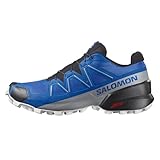
- BEST FOR: For the next-generation Speedcross men’s trail running shoes, we revisited the essence of what made the original Speedcross legendary. By enhancing its grip and introducing a more dynamic upper, we've set a new standard for performance and fit. With improved stability and a sleek, refined design, the Speedcross establishes a new benchmark in trail footwear. Ideal for trail running in mixed and muddy terrain.
- PROTECTIVE UPPER: Completely welded upper with disassociated Sensifit arms to move more naturally with your foot. Anti-debris mesh upper keeps trail debris and mud out. Highly durable ripstop fabric construction won’t tear or rip and is abrasion-resistant, ideal for use through varied and overgrown terrains.
- MUD CONTRAGRIP: Deep, sharp lugs and a high-adhesion compound deliver maximum grip on soft, loose, and rugged terrain for premium adhesion/traction with confidence. Ideal for navigating diverse terrain, including rocky trails, muddy paths, and loose gravel on a wide range of outdoor trail terrain.
- STABILITY: The Speedcross features a specialized heel unit that cradles your heel for optimal support, promoting a clean foot strike and enhancing stability throughout your stride for unmatched stability and reliability on any terrain.
- SECURE FIT: Featuring Sensifit construction and a Quicklace single pull and stowable closure for a precise optimal foothold, and welded, foot-hugging comfort.
As an Amazon Associate, Balance Foot and Ankle earns from qualifying purchases. Product links are affiliate links and we may earn a commission at no extra cost to you. This does not influence our clinical recommendations. Last update on 2026-09-22 / Images from Amazon Product Advertising API
1. Hoka Speedgoat 6 — Best Overall Trail Running Shoe 2026
The Speedgoat 6 earns the top spot through the combination that matters most in trail running: maximum cushioning for the foot, aggressive enough grip to handle technical terrain, and enough stability to protect runners with imperfect form. The CMEVA midsole provides consistent cushioning over long miles, the Vibram Megagrip outsole with 5mm lugs handles everything from hardpack to light mud, and the wide-base geometry provides lateral stability without sacrificing ground feel. Available in wide widths — a detail Hoka has improved over previous generations.
→ Hoka Speedgoat 6 on Amazon — check prices and colorways
- Best for: Long-distance trail running, runners with heel pain or plantar fasciitis
- Lug depth: 5mm | Rock plate: Yes | Heel drop: 4mm
- Width options: D, 2E (men’s); B, D (women’s) | Price: $155–$170
2. Salomon Speedcross 6 — Best Grip for Muddy Terrain
The Speedcross is the benchmark for aggressive grip in trail running. Its chevron-shaped 6mm lugs cut through mud and soft terrain with unmatched efficiency. The Sensifit upper locks the foot into the shoe without pressure points — critical for lateral stability on uneven terrain. The Speedcross is narrow and runs long; size up half a size and opt for the wide version if you have a standard-width foot. Not ideal for hardpack or rocky terrain where the tall lugs create instability.
→ Salomon Speedcross 6 on Amazon
- Best for: Muddy trails, soft terrain, trail racers
- Lug depth: 6mm | Rock plate: No | Heel drop: 10mm
- Width options: Standard, Wide | Price: $130–$145
3. Brooks Cascadia 17 — Best Stability Trail Shoe
The Cascadia is my go-to recommendation for overpronating trail runners — it’s one of the few trail shoes with a genuine medial post for motion control combined with an aggressive enough outsole for technical trails. The TrailTack rubber on the outsole provides excellent wet-rock grip. For patients with PTTD, flat feet, or a history of tibialis posterior issues who want to trail run, the Cascadia is the most protective option available at any price point.
→ Brooks Cascadia 17 on Amazon
- Best for: Overpronators, flat-footed trail runners, technical trails
- Lug depth: 4mm | Rock plate: Yes | Heel drop: 8mm
- Width options: D, 2E (men’s); B, D (women’s) | Price: $130–$145
4. ASICS Gel-Trabuco 12 — Best Cushioned Trail Shoe
The Gel-Trabuco 12 bridges road and trail running better than almost any other shoe — substantial ASICS GEL cushioning in the heel, an embedded rock plate for protection, and a versatile outsole that handles both hardpack and moderate soft terrain. For trail runners transitioning from roads who aren’t ready to sacrifice cushion, the Trabuco is the ideal stepping stone. The FF Blast midsole provides road-shoe-level softness with trail-capable protection.
→ ASICS Gel-Trabuco 12 on Amazon
- Best for: Road-to-trail transition runners, moderate trails
- Lug depth: 4mm | Rock plate: Yes | Heel drop: 8mm
- Width options: D, 4E (men’s); B, D (women’s) | Price: $120–$135
5. Merrell Moab Speed 2 GTX — Best Value Trail Running Shoe
Merrell’s Moab Speed 2 brings Gore-Tex waterproofing, a Vibram outsole, and a FloatPro midsole at a price point well below Hoka and Salomon. For Michigan trail runners — where wet conditions and sandy hardpack are common — the GTX version’s waterproofing pays dividends from April through November. The Moab Speed 2 is slightly heavier than pure trail racers but more durable for regular trail mileage. An excellent first trail shoe for runners not ready to commit to premium pricing.
→ Merrell Moab Speed 2 GTX on Amazon
- Best for: Wet conditions, Michigan trails, budget-conscious trail runners
- Lug depth: 4mm | Rock plate: No | Heel drop: 8mm
- Waterproof: Gore-Tex | Price: $115–$130
Trail Running Injuries I See Most — And How Shoes Prevent Them
Lateral Ankle Sprains
The most common trail running injury. A shoe with a wide base, grippy outsole, and firm heel counter significantly reduces sprain risk compared to narrow road shoes on trail terrain. For runners with a history of repeated sprains, a low-cut trail shoe combined with a lace-up ankle brace provides meaningful protection without sacrificing performance.
Metatarsal Stress Fractures
Rock impact on the metatarsals without a protective rock plate can cause stress reactions and eventual stress fractures — particularly in the second and third metatarsals, which absorb the highest ground reaction forces. The Hoka Speedgoat 6, Brooks Cascadia 17, and ASICS Gel-Trabuco 12 all include rock plates. If you run more than 15 miles per week on rocky trails, a rock plate is non-negotiable in my view.
Black Toenails (Subungual Hematoma)
Downhill running pushes the foot forward — if the toe box is too snug, the nails repeatedly impact the shoe’s toe cap and bleed under the nail. The fix is simple: size up half a size for trail shoes, ensure a full thumb’s width at the toe, and keep toenails trimmed short. Severe cases where blood accumulates under the nail require drainage to relieve pressure — don’t let it go untreated.
Plantar Fasciitis Flares in Trail Runners
Trail terrain constantly changes surface angle — every step is slightly different. This variability is excellent for overall foot strength but can overload the plantar fascia if the shoe lacks adequate heel cushioning and arch support. If you’re trail running with existing plantar fasciitis, the Hoka Speedgoat 6 (most heel cushion) or Brooks Cascadia 17 (best arch control) are the safest choices. Pair with PowerStep trail insoles for additional support.
When Trail Running Pain Needs a Podiatrist
- Ankle pain that persists more than 2 weeks after a sprain — may indicate ligament tear or fracture
- Sharp forefoot pain during and after runs that worsens progressively — possible stress fracture
- Heel pain that’s severe on first steps in the morning — plantar fasciitis requiring structured treatment
- Black toenail with throbbing pain and pressure — needs drainage
- Any pain causing you to alter your running gait — compensation injuries develop fast
Dr. Tom’s Insole Upgrade — Works With Any Shoe
The right shoe is step one. Step two is pairing it with a proper insole — the factory footbeds in most athletic shoes offer minimal arch support. These are the two I recommend most in clinic.
Shop PowerStep on Amazon →
Shop CURREX RunPro on Amazon →
Affiliate disclosure: Balance Foot & Ankle earns a commission from qualifying Amazon purchases.
Frequently Asked Questions
Can I use road running shoes for trail running?
For groomed or hardpack trails with no rocks or roots, yes — briefly. For technical trails with roots, rocks, mud, or significant elevation change, no. Road shoes lack the grip to prevent slipping, the rock plate to prevent impact injuries, and the lateral stability to protect against ankle sprains. The risk-to-reward ratio for using road shoes on real trails is poor.
How long do trail running shoes last?
Trail running shoes typically last 300–500 miles — slightly less than road shoes due to the more abrasive terrain wearing down both the outsole lugs and midsole faster. Check lug depth regularly: when lugs are worn flush or near flush, grip is compromised. The midsole also compresses over time — if the shoe feels harder than when new, it’s past functional life.
Should trail running shoes fit differently than road shoes?
Yes — size up half a size compared to your road shoe. Downhill running pushes the foot forward significantly, and you need the extra toe room to prevent nail trauma. Width should match your foot type — avoid narrow trail shoes if you have a standard or wide forefoot. The fit should be snug at the heel and midfoot but spacious at the toes.
The Bottom Line
Trail running is harder on feet than road running — more varied impact, more lateral demand, and more injury risk from terrain. Investing in a proper trail shoe (rock plate, appropriate lug depth, lateral stability) prevents the stress fractures, ankle sprains, and nail injuries I treat regularly in trail runners who cut corners on footwear. For most Michigan trail runners, the Hoka Speedgoat 6 is the safest all-around choice. If grip is your priority, the Salomon Speedcross 6. For overpronators, the Brooks Cascadia 17.
If you’re dealing with a trail running injury or want a gait analysis before your next race, call Balance Foot & Ankle at (810) 206-1402. We serve runners from Howell, Bloomfield Township, and across southeast Michigan.
Trail Running Injury Evaluation — Balance Foot & Ankle
Howell & Bloomfield Township, Michigan | (810) 206-1402
4.9★ | 1,123 Reviews | 3,000+ Surgeries Performed
Sources
- Krabak BJ, et al. “Study of injury and illness rates in multiday ultramarathon runners.” Am J Sports Med. 2011;39(6):1451–1459.
- Road Trail Run Independent Shoe Reviews. 2025–2026 Season Trail Shoe Analysis.
- Mündermann A, et al. “Foot orthotics affect lower extremity kinematics and kinetics during running.” Clin Biomech. 2003;18(3):254–262.
- Nigg BM, et al. “Running shoes and running injuries: mythbusting and a proposal for two new paradigms.” Br J Sports Med. 2015;49(20):1290–1294.
📋 Dr. Tom Biernacki, DPM, FACFAS answers:
Trail running places demands on the foot that road running simply does not — constant lateral micro-adjustments on uneven terrain, impact from rocks and roots, and the unpredictable traction challenges of dirt and mud. From a podiatric standpoint, the key protective features I look for in trail shoes are the rock plate, the outsole lug pattern, and the lateral stability of the upper. The rock plate — a rigid layer in the midsole — is non-negotiable for rocky terrain; without it, sharp stones transmit directly into the plantar fascia and metatarsal heads, causing metatarsal stress reactions that I see regularly in trail runners who made the switch from road shoes without upgrading their footwear. For my patients with plantar fasciitis, I recommend trail shoes with higher heel-to-toe drop (8 to 10mm minimum) to keep the Achilles-plantar fascia chain at a more comfortable length during the repetitive impact of trail running. HOKA Speedgoat 6 is my most frequent recommendation — the maximal cushioning pairs well with the rock plate protection. Brooks Cascadia serves my overpronating trail patients well. For wide-foot patients with bunions or hammertoes, Altra Lone Peak is excellent because of the foot-shaped toe box, though I counsel those patients to build up slowly given the zero-drop design.
In-Office Treatment at Balance Foot & Ankle
Dr. Tom Biernacki DPM provides expert in-office care at Balance Foot & Ankle, serving Howell and Bloomfield Township, Michigan. Learn more about scheduling your appointment at Balance Foot & Ankle. Same-day appointments: (810) 206-1402 | New Patient Information

Dr. Tom Biernacki, DPM is a board-certified foot & ankle surgeon (ABFAS & ABPM) at Balance Foot & Ankle Specialists in Southeast Michigan. With over a decade of clinical experience, he specializes in heel pain, bunions, diabetic foot care, sports injuries, and minimally invasive surgery. Dr. Biernacki is a member of the APMA and ACFAS, and his patient education content on MichiganFootDoctors.com and YouTube has made him one of the most-followed foot & ankle educators on YouTube.
More questions patients ask
What are the top trail running shoes for 2026?
See our full guide from Dr. Tom Biernacki DPM at Balance Foot & Ankle, Howell & Bloomfield Township, MI.
How do you choose trail running shoes for your foot type?
See our full guide from Dr. Tom Biernacki DPM at Balance Foot & Ankle, Howell & Bloomfield Township, MI.
What trail shoe features prevent injuries?
See our full guide from Dr. Tom Biernacki DPM at Balance Foot & Ankle, Howell & Bloomfield Township, MI.
When should a trail runner see a podiatrist?
See Dr. Tom Biernacki at Balance Foot & Ankle — same-day appointments. Call (810) 206-1402. Howell & Bloomfield Township, MI.
Does insurance cover trail running injury treatment?
Most PPO and Medicare plans cover medically necessary foot care. We accept BCBS and most Michigan insurers. Call (810) 206-1402.
Still have a question about coverage or cost? Book online and we will check your benefits before your visit: Book in Howell · Book in Bloomfield Township. Prefer to talk it through first? Call (810) 206-1402.