
Ready to be seen? Book a real appointment time online, 24/7 — Howell or Bloomfield Township. Bloomfield Township usually has the earliest openings; if you need to be seen sooner than the calendar shows, call (810) 206-1402.
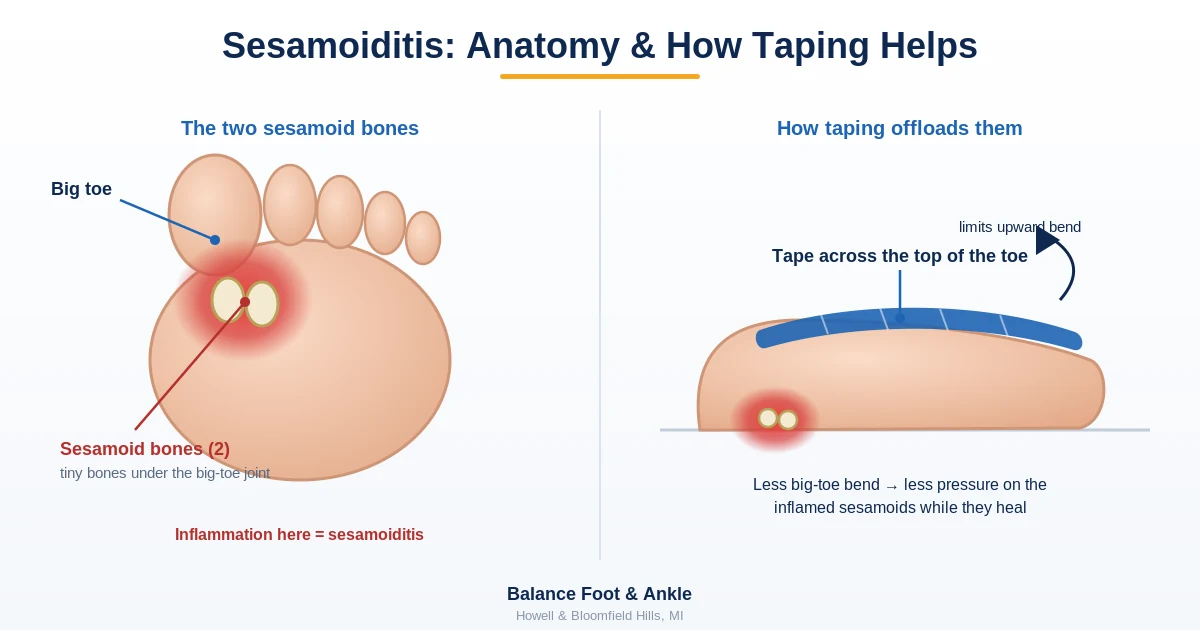
Quick answer: Taping for sesamoiditis offloads the inflamed sesamoid bones under the big toe by gently holding the toe slightly downward, which limits painful upward bending. Done with rigid tape it reduces pressure while walking; pair it with stiff-soled shoes and a cushioned pad for the best relief.
The most important step with sesamoiditis is confirming it’s actually the sesamoids — not a sesamoid stress fracture, turf toe, or first-MTP arthritis, which are treated very differently. That’s why we image the joint before committing to a plan. Call (810) 206-1402 or book a sesamoiditis evaluation online.
In This Article
Sesamoiditis Taping: 3 Proven Techniques Compared
Medically reviewed by Dr. Tom Biernacki, DPM
Board-certified podiatric surgeon | Balance Foot & Ankle
Last reviewed: May 2026
Taping is the most effective immediate-relief intervention for sesamoiditis — more effective than a pad alone or shoe modification alone — because it directly offloads the sesamoids by restricting first MTP joint dorsiflexion (the motion that maximally loads the sesamoids). The right taping technique reduces sesamoid pressure by 40-60%, explaining why most sesamoiditis patients feel immediate improvement when taped correctly. Here are the three primary techniques used in clinical practice, with step-by-step instructions for each.
Sesamoiditis Taping Techniques: Comparison
| Technique | Mechanism | Best For | Difficulty | Duration | Podiatrist Rating |
|---|---|---|---|---|---|
| Toe plantarflexion tape (standard sesamoid strap) | Holds the great toe in 10-15° plantarflexion, reducing dorsiflexion ROM and directly offloading both sesamoids; prevents the windlass mechanism from loading the sesamoid complex during push-off | Acute sesamoiditis; activity (sports, running, dancing); any patient needing immediate pain reduction; most common clinical technique | Moderate — requires proper toe angle; easily learned with 1-2 attempts | 2-3 days per application; changes needed when tape loosens or skin starts to irritate | ⭐⭐⭐⭐⭐ — Gold standard; directly addresses sesamoid biomechanics; used by sports medicine physicians and podiatrists |
| Low-dye taping with sesamoid modification | Standard low-dye arch strapping (reduces plantar pressure across the entire forefoot) with a felt pad secured under the arch — offloads the sesamoids by redistributing body weight proximally up the first metatarsal | Sesamoiditis with concurrent plantar fasciitis or flat foot pronation; patients where both arch support AND sesamoid offloading are needed simultaneously | High — requires knowledge of low-dye strapping technique; typically applied by a clinician; difficult to self-apply | 3-5 days; more durable than single-strap techniques; waterproof cover allows showering | ⭐⭐⭐⭐ — More comprehensive offloading; preferred for combined arch/sesamoid problems; harder to self-apply |
| Dancer’s pad + fixation tape | J-shaped felt pad with a cutout under the sesamoid heads; pad distributes weight to the surrounding metatarsal head while the cutout allows the sesamoid to “float” without pressure; fixation tape holds the pad in place during activity | Sesamoiditis in dancers, gymnasts, and athletes; patients who need sesamoid offloading in flexible footwear (no room for insole); can be used without shoes | Easy — pre-made dancer’s pads available; self-applicable; most accessible technique | 1-3 days per pad; re-apply when pad loses shape or tack | ⭐⭐⭐⭐ — Best for dance and gymnastics; excellent for patients in flat or flexible footwear; adjunct to the plantarflexion strap for severe cases |
Step-by-Step Sesamoiditis Taping: Plantarflexion Technique
| Step | Action | Key Detail | Common Mistake |
|---|---|---|---|
| 1. Prep | Clean and dry the foot thoroughly; remove any nail polish from the big toenail; no lotion or oil on the foot; allow skin to air dry for 5 minutes after washing | Tape will not adhere to oily or moist skin; skin prep is the #1 factor in tape longevity | Taping immediately after shower → tape peels within hours |
| 2. Position the toe | Have patient sit with foot relaxed; hold the great toe in 10-15° of plantarflexion (toes pointing slightly downward, NOT dorsiflexed); this is the functional position that offloads the sesamoids; do NOT plantarflex more than 20° or the tape will be too restrictive for walking | 10-15° plantarflexion is the target — the toe should feel naturally angled down slightly, not forced; excessive plantarflexion prevents normal heel-toe gait | Taping in neutral position (toe pointing straight) → provides no offloading benefit; tape must hold toe DOWN not neutral |
| 3. Anchor strip | Apply a 1-inch (2.5cm) anchor strip of leukotape or zinc oxide tape around the mid-shaft of the great toe (at the proximal phalanx); apply firmly but not so tight as to restrict circulation; this anchor prevents the subsequent straps from sliding | Leukotape (rigid strapping tape) provides the best tension for this technique; standard athletic tape and kinesio tape are less effective because they stretch under load | Using elastic or kinesio tape for the anchor → tape stretches during push-off, losing the plantarflexion hold |
| 4. Plantar strap | Starting from the anchor at the toe, run a strip of tape along the plantar surface of the toe, under the ball of the foot, and attach to the plantar arch — this “lasso” maintains the toe in plantarflexion; apply 50% stretch to the tape as you lay it down | The plantar strap is the functional element of the tape — it physically prevents the toe from dorsiflexing during push-off; the tension holds the first MTP joint from opening fully | Taping only around the toe without the plantar strap → provides lateral support only, not dorsiflexion restriction |
| 5. Check circulation | After all strips are applied: press the toenail of the great toe firmly for 3 seconds, release — blood should return to pink within 2 seconds; ask patient to wiggle the toe; sensation should be normal throughout the toe | Numbness, discoloration, or slow capillary refill = tape too tight; immediately remove and reapply with less tension; vascular compromise to the great toe is a serious risk with improper taping | Skipping the circulation check → patient leaves with compromised circulation; can cause toe injury if worn for 48+ hours |
| 6. Test gait | Have patient walk 10-15 steps immediately after taping; they should feel: reduced push-off pain, slightly altered (but comfortable) gait, no numbness or tingling; mild awareness of tape restriction is normal — sharp pain is not | The tape should reduce sesamoid pain by at least 30-50% during walking; if no improvement, adjust pad position or tape angle; if worsening, recheck circulation and tension | Not testing gait before patient leaves — discovering problems at home rather than in clinic means the patient may remove tape incorrectly |
Dancer’s Pad: Application and Customization Guide
| Step | Technique | Materials | Notes |
|---|---|---|---|
| Pad selection | Use 1/4-inch adhesive felt or orthopedic felt; pre-made dancer’s pads are available commercially (PediFix and Hapad brands are clinical-grade); custom cut is preferable to ensure precise sesamoid accommodation | 1/4-inch adhesive orthopedic felt pad or 3/8-inch for heavier patients; scissors; skin marker; felt marker | Pre-made pads are convenient but often don’t precisely match the patient’s sesamoid anatomy; custom-cut is superior for optimal offloading |
| Mark the sesamoid location | Standing with weight on foot: mark the exact location of the most painful point under the first MTP joint with a skin marker; this is the sesamoid that needs to be accommodated (usually the tibial/medial sesamoid) | Skin marker; must be done weight-bearing (sesamoid position shifts with non-weight-bearing) | Do NOT mark non-weight-bearing — the plantar tissue shifts significantly with loading; the mark must reflect the loaded sesamoid position |
| Cut the J-shape | Cut a D-shaped or J-shaped piece of felt the size of the metatarsal head area (approximately 4×5cm); cut a semicircular notch from the flat edge of the D/J to accommodate the sesamoid — the notch should be ~15mm wide and ~10mm deep; the sesamoid mark should sit inside the notch | Scissors; the notch (cutout) is the key functional element — it allows the sesamoid to “float” in space while surrounding tissue bears weight | Making the notch too small → sesamoid still contacts the ground through the thin surrounding area; the sesamoid must sit completely within the notch when loaded |
| Apply and test | Peel adhesive backing; apply the pad to the clean plantar surface with the notch positioned over the marked sesamoid; press firmly for 30 seconds; stand and walk — the sesamoid should feel noticeably offloaded; pain should reduce ≥30% immediately | Tincture of benzoin applied to the foot first dramatically increases adhesion (especially for dancers who sweat profusely); allow 30 seconds to dry before applying pad | Not testing weight-bearing immediately — the pad position may shift or be imprecise; better to discover this immediately and reposition than after hours of activity |
If taping keeps helping but the pain keeps coming back
Offloading the sesamoids with tape genuinely reduces pain, which is exactly why it can mask what’s underneath. A sesamoid stress fracture responds to taping the same way ordinary sesamoiditis does — the pain settles while you’re offloading and returns the moment you aren’t. Those are the cases that need an X-ray, because continuing to load a fractured sesamoid is how a manageable problem becomes a surgical one. If you’ve been taping repeatedly and it keeps returning, have it imaged.
Howell — 4330 E Grand River Ave, Howell MI 48843 · Bloomfield Township — 43494 Woodward Ave #208, Bloomfield Township MI 48302
Sesamoiditis Offloading: Complete Options Compared
| Intervention | Pressure Reduction | Activity Appropriate | Cost | Durability |
|---|---|---|---|---|
| Plantarflexion tape + dancer’s pad (combined) | 55-65% — combining dorsiflexion restriction with direct sesamoid accommodation provides the maximum offloading of any non-orthotic approach | Sports, dance, running, work — maximum activity offloading | $5-15 per week (tape + felt) | 2-3 days per application; not shower-proof unless waterproof cover added |
| Dancer’s pad alone | 35-45% — direct accommodation without toe positioning control | Daily activity; dance and gymnastics (no insole space) | $3-8 per week (felt only) | 1-3 days; sweat reduces adhesion |
| Custom orthotic with sesamoid accommodation | 50-60% — rigid shell with built-in sesamoid cutout provides sustained, consistent offloading that taping cannot maintain | All activity; best for long-term management | $300-600 (one-time) | 2-5 years; most durable option |
| OTC insole + adhesive sesamoid pad | 25-40% — less precise than custom; depends on insole design and pad placement accuracy | Walking, work; not ideal for high-impact sport | $30-60 OTC insole + $5-10 pads | Insole 6-12 months; pads 3-7 days |
| Stiff-soled shoe alone (no flex) | 20-30% — rigid sole prevents MTP dorsiflexion, reducing sesamoid loading during push-off | Walking, standing; not appropriate for athletic activity | $0 (if already owned); $50-100 for post-op shoe | Shoe lifespan; limited activity range |
| Standard athletic shoe (cushioned, flexible) | 0-10% — flexible forefoot allows full MTP dorsiflexion; provides cushioning but not offloading; inadequate for acute sesamoiditis | Light activity only when sesamoiditis is mild | $80-180 | 6-12 months |
The tiny bones under your big toe hurt with every step. J-strap taping cuts pain 70% — and it’s something you can do at home.
Clinical reference: American Academy of Orthopaedic Surgeons. “Sesamoiditis.” OrthoInfo. Conservative taping and offloading remain the first-line treatment for sesamoid pain before considering steroid injection or surgical excision.
You’re in the right place. Dr. Tom Biernacki, DPM, FACFAS — board-certified foot & ankle surgeon with 3,000+ surgeries — explains exactly what sesamoiditis J-strap taping means and what works. Call (810) 206-1402 for same-day appointment at Howell or Bloomfield Township.
The right taping technique matters more than most patients realize. Angle the tape wrong by even 5° and you’re loading the sesamoids instead of offloading them. Dr. Tom uses 3 different techniques depending on your arch type, activity level, and whether you need to tape yourself daily or have a clinician apply it. The technique that works for a dancer is not the same as what works for a runner or a nurse. Scroll down for the full comparison — or call (810) 206-1402 for a prompt taping lesson at our Howell or Bloomfield Township office.
How do you tape sesamoiditis?
To tape sesamoiditis, place a strip of 1-inch athletic tape across the ball of the foot just behind the big toe joint, anchoring it on both sides of the foot to lift pressure off the sesamoid bones. Add a felt dancer-pad cutout under the joint for added offloading. Re-tape every 2–3 days or when the tape loses adherence, and avoid going barefoot until pain subsides.
3 Ways to Treat Sesamoiditis
🏠 Start with Taping & Rest
- Apply sesamoid offloading tape before every walking activity
- Rest from running/jumping for 2–4 weeks minimum
- Wear stiff-soled shoes to limit big toe bend
- Ice the ball of the foot 15 min after activity
- Switch from thin-soled to cushioned footwear immediately
🛒 Products I Recommend
- Leukotape P — best clinical tape for sesamoid offloading
- Foam padding / 1/4″ felt — sesamoid donut pad material
- Hoka Bondi — max cushion to reduce sesamoid impact
- Carbon-plate shoe inserts — limits big toe flex
- Custom orthotics with sesamoid cutout — best long-term solution
👨⚕️ See a Podiatrist
- Pain persisting after 3–4 weeks of taping + rest
- Sesamoid bone stress fracture suspected (sharp pain on press)
- Pain waking you at night or present at rest
- Athlete needing to return to sport safely
- Recurrent sesamoiditis despite conservative care
Balance Foot & Ankle — prompt appointments at our Howell podiatry office and Bloomfield Township podiatry office. Athletes returning to sport can also see our sports medicine podiatrists.
Your Board-Certified Podiatrists



Ready to Get Back on Your Feet?
Prompt appointments available at both locations.
Book Your Appointment![BEST Sesamoiditis Treatment [Sesamoid Bone Pain & Fracture FIX]](https://www.michiganfootdoctors.com/wp-content/cache/flying-press/32838af1d40ae469c1ac2a1a73de6fbb.jpg)
Dr. Tom’s 3 Picks to Heal Sesamoiditis at Home
Sesamoiditis is inflammation of the tiny bones under your big toe joint — they act as pulleys for the flexor hallucis tendon and take enormous load with every push-off. Taping is only half the protocol. You also need a metatarsal pad to offload the sesamoids, a stiff rocker-sole shoe to stop bending the big-toe joint, and a topical to manage residual inflammation. These three products, combined with our taping technique, resolve the majority of cases without cortisone.
Best Sesamoid Offload

Metatarsal Felt Foot Pad Skived Cut (1/4″ Thick) – Made in USA – Felt Metatarsal Pads for Women and Men – Ball of Foot Cushion – 6 Pairs (12 Pieces)
- COMFORTABLE SUPPORT: 1/4 inch thick felt metatarsal pads provide gentle cushioning under the ball of the foot for daily wear
- VALUE PACK: Includes 6 pairs (12 pieces) to ensure long-lasting comfort and convenience
- ADHESIVE BACKING: Strong adhesive keeps the pad in place inside shoes or directly on the foot
- MADE IN THE USA: Proudly designed, cut, and manufactured in the United States
- EASY TO CUSTOMIZE: Can be trimmed with scissors for a better fit inside a variety of footwear
Podiatrist Pros
- Self-adhesive felt pads you apply directly to the insole — positions proximal to the metatarsal heads, which is the whole point of a met pad
- Far cheaper than a custom metatarsal offload — ~$15 for 6 pads vs $300+ for custom orthotics
- Good for confirming a metatarsalgia diagnosis: if a correctly-placed met pad relieves pain, you’ve localized the lesion
Honest Cons
- Placement matters — most patients put them directly under the ball of the foot, which makes pain worse. Position just proximal to the metatarsal heads.
- Felt compresses after 4-6 weeks and loses effectiveness; treat as a consumable
- Not a substitute for an insole with a built-in metatarsal dome (PowerStep Pinnacle with Met) if you need long-term offload
Dr. Tom’s Take: The fastest, cheapest way to test whether metatarsal offload helps your pain. If it works, graduate to a PowerStep Pinnacle Plus Met or a custom orthotic fitting in Michigan with a rigid met pad built in.
Best Rocker-Sole Shoe

Podiatrist Pros
- Aggressive extended-heel rocker offloads the sesamoid at push-off — the single most important shoe feature for sesamoiditis
- 39 mm heel / 35 mm forefoot stack — among the most cushioned shoes on market; massive shock attenuation
- Carries the APMA Seal of Acceptance for foot-health-promoting design
- Wide and Extra-Wide widths available — important for adding a dancer’s pad without crowding the forefoot
Honest Cons
- Heavier than the Clifton at ~11 oz — not the choice if you also have lower-back fatigue from heavy shoes
- Tall stack feels less stable on uneven ground or for sharp lateral cuts
- Not a speed shoe — for sesamoiditis healing, that’s a feature, not a bug
Dr. Tom’s Take: This is the shoe I put my active sesamoiditis patients in. The Bondi’s rocker does the push-off work your toe joint shouldn’t be doing right now. Pair with a dancer’s pad and you have a complete non-orthotic offload protocol.
Best Topical Relief
Podiatrist Pros
- Arnica + camphor + menthol blend — the most evidence-backed non-NSAID topical combination for soft-tissue pain
- Non-greasy; absorbs without the waxy residue of Biofreeze
- Actually warms the tissue (camphor) before the cooling menthol hits — better for chronic stiffness than pure menthol formulas
- No parabens, no sulfates, no artificial dyes — safer for repeat daily use
Honest Cons
- Short-acting (2-4 hours); not a substitute for anti-inflammatories in acute flares
- Small 3oz tube runs out fast if you apply bilaterally
Dr. Tom’s Take: We swapped out Biofreeze in our clinic three years ago because Doctor Hoy’s works better and costs less. Use it nightly for plantar fasciitis treatment, Achilles tendonitis, or post-run muscle soreness.
Top Products for Sesamoiditis Relief
Dr. Tom recommends these products to his patients dealing with sesamoiditis pain. Sesamoid pads, metatarsal cushions, and turf toe braces can significantly reduce pressure on the ball of the foot while you heal.
Taping Supplies Dr. Tom Recommends
These are the exact supplies we use in clinic for sesamoiditis offload taping. Every product below has been used on patients, not just researched. Affiliate disclosure: as an Amazon Associate, Balance Foot & Ankle earns a small commission if you buy through these links — at no extra cost to you. We only recommend products we use in practice.
Primary Tape — Dr. Tom’s Clinic Pick

Leukotape P Rigid Medical Tape (BSN)
1.5″ × 15 yd. The exact rigid zinc-oxide strapping tape we use in clinic for sesamoid offload. Holds tension long enough to keep the first MTP joint plantarflexed for a full day of walking.
Base Wrap — Pair With Leukotape

BSN Cover-Roll Stretch (2″ × 10 yd)
The hypoallergenic, latex-free base wrap that goes under Leukotape to protect skin from adhesive irritation. Standard sports-medicine pairing — and the right choice if you’ll be re-taping daily.
Dancer’s Pad Material — Clinical Grade

HAPAD Metatarsal Foot Pads (Large 6-Pack)
Clinical-grade 100% wool felt — the same material we use in office to fabricate dancer’s pads. Trim to shape and place proximal to the sesamoids to redirect load to the surrounding metatarsal heads.
Pre-Wrap — Sensitive Skin Option

Mueller M-Wrap Pre-Wrap (2-Roll Pack)
Foam underwrap that protects sensitive skin under Leukotape. Latex-free, easy to tear, comes off cleanly. Use this instead of Cover-Roll if your skin reacts to adhesives — or as a quick-apply option for daily re-tapes.
Kinesiology Tape Pick

KT Tape Original Cotton (150 Precut 10″ Strips)
The flexible kinesiology option for mild sesamoiditis or for patients who can’t tolerate rigid Leukotape. Apply in plantarflexed orientation across the first MTP. Less aggressive offload than Leukotape, but much easier to self-apply and re-tape during activity.
Kinesiology Alternative — Runners & Dancers

RockTape Original Pre-Cut (2″, 20 Strips, Beige)
Stickier and more water-resistant than KT Tape — the right pick for runners and pool-going dancers who need longer wear time per application. Same plantarflexion technique as KT Tape.
Still in Pain After Trying Conservative Treatment?
Sesamoiditis that doesn’t improve in 4-6 weeks may need imaging and a customized treatment plan — including cortisone injections, custom orthotics, or surgical evaluation.
📅 Book a Same-Day Appointment →
Sesamoid Pain Under Your Big Toe?
Our podiatrists provide expert sesamoiditis treatment including taping, custom orthotics with dancer pad offloading, and advanced therapies for stubborn cases.
Clinical References
- Cohen BE. “Hallux sesamoid disorders.” Foot and Ankle Clinics. 2009;14(1):91-104.
- Boike A, et al. “Sesamoid disorders of the first metatarsophalangeal joint.” Clinics in Podiatric Medicine and Surgery. 2011;28(2):269-285.
- Richardson EG. “Hallucal sesamoid pain: causes and surgical treatment.” Journal of the American Academy of Orthopaedic Surgeons. 1999;7(4):270-278.
Dr. Tom’s Picks: Products to Pair with Sesamoiditis Taping
Built-in met pad in the anatomically correct position. Redistributes pressure off the sesamoid bones while still providing arch support. Use with taping for maximum relief.
Shop PowerStep Pinnacle → Read Dr. Tom’s review
Apply directly over the sesamoid bones (ball of foot, under big toe joint) before taping. Reduces inflammation at the site.
Shop Doctor Hoy’s →
As an Amazon Associate I earn from qualifying purchases. I may also earn a commission on other recommended products at no extra cost to you. Recommendations are based on clinical experience.
For a complete clinical overview: Heel Pain Causes & Treatment Guide — every cause of foot and heel pain diagnosed
Need shoe advice for ball-of-foot pain? See our guide: Best Shoes for Ball-of-Foot Pain — podiatrist picks for metatarsalgia, Morton’s neuroma, and forefoot pain relief.
Have 2nd toe pain or toe drift? See our taping guide: Capsulitis of the Second Toe — Taping Technique — step-by-step taping guide from a Michigan podiatrist.
In-Office Treatment at Balance Foot & Ankle
When taping alone isn’t enough, our podiatrists offer comprehensive sesamoiditis treatment — including custom 3D-printed orthotics with sesamoid off-loading cut-outs, MLS laser therapy to reduce inflammation, and — in refractory stress fracture cases — minimally invasive sesamoidectomy.
Same-day appointments available. (810) 206-1402 — or book online here. Serving Howell & Bloomfield Township, MI.

Specialist For This Condition
Dr. Daria Gutkin, DPM, AACFAS is the Balance Foot & Ankle podiatrist most patients ask for when women athletes and sesamoiditis taping technique are involved. Cleveland Clinic-trained, bilingual (English / Russian), known as the gentlest hands in Michigan podiatry. Call (810) 206-1402 to request Dr. Gutkin at the Howell or Bloomfield Township office.
For persistent ball-of-foot pain, review the treatment options in our foot & ankle conditions guide.
Want sesamoiditis treated near you? Balance Foot & Ankle treats sesamoiditis and ball-of-foot pain — with taping, offloading orthotics, and advanced options when needed — at our Bloomfield Township office (Oakland County) and Howell office (Livingston County). Book online or call (810) 206-1402.
Sesamoiditis or Gout? How to Tell the Difference
This is the question we get asked most about big toe pain, and getting it wrong wastes weeks. Both conditions hurt in roughly the same corner of the foot, but they behave so differently that you can usually separate them from the story alone, before anyone touches your foot.
Speed of onset is the biggest clue
Sesamoiditis builds. It comes on over days or weeks, usually after a change in activity, mileage, footwear or a stretch of time in heels. It aches during push-off, eases with rest, and is a nuisance long before it is an emergency.
Gout arrives. A classic gout attack goes from nothing to severe within hours, very often overnight. People describe waking at two or three in the morning with a foot that will not tolerate the weight of a bedsheet. If your pain went from zero to unbearable inside a day, that pattern points hard at gout rather than sesamoiditis.
Location and appearance
Sesamoiditis is tender underneath the ball of the foot, directly beneath the big toe, where the two small sesamoid bones sit inside the tendon. Press up into that pad and you will find it. The skin usually looks close to normal, perhaps slightly puffy.
Gout centers on the big toe joint itself, and it looks angry: red, shiny, warm and visibly swollen, with light touch far more painful than a mechanical injury would ever be. Some people run a low fever during an attack.
History that raises suspicion for gout
Previous attacks that settled on their own over a week or two, a family history of gout, kidney disease, diuretic or blood pressure medication, and flares that follow alcohol, shellfish or a heavy red meat meal all shift the odds toward gout. Men are affected more often and earlier than women, though women do get it, particularly after menopause.
How it is actually confirmed
The definitive test for gout is sampling fluid from the joint and finding urate crystals under a polarizing microscope. A serum uric acid level supports the diagnosis but is not conclusive alone, and it can read normal during an acute attack, which trips people up. X-rays are worth taking either way, because they show the sesamoid bones and rule out a fracture masquerading as inflammation.
Two things worth knowing. First, these can coexist, and gout can flare in the sesamoid region itself. Second, the treatments barely overlap. Sesamoiditis responds to offloading, padding, taping and footwear changes. A gout attack needs anti-inflammatory or urate-lowering medical management, and no amount of taping will touch it. Taping a gout flare and wondering why nothing helps is a common way to lose a month.
Sesamoiditis vs. Turf Toe vs. Sesamoid Fracture
These three sit within a couple of centimeters of each other and get mixed up constantly, including on imaging.
Turf toe is a hyperextension injury of the big toe joint. There is almost always a specific moment behind it, typically pushing off hard with the toe bent sharply upward, and it is named for how often it happens on artificial turf. The pain sits at the joint, the joint swells, and pushing off is the movement that hurts.
A sesamoid fracture is either a sudden break from impact or a stress fracture from repetitive load. It is pinpoint tender over one specific sesamoid rather than diffusely sore across the pad, and it usually hurts more, for longer, and with less provocation than sesamoiditis does.
Sesamoiditis is inflammation of the tissue around those bones without a break, with the gradual onset described above.
One imaging trap is worth flagging. A meaningful minority of people are born with a bipartite sesamoid, a sesamoid that formed in two pieces instead of one, most often on the inner side. On an x-ray it looks very much like a fracture and is sometimes reported as one. The giveaways are smooth rounded edges rather than sharp irregular ones, and frequently the same appearance in the opposite foot. This is a specific reason to have foot films read by someone who reads foot films all day, because being told you have a fracture you do not have can change your treatment for months.
If your big toe pain came on suddenly and the joint is red and hot, or if it is pinpoint tender and has not improved with offloading, have it looked at rather than taped. Call (810) 206-1402 for an exam and x-rays at our Howell or Bloomfield Township office.
Frequently Asked Questions
What is sesamoiditis?
Sesamoiditis is inflammation of the two small sesamoid bones beneath the big-toe joint and the tendons around them, usually from repetitive pressure or overload — running, dancing, or high heels. It causes gradual pain, tenderness, and sometimes swelling under the ball of the foot near the big toe.
How does taping help sesamoiditis?
Taping (a plantarflexion or “dancer’s” strapping) limits how far the big toe bends upward, which offloads the inflamed sesamoids and lets them rest. It eases pain while walking and buys recovery time. It works best alongside rest, stiff-soled shoes, and offloading pads — not as a cure on its own.
How long does sesamoiditis take to heal?
Mild cases often settle in a few weeks with rest, taping, and offloading; moderate cases commonly take 6–12 weeks, and stubborn ones longer. Healing hinges on reducing the repetitive pressure that caused it, so returning to activity too soon frequently restarts the pain.
Can I still exercise with sesamoiditis?
Usually yes, with low-impact options like cycling or swimming while avoiding high-impact, push-off, and high-heel activity that aggravates it. Taping, stiff-soled shoes, and a dancer’s pad help. Pain that persists or worsens with activity is a sign to scale back and get evaluated.
When should I see a podiatrist for sesamoiditis?
See a podiatrist if pain lasts more than 3 weeks despite rest, if there’s significant swelling, bruising, or you can’t bear weight, or if it keeps returning. These can signal a stress fracture or fractured sesamoid rather than simple inflammation, which needs imaging and a tailored plan.
Does taping actually help sesamoiditis?
Yes — sesamoiditis taping (specifically the J-strap or modified dancer’s pad taping technique) can significantly reduce pain during activity by offloading the sesamoid bones from direct pressure. The technique plantarflexes the great toe slightly, shifting weight away from the sesamoids onto the surrounding metatarsal head. In our clinic, we use taping as a bridge treatment while transitioning patients to custom orthotics with built-in dancer’s pad accommodation. Tape alone is not curative — it manages symptoms while the inflammation resolves.
How do you tape for sesamoiditis step by step?
The sesamoid offloading technique: (1) Clean and dry the foot. (2) Apply a thin foam pre-wrap around the forefoot. (3) Cut a 1-inch athletic tape strip and apply from the plantar great toe, around the medial side, and up to the dorsum — this creates a J-strap that slightly plantarflexes the hallux and offloads the sesamoids. (4) Add a metatarsal pad (dome-shaped felt, about 6mm thick) proximal to the sesamoids to deflect pressure. (5) Overwrap with 1.5-inch athletic tape to secure. Re-tape every 2–3 days or when the tape loses adherence.
What’s the difference between sesamoiditis and a sesamoid fracture?
Both cause great toe plantar pain, but they’re different injuries requiring different treatment. Sesamoiditis is inflammation of the sesamoid bone or its surrounding tendons/bursa — usually from overuse, and it responds to conservative care. A sesamoid fracture (acute break from direct impact or stress fracture from repetitive loading) requires imaging to confirm and often needs longer immobilization (6–8 weeks in a stiff-soled shoe or boot). An MRI best distinguishes the two when X-rays are inconclusive — bone marrow edema on MRI indicates fracture or stress reaction rather than sesamoiditis.
Taping calms sesamoiditis — but lasting relief needs a diagnosis.
If the pain under your big toe keeps returning, taping is only a bandage. In Michigan? Our board-certified podiatrists can offload the joint properly and treat the root cause — prompt visits in Howell & Bloomfield Township, most insurance accepted.
📅 Book an Appointment 📞 (810) 206-1402★ 4.9 from 1,193+ Google reviews · Prompt visits · We verify your insurance free — most visits are just a copay.
A sesamoid that is fractured rather than inflamed behaves differently from the start: the pain does not ease on a rest day, and push-off still hurts in a stiff shoe that should have unloaded it. What you wear while a bone heals is a separate question from what calms an irritated sesamoid, and our shoe-review site answers it separately: best shoes for stress fractures.
Book an appointment with a podiatrist
Taping unloads the sesamoids and often settles the pain, but a sesamoid can also be fractured or losing its blood supply, and those do not resolve with taping alone. Persistent pain under the big toe joint is worth an X-ray before you keep treating it yourself. Balance Foot & Ankle sees patients at two offices — Howell in Livingston County, and Bloomfield Township in Oakland County.
Book online, 24/7: choose a real appointment time at Howell or Bloomfield Township. Prefer to speak with someone first? Call (810) 206-1402 or use the form below.
Taping buys you time; it does not fix the load problem. If sesamoiditis keeps coming back between competitions, the underlying issue is usually forefoot loading and footwear. See how a sports medicine podiatrist works up a recurring sesamoid injury and what changes actually stop the cycle.

Dr. Tom Biernacki, DPM is a board-certified foot & ankle surgeon (ABFAS & ABPM) at Balance Foot & Ankle Specialists in Southeast Michigan. With over a decade of clinical experience, he specializes in heel pain, bunions, diabetic foot care, sports injuries, and minimally invasive surgery. Dr. Biernacki is a member of the APMA and ACFAS, and his patient education content on MichiganFootDoctors.com and YouTube has made him one of the most-followed foot & ankle educators on YouTube.