
Quick answer: Big Toe Joint Pain Causes has multiple potential causes including mechanical, neurological, vascular, and inflammatory. The most common causes we identify are overuse, ill-fitting shoes, and biomechanical imbalance. Red flags requiring urgent evaluation: warmth/redness (infection), inability to bear weight (fracture), and unilateral swelling without injury (DVT). Call (810) 206-1402.
Medically reviewed by Dr. Tom Biernacki, DPM
Board-certified podiatric surgeon | Balance Foot & Ankle
Last reviewed: May 2026


![Stiff Big Toe Joint Pain(Hallux Rigidus) TREATMENT [Exercises, Taping]](https://www.michiganfootdoctors.com/wp-content/cache/flying-press/c5176884df3f62ec55c9a49e0ec09089.jpg)
Watch: Stiff Big Toe Joint Pain(Hallux Rigidus) TREATMENT [Exercises, Taping] — MichiganFootDoctors YouTube
Your big toe joint is one of the most mechanically stressed structures in the human body — it bears 40–60% of your body weight with each walking step and up to 300% body weight while running. It’s no wonder that when something goes wrong here, it affects everything from your morning commute to your favorite sport. Understanding what’s actually causing your big toe joint pain is the first step toward the right treatment.
The most important clinical decision with Big Toe Joint Pain Causes isn’t which treatment to start with — it’s identifying the correct subtype. That changes everything. Call (810) 206-1402.
Anatomy of the Big Toe Joint
The first metatarsophalangeal (MTP) joint connects the first metatarsal bone to the proximal phalanx of the big toe. Beneath this joint lie two small sesamoid bones embedded in the flexor hallucis brevis tendon — these act as a pulley system and bear significant pressure with each step. The joint is stabilized by the plantar plate, collateral ligaments, and surrounding tendons. Any of these structures can be the source of pain.
7 Most Common Causes of Big Toe Joint Pain
1. Bunion (Hallux Valgus)
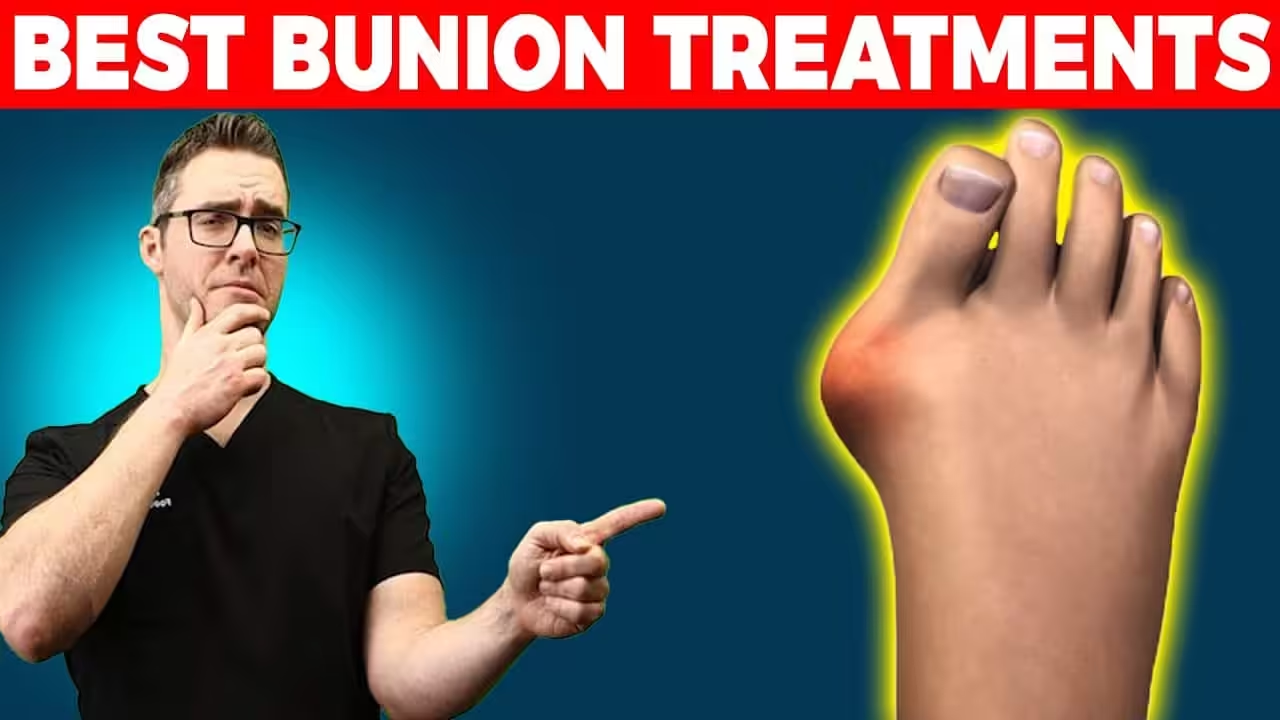
A bunion forms when the first metatarsal drifts outward and the big toe angles toward the second toe. The prominence on the medial (inner) side of the foot becomes inflamed from shoe pressure, causing aching, throbbing, and soreness that worsens with activity. Pain is at the medial aspect of the first MTP and is provoked by tight footwear.
2. Hallux Rigidus (Arthritis)
Hallux rigidus is degenerative arthritis of the first MTP joint — the most common arthritic condition of the foot. Pain is felt on top of the joint and during push-off when the toe must dorsiflex. A dorsal bone spur is often visible and palpable. Motion becomes progressively restricted.
3. Gout
Gout presents as sudden, severe, often nocturnal pain with intense swelling, warmth, and redness at the first MTP joint (podagra). It’s caused by uric acid crystal deposition. Even touching a bedsheet can be excruciating during an acute attack. Serum uric acid levels and sometimes joint aspiration confirm the diagnosis.
4. Sesamoiditis
Sesamoiditis involves inflammation of one or both sesamoid bones beneath the first MTP joint. Pain is focal, directly under the ball of the foot, and worsens when bearing weight on the forefoot or pushing off. It’s common in ballet dancers, runners, and athletes who spend time on the balls of their feet.
5. Turf Toe
Turf toe is a hyperextension sprain of the first MTP joint’s plantar plate, most common in athletes who play on hard artificial surfaces. It causes immediate pain, swelling, and limited range of motion at the joint’s plantar surface. Severity ranges from mild stretching (Grade 1) to complete plantar plate rupture (Grade 3).
6. Stress Fracture of the First Metatarsal
A stress fracture near the first MTP joint presents as gradually worsening pain with activity that eases with rest, localized tenderness over the metatarsal neck or head, and occasional swelling. It may be invisible on initial X-rays — an MRI or bone scan is needed for early detection.
7. Inflammatory Arthritis
Rheumatoid arthritis and psoriatic arthritis often involve the small joints of the foot, including the first MTP. Bilateral involvement, morning stiffness lasting over 30 minutes, and systemic symptoms suggest inflammatory rather than mechanical causes. Rheumatology co-management is appropriate.
Key takeaway: The location of your big toe pain is a powerful diagnostic clue: medial = bunion; dorsal = hallux rigidus; plantar = sesamoiditis or turf toe; sudden severe with redness = gout.
⚠️ When to See a Podiatrist for Big Toe Joint Pain
- Pain is sudden, severe, and associated with swelling and redness (possible gout or fracture)
- Pain is worsening progressively over weeks or months
- You heard or felt a pop with acute onset of pain (turf toe or plantar plate injury)
- Pain is present at rest or waking you from sleep
- Big toe joint pain with diabetes — foot problems escalate faster with metabolic disease
- You have a visible deformity or bump at the joint that is changing over time
In-Office Treatment at Balance Foot & Ankle
If home treatment isn’t providing relief for your big toe pain, our podiatry team at Balance Foot & Ankle can help with same-day evaluations and advanced in-office care.
Same-day appointments available. (810) 206-1402
Doctor Hoy’s Natural Pain Relief Gel
Natural topical pain relief I use in our clinic. Arnica + camphor formula — apply directly to the area 3–4x daily. ($20–25)
Shop Doctor Hoy’s →Frequently Asked Questions
How do I know if my big toe joint pain is a bunion or arthritis?
Bunion pain is felt on the inner side of the big toe joint, often with a visible prominence, and is aggravated by shoe pressure. Hallux rigidus pain is felt on top of the joint during push-off and is associated with stiffness and reduced dorsiflexion. Both can be confirmed with weight-bearing X-rays in a single office visit.
What does gout feel like in the big toe?
Gout feels like sudden, intense, burning pain — often described as the worst pain imaginable — with significant swelling, warmth, and bright redness. It frequently starts at night and can make even light bedsheet contact intolerable. It typically resolves in 7–14 days but will recur without treatment.
Can big toe joint pain go away on its own?
Acute causes like gout flares and mild turf toe can resolve with rest and anti-inflammatory treatment. Chronic conditions like bunions, hallux rigidus, and sesamoiditis typically worsen without treatment.
Is big toe joint pain serious?
For most people, it’s manageable but shouldn’t be ignored. In people with diabetes or circulation problems, any foot pain warrants prompt evaluation as complications can escalate quickly.
The Bottom Line
Big toe joint pain has many causes — bunion, arthritis, gout, sesamoiditis, turf toe, and stress fracture being the most common. Location, onset pattern, and associated symptoms all point toward the correct diagnosis. Weight-bearing X-rays and sometimes blood work are needed for definitive diagnosis. Treatment is highly effective when the correct cause is identified early.
Ready to Get Relief?
Same-day appointments available in Howell & Bloomfield Township, MI
4.9★ | 1,123 Reviews | 3,000+ Surgeries
Or call: (810) 206-1402
Sources
- Coughlin MJ et al. Surgery of the Foot and Ankle, 9th ed. 2020.
- Doty JF, Coughlin MJ. “Sesamoid and lesser toe disorders.” J Am Acad Orthop Surg. 2014.
- Khanna D et al. “ACR gout management guidelines.” Arthritis Rheumatol. 2020.
Frequently Asked Questions
When should I see a doctor?
See a podiatrist if pain persists past 2 weeks, prevents normal activity, or is accompanied by red-flag symptoms (warmth, swelling, numbness, inability to bear weight).
Can I treat this at home?
Mild cases respond to RICE protocol (rest, ice, compression, elevation), supportive shoes, and OTC anti-inflammatories. Persistent symptoms need professional evaluation.
How long does it take to heal?
Most soft tissue injuries resolve in 2-6 weeks with appropriate care. Bone injuries take 6-12 weeks. Chronic conditions need longer-term management.

Dr. Tom Biernacki, DPM is a board-certified foot & ankle surgeon (ABFAS & ABPM) at Balance Foot & Ankle Specialists in Southeast Michigan. With over a decade of clinical experience, he specializes in heel pain, bunions, diabetic foot care, sports injuries, and minimally invasive surgery. Dr. Biernacki is a member of the APMA and ACFAS, and his patient education content on MichiganFootDoctors.com and YouTube has made him one of the most-followed foot & ankle educators on YouTube.