

✔ Medically reviewed by Dr. Tom Biernacki, DPM, Balance Foot & Ankle · Updated July 2026
Ready to be seen? Book online, 24/7 — Howell or Bloomfield Township. Choose New patient, then pick any green day on the calendar — openings most weeks. (Closed weekends, so today may show none.)
Howell & Bloomfield Township, Michigan
Custom Orthotics — Book Your Fitting Today
Doctor-designed prescription orthotics, fitted at our Howell and Bloomfield Township offices. Same-week appointments, most insurance accepted — book online in seconds, or call and we’ll take care of it.
Prefer we call you?
Send us a message and our team will reach out to schedule your fitting.
Quick answer: Custom orthotics are prescription medical devices molded to the exact shape of your foot to correct how you stand, walk, and distribute pressure. Unlike store-bought insoles, they are designed by a podiatrist from a 3D scan or cast and built in a lab to your diagnosis. At Balance Foot & Ankle in Howell and Bloomfield Township, our board-certified podiatrists prescribe and fit custom orthotics for heel pain, flat feet, bunions, diabetic foot protection, and sports performance. Most major insurance is accepted. Book online or call (810) 206-1402 for a same-week fitting.
★ 4.9-star rated by Michigan patients on Google · Board-certified podiatrists · Two offices
Custom Orthotics in Howell & Bloomfield Township, MI
Custom orthotics from a board-certified podiatrist are prescription medical devices — not the gel inserts you grab at the pharmacy. They are built from a precise 3D model of your foot to control motion, offload painful pressure points, and support your specific arch and gait. When they’re made correctly and from the right diagnosis, they can resolve pain that insoles never touch.
At Balance Foot & Ankle, Dr. Tom Biernacki, Dr. Carl Jay, and Dr. Daria Gutkin prescribe custom orthotics as part of a complete treatment plan — never as a one-size product sold off a shelf. This page explains what custom orthotics are, who actually benefits, how we make them, and what they cost.
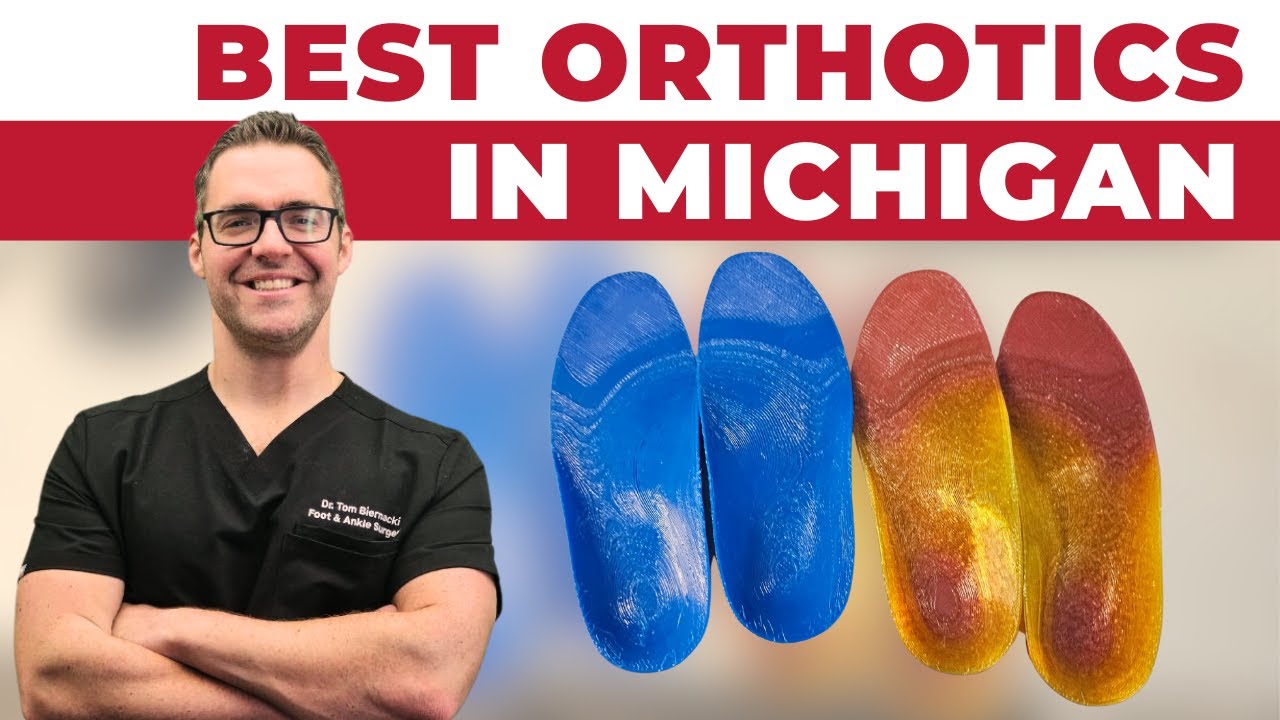
Watch: Are Custom Orthotics Worth It? (2026)
★★★★★ 4.9 stars from 1,193+ patients • Trusted by 50,000+ Michigan patients • Board-certified podiatrists
Most major insurance accepted
We accept Medicare, Blue Cross Blue Shield of Michigan, United Healthcare, Aetna, Cigna, HAP, Priority Health, Humana, McLaren, Meridian, and Michigan Medicaid — so your office visit is typically covered — coverage for the custom orthotic device itself varies by plan, and we’ll verify yours before your visit. Not sure about your plan? Book online or call (810) 206-1402 and we’ll check for you.
Custom orthotics vs. over-the-counter insoles
Over-the-counter insoles add cushioning and mild arch support, and for minor, occasional aches they’re a reasonable first step. Custom orthotics are a different category of device: they’re prescribed to a diagnosis and manufactured to your foot’s measurements, so they can actively change biomechanics rather than just pad them.
| Over-the-counter insoles | Custom orthotics | |
|---|---|---|
| Fit | Generic sizes | Molded to your exact foot from a 3D scan/cast |
| Based on | Shoe size | A podiatrist’s diagnosis and gait analysis |
| Function | Cushion & mild support | Corrects motion, offloads specific pressure points |
| Materials | Foam/gel | Prescription-grade shells (incl. carbon-fiber, accommodative) |
| Lifespan | ~6–12 months | Typically 3–5 years with periodic refurbishment |
| Insurance | Out of pocket | Often covered (see below) |
If you’ve already tried quality insoles and still hurt, that’s usually the sign it’s time for a custom device and a proper diagnosis.
Conditions custom orthotics help
We prescribe custom orthotics most often for:
- Heel pain & plantar fasciitis — control arch collapse and reduce strain on the plantar fascia. (See our plantar fasciitis treatment page.)
- Flat feet & fallen arches / overpronation — realign the foot and reduce fatigue. (See flat feet treatment.)
- Bunions & forefoot pain — redistribute pressure away from the big-toe joint.
- Diabetic foot protection — accommodative orthotics offload high-pressure areas to help prevent ulcers. (See diabetic foot care.)
- Ball-of-foot pain & high arches — cushion and support rigid, high-arched feet.
- Sports & overuse injuries — improve alignment and shock absorption for active patients.
Recognize your foot pain above? For most of these conditions, custom orthotics are the difference between managing the pain and actually fixing it.
Book Your Fitting →How we make your custom orthotics
- Exam & diagnosis. Your podiatrist examines your feet, reviews your history and footwear, and identifies the underlying problem.
- Gait & biomechanical analysis. We assess how you stand and walk to see exactly where motion and pressure go wrong.
- 3D scan or cast. We capture a precise model of your foot in its corrected position.
- Lab fabrication. Your prescription — shell type, posting, and any accommodations — is built to your diagnosis.
- Fitting & follow-up. We fit the finished orthotics, guide your break-in, and fine-tune as needed.
Because the device is built from a diagnosis, two patients with “arch pain” can receive very different orthotics — which is the whole point.
Cost and insurance
Many Michigan plans cover all or part of custom orthotics when they’re medically necessary, and Medicare covers therapeutic inserts for qualifying diabetic patients. Coverage varies by plan, so before your fitting we verify your benefits and tell you your expected out-of-pocket cost up front — no surprises. We accept Medicare, Blue Cross Blue Shield of Michigan, Aetna, UnitedHealthcare, Cigna, Humana, HAP, Priority Health, McLaren, Meridian, and most major insurances. Book online or call (810) 206-1402 and we’ll check your coverage.
Most patients pay little to nothing out of pocket. We’ll verify your coverage and get you fitted — often the same week.
Book Your Fitting →Why patients choose Balance Foot & Ankle
Our three board-certified podiatrists have performed thousands of foot and ankle procedures and are rated 4.9 stars by Michigan patients on Google. We treat custom orthotics as medicine, not merchandise: every device starts with a diagnosis, and we tell you honestly when a quality insole would serve you just as well. Same-week appointments are available at both offices.
Visit us — two Michigan offices
Balance Foot & Ankle — Howell
4330 E Grand River Ave, Howell, MI 48843
Livingston County · (810) 206-1402
Mon–Fri 9:00 AM–4:30 PM · Free on-site parking
Balance Foot & Ankle — Bloomfield
43494 Woodward Ave #208, Bloomfield Township, MI 48302
Oakland County · (810) 206-1402
Mon–Fri 9:00 AM–4:30 PM · Serving Bloomfield Township, Birmingham, Troy & West Bloomfield
Request your custom orthotics fitting →
Custom orthotics near me: what your fitting visit looks like
If you searched “custom orthotics near me,” you likely want three things: a clinician actually qualified to prescribe them, an appointment this week, and a straight answer on price. Here is exactly how it works at Balance Foot & Ankle. Your fitting visit starts with a biomechanical exam and gait check — we watch how you stand and walk, because an orthotic that ignores your mechanics is just an expensive insole. We then take a 3D scan of both feet and review the shoes you actually wear, so the finished device works in your real life, not just in the exam room. Most patients have their evaluation, scan, and treatment plan done in a single visit.
Two offices, same-week fittings
We fit custom orthotics at both locations: our Howell office at 4330 E Grand River Ave (serving Brighton, Hartland, Fowlerville, Pinckney, and Fenton) and our Bloomfield Township office at 43494 Woodward Ave #208 (serving Birmingham, Troy, West Bloomfield, Pontiac, and Rochester Hills). Same-week appointments are usually available at one office or the other — the front desk will book you at whichever is closer.
Not ready for prescription orthotics?
Honest answer: not everyone needs a custom device. For mild arch fatigue or all-day standing without a diagnosed deformity, a quality over-the-counter insole is a reasonable first step — our doctors keep an updated list of podiatrist-recommended orthotics and insoles you can try first. If pain persists past a few weeks, that is exactly when a custom evaluation earns its keep. Details on pricing and coverage are in the cost and insurance section above — and yes, HSA/FSA funds typically apply.
Ready to get fitted? Request your first visit or call (810) 206-1402.
What Michigan Patients Say
“Dr. Biernacki was wonderful. Very attentive and gave me detailed explanations. My time with him wasn’t rushed. What a refreshing experience!”
“Dr. Biernacki thoroughly explained the biomechanics of the foot and the treatment. Very patient, answered all my questions.”
“Dr. Gutkin was professional and thorough. I felt she understood my concerns and put them at ease. So happy to find a doctor I trust.”
Verified Across the Web
Listed and reviewed on every major medical directory and review platform.
Hospital & Health-System Affiliations
Board-certified by ABFAS · Fellows of FACFAS · Members of APMA & Michigan Podiatric Medical Association
Find Balance Foot & Ankle
Same-week appointments at both offices. Serving Livingston & Oakland County.
Howell Office · Livingston County
Balance Foot & Ankle — Howell
4330 E Grand River AveHowell, MI 48843
(810) 206-1402
Mon–Fri 9:00 AM–4:30 PM
Serving Howell, Brighton, Hartland, Fowlerville, Pinckney & South Lyon
Bloomfield Office · Oakland County
Balance Foot & Ankle — Bloomfield Township
43494 Woodward Ave #208Bloomfield Township, MI 48302
(810) 206-1402
Mon–Fri 9:00 AM–4:30 PM
Serving Bloomfield Township, Birmingham, Troy, West Bloomfield, Farmington Hills & Royal Oak
Frequently asked questions
Where can I get custom orthotics near me?
Balance Foot & Ankle makes custom orthotics at two Michigan offices — Bloomfield Township (serving Oakland County) and Howell (serving Livingston County) — both staffed by the same board-certified podiatrists. We scan or cast your feet in-office and build your orthotics to your exact diagnosis. Call (810) 206-1402 to book at the location nearest you.
Are custom orthotics worth the cost?
If quality over-the-counter insoles haven’t relieved your pain, yes — because custom orthotics are built to your diagnosis and foot shape, they correct the underlying mechanics insoles only cushion. They also last far longer (years vs. months).
Does insurance cover custom orthotics?
Often, when they’re medically necessary. Medicare covers therapeutic inserts for qualifying diabetic patients. We verify your specific benefits and tell you your cost before your fitting.
How long do custom orthotics last?
Typically 3–5 years, depending on activity and body weight, often with a mid-life refurbishment (new top covers/posting) rather than full replacement.
Do I need a referral or prescription?
No referral is needed to see us — podiatrists are direct-access providers in Michigan. The orthotics themselves are prescribed by your podiatrist after your exam.
Can I use one pair in all my shoes?
We can build orthotics for specific shoe types (dress, athletic, work). Tell us how you’ll use them and we’ll prescribe accordingly; some patients need a second pair for very different footwear.
How is the orthotic made to my foot?
We capture a 3D scan or cast of your foot in its corrected position, then a lab builds the device to your prescription. The result is matched to your anatomy, not your shoe size.
Serving patients across Livingston & Oakland County — visit our Howell podiatry office or Bloomfield Township podiatry office.
Stop working around your foot pain
Custom orthotics are one visit away. Same-week fittings at our Howell and Bloomfield Township offices, and most insurance is accepted.
Clinical sources
- Custom-Made Foot Orthoses versus Prefabricated: a review of clinical and cost-effectiveness. CADTH. NCBI
- Custom foot orthoses improve first-step pain in plantar fasciopathy: a pragmatic randomized controlled trial. PMC
- Evidence for foot orthoses for adults with flatfoot: a systematic review. Journal of Foot & Ankle Research, 2021. PMC
Custom orthotics across Metro Detroit & Livingston County: we care for patients from Howell, Brighton, Novi, Bloomfield Township, Birmingham, Troy, Rochester Hills, and Auburn Hills.
Custom orthotics at your nearest office
Custom orthotics in Bloomfield Township, MI · Howell office · Both office locations & hours
Custom orthotics — cities we cast for
Casting takes one short visit, with a quick follow-up fitting once your devices arrive. Choose your city for directions and appointment availability.
Cast at our Howell office
Brighton · Hartland · Pinckney · Hamburg · Fenton · Whitmore Lake · Ann Arbor · South Lyon · New Hudson · Milford · Highland · White Lake
Cast at our Bloomfield Township office
Birmingham · Troy · Rochester Hills · Royal Oak · Madison Heights · Southfield · Novi · Farmington Hills · West Bloomfield · Keego Harbor · Wolverine Lake · Walled Lake · Commerce Township · Wixom · Waterford · Pontiac · Clarkston · Auburn Hills · Lake Orion · Livonia
Howell office · Bloomfield Township office · Both offices & hours
Ready to be fitted for custom orthotics? A custom device starts with an in-office exam, so the first step is booking a visit at our Howell or Bloomfield Township office. Our new patient information page covers what to bring to that appointment, the insurance plans we accept, and the intake forms you can complete online beforehand.
More questions patients ask
Do I need a referral or prescription for custom orthotics?
No referral is needed — podiatrists are direct-access providers in Michigan. The orthotics are prescribed by your podiatrist after your exam.
Can I use one pair of orthotics in all my shoes?
Orthotics can be built for specific shoe types such as dress, athletic, or work shoes. Some patients need a second pair for very different footwear.
How are custom orthotics made to my foot?
A podiatrist captures a 3D scan or cast of your foot in its corrected position, then a lab builds the device to your prescription so it matches your anatomy, not your shoe size.
Still have a question about coverage or cost? Book online and we will check your benefits before your visit: Book in Howell · Book in Bloomfield Township. Prefer to talk it through first? Call (810) 206-1402.