
Medically reviewed by Dr. Tom Biernacki, DPM · Board-Certified Podiatric Surgeon · Last reviewed: April 2026 · Editorial Policy
The most important clinical decision with Distal Fibula Fracture Fixation Indications Technique isn’t which treatment to start with — it’s identifying the correct subtype. That changes everything. Call (810) 206-1402.
Quick Answer
Distal Fibula Fracture Fixation: Stability Assessment, ORIF relates to foot/ankle injury — typically caused by trauma or twist. Most patients improve in 4-8 weeks with conservative care. Same-week appointments in Howell + Bloomfield Township: (810) 206-1402.
Quick Answer
Most foot and ankle problems respond to conservative care — proper footwear, supportive inserts, activity modification, and targeted stretching — within 4-8 weeks. Persistent pain beyond that window, or any symptom that prevents walking, warrants a podiatric evaluation to rule out fracture, tendon tear, or systemic cause.
Medically reviewed by Dr. Tom Biernacki, DPM — Board-Certified Podiatric Surgeon — Balance Foot & Ankle, Howell & Bloomfield Township, MI. Last updated April 2026.
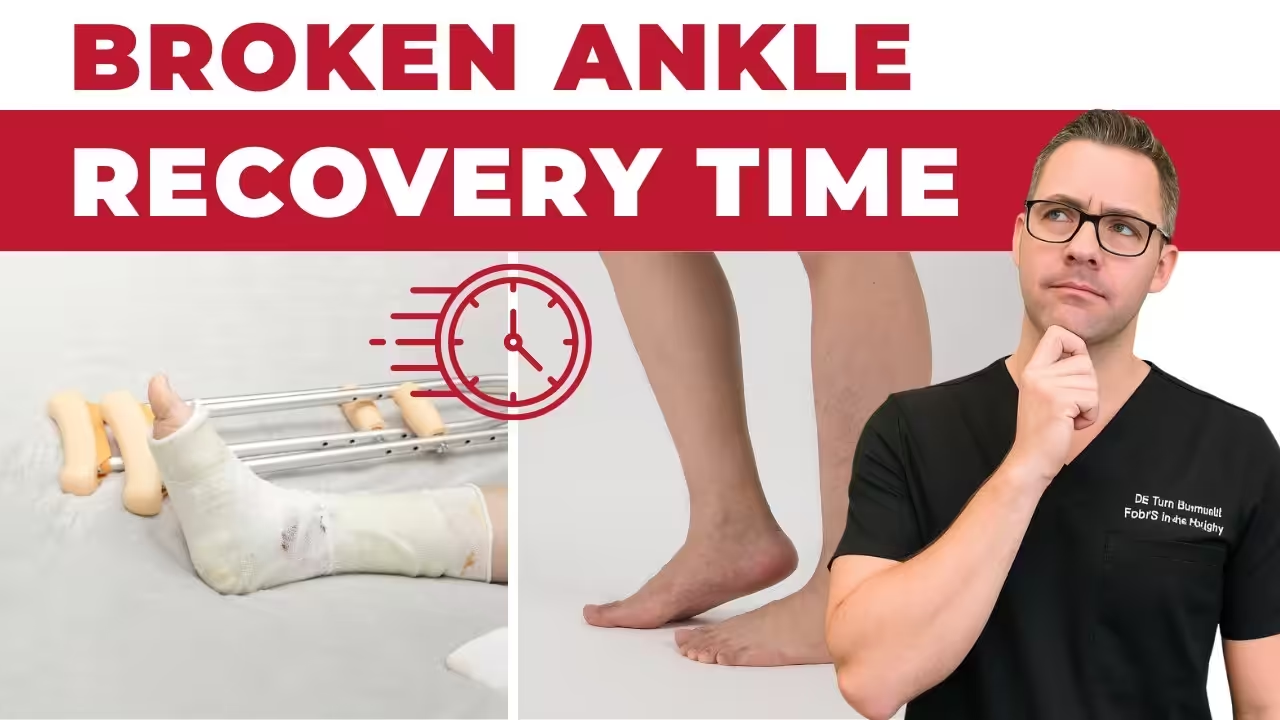
Watch: Dr. Tom Biernacki, DPM
Medically Reviewed by Dr. Tom Biernacki, DPM — Board-Certified Podiatrist, Balance Foot & Ankle Specialists, Michigan. Last updated April 2026.
Distal fibular fractures — the most common fractures of the ankle, ranging from isolated lateral malleolus avulsion fractures to complex trimalleolar injuries — require accurate stability assessment to distinguish fractures that will heal predictably with conservative management from those requiring surgical fixation. The fundamental question is whether the ankle mortise is stable under physiologic loading — and the gravity stress view (or externally rotated stress view) under fluoroscopy is the key investigation that answers this question and determines whether non-operative cast management or surgical ORIF is appropriate.
Stability Classification and Stress Testing
Weber classification: Weber A — fracture below the syndesmosis (avulsion at the lateral malleolus tip from inversion); stable if isolated; treated in a walking boot; Weber B — fracture at the level of the syndesmosis (most common — oblique fibular fracture from external rotation); may be stable or unstable — requires stress testing; Weber C — fracture above the syndesmosis (Maisonneuve — proximal fibular fracture or distal fracture above the plafond); syndesmosis disrupted — almost always unstable, requires ORIF and syndesmotic fixation. Gravity stress view: the patient is positioned supine with the hip and knee flexed, allowing the ankle to hang in external rotation under gravity; the AP ankle X-ray obtained in this position stresses the medial ankle structures; medial clear space (MCS) >5mm or MCS 1mm wider than the superior joint space confirms medial instability (deltoid ligament rupture) — unstable fracture requiring ORIF. Clinical importance: up to 50% of Weber B fractures that appear stable on standard X-ray show medial instability on gravity stress view — changing the treatment from walking boot to ORIF.
ORIF Technique and Outcomes
Lateral plate fixation: posterolateral approach; 3.5mm locking plate (one-third tubular or anatomic distal fibular plate) applied to the lateral or posterior fibular surface; lag screw for oblique fracture patterns; 6–8 cortices proximal to the fracture for secure fixation. Anti-glide plate: applied posteriorly on the fibula, using the plate as a buttress against glide forces on the oblique fracture; requires fewer screws than lateral plate; strong biomechanical fixation with excellent outcomes. Syndesmotic fixation: for Weber C and unstable Weber B with stress-positive medial instability; suture button (TightRope) or 3.5mm trans-syndesmotic screw from fibula to tibia, 2–3cm above the plafond; reduction of the syndesmosis confirmed fluoroscopically. Recovery: non-weight-bearing 2 weeks; progressive weight-bearing in boot at 2–6 weeks depending on fracture pattern; return to full activity at 3–4 months; outcomes — 85–90% restoration of pre-injury function; post-traumatic arthritis in 20–30% of bimalleolar and trimalleolar fractures at 10-year follow-up. Dr. Biernacki at Balance Foot & Ankle performs stability assessment and ORIF for distal fibula fractures at our Bloomfield Township and Howell offices. Call (810) 206-1402.
📧 Get Dr. Tom’s Free Lab Test Guide
Discover the 5 lab tests every person over 35 should ask their doctor about — explained in plain English by a board-certified physician.
📍 Located in Michigan?
Our board-certified podiatrists treat this condition at two convenient locations. Same-day appointments often available.
More Podiatrist-Recommended Foot Health Essentials
Hoka Clifton 10


Max-cushion everyday shoe — podiatrist favorite for walking and running.

OOFOS Recovery Slide

Impact-absorbing recovery sandal — wear after long days on your feet.
As an Amazon Associate, Balance Foot & Ankle earns from qualifying purchases. Product recommendations are based on clinical experience; prices and availability shown above update live from Amazon.

When to See a Podiatrist
If foot or ankle pain has been bothering you for more than a few weeks, home care alone may not be enough. Balance Foot & Ankle offers same-week appointments at our Howell and Bloomfield Township clinics — no referral needed in most cases. Bring your current shoes and a short list of symptoms and we’ll build you a treatment plan in one visit.
Call Balance Foot & Ankle: (810) 206-1402 · Book online · Offices in Howell & Bloomfield Township
Frequently Asked Questions
When should I see a podiatrist?
See a podiatrist for any foot or ankle pain that persists more than 2 weeks, doesn’t improve with rest, limits your daily activities, or is accompanied by swelling, numbness, or skin changes. People with diabetes or circulation problems should see a podiatrist regularly even without symptoms.
What does a podiatrist treat?
Podiatrists diagnose and treat all conditions of the foot, ankle, and lower leg including plantar fasciitis, bunions, hammertoes, toenail problems, heel pain, nerve pain, diabetic foot care, sports injuries, fractures, and foot deformities — both surgically and non-surgically.
What can I expect at my first podiatry visit?
Your first visit includes a full medical history, physical examination of your feet and gait, and in-office diagnostic imaging if needed (X-rays, ultrasound). We’ll discuss your diagnosis and create a plan tailored to your foot type. Most visits take 30–45 minutes.
Need Treatment at Balance Foot & Ankle?
Dr. Tom Biernacki, Dr. Carl Jay, and Dr. Daria Gutkin see patients at our Howell and Bloomfield Township offices.
Book Online or call (810) 206-1402
Insurance Accepted
BCBS · Medicare · Aetna · Cigna · United Healthcare · HAP · Priority Health · Humana · View All →
Howell Office
4330 E Grand River Ave
Howell, MI 48843
Get Directions →
Bloomfield Township Office
43494 Woodward Ave, #208
Bloomfield Township, MI 48302
Get Directions →
Your Board-Certified Podiatrists



Ready to Get Back on Your Feet?
Same-week appointments available at both locations.
Book Your AppointmentMost Common Mistake We See
The most common mistake we see is: Waiting too long before seeking care. Fix: any foot pain lasting more than 4 weeks, or any sudden severe symptom, deserves a professional evaluation rather than more rest.
Warning Signs That Need Same-Day Care
Seek immediate evaluation at Balance Foot & Ankle if you experience any of the following:
- Unable to bear weight
- Severe swelling with skin colour change
- Fever with foot pain (possible infection)
- Diabetes plus any new foot symptom
Call (810) 206-1402 — same-day and next-day appointments at our Howell and Bloomfield Township offices.
Watch: Dr. Tom explains
Podiatrist-recommended products
As an Amazon Associate, Dr. Tom earns from qualifying purchases.
Related resources
Ready to solve this? Book today.
Same-week appointments · Howell & Bloomfield Township · 4.9★ (1,123+ reviews)
☎ (810) 206-1402Book Online →Pros & Cons of Conservative Care for foot care
Advantages
- ✓ Conservative care first
- ✓ Same-week appointments
- ✓ Multiple insurance accepted
Considerations
- ✗ Self-treatment can mask issues
- ✗ See a podiatrist if pain >2 weeks
Dr. Tom’s Recommended Products for foot care
Affiliate disclosure: As an Amazon Associate, Balance Foot & Ankle earns from qualifying purchases. We only recommend products we use with patients.
Footnanny Heel Cream Dr. Tom’s Pick
Best for: Daily moisturizer for cracked heels
Ready to Get Back on Your Feet?
Same-day appointments in Howell + Bloomfield Township. Most insurance accepted. Dr. Tom Biernacki, DPM & team.
Book Today — Same-Day Appointments Available
Call Now: (810) 206-1402
About Your Care Team at Balance Foot & Ankle
Dr. Tom Biernacki, DPM · Board-Certified Foot & Ankle Surgeon. Specializes in conservative-first care, minimally invasive bunion surgery, and complex reconstruction.
Dr. Carl Jay, DPM · Accepting new patients. Specializes in sports medicine, athletic injuries, and routine podiatric care.
Dr. Daria Gutkin, DPM, AACFAS · Accepting new patients. Specializes in surgical reconstruction and pediatric podiatry.
Locations: 4330 E Grand River Ave, Howell, MI 48843 · 43494 Woodward Ave Suite 208, Bloomfield Township, MI 48302
Hours: Mon–Fri 8:00 AM – 5:00 PM · (810) 206-1402
In-Office Treatment at Balance Foot & Ankle
If home treatment isn’t providing relief for your foot and ankle conditions, our podiatry team at Balance Foot & Ankle can help with same-day evaluations and advanced in-office care.
Same-day appointments available. (810) 206-1402
Frequently Asked Questions
When should I see a podiatrist?
If symptoms persist past 2 weeks, affect your normal activity, or are accompanied by red-flag symptoms (warmth, redness, swelling, inability to bear weight).
What does treatment cost?
Most diagnostic visits and conservative treatments are covered by Medicare and major insurers. Out-of-pocket costs vary by your specific plan.
How quickly can I get an appointment?
Most non-urgent cases see us within 5 business days. Urgent cases (sudden pain, possible fracture) typically same or next business day.
Ready for Expert Care?
Same-day appointments in Howell & Bloomfield Township, MI.
4.9★ | 1,123 Reviews | 3,000+ Surgeries
Or call: (810) 206-1402

Dr. Tom Biernacki, DPM is a board-certified foot & ankle surgeon (ABFAS & ABPM) at Balance Foot & Ankle Specialists in Southeast Michigan. With over a decade of clinical experience, he specializes in heel pain, bunions, diabetic foot care, sports injuries, and minimally invasive surgery. Dr. Biernacki is a member of the APMA and ACFAS, and his patient education content on MichiganFootDoctors.com and YouTube has made him one of the most-followed foot & ankle educators on YouTube.