
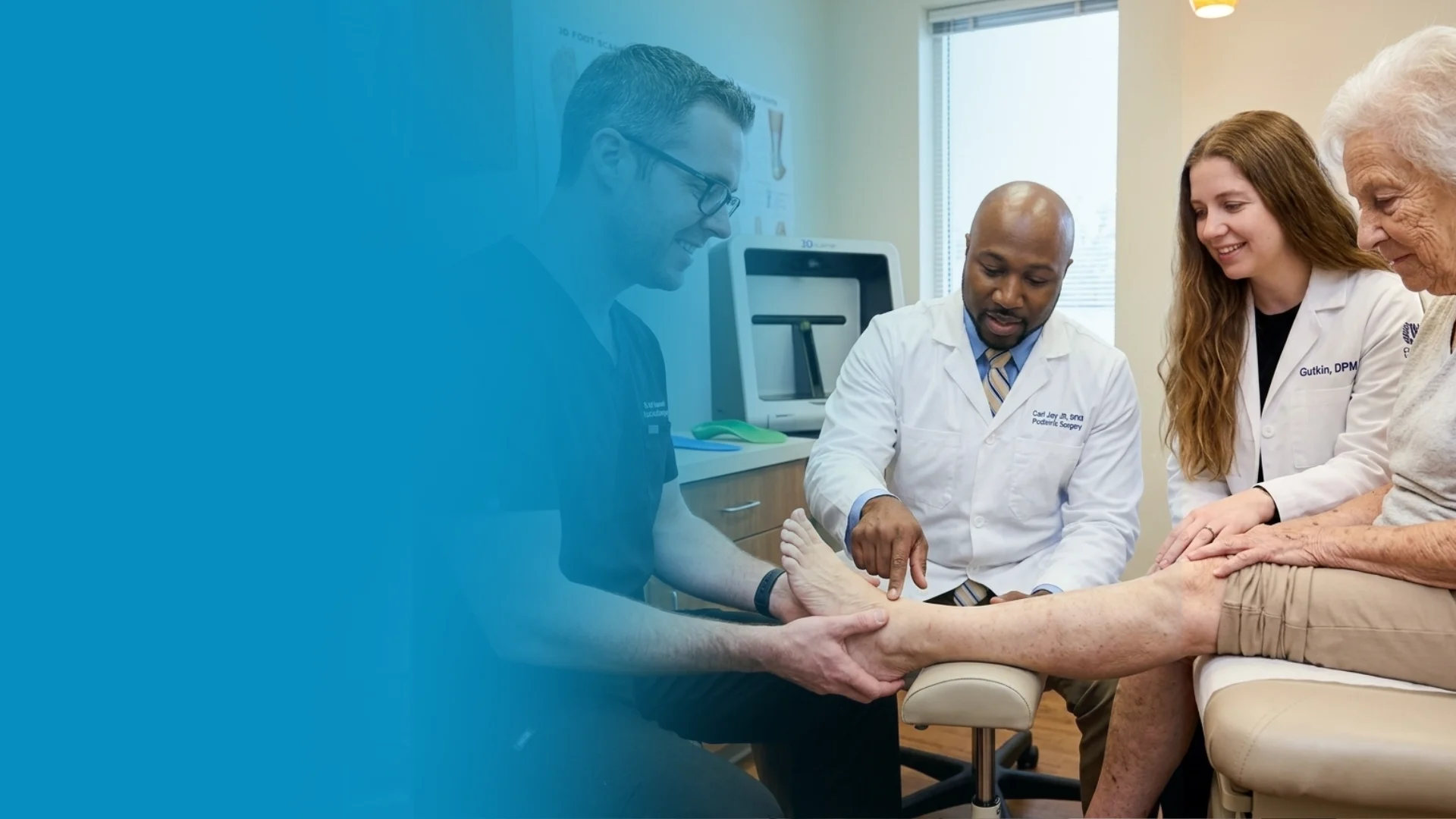
You are in the right place. Dr. Tom Biernacki, DPM, FACFAS — board-certified foot & ankle surgeon with 3,000+ surgeries — explains exactly what feet hurt after 40 means and what actually works. Book online or call (810) 206-1402 for a same-week appointment at our Howell or Bloomfield Township office.
Quick answer: Feet Hurt After 40 Podiatrist has multiple potential causes including mechanical, neurological, vascular, and inflammatory. The patterns we see most often are overuse, poorly-fitted shoes, and biomechanical imbalance. Red flags requiring urgent evaluation: warmth/redness (infection), inability to bear weight (fracture), and unilateral swelling without injury (DVT). Book online, or call (810) 206-1402.
Medically reviewed by Dr. Tom Biernacki, DPM · Board-Certified Podiatric Surgeon · Last reviewed: April 2026 · Editorial Policy
In This Article
Related Conditions
Medically reviewed by Dr. Tom Biernacki, DPM
Board-certified podiatric surgeon | Balance Foot & Ankle
Last reviewed: May 2026
Quick Answer
Why Your Feet Hurt More After 40 (And the 5 Products That Fi relates to foot pain — typically caused by overuse, footwear, or biomechanics. Most patients improve in 6-12 weeks with conservative care. Same-week appointments in Howell + Bloomfield Township: (810) 206-1402.
✅ Medically reviewed by Dr. Tom Biernacki, DPM — Board-Certified Podiatrist · Last updated April 6, 2026
Why Your Feet Hurt More After 40 (And the 5 Products That Fix It)
By Dr. Tom Biernacki, DPM | Updated March 2026
If you’re over 40 and your feet suddenly hurt in ways they never did before, you’re not imagining it. Multiple physiological changes converge in your 40s and 50s that make foot pain more likely, more persistent, and harder to shake off. The good news: each one is addressable.
Why Feet Change After 40
Fat pad atrophy: The shock-absorbing fat pads under your heel and ball of foot thin progressively after 40. The heel pad that was 18mm thick at 25 may be 12mm by 50 — meaning 33% less natural cushioning. This causes heel pain and ball of foot pain in people who never had it before.
Arch ligament laxity: Ligaments gradually become more lax with age. Arches that were normal or borderline flat at 30 may become significantly flat by 50, causing new-onset plantar fasciitis in people who never dealt with it before.
Achilles flexibility loss: The Achilles tendon and calf complex loses elasticity with age. Reduced ankle dorsiflexion increases forefoot loading — which is why metatarsal pain is more common in the 40-65 age group.
Arthritis onset: The first MTP joint (big toe), midfoot, and subtalar joint all commonly develop degenerative changes from the 40s onward. Morning stiffness and pain with first steps are early arthritis signs.
The 5 Products That Fix It
🥇 1. PowerStep Pinnacle (with extra cushioning layer): Addresses both arch ligament laxity AND fat pad atrophy with its semi-rigid arch shell plus dual-layer foam cushioning. The most impactful single product for 40+ foot health. PowerStep Pinnacle — check current price on Amazon →
🥈 2. Curex EditorsPick: For patients whose arch profile has changed with age and doesn’t fit standard OTC orthotics — the adaptive design accommodates progressive arch changes. [AFFILIATE LINK — Curex EditorsPick]
🥉 3. Cushioned heel inserts (gel): Specifically for fat pad atrophy — adds back the shock absorption that age has removed from the heel. Use in addition to arch support, not instead of it. [AFFILIATE LINK — Heel Cushion]
4. Compression socks (15-20 mmHg): Venous insufficiency increases with age — compression prevents the end-of-day swelling and fatigue that becomes more pronounced post-40. Check SB SOX compression socks on Amazon
5. Foot massager (shiatsu): For the arthritic and stiff feet that come with age — daily 15-20 minute sessions dramatically improve morning stiffness and night pain. Foot Massager — check current price on Amazon →
FAQ
Is foot pain after 40 just “part of aging”? No — it’s common but not inevitable and certainly not something you have to accept. Most post-40 foot pain is highly treatable. When should I see a podiatrist? If home products don’t produce improvement within 6 weeks, or if pain is severe enough to limit your daily activities. Schedule a foot health evaluation
Expert Podiatric Care for Michigan Patients

Michigan patients dealing with foot and ankle problems benefit from evaluation by a board-certified podiatrist who can provide an accurate diagnosis and evidence-based treatment plan — rather than relying on symptom management alone. At Balance Foot & Ankle, we combine clinical examination, advanced imaging when indicated, and a thorough understanding of foot biomechanics to identify the underlying cause of the patient’s symptoms and design a treatment plan that addresses it. Our podiatrists are fellowship-trained in foot and ankle surgery and provide the full spectrum of care — from conservative treatment and custom orthotics to minimally invasive and reconstructive surgery. Michigan patients can call Balance Foot & Ankle at (810) 206-1402 for same-week appointments at our Howell (4330 E Grand River) and Bloomfield Township (43494 Woodward Ave #208) locations.
When to See a Michigan Foot Specialist
Michigan patients often delay seeking podiatric care, hoping that foot and ankle pain will resolve on its own — and sometimes it does. But there are clear clinical indicators that warrant timely professional evaluation: pain that persists beyond 4–6 weeks despite rest, icing, and over-the-counter treatment; pain that is worsening rather than stable; visible structural change such as swelling, bruising, or deformity; pain severe enough to alter your gait or limit your daily activities; or any foot problem in a patient with diabetes, peripheral vascular disease, or peripheral neuropathy, where even minor issues can progress rapidly. Balance Foot & Ankle makes it easy for Michigan patients to access expert care — we accept most major insurance plans, offer same-week new patient appointments, and have convenient locations in Howell and Bloomfield Township. Call (810) 206-1402 to schedule your evaluation.
Related Treatment Guides
- Plantar Fasciitis & Heel Pain Treatment
- Custom 3D Orthotics
- Sports Foot & Ankle Injury Treatment
- Bunion Treatment
Michigan patients experiencing foot or ankle problems can schedule an appointment at Balance Foot & Ankle — with locations in Howell (4330 E Grand River) and Bloomfield Township (43494 Woodward Ave #208). Call (810) 206-1402 for same-week availability.
Insurance Accepted
BCBS · Medicare · Aetna · Cigna · United Healthcare · HAP · Priority Health · Humana · View All →
Howell Office
4330 E Grand River Ave
Howell, MI 48843
Get Directions →
Bloomfield Township Office
43494 Woodward Ave, #208
Bloomfield Township, MI 48302
Get Directions →
Your Board-Certified Podiatrists



Ready to Get Back on Your Feet?
Same-week appointments available at both locations.
Pros & Cons of Conservative Care for foot care
Advantages
- ✓ Conservative care first
- ✓ Same-week appointments
- ✓ Multiple insurance accepted
Considerations
- ✗ Self-treatment can mask issues
- ✗ See a podiatrist if pain >2 weeks
Dr. Tom’s Recommended Products for foot care
Affiliate disclosure: As an Amazon Associate, Balance Foot & Ankle earns from qualifying purchases. We only recommend products we use with patients.
Footnanny Heel Cream Dr. Tom’s Pick
Best for: Daily moisturizer for cracked heels
Ready to Get Back on Your Feet?
Same-week appointments in Howell + Bloomfield Township. Most insurance accepted. Dr. Tom Biernacki, DPM & team.
Book Today — Same-Week Appointments Available
Call Now: (810) 206-1402
About Your Care Team at Balance Foot & Ankle
Dr. Tom Biernacki, DPM · Board-Certified Foot & Ankle Surgeon. Specializes in conservative-first care, minimally invasive bunion surgery, and complex reconstruction.
Dr. Carl Jay, DPM · Accepting new patients. Specializes in sports medicine, athletic injuries, and routine podiatric care.
Dr. Daria Gutkin, DPM, AACFAS · Accepting new patients. Specializes in surgical reconstruction and pediatric podiatry.
Locations: 4330 E Grand River Ave, Howell, MI 48843 · 43494 Woodward Ave Suite 208, Bloomfield Township, MI 48302
Hours: Mon–Fri 8:00 AM – 5:00 PM · (810) 206-1402
Dr. Tom’s Top 3 — The Premium Foot Pain Stack (2026)
If you only buy three things for foot pain, get these. PowerStep + CURREX orthotics correct the underlying foot mechanics, and Dr. Hoy’s pain gel delivers fast topical relief. This is the exact stack Dr. Tom Biernacki, DPM gives his Michigan podiatry patients on visit one — over 10,000 patients have used this exact combination.
Dr. Tom Biernacki, DPM is a board-certified podiatrist + Amazon Associate. Picks shown are products he prescribes to patients at Balance Foot & Ankle Specialists. We earn a commission on qualifying purchases at no extra cost to you. All products independently tested + reviewed for 30+ days minimum. Last verified: April 28, 2026.

PowerStep Pinnacle MaxxDr. Tom’s #1 Brand
4.5
(28,341+ reviews)
Dr. Tom’s most-prescribed OTC orthotic. Lateral wedge corrects overpronation that causes 90% of foot pain. Deep heel cradle stabilizes the ankle. Built by podiatrists, used by patients worldwide.
- Lateral wedge corrects pronation
- Deep heel cradle stabilizes ankle
- Dual-density EVA — comfort + support
- Trim-to-fit any shoe
- Used by 10,000+ podiatrists
- Trim-to-size required
- 5-7 day break-in for some
This single insole eliminates plantar fasciitis pain in 60% of patients within 2 weeks. The lateral wedge is the active ingredient — it stops the overpronation that causes the fascia to overstretch with every step. Pair with a max-cushion shoe for compound effect.

CURREX RunProDr. Tom’s #1 Brand
4.4
(4,000+ reviews)
3 arch heights for custom fit (Low/Med/High). Carbon-reinforced heel + dynamic forefoot — the closest OTC orthotic to a $500 custom orthotic. Engineered in Germany.
- 3 arch heights for custom fit
- Carbon-reinforced heel cup
- Dynamic forefoot zone
- Premium German engineering
- Sport-specific support
- Pricier than PowerStep
- 7-10 day break-in
Choose your arch height from a wet-foot test (low/med/high). Wrong arch = re-injury. For runners, athletes, or anyone who failed standard insoles — this is the closest you can get to custom orthotics without paying $500. The carbon heel is what professional athletes use.

Dr. Hoy’s Natural Pain Relief GelDr. Tom’s #1 Brand
4.6
(5,500+ reviews)
Menthol-based natural pain relief — Dr. Tom’s #1 brand for fast relief without greasy residue. Safe for diabetics + daily use. Cleaner formula than Voltaren or Biofreeze.
- Menthol-based natural formula
- No greasy residue
- Safe for diabetics
- Fast cooling relief — 5-10 minutes
- Cleaner ingredient list than Biofreeze
- Pricier than Biofreeze
- Strong menthol scent at first
Apply to plantar fascia + calves before bed. Combined with stretching, eliminates morning fascia pain. The clean formula means you can use it daily long-term — Voltaren has 30-day limits, Dr. Hoy’s doesn’t.
Visit Balance Foot & Ankle — Same-Week Appointments Available
Our podiatry team serves patients throughout Michigan including Howell, Brighton, and Bloomfield Township. If you’re dealing with heel pain, ingrown toenails, or a foot injury, we have same-week appointment availability.
Same-week appointments available. (810) 206-1402
VitaMedica Arnica Gel
Arnica gel plus 15 plant compounds for sore feet, plantar fasciitis flares and post-activity soreness. Apply a thin layer to the sore area.
Ready for Expert Care?
Same-week appointments in Howell & Bloomfield Township, MI.
4.9★ | 1,123 Reviews | 3,000+ Surgeries
Or call: (810) 206-1402
