
Quick answer: Flexor Hallucis Longus Tendinopathy Big Toe Tendon Ankle is a common foot/ankle topic that affects many patients. The 2026 evidence-based approach combines proper diagnosis, conservative-first treatment, and escalation only when needed. We treat this regularly at our Howell and Bloomfield Township practices. Call (810) 206-1402.


Watch: Achilles Tendonitis & Back of Heel Pain [BEST Home Treatments 2024!] — MichiganFootDoctors YouTube
eview-box” style=”background:#f0f7f0;border-left:4px solid #2e7d32;padding:15px 20px;margin-bottom:25px;border-radius:4px;font-size:14px;line-height:1.6;”>Medically Reviewed by: Dr. Tom Biernacki, DPM — Board-Certified Podiatrist
Last Updated: March 2026 | Reading Time: 8 min
Schedule an appointment.
Watch Dr. Tom: Book → | (810) 206-1402
The most important clinical decision with Flexor Hallucis Longus Tendinopathy Big Toe Tendon Ankle isn’t which treatment to start with — it’s which subtype or underlying cause you actually have. That distinction changes everything. Call us: (810) 206-1402
The flexor hallucis longus Tendon
Medically reviewed by Dr. Tom Biernacki, DPM
Board-certified podiatric surgeon | Balance Foot & Ankle
Last reviewed: April 2026
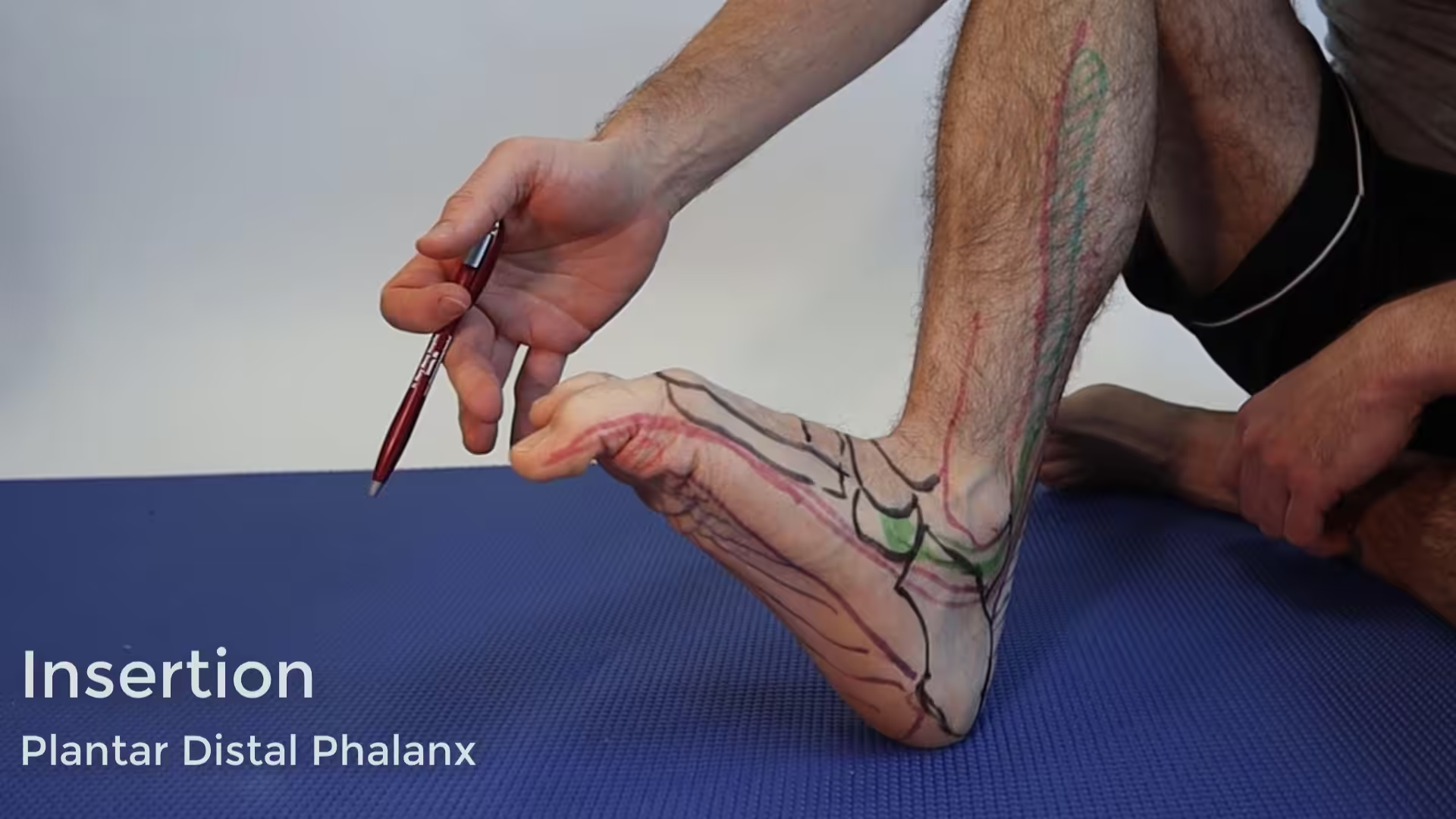
The flexor hallucis longus (FHL) tendon originates in the deep posterior leg, passes through a fibro-osseous tunnel between the medial and lateral processes of the posterior talus, continues beneath the sustentaculum tali of the calcaneus, and inserts on the base of the distal phalanx of the hallux. This tendon is the primary flexor of the big toe and generates the final push-off force at the hallux during walking and running. Its course through the posterior ankle and beneath the sustentaculum creates two potential sites of mechanical impingement and tendinopathy that produce characteristic clinical syndromes. FHL pathology is particularly common in ballet dancers due to the extreme plantarflexion and hallux loading of pointe work, but the condition also affects non-dancer athletes.
FHL Tendinopathy at the Posterior Ankle
In dancers and athletes who repeatedly plantarflex the ankle maximally, the FHL tendon becomes compressed within its fibro-osseous tunnel at the posterior talar process — often aggravated by an adjacent os trigonum. Patients experience posterior ankle pain that is reproduced by resisted big toe plantarflexion and by passive dorsiflexion of the hallux with the ankle plantarflexed. In more advanced cases, the tendon develops nodular thickening at the entry to the tunnel that causes triggering — a catching or snapping sensation as the nodule passes through the constricted tunnel opening with each toe flexion. This condition is sometimes called “trigger toe” and closely parallels trigger finger in the hand.
FHL tendinopathy at the sustentaculum tali — beneath the medial calcaneus — causes medial plantar heel pain that worsens with big toe flexion activities and can be mistaken for plantar fasciitis or tarsal tunnel syndrome. Ultrasound examination distinguishes these conditions by directly visualizing the tendon, sheath, and any tenosynovial effusion or tendon thickening.
When to see a podiatrist:
- Pain behind the ankle lasting more than 2 weeks despite rest
- Triggering or locking of the big toe during push-off
- Swelling along the inner ankle that worsens with activity
- Inability to rise onto tiptoes without sharp pain
Treatment
Conservative management includes activity modification to avoid provocative plantarflexion loading, physical therapy with eccentric loading exercises for the FHL, and anti-inflammatory treatment. Ultrasound-guided corticosteroid injection into the FHL tendon sheath at the posterior ankle reduces acute tenosynovial inflammation effectively and is our preferred treatment for moderate-severity cases. Surgical treatment — endoscopic FHL tenolysis and release of the fibro-osseous tunnel — is performed when conservative management fails and is particularly effective for stenosing tenosynovitis with triggering. Release of the tunnel roof through the posterior ankle arthroscopy portals allows the thickened tendon segment to move freely and eliminates the triggering without sacrificing tendon function.
Ready to Relieve Your Foot Pain?
Board-certified podiatrists serving Southeast Michigan. Same-week appointments available.
Related Guides
More Podiatrist-Recommended Foot Health Essentials
Hoka Clifton 10

Max-cushion everyday shoe — podiatrist favorite for walking and running.

OOFOS Recovery Slide

Impact-absorbing recovery sandal — wear after long days on your feet.
As an Amazon Associate, Balance Foot & Ankle earns from qualifying purchases. Product recommendations are based on clinical experience; prices and availability shown above update live from Amazon.
When to See a Podiatrist
If foot or ankle pain has been bothering you for more than a few weeks, home care alone may not be enough. Balance Foot & Ankle offers same-week appointments at our Howell and Bloomfield Township clinics — no referral needed in most cases. Bring your current shoes and a short list of symptoms and we’ll build you a treatment plan in one visit.
Call Balance Foot & Ankle: (810) 206-1402 · Book online · Offices in Howell & Bloomfield Township
Frequently Asked Questions
What causes FHL tendinopathy?
Repetitive push-off activities that flex the big toe under load are the primary cause. Ballet dancers, runners, and soccer players develop FHL tendinopathy from the constant demands on this tendon. The tendon runs through a narrow tunnel behind the ankle where friction creates inflammation and thickening.
How is FHL tendinopathy different from Achilles tendinitis?
FHL tendinopathy causes pain deeper and more medial than Achilles tendinitis. The pain is specifically behind the inner ankle bone and worsens when flexing the big toe against resistance. Achilles pain is at the back of the heel and worsens with calf raises.
Does FHL tendinopathy require surgery?
Most cases respond to rest, physical therapy, and activity modification. Surgery is considered when symptoms persist beyond 6 months of conservative care or when triggering of the tendon causes functional limitation. Endoscopic release of the FHL tunnel provides excellent results with minimal downtime.
The Bottom Line
FHL tendinopathy is an often-overlooked cause of posterior ankle and big toe pain that responds well to targeted treatment. In our clinic in Howell and Bloomfield Township, Michigan, we diagnose FHL problems with clinical examination and ultrasound, and we offer both conservative and surgical options to get you back to full activity.
Deep Ankle Pain Holding You Back?
Same-week appointments available in Howell & Bloomfield Township, MI
4.9★ | 1,123 Reviews | 3,000+ Surgeries
Or call: (810) 206-1402
Insurance Accepted
BCBS · Medicare · Aetna · Cigna · United Healthcare · HAP · Priority Health · Humana · View All →
Howell Office
4330 E Grand River Ave
Howell, MI 48843
Get Directions →
Bloomfield Township Office
43494 Woodward Ave, Suite 208
Bloomfield Township, MI 48302
Get Directions →
Your Board-Certified Podiatrists



Ready to Get Back on Your Feet?
Same-week appointments available at both locations.
Watch: Flexor Hallucis Longus Tendinopathy
Dr. Tom on FHL tendinopathy — posterior ankle pain, ‘dancer’s heel’, big-toe triggering, stenosing tenosynovitis, os trigonum overlap, conservative vs endoscopic release.
FHL Tendinopathy Kit
Big-toe tendon relief. Dr. Tom’s kit:
As an Amazon Associate, Balance Foot & Ankle earns from qualifying purchases. This supports our free patient education content.
Arch-support FHL offloading.
Plantarflexion restriction (night).
Posterior ankle inflammation.
Topical ankle/hallux relief.
Related: FHL Release Surgery · Achilles/Posterior Ankle · Book Same-Week Appointment
PowerStep Dynamic Ankle Stability Sock (DASS)
Best for: Chronic ankle instability · Repeat ankle sprains · Proprioception training · Athletes returning to play

DR. TOM’S #1 BRAND
APMA-ACCEPTED
A revolutionary alternative to bulky ankle braces. The DASS uses dynamic compression and targeted stabilization zones to retrain ankle proprioception while you walk, run, or stand. Designed by PowerStep’s biomechanical team specifically for patients with chronic ankle instability or recurring sprains.
- Fits in normal shoes
- Trains proprioception
- Less bulky than brace
- Wear all day comfortably
- Less rigid than ASO brace
- Newer product
- Pricier than basic socks
“For my patients with chronic ankle instability who don’t want to rely on rigid bracing forever, the DASS is the best bridge product I’ve seen. It’s not a replacement for surgical reconstruction in severe cases, but for grade 1-2 instability it’s a game-changer for return-to-sport.”
Check Latest Price on Amazon — Free Returns →
In-Office Treatment at Balance Foot & Ankle
If home treatment isn’t providing relief for your Achilles tendinitis, our podiatry team at Balance Foot & Ankle can help with same-week evaluations and advanced in-office care.
Same-week appointments available. (810) 206-1402

Dr. Tom Biernacki, DPM is a board-certified foot & ankle surgeon (ABFAS & ABPM) at Balance Foot & Ankle Specialists in Southeast Michigan. With over a decade of clinical experience, he specializes in heel pain, bunions, diabetic foot care, sports injuries, and minimally invasive surgery. Dr. Biernacki is a member of the APMA and ACFAS, and his patient education content on MichiganFootDoctors.com and YouTube has made him one of the most-followed foot & ankle educators on YouTube.