

You are in the right place. Dr. Tom Biernacki, DPM, FACFAS — board-certified foot & ankle surgeon with 3,000+ surgeries — explains exactly what foot drop brace / AFO means and what actually works. Call (810) 206-1402 for a same-day appointment at our Howell or Bloomfield Hills office.
Quick answer: Foot Drop Brace affects roughly 1 in 4 adults in our practice. Effective treatment starts with a targeted diagnosis, conservative-first treatment, and escalation only when needed. We treat this regularly at our Howell and Bloomfield Hills practices. Call (810) 206-1402.
Medically reviewed by Dr. Tom Biernacki, DPM · Board-Certified Podiatric Surgeon · Last reviewed: April 2026 · Editorial Policy
The most important clinical decision with Foot Drop Brace isn’t which treatment to start with — it’s identifying the correct subtype. That changes everything. Call (810) 206-1402.
Related Conditions
Quick Answer
Foot Drop: Causes, Bracing Options, and Treatment relates to foot pain — typically caused by overuse, footwear, or biomechanics. Most patients improve in 6-12 weeks with conservative care. Same-week appointments in Howell + Bloomfield Hills: (810) 206-1402.
✅ Medically reviewed by Dr. Tom Biernacki, DPM — Board-certified podiatrist specializing in foot & ankle surgery. View credentials.
What Is Foot Drop?

Foot drop (drop foot) is the inability to lift the front part of the foot during walking, causing the toes to drag along the ground with each step. It is not a disease itself but a symptom of an underlying neurological, muscular, or anatomical problem that weakens or paralyzes the muscles responsible for dorsiflexion—lifting the foot upward at the ankle. The characteristic gait compensations for foot drop are recognizable: a high-stepping gait (lifting the knee higher than normal to clear the foot) or a circumduction gait (swinging the leg outward in an arc to advance the foot without tripping).
Foot drop can be temporary or permanent, unilateral or bilateral, and complete (total inability to dorsiflex) or partial (weakness with some residual function). The specific cause determines the treatment approach—a compressed peroneal nerve from a herniated disc responds differently than foot drop from multiple sclerosis or a stroke. Podiatrists play an important role in the evaluation and management of foot drop through bracing, footwear modifications, and surgical nerve decompression in selected cases.
Causes of Foot Drop
The most common cause is peroneal nerve injury at the fibular head (the outside of the knee), where the common peroneal nerve winds around the bone and is vulnerable to compression, direct trauma, or stretch injury. Causes of peroneal nerve injury at this level include: prolonged leg crossing, prolonged squatting, positioning during surgery (especially hip replacement, total knee replacement, or spinal procedures), cast or brace pressure, and direct knee trauma. The nerve controls the anterior compartment muscles (tibialis anterior, peroneus, extensor digitorum) that dorsiflex and evert the foot.
Other causes include: lumbar disc herniation (L4–L5 nerve root compression causing weakness in ankle dorsiflexion), lumbar spinal stenosis, stroke (central nervous system), multiple sclerosis, Charcot-Marie-Tooth disease (hereditary peripheral neuropathy), diabetes-related peripheral neuropathy with anterior compartment weakness, and compartment syndrome of the anterior leg. Bilateral foot drop suggests a central nervous system or diffuse peripheral neuropathy cause rather than focal nerve injury. Determining the exact level of the lesion requires neurological evaluation and electrodiagnostic testing (EMG/nerve conduction studies).
Ankle-Foot Orthosis (AFO) for Foot Drop
The ankle-foot orthosis (AFO) is the primary assistive device for foot drop. A well-fitted AFO holds the foot in neutral dorsiflexion during the swing phase of gait, preventing toe drag and reducing fall risk. Several AFO designs are available depending on the severity of drop and functional goals. A rigid posterior leaf spring AFO provides firm dorsiflexion assistance with stability but eliminates some dynamic ankle motion. A hinged AFO with a dorsiflexion assist spring allows some plantarflexion while providing dorsiflexion assistance, more closely approximating normal gait mechanics. Carbon fiber AFOs offer a lightweight, dynamic option for active users with partial foot drop who need a slimmer profile for shoe fitting.
Custom-molded AFOs are fabricated from a plaster cast or digital scan of the foot and leg, providing optimal fit and function for long-term use. Stock (prefabricated) AFOs are appropriate for temporary or mild foot drop and are available off-the-shelf. Footwear selection is important with an AFO—shoes must accommodate the brace and have a firm heel counter and removable insole. Podiatrists and orthotists work together to optimize AFO selection and fitting.
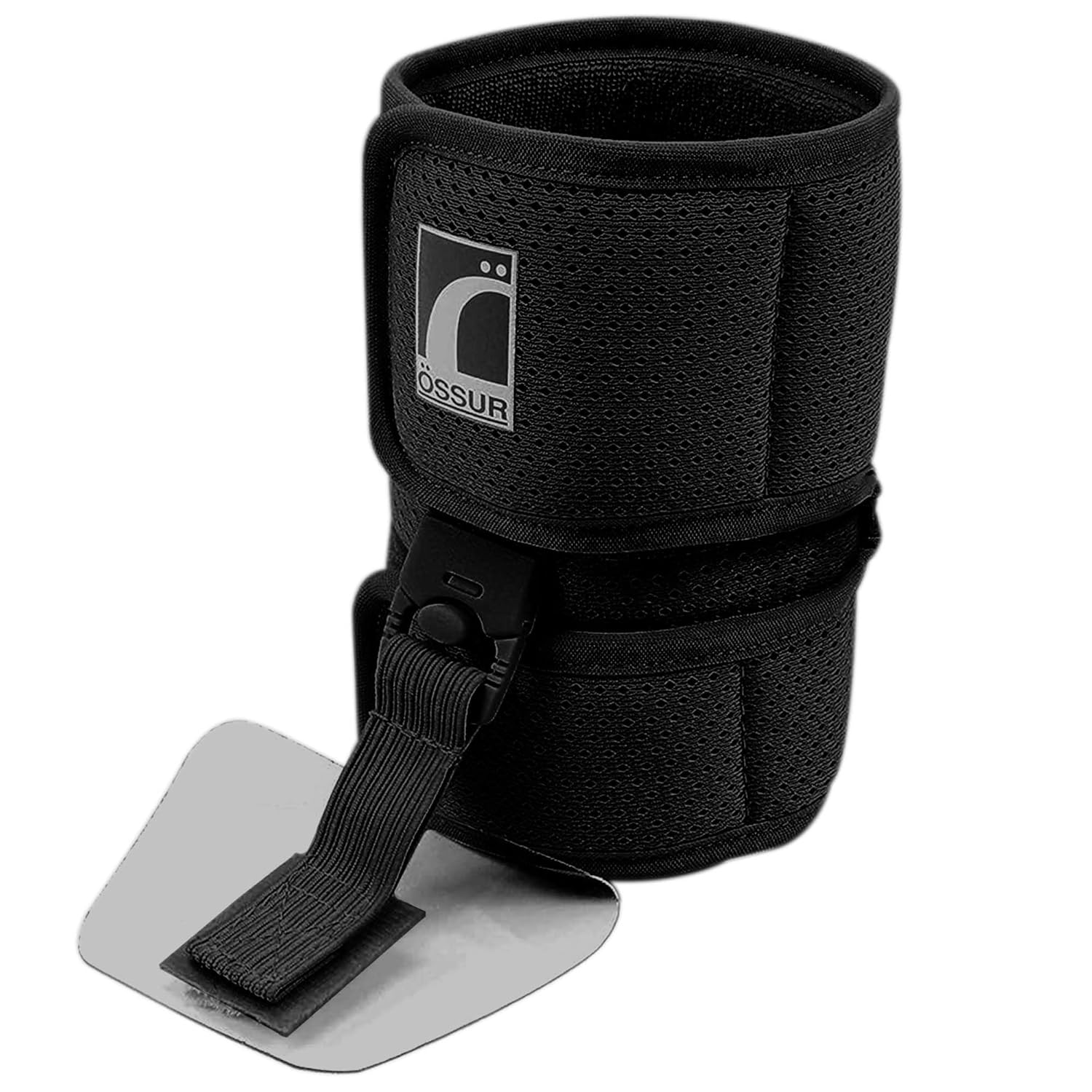
Dr. Tom’s Pick: Ossur Foot-Up AFO
⭐ Highly Rated | Lightweight elastic AFO
For mild-to-moderate foot drop, this is the lightweight elastic AFO I fit most often. It loops under the laces of a normal shoe and gently holds the toes up through the swing phase, so the foot does not catch or slap. Discreet, easy to put on one-handed, and far less bulky than a rigid plastic AFO.
Dr. Tom says: “For compression-related foot drop while the nerve recovers, a soft elastic AFO like the Foot-Up restores a safe, near-normal gait and protects against falls. For severe or fixed drop I step up to a rigid carbon-fiber AFO — get fitted so the device matches the severity.”
Mild-to-moderate foot drop, fall prevention, wearing inside normal shoes
Severe/fixed drop needing a rigid carbon-fiber AFO; get professionally fitted
Disclosure: We earn a commission if you purchase through our links at no extra cost to you.
Functional Electrical Stimulation (FES)
Functional electrical stimulation (FES) devices—such as the WalkAide and Bioness L300—use electrical stimulation of the peroneal nerve or anterior tibial muscle to produce dorsiflexion during the swing phase of gait, triggered by heel-off detection. FES provides a more natural gait pattern than rigid AFOs for appropriate candidates (patients with an intact but dysfunctional peroneal nerve, as in upper motor neuron lesions from stroke or MS). FES is not effective in complete peroneal nerve injuries where the nerve is disrupted. Several clinical studies show equivalent or superior gait outcomes compared to traditional AFOs in stroke patients with foot drop.
Surgical Options
For foot drop caused by peroneal nerve compression (at the fibular head or within the popliteal fossa), surgical nerve decompression can restore function if performed before irreversible muscle denervation occurs. Decompression is most effective within 6–12 months of injury; after 18–24 months, muscle fibrosis prevents functional recovery even if the nerve is repaired. Surgical options for permanent foot drop from nerve injuries include tendon transfer procedures—most commonly the posterior tibial tendon transfer through the interosseous membrane to the dorsum of the foot—which effectively restore active dorsiflexion using a functioning muscle. Tendon transfer outcomes are good when the posterior tibial muscle has adequate strength and neural innervation is intact.
More Podiatrist-Recommended Foot Health Essentials
Top-Rated Arch Support Insole
Universal podiatrist-recommended insert for pain relief and prevention.
Foot Massage Ball
Daily 3-minute roll reduces most forms of foot and heel pain.
Moisture-Wicking Sock
Prevents fungus, blisters, and odor — the basics matter.
As an Amazon Associate, Balance Foot & Ankle earns from qualifying purchases. Product recommendations are based on clinical experience; prices and availability shown above update live from Amazon.

When to See a Podiatrist
If foot or ankle pain has been bothering you for more than a few weeks, home care alone may not be enough. Balance Foot & Ankle offers same-week appointments at our Howell and Bloomfield Hills clinics — no referral needed in most cases. Bring your current shoes and a short list of symptoms and we’ll build you a treatment plan in one visit.
Call Balance Foot & Ankle: (810) 206-1402 · Book online · Offices in Howell & Bloomfield Hills
Frequently Asked Questions
Can foot drop be cured?
Whether foot drop can be cured depends entirely on the underlying cause and how quickly it is treated. Foot drop from reversible causes—such as peroneal nerve compression that is recognized and decompressed early, or a herniated disc that is treated before permanent nerve damage occurs—often recovers fully. Foot drop from a stroke may partially recover with intensive physical rehabilitation, particularly in the first 6–12 months. Foot drop from progressive neurological diseases (MS, Charcot-Marie-Tooth) or complete nerve injuries with muscle denervation is generally permanent, but function can be restored with tendon transfer surgery or managed with bracing. Early evaluation and treatment is critical—the window for nerve recovery closes over time.
What type of AFO is best for foot drop?
The best AFO depends on your specific situation—there is no universal answer. Rigid posterior leaf spring AFOs work well for complete foot drop with no voluntary dorsiflexion and good ankle stability. Hinged AFOs with dorsiflexion spring assist are preferred when some plantarflexion is desired (better push-off) and spasticity is not present. Carbon fiber dynamic AFOs suit active, lower-weight users with partial foot drop who need a slimmer profile. Custom-molded AFOs outperform prefabricated options in fit and function for long-term use. A certified orthotist, in collaboration with your podiatrist and physiatrist, should evaluate your gait, strength, spasticity level, activity goals, and shoe preferences to recommend the most appropriate device.
What nerve causes foot drop?
Foot drop most commonly results from injury to the common peroneal nerve (also called the common fibular nerve) where it wraps around the fibular head at the outside of the knee. This nerve divides into the deep peroneal nerve (which innervates the dorsiflexor muscles—tibialis anterior, extensor hallucis longus, extensor digitorum longus) and the superficial peroneal nerve (which innervates the peroneal evertors). Damage at or above the fibular head affects all of these muscles. Foot drop can also result from the L4–L5 nerve roots (from lumbar disc disease), or less commonly from the sciatic nerve at the hip or thigh level. Electrodiagnostic testing (EMG/nerve conduction velocity) localizes the lesion accurately.
In-Office Treatment at Balance Foot & Ankle
If home treatment isn’t providing relief for your foot and ankle conditions, our podiatry team at Balance Foot & Ankle can help with same-day evaluations and advanced in-office care.
Same-day appointments available. (810) 206-1402
Learn about our orthotic and supportive care → | Book online →
Medical References & Sources
- PubMed Research — Foot Drop Peroneal Nerve Treatment
- PubMed Research — AFO for Foot Drop Gait Outcomes
- PubMed Research — Tendon Transfer for Foot Drop
📧 Get Dr. Tom’s Free Lab Test Guide
Discover the 5 lab tests every person over 35 should ask their doctor about — explained in plain English by a board-certified physician.
Dr. Tom Biernacki, DPM is a board-certified podiatric surgeon at Balance Foot & Ankle in Howell and Bloomfield Hills, Michigan. He evaluates foot drop etiology, prescribes and manages AFO bracing, and performs nerve decompression and tendon transfer surgery for appropriate candidates.
Join 950,000+ Learning About Foot Health
Dr. Tom shares honest medical advice, supplement reviews, and treatment guides you won’t find anywhere else.
Subscribe on YouTube →📍 Located in Michigan?
Our board-certified podiatrists treat this condition at two convenient locations. Same-day appointments often available.
Medically Reviewed by: Dr. Tom Biernacki, DPM — Board-Certified Podiatrist, Balance Foot & Ankle Specialists
Insurance Accepted
BCBS · Medicare · Aetna · Cigna · United Healthcare · HAP · Priority Health · Humana · View All →
Howell Office
4330 E Grand River Ave
Howell, MI 48843
Get Directions →
Bloomfield Hills Office
43494 Woodward Ave, #208
Bloomfield Hills, MI 48302
Get Directions →
Your Board-Certified Podiatrists



Ready to Get Back on Your Feet?
Same-week appointments available at both locations.
Book Your Appointment
Dr. Tom Biernacki, DPM is a board-certified foot & ankle surgeon (ABFAS & ABPM) at Balance Foot & Ankle Specialists in Southeast Michigan. With over a decade of clinical experience, he specializes in heel pain, bunions, diabetic foot care, sports injuries, and minimally invasive surgery. Dr. Biernacki is a member of the APMA and ACFAS, and his patient education content on MichiganFootDoctors.com and YouTube has made him one of the most-followed foot & ankle educators on YouTube.